
<<
ANTIOCHIA OF SYRIA – City in the fertile valley of the Orontes River, 25 km from the sea, today Antāhijah.
SUMMARY: I. A. in the Bible. – II. A. in Christian archaeology. –
III. The Patriarchate of A
IV. The Councils of A
V. The School of A
VI. The Antiochene Rite
VII. A. of the Maronites. – VIII. A. of the Melkites. – IX. A. of the Syrians.I. A. IN THE BIBLE. - A. was the capital of the Seleucid kingdom, founded in 300 B.C. by Seleucus I Nicator, who named it in honor of his father Antiochus. Thanks to the port of Seleucia and its position at the crossroads of routes from the Euphrates to the Mediterranean and from Syria to Asia Minor, it gained great commercial importance, but was also a center of corruption. A cosmopolitan city, it counted at the beginning of the common era approximately 300,000 inhabitants, besides slaves (approximately 200,000). In 64 B.C., Pompey reduced Syria (v. SYRIA) to a Roman province, with A. as its capital, becoming the largest city of the Roman Empire after Rome and Alexandria.
A. played a significant role in the early spread of Christianity. Its evangelization began shortly after the death of Stephen, through the work of converted Jews expelled from Jerusalem; soon Barnabas (v. BARNABAS) joined them, who called Saul (Paul) to his aid: the community soon prospered, and there the disciples of Christ were first called Christians (Act. 11, 19-26). A. was the starting and ending point of the first and second apostolic journeys of St. Paul (Act. 13, 1-14, 27; 15, 35-18, 22), and the third also departed from there (Act. 18, 23). In A., the dispute arose regarding the relationship between legal observances and the new religion (Act. 14, 26-15, 1); thus, the solution given by the Apostles gathered for this purpose in Jerusalem was first communicated to A. (Act. 15, 2-32). There we also find St. Peter (Gal. 2, 11) as head of that community (Eusebius, Hist. ecl., 3, 36: PG 20, 228), although we do not know the date and duration of his governance.
Important excavations have been carried out since 1932 by the American University of Princeton: C. S. Fisher, F. O. Wage, J. Lassus, Antioch on the Orontes, The Excavations of 1932, Princeton 1934; R. Stillwell (with others), II, II: The Excavations 1933-36, ibid. 1938; W. A. Campbell, The Third Season of Excavations at Antioch on the Or., in American Journal of Archaeology, 40 (1936), pp. 1-10; R. J. Braidwood, Mounds in the Plain of Antioch: An Archaeological Survey, Chicago 1937; C. R. Morey, The Mosaics of Antioch, Londra 1938; G. M. A. Kaufmann, Notes on the Mosaics from Antioch, in Amer. J. of Archaeology, 43 (1939), pp. 229-46; G. Downey, The Gate of the Cherubias at Antioch, in Danish Quarterly Review, 29 (1938-39), pp. 167-177; id. R. Krautheimer, in Riv. di Archeologia Cristiana, 16 (1939), pp. 129-32.
II. ANTIOCH IN CHRISTIAN ARCHAEOLOGY
Immediately after Rome, Antioch is the city that offers the most evidence for the development of the cult of the martyrs. The city seems "as if divinely fortified all around by the relics of the Saints," exclaims St. John Chrysostom (In coemeterii appellationem, 1: PG 49, 393). The so-called sermon of Pseudo-Eusebius (BHO, 70), the Syriac Martyrology of the year 411, and the Martyrologium Hieronymianum allow us to reconstruct the calendar of the Church of Antioch with the list of its bishops and martyrs. Great promoters of the cult of the martyrs were Bishop Flavian, builder of churches in their honor, and, through their sermons, St. John Chrysostom and Patriarch Severus. A characteristic of Antioch is also the frequency of the translations of the bodies of the martyrs, carried out with solemn processions that went to receive the relics, even traveling great distances from the city. Thus, the translations of the remains of many martyrs are documented, such as St. Ignatius, St. Babylas, St. Meletius, St. Eustathius, St. Simeon Stylites, and others.The birthdays of the martyrs were solemnly celebrated in Antioch with prayers, hymns, readings, night vigils, panegyrics, and banquets (Eusebius: PG 21, 1096; St. John Chrysostom: PG 50, 587; Theodoret: PG 83, 1033). St. John Chrysostom advises the faithful to pray at the tombs of the martyrs, embracing their sarcophagi (PG 50, 665); this was the custom at the tombs of the mar-
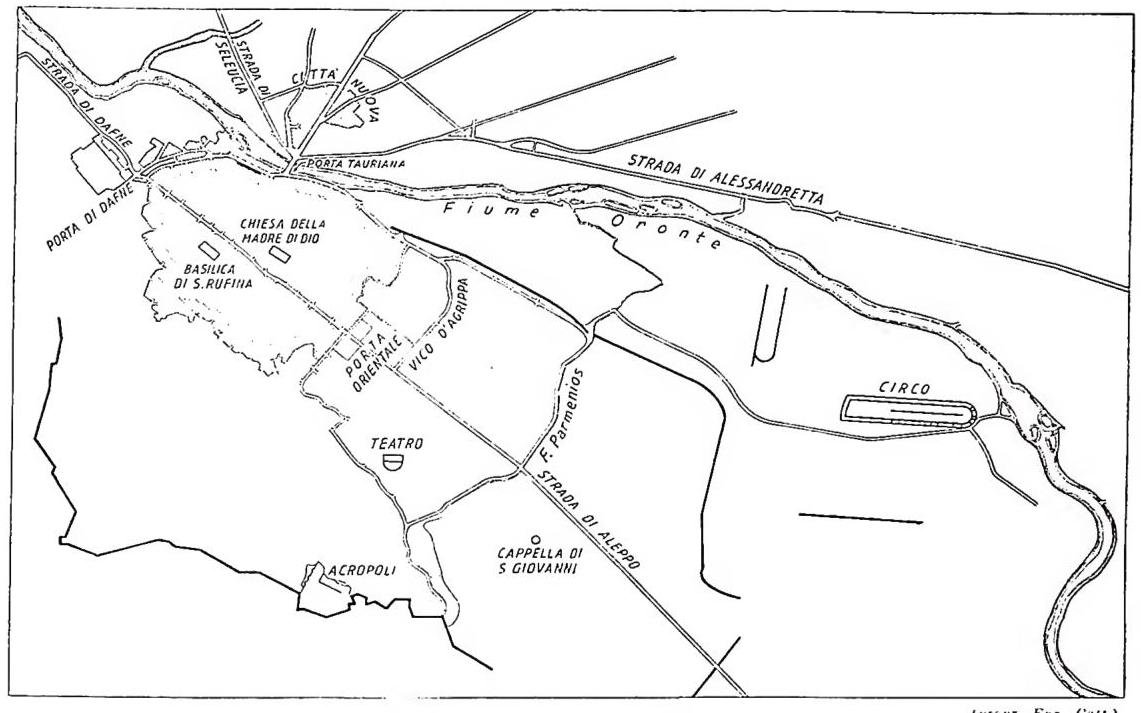
Despite the wealth of documentation, this is not matched by the surviving monuments.
(properly Enc. Catt.)
Another cemetery was located outside the Romanesia Gate; after being usurped for some time by heretics, Bishop Meletius transferred the bodies of the martyrs to the upper monument, covering the rest (St. John Chrysostom, In Ascens., 1: PG 50, 442).
Recently, beyond the St. Paul Gate and near the city walls, numerous Christian tombs covered with mosaics have been discovered, arranged in a portico preceding a 5th-century church; additionally, tombs of monks from the 9th and 10th centuries have been found (J. Lassus, Sanctuaires Chrétiens de Syrie, Paris 1947).
Regarding the places of worship in Antioch, the Chronicon Paschale (ed. Bonn, p. 584) recalls that Christians gathered in a very spacious place called the παλαία, which Theodoret calls the Apostolic (Hist. eccl., 38: PG 82, 110) and Malalas locates near the Pantheon, on Singon Street (Chronicon, ed. Bonn, p. 42).
Eusebius left us a description of the magnificent octagon built by Constantine, a structure unique in its grandeur and splendor, worthy of the city (Vita Const., 3, 50). Within a vast enclosure, large porticoes led to the typical octagonal construction, entirely in stone, with hemicycles on the exterior and alternating curvilinear and rectangular niches on the interior. The mass rose to great heights through two superimposed floors and was clearly visible on the horizon from afar. The interior gleamed with reflections of gold, bronze, and other precious materials. Eusebius (De laude Const.: PG 20, 1109) mentions the richness of the flooring, the inlays on the walls, and the columns supporting the gilded dome (Theophanes, Chronogr.: PG 108, 111); St. Jerome therefore calls the building dominicum aureum. It was dedicated to Christ by Constantius II on the day of Epiphany in the year 341, hence its name, the Octagon of the Lord (Theophanes, Chronogr.: PG 86, 2468). The altar, contrary to custom, faced westward (Socrates, Hist. eccl., 5, 22).
J. Lassus, through the depiction on a floor mosaic from around 470 discovered in 1932, identifies the Constantinian octagon as located on the island formed by the Orontes River, in the new city, near the Taurian Gate, not far from the imperial palace (J. Lassus, Antioch on the Orontes, I, Princeton 1932, pp. 114-28).
Grabar believes that Constantine began construction after his victory over Licinius and the unification of the West with the East; in this sense, he explains the name given to the octagon in some documents: ὁμονοία, concord. The church was closed in 362 by Emperor Julian; it suffered severe damage from the earthquake of 526; the architect Ephrem restored it but rebuilt the roof in wood, using the cypresses from the sacred grove of Daphne.
Other churches include: the Church of St. Ignatius: Theodosius II (405-50) transformed the Temple of Fortune (τυχαῖον) into a sacred building and transferred the relics of the holy bishop there; the Church of the Theotokos, erected by Emperor Justinian; the Church of St. Peter on the hill; the Church of the Protomartyr St. Stephen in the western part of the city; the Church of SS. Cosmas and Damian; the Church of St. Thecla; the Church with the relics of the Seven Maccabees, mentioned by St. John Chrysostom (BHG 1008, 1009) and in the itinerary of the pseudo-Antoninus of Piacenza (Itin. Hieros., ed. Geyer, Vienna 1898, p. 190); the Church of St. Barlaam, built by Bishop Flavian (H. Delehaye, S. Barlaam martyr à Antioche, in Analecta Bolland., 22 [1903], pp. 129-45); the Church of St. Romanus, deacon of a church near Caesarea but martyred in Antioch in 303 and celebrated by St. John Chrysostom, Prudentius, and Severus; the Church of St. Leontius, built in 507 on the site of the destroyed synagogue; the Church of St. Simeon.
Great veneration was also given in Antioch to the two young martyrs Drosis and Pelagia, celebrated by St. John Chrysostom, and to the two martyred presbyters Lucian and Theodore.
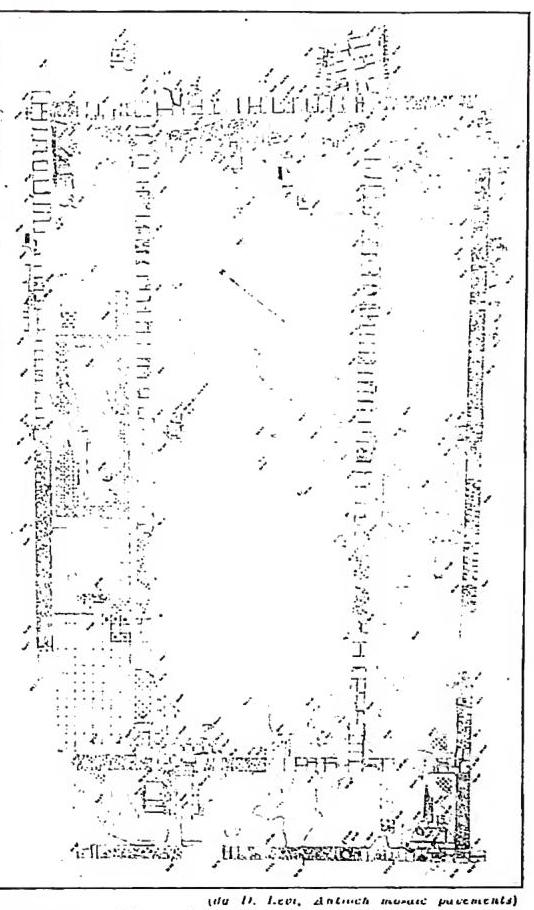
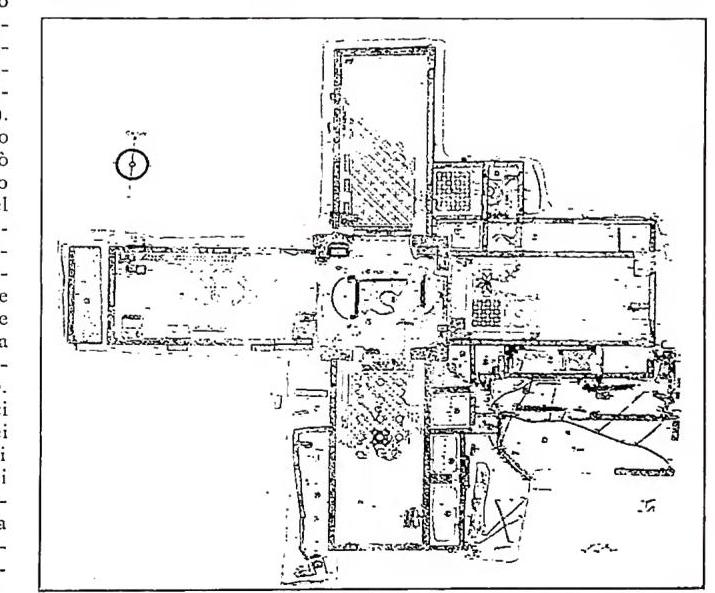
In addition to the urban places of worship, those outside the city must also be mentioned. Among these, the Church of St. Babylas stands out, identified by J. Lassus at Kaoussié, three hundred meters beyond the Orontes River. It was cross-shaped with four equal arms of 25 × 11 meters (called ἐξέδρα), extending from a central square of 16 meters per side. It was built by Bishop Meletius in the year 381 to house the relics of St. Babylas. However, the remains of the holy bishop had already been removed from the cemetery of Antioch by Gallus Caesar (351-54) to be placed in Daphne in a basilica specially erected in his honor; the oracle had then fallen silent, so much so that in 362 Emperor Julian had the relics of the martyr removed and returned to the cemetery of Antioch. Bishop Meletius was buried in the same sarcophagus as St. Babylas (St. John Chrysostom: PG 50, 544). His successor, Flavian, embellished the floor with mosaics dated to the year 387. Slightly later is the baptistery with three adjoining rooms. Then there is the Basilica with the relics of St. Julian, martyr of Cilicia. It was built by Bishop Flavian; the martyr Marinus and the holy ascetics Aphraates, Theodosius, and Macedonius were also interred there (Theodoret, Relig. Histor., 10, 1199; 13, 1215; Malalas, Chronogr., 18); the Church of St. John called τοῦ προεδρίαιον with an adjoining baptistery in the vicus Tiberinus; the Church of St. Martha; the Church of St. Michael, where the bodies of SS. Phocas and Procopius were kept; the Church outside the St. Paul Gate in a place called Mašuká, discovered in 1936, with three naves divided by columns, a mosaic floor, and preceded by a narthex (D. Levi, Antioch Mosaic Pavements, Princeton 1947, p. 368 and pls. 140-41). Even farther away were the churches of St. Simeon Stylites, from the late 5th century, in the Gebel between Antioch and Aleppo (v. QAL'AT SIM'AM). Finally, St. Simeon Stylites of Mount Amm'rabile, between Antioch and Seleucia. An octagonal church from the late 6th century, without a dome, an enlargement of architectural schemes originally conceived for domes and vaults.
From literary sources and the modest surviving remains, some have recognized in Antioch a preponderant importance as a center of artistic developments later passed into Western art. In this way, the Constantinian octagon of Antioch would have inspired the octagon of San Vitale in Ravenna (Strzygowski, Morey). A characteristic of Antiochene art would be the elaboration of ornamentation and polychrome effects. As early as 1902, Strzygowski proposed recognizing as products of Antiochene art the two Acritan pillars in the square of St. Mark’s and some capitals in St. Mark’s in Venice; the ivory cathedra of Maximian in Ravenna, which Morey instead attributes to artists from Alexandria residing in Constantinople. Strzygowski also believed that the Sidamara-type sarcophagi, with niches and columns, had Antioch as their production center, though this cannot be proven.
BIBL.:
J. Lassus, Sanctuaires Chrétiens de Syrie, Paris 1947; Id., Antioch on the Orontes, I, Princeton 1932; A. Grabar, L’empereur dans l’art byzantin, Paris 1936; C. R. Morey, Early Christian Art, Princeton 1942; J. Strzygowski, Orient oder Rom, Leipzig 1901; Id., Hellenistische und koptische Kunst in Alexandria, Vienna 1902; D. Levi, Antioch Mosaic Pavements, Princeton 1947; H. Delehaye, Les origines du culte des martyrs, Bruxelles 1933; Id., S. Barlaam martyr à Antioche, in Analecta Bollandiana, 22 (1903), pp. 129-45.
A. M. SCHNEIDER
Certo A. fu la capitale della cultura dell'Asia Minore; il fattore siro-palestinese nello stile e nella iconografia si è formato non in Gerusalemme ma in A. Gli elementi decorativi dei musaici pavimentali d'A. (recentemente editi da D. Levi e da J. Lassus) ritornano nelle miniature della Genesi di Vienna, della topografia di Cosma Indicopleuste, nell'evangelista s. Marco e nell'ultima Cena del Codice purpureo di Rossano, negli evangelieri di Entschmiedzin e di Rabula; c'è insomma un'influenza degli Scriptoria antiochei sulla serie di miniature con scene del Vecchio Testamento e dei Vangeli. Così pure, secondo il Morey, nei musaici ravennati, specie nello sfondo architettonico del palazzo di Teodorico, nella fenice e nei pavoni della cattedra di Massimiano. Così negli intarsi del battistero degli ortodossi di Ravenna si è vista una derivazione di quelli dell'ottagono di A. descritti da Eusebio.
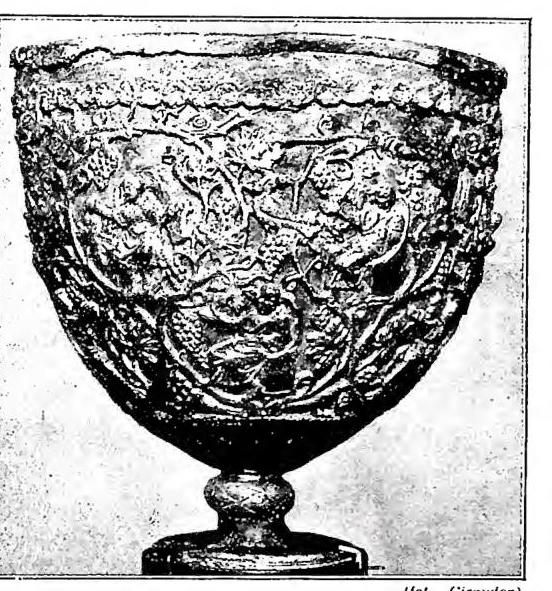
Un'intera letteratura si è riunita per il cosiddetto argenteo calice di A., che si dice scoperto in un pozzo presso l'Oronte nel 1910, ora nella collezione Fahim-Koucha-Kji a Nuova York; ma la provenienza da A. venne infirmata da Ch. Diehl e dal Woolley. Differenti ipotesi diano questo prodotto dell'arte siriaca dal 50-70 d. C. (Strzygowski) al sec. vi (de Jerphanion). La decorazione cesellata a sbalzo rappresenta tralci vitinei sui quali sono assisi in cattedra due volte Cristo e gli Apostoli; il piede è sproporzionato alla coppa. Contro l'autenticità ha scritto G. Wilpert con argomenti ritenuti insufficienti dal Rodenwaldt e da altri. Sarebbe desiderabile un'analisi chimica, secondo la proposta del Dussad. Il Brehier e il Diehl hanno proposto di riconoscere come prodotti da A. un gruppo di tesori di argenteria siriaca, tra i quali lo scudo argento di Teodosio e il cofano d'argento di s. Nazzaro.
Per l'arte in A.: G. Strzygowski, Antiochmische Kunst, in Oriens Christianus, 2 (1902), pp. 421, 433; 15 (1915), pp. 83-110; id., in Denkwürrften der K. K. Akademie der Wissenschaften, Vienna 1905, p. 169; id., A sarcophagus of the Sidamara type, in Journal of Hellenic Studies, 27 (1907), pp. 99-122; H. C. Butler, nel rendiconto dell'American Archaeological Expedition to Syria in 1899-1900, parte II: Architecture and other arts, Nuova York 1903; id., nel rendiconto della Princeton University Archaeological Expedition to Syria in 1904-1905, Division II: Ancient Architecture in Syria, Leida 1908; O. Wolff, Altschritische und Byzantinische Kunst, Berlino 1918; id., Bibliographisch-kritischer Nachtrag, Potsdam 1935, pp. 24-36; C. R. Morey, Early Christian Art, Princeton 1942; D. Levi, Antioch Mosaic Pavements, 2 voll., ivi 1947.
Per il calice di A.: G. A. Eisen, The great chalice of Antioche, Nuova York 1923; G. de Jerphanion, Le calice d'Antioche,
in Orientalia Christiana, VII, Roma 1926; G. Wilpert, in The Art Bulletin, 1926, p. 126 seg.; id., Antichità Moderne, in Riv. d'Arch. Crist., 4 (1927); G. Bodenwaldt, Ara pacis und S. Vitale, in Bonner Jahrbücher, 133 (1928), p. 228 seg. Enrico Josi
### III. THE PATRIARCHATE OF ANTIOCH
At the Council of Nicaea (325), where the Antiochene bishop St. Eustathius—one of the most valiant champions of orthodoxy against Arius—was present, canon 6 sanctioned the privileged status of Antioch, whose bishop exercised metropolitan rights not only over the 22 bishops of Coelesyria but also over those of Cilicia, Mesopotamia, Palestine, and Cyprus. This patriarchal preeminence was reaffirmed by the Council of Constantinople (381) in canon 2 and by that of Ephesus (431), which, however, removed Cyprus from Antioch’s jurisdiction.
In the second half of the 4th century, Antioch was troubled by the schism of Meletius, which divided the West and the Alexandrians on one side from the majority of the Easterners on the other. The deposition of St. John Chrysostom (v. CRISOSTOMO) provoked another schism until his successors, in agreement with Pope Innocent, later included his name in the diptychs.
At the Council of Ephesus, the Antiochenes, led by Bishop John—a somewhat sympathetic figure to Nestorius—though not sharing Nestorius’s errors, did not immediately accept the actions of St. Cyril and the orthodox. Instead, they held a synod to condemn them. After lengthy negotiations, they made peace with St. Cyril in 433; however, a latent aversion to "Dyophysite" language persisted among some Antiochenes. Yet the Council of Chalcedon (451), by elevating the patriarchate of Constantinople to the foremost see of the East—at the expense of Antioch’s ancient glories—was not warmly received by many in Syria. Gradually, Monophysitism infiltrated the region, leading to the establishment of a heretical patriarchal see in Antioch, at the head of the so-called Syriac Church, known as "Jacobite" after Jacob Baradaeus (v.), the propagator of these errors.
2. Internal Religious Struggles of the 6th Century, the Arab Invasion of Syria in the 7th Century, the Byzantine Victory (969-1098), Latin Rule (1098-1268), and the Mamluk Domination.
After the Council of Chalcedon, the decline of the Greek patriarchate began. Until the mid-6th century, it was at times Monophysite and at other times orthodox, while from then onward, two hierarchies existed side by side: one Monophysite and the other orthodox. This decline had already been prepared by the Christological disputes surrounding Nestorius and, in part, by the Meletian schism. From 512 to 518, the Monophysite Severus was patriarch of Antioch; he was deposed by Emperor Justin I and later lived in Alexandria, where he died in 538. Faithful to the Council of Chalcedon were the patriarchs and writers Ephrem (529-45) and Anastasius I (559-99), exiled by Emperor Justinian for opposing his Aphthartodocetism but later able to return to his see thanks to the intervention of Pope Gregory the Great. Anastasius II (599-609) translated St. Gregory the Great’s Regula Pastoralis into Greek. Prominent propagators of Monophysitism included, in addition to Jacob Baradaeus, Bar-
BIBL.:
In addition to the works cited in the general bibliography of the article ANTIOCHIA DI SIRIA, see: F. Cavallera, Le schisme d'Antioche (IVe-Ve siècle), Paris 1905; G. Bardy, Paul de Samosate, Louvain 1929; E. Schwartz, Publizistische Sammlungen zum Acacianischen Schisma, Munich 1934; H. Delehaye, Les origines du culte des martyrs, Brussels 1933; J. Lebon, Le monophysisme sévérien, Louvain 1909; G. Downey, A History of Antioch in Syria from Seleucus to the Arab Conquest, Princeton 1961; R. Devreesse, Le patriarcat d'Antioche depuis la paix de l'Église jusqu'à la conquête arabe, Paris 1945. Enrico Josi
ANTIOCH — Plan of the church of Ma'šuká (late 5th century).
Antioch was the scene of intense ecclesiastical activity and profound divisions. Peter the Fuller, patriarch of Antioch (470–71) by the favor of the governor of Syria, the future Emperor Zeno, and Patriarch John Codonatus (478, deposed after three months) following Peter the Fuller’s second patriarchate, illustrate the turbulent succession. Stephen II (478–81), a Catholic patriarch, died a martyr for the faith. Further internal strife was fueled by Patriarch Acacius of Constantinople. Peter the Fuller succeeded in occupying the see of Antioch a third time until his death in 488; he was succeeded by Palladius, also a heretic. Many revolted against St. Flavian (498–512), especially Severus the monk, who later became patriarch and organizer of the Jacobite Church, which by the mid-6th century was already constituted; about half of the inhabitants of Syria (totaling around four million) adhered to Monophysitism.
Another severe blow to the Greek Church of Antioch came with the Arab occupation of Syria (638–969). While the Jacobites, as indigenous Christians, received favors from the new Muslim rulers, the faithful of the Greek Church found themselves in a precarious situation. During the 7th century, the see of Antioch was often vacant; in calmer periods, heretics such as Athanasius, Macedonius, and George held the patriarchal dignity. Patriarch Macarius was deposed by the Sixth Ecumenical Council. From the beginning of the 8th century, the see remained vacant for forty years. It was probably in this period that the Maronite schism occurred. During the iconoclastic controversies of the 8th century, the patriarch of Antioch defended Catholic orthodoxy: as in the Seventh Council, so too in the Eighth Ecumenical Council, the patriarch was represented and was in agreement with the Pope.
Byzantine rule brought better times to the Greek Church of Antioch; however, the subordination of the patriarchate of Antioch to the “Ecumenical” patriarch of Constantinople became even more pronounced. We know that John II (996–1029) included the Pope’s name in the diptychs; under him, Greece, which had been closely connected with Antioch since the end of the 5th century, gained greater autonomy. Peter III (1052–56) notified Pope Leo IX of his patriarchal appointment and, as Michel has recently demonstrated, acted as a peacemaker between East and West, using strong and courageous language toward Patriarch Michael Cerularius of Constantinople.
At the time of the Crusades, the Greek Patriarch John V (1096–1100) was able to remain in his see for a time. Only after his departure for Constantinople was the Latin patriarchate of Antioch established. Prince Bohemond III restored the Greek Patriarch Athanasius to Antioch, who blessed the marriage of Emperor Manuel Comnenus to Bohemond’s younger sister on Christmas 1161. Already in 1137, Raymond of Antioch seems to have taken a similar step. Theodore Balsamon (1185–95) is known as a canonist. Patriarch Simeon participated in the religious disputes between the delegates of Pope Gregory IX and the Greeks at Nif near Smyrna in 1234. To Patriarch David, perhaps a Catholic, Pope Innocent IV sent a bull (9 August 1246), in which he recommended his legate Laurence, a Franciscan (Potthast, 12248); the following year, he sought to win over the bishops of Antioch to the cause of the Catholic Church (Potthast, 12636; E. Berger, Les registres d’Innocent IV, II, Paris 1887, nos. 4051–53). The Greek patriarchs of Antioch often resided in Constantinople not only under Latin rule but also for an indeterminate period under Mamluk governance. Under these rulers, the two well-known Councils for union were held: Lyons (1274) and Florence (1438–45). Patriarch Theodosius of Antioch, residing in Constantinople, seems to have favored the union of Lyons. Patriarch Dorotheus was represented at the Council of Florence but did not remain steadfast to its union decrees beyond 1443.
3. The dissident Greek patriarchate of Antioch under Turkish rule (1517–1920). — Under the Turks, the dissident Greek Church of Antioch continued to decline. Internal discord, especially during patriarchal elections, financial difficulties, and religious strife greatly disturbed ecclesiastical life. Patriarchs Joachim V (1584–87) and Macarius II (1647–72) undertook journeys to Russia to seek alms; the latter—accompanied by his son, the archdeacon Paul of Aleppo, who left us a valuable account—departed from Damascus on 9 July 1652, spent more than a year in Moldavia, where he was well received by the princes; on 26 January 1655 he entered Moscow and, soon received by Tsar Alexis, remained in that empire until 21 August 1656 before returning to Moldavia and thence to Wallachia. He arrived back in Aleppo on 7 May 1661.
At the end of the 16th century, a Jacobite patriarch of Antioch, Namat Allah, favored union with the Catholic Church; in the 17th and 18th centuries, with the effective aid of Latin missionaries, this union in part became a reality, resulting in the Syriac-rite Church with a patriarch. Alongside this union movement arose the origin of the Melkite Catholic Church, effectively prepared in the 17th century and established in the first half of the 18th century. These two momentous events (especially the union of the Melkites) had profound repercussions on the Greek patriarchate of Antioch, even occasioning joint action by dissident Greek patriarchs in synods (cf. Mansi, XXXVII) and steps, unfortunately successful, taken with the Ottoman government against Catholic missionary activity.
When in 1860 the Druse massacred Christians, not only Catholics (e.g., those later beatified by Pope Pius XI) but also the subjects of the dissident patriarch of Antioch suffered. On that occasion, the patriarchal church in Damascus, with its treasure and library, was completely destroyed. The present condition of the dissident patriarchate will be mentioned below.
4. The Catholic Melkite Church under the Turks. — We are well informed about the development of the Melkite union thanks especially to the investigations of the Rev. Cyril Korolevskij and of Msgr. Ludovico Petit, as well as to several still unpublished documents. Not a few are the documents written by the Greek patriarchs of A. to the Supreme Pontiffs in the 17th century. The first of these known to date is the letter of Patriarch Ignatius (recently noted in Orientalia Christiana Periodica, 9 [1943], p. 311), dated 4 July 1625; this is not a profession of Catholic faith, but nonetheless it is very important for understanding the mentality then prevailing among the leaders of the Greek Church of A. and for better comprehending the origins of the Catholic Church of the Melkite rite. He complains of the trials he must endure from “alien” people of Arabia (he probably means the Muslim rulers), but even more he laments against Patriarch Cyril Lukaris of Constantinople “who is the ruin of our Church” (“more than 40,000 crosses”). Evidently this document is primarily a plea to receive financial aid from the Pope, but it is very instructive. It cannot be said whether this patriarch had knowledge of Leonardo Abel, envoy of Pope Gregory XIII to the East, and of the relations of this ambassador with the Greek patriarch of A., Michael VII, then retired and withdrawn to Aleppo. Of Patriarch Euthymius III there is reported (v. Statistica con cenni storici della gerarchia e dei fedeli di rito orientale, p. 139) a profession of faith sent to Rome in 1634. He—as we know from a letter of the Jesuit Girolamo Queyrot to Fr. General Muzio Vitelleschi, from Berea (Aleppo), Syria, of 12 Sept. 1640—invited the father to come to Damascus, the patriarch’s residence, to give instruction (“he declared that he had no learned man in his Church”); after repeated requests and after taking counsel with his confreres, Fr. Queyrot indeed went to Damascus on 12 May 1641, and took up lodging from the day of his arrival, 23 May, in the patriarch’s house; though he was unable to celebrate Holy Mass. The aforementioned Patriarch Macarius II (1647–72) maintained good relations with the Latin missionaries (and a letter addressed to him from Pope Alexander VII, dated 22 July 1662, published in full by Grumel, has come down to us); but given his almost simultaneous relations with the dissident Greeks (participation in the Synod of 13 March 1663), one must be cautious in counting him among the genuine friends of Rome. The personality of Patriarch Athanasius III Dabbas also gives rise to observations, despite his letters to the Roman Curia; he was an anti-patriarch (1685–94), and patriarch after the death of the true patriarch Cyril V Zaim (1720–24). Cyril V, won over to the Catholic cause by his friend Poullard, French consul at Sidon, sent his profession of faith to Rome in 1716. An indigenous apostle of the union was then Euthymius Saifi, metropolitan of Tyre and Sidon (d. 1722). His nephew Cyril VI Tanas became Melkite Catholic patriarch in 1722 and was able, despite the fierce resistance of the dissident Greek patriarch Sylvester of Cyprus and others, to save the “indigenous” Greek Catholic Church. While the Melkite Catholics dispersed in the two patriarchates of Alexandria and Jerusalem remained for about half a century subject to the Custody of the Holy Land, the Melkite patriarch then residing in Lebanon received, by the decree of Propaganda of 13 July 1775, also the administration of those. Patriarch Maximos III Mazloum, elected in 1832, fleeing the Egyptian invasion, fixed his residence in Damascus. He received the title of Patriarch of Jerusalem and Alexandria from Pope Gregory XVI, a title which in fact his successors also add to that of Patriarch of A. Gregory II Youssef (1864–1897) distinguished himself by his great zeal and pastoral prudence. Leo XIII subjected in 1894 to the jurisdiction of the Melkite patriarch all the Melkites of the Ottoman Empire. Under his successors many conversions were obtained in the regions of Tripoli, Homs, and Transjordan. At this time the Society of Melkite Missionaries of St Paul acquired special merits.
The active life of the Melkite Church is also shown in the synods held between 1761 and 1902, whose acts are published by Msgr. Petit in the large volume (the XLVI) entirely devoted to them in the Mansi collection.
Giorgio Hofmann
IV. THE COUNCILS OF A
Among the numerous councils and conciliabula celebrated in A., the following may be mentioned:1. The councils against Paul of Samosata, bishop of A. in 264 and in 268. — Critics still debate their number: Tillemont, Duchesne, Harnack distinguish three, while Baronius, F. A. Zaccaria, G. Bardy admit only two, an opinion that seems the most satisfactory. Differing too are the opinions encountered among authors regarding their date; nonetheless, it can be said that today the agreement, if not complete, is at least largely reached. The first took place in 264 and the second in the autumn of 268. The chief aim of these two councils was to combat the errors of Paul (v.) of Samosata, successor of Demetrianus in the Antiochene see around 260. Indeed, Paul, denying both the mysteries of the Trinity and the Incarnation, constituted one of the principal heretics of the ancient Church, a true precursor of Arius and Nestorius.
The first Council was perhaps convened through the efforts of Eleno of Tarsus, and a great number of bishops from Syria, Palestine, Phoenicia, Arabia, Cappadocia, and Pontus took part in II. Dionysius of Alexandria was also invited, but he declined the invitation with a letter addressed to the community of A., in which he openly notified his opposition to the errors of the Samosatene. Firmilian of Caesarea was the most prominent figure at the meeting, and it is therefore to be believed that he himself presided over II. Paul
ANTIOCHIA — Plan of the church of St Babila at Kaoussié (end of 4th cent.).
of Samosata, summoned to justify himself, succeeded, by dint of sophistical skill, in making his orthodoxy appear credible and promised to avoid equivocal expressions. The Fathers gave credence to his promises and separated without reaching any conclusion; they were well aware, moreover, that the heretic enjoyed the esteem and protection of Zenobia, queen of Palmyra, who had then reached the zenith of her power. Under this powerful patronage, Paul, heedless of the warnings that many bishops of the region addressed to him, did not in any way change his conduct. It then seemed opportune to all to convene a new council, in order to put an end to the scandal that the bishop was causing by openly denying the fundamental truths of Christianity.
In the autumn of about 268, some eighty members gathered again under the presidency of Eleno of Tarsus; Firmilian died while on his way to the council. This time, Paul, hard pressed by the dialectical skill of a certain Malchion, was forced fully to acknowledge his errors and was deposed and replaced by Domnus. As was customary, the Fathers, before separating, drew up a synodal letter and sent it to all Catholic bishops. The historian Eusebius has preserved long fragments of this important document for us, though unfortunately omitting the principal dogmatic passages (Eusebius, Hist. eccl., VII, 30, 2).
It is well known that Paul mocked the sentence, refusing to hand over to the Catholics the “house of the Church,” that is, the church and the adjoining episcopal residence, property of the Christian community, and did not leave the see until the intervention of the police of the emperor Aurelian, who was then passing through Antioch (271).
2. The councils during the Arian controversy
a) A synod, called the Dedicatio in encaeniis, was held in the summer of 341 in the presence of the emperor Constantius II on the occasion of the consecration of the great church of Antioch, built by order of Constantine and which was called the “Golden Church.”The assembly numbered as many as 97 bishops, all from the East, for the most part dependent on Antioch and mostly orthodox. There was a small representation of Arians, among whom was the aged Eusebius of Nicomedia, who had recently been installed in Constantinople (339); and it was therefore the Eusebians who, in reality, directed the council. They secured confirmation of the deposition of Athanasius and, while pretending to be orthodox, used respectful words about the Council of Nicaea, while omitting the term “consubstantial,” homoousios, in the four professions of faith that they drew up. These professions, preserved for us by St Athanasius (De Synodis, 22-25), reject pure Arianism and are capable of an orthodox interpretation; St Hilary, moreover, explicitly approved two of them (De Synodis, 29-32): yet here and there ambiguity is betrayed. The third, drawn up by Theophronius of Tiana, expressly condemns Marcellus of Ancyra and his masked Sabellianism. Only the fourth, addressed to the emperor Constantius, is the most orthodox, but, like the others, it says nothing at all about consubstantiality; hence it may be concluded that these formulae foreshadow the so-called “homoiousianism,” and the synod became famous more for the twenty-five disciplinary canons that it formulated than for these professions of faith.
Soon the East and the West accepted these canons as the “work of the holy Fathers.” The 4th and 5th were also cited in the Council of Chalcedon, and even popes Zachary and Leo IV made use of them. The title of Synodus Sanctorum Patrum gave rise to doubts regarding their authenticity as the work of the council of 341. Critics, indeed, advance various hypotheses on this point, which Hefele expounds at length in his Histoire des Conciles (Hefele-Leclercq, I, pp. 706-14). One may agree with him that these canons, some of which reveal the influence of the Eusebians, were formulated by the present council.
Canons 4 and 12 are particularly directed against the Roman synod of 340 and against the right of appeal to the Holy See; moreover, their legislation was an excellent work and explains why it was so readily accepted both in the East and in the West.
b) Another council was convoked in 363, at the beginning of the reign of the emperor Jovian, by Acacius of Caesarea. He had hitherto been a zealous Arian, but, having then gone over to orthodoxy to please the new sovereign, he adhered to the Nicene synod with Meletius of Antioch and twenty-five other bishops. In the synodal letter, addressed to Jovian, the Fathers gave an explanation, certainly orthodox, of the term homoousios, though not without ambiguity where it is said that the Son is like the Father as regards substance, homoios kat’ ousian (cf. Athanasius, De Synodis, 41; Socrates, Hist. eccl., III, 25).
c) A third council, held in Sept. 379, nine months after the death of St Basil, was attended by 146 Fathers, who attempted, though in vain, to extinguish the schism of Antioch and gave fresh impetus to the triumph of the Church over Arianism, which had shortly before lost, in the person of Valens, a great protector. They also subscribed, attaching to it certain clauses, the tomus of the Roman council of 369 and sent a letter to the bishops of Italy and of the Galilees.
3. Other councils
Among the principal ones may be recalled: a) The provincial council of 389, reported by Sozomen in his Hist. eccl., VII, 15, which forbade the sons of Marcellus of Apamea in Syria to avenge the death of their father, who had been martyred by pagans and whose temples the emperor Theodosius had ordered to be destroyed.b) The council of 424, which many place in 418. Of it nothing further is known beyond the expulsion of Pelagius from Antioch and the condemnation of his doctrine (Mansi, IV, cols. 474-75).
c) The Monophysite conciliabulum of 521, which installed in Antioch the famous Severus, hence called Severus of Antioch.
d) The Latin council of 1139, convened over the case of Raoul of Domfront. He, previously bishop of Mamistra or Mopsuestia, was then elected, by popular acclamation, patriarch of Antioch, upon the death of Bernard of Valence (1134-35). In the midst of the schism of Anacletus II (Pierleoni), Raoul, refusing to receive the pallium from the legitimate pope Innocent II, took it for himself upon the altar. Meanwhile, two canons of Antioch, who had opposed his election and complained of him, had recourse to Rome. The Pope then delegated Alberic, cardinal of Ostia, to hold an inquiry on the spot. He, having convened a council in the months of Nov.-Dec. 1139, deposed Raoul for irregular election, simony, and incontinence. It should be noted, however, that prince Raymond, hostile to the patriarch, also contributed to the severity of this sentence. Raoul, however, managed to escape and came as far as Rome, where doubtless he was able to justify himself.
V. THE SCHOOL OF A
4. General Notion
By the name School of A. it is customary to designate a certain number of Fathers and ecclesiastical writers of the 3rd, 4th and 5th centuries, originating from A. and its surroundings, or even from other places, who have in common not the fact of having studied at the same school or under the same teachers, nor of teaching the same philosophical and theological doctrine, but of employing a similar method in the interpretation of Sacred Scripture.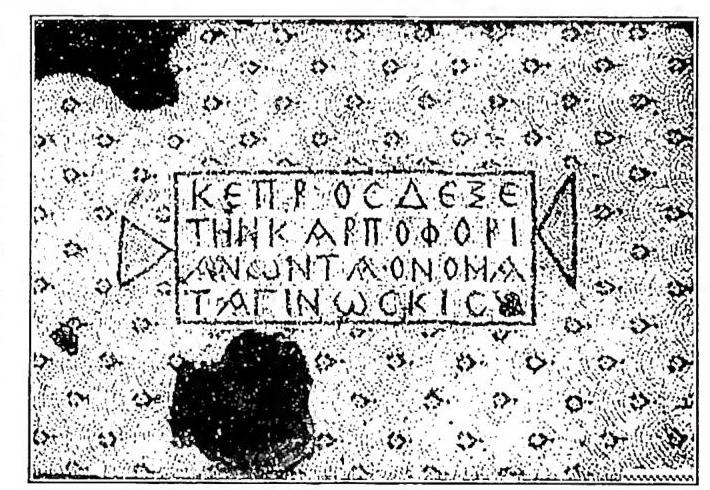
Although one cannot speak of a unity of philosophical doctrine within the group in question, it is undeniable that it tends towards Aristotelianism rather than Platonism. In theology, the realistic spirit of the school seeks to emphasize the distinction of the divine Persons among themselves and, with regard to the mystery of the Incarnation, to insist on the humanity of the Saviour and its integrity. Diodorus of Tarsus and Theodore of Mopsuestia will attempt to explain the manner of the union of the two natures, divine and human. This attempt will prove unfortunate and betray a rationalist tendency. Their polemic against Arianism and Apollinarianism will naturally lead them to emphasize, on the one hand, the transcendence of the Word, and on the other, the most realistic manifestations of the human nature which He assumed. They will soon be accused of wishing to revive the adoptionism of Paul of Samosata.
5. Historical Profile
The rationalist heretic Paul of Samosata had disciples during his lifetime and after his death. Even at A. itself a small community of Paulianists persisted for some time. According to an opinion commonly held but now contested by several scholars of repute, it was from this centre that there emerged the man generally regarded as the true founder of the School of A., namely the priest St. Lucian of Samosata, who died a martyr at Nicomedia on 7 January 312.The question arises whether this Lucian, of whom St. Alexander of Alexandria speaks in his letters to Alexander of Byzantium (Theodoret, Historia eccl., I, 4, 46), is the same as the martyr of Nicomedia. R. Geillier, F. Loofs and, more recently, G. Bardy (Recherches sur s. Lucien d'Antioche et son Ecole, Paris 1936, pp. 47-60) deny this identification and adduce serious reasons, though they do not provide absolute certainty.
What is certain is that the martyr St. Lucian was at A. towards the end of the 3rd century and at the beginning of the 4th, a most renowned professor of exegesis, to whom is owed a recension of the whole Bible based on the original texts. Although he scarcely wrote anything himself, reliable indications allow us to affirm that in the interpretation of the sacred books he sought above all to make clear the literal and grammatical sense. For this reason he may be considered the first representative of the School of A. He had numerous disciples, on whom he exercised considerable influence; however, some of them
ANTIOCHIA – Mosaic pavement of the church of Μαΐκκδ (late 5th century).
promised to preserve his memory and formed groups around Arius, one of them, when he revealed his heresy. This is the group of the Collucianists, a term used by Arius himself in his Letter to Eusebius of Nicomedia (cf. Theodoret, Historia eccl., I, 5, 4). The principal members were: Eusebius of Nicomedia, Mari of Chalcedon, Theognis of Nicaea, Asterius the Sophist, and Athanasius of Anazarbus. If one were to believe these disciples, St. Lucian would be the true father of Arianism. Without endorsing this judgment, one may suppose that the master, at least at a certain period, used unfortunate words and equivocal expressions regarding the divinity of the Word (v. LUCIAN OF A).
Only much later, around 360, did the true theorist of the school, Diodorus of Tarsus, gather around himself, in the monastery he had founded at Antioch, a number of disciples, the two most illustrious of whom were St. John Chrysostom and Theodore of Mopsuestia. If to these three names are added those of Nestorius and Theodoret, one has the most important representatives in their writings, the most celebrated for the role they played and the influence they exerted. Unfortunately, this influence has not always been of good quality. Diodorus is regarded as the one who sowed the first seeds of the heresy that bears the name of Nestorius. Theodore developed and expounded it in detail. Nestorius did not hesitate to preach it at Constantinople, thereby bringing about his solemn condemnation at the Council of Ephesus. More circumspect, and no doubt always orthodox,
Theodoret suffered much in his reputation because of the disputes with the opponents of Nestorius and Theodore. Theodore is the most heterodox of all, although he was not condemned during his lifetime. Yet his heterodoxy does not so much concern his exegetical method—which was excellent—as his systematic spirit (for he had an entire theological system), his contempt for ecclesiastical tradition, and his rationalistic tendencies. For several centuries he was the doctor of the Nestorian Church, which gave him the title of “interpreter” par excellence, Mphaskānā.
The school of Antioch died for the Church with the condemnation of Nestorian heresy. After the closing of the school of Edessa by Zeno (489), it took refuge in Persia, where the works of Theodore were expounded. But its influence did not end with this. The writings of St. John Chrysostom, Theodoret, Theodore himself, and a few others preserved in the Church the primacy of literal exegesis. From the 6th century onward, the catenae writers in the East gave it preference over Alexandrian allegorism. Its glory lies in having inaugurated scientific exegesis.
VI. THE ANTIOCHENE RITE
By this name we mean the rite that took shape in Antioch, in Syria and Palestine, practiced by the Orthodox, while referring to another entry (WEST SYRIAN RITE) for the rite used by those Syrians and Palestinians who separated from the Church in opposition to the Council of Chalcedon (451), known under the name of Jacobites.This rite never attained great stability, nor did it ever become uniform throughout the various regions of the Orthodox patriarchate of Antioch, except after its fusion with the Byzantine rite from the 13th century onward. Its history consists in a continuous process of give and take that led to its disappearance. We can divide this history into four periods.
Of the first period (1st–3rd centuries) we know only that from apostolic times a liturgical rite in the Greek language must have taken shape in Antioch; the Epistles of St Ignatius speak of it in general terms, perhaps also the Didache and some apocryphal works.
In the second period (4th–6th centuries) the rite comes fully into view. Abundant and precise information is contained in the homilies of St John Chrysostom, delivered in Antioch between 386 and 397; with these Brightman (Lit. East. and West., pp. 470–81) was able to reconstruct a very large part of the Antiochene Mass. In the same homilies and in other works of the saint there are also precious indications regarding the Sacraments, e.g. on Penance. For the Divine Office we are better informed by Theodore of Cyrus in his Monastic History (PG 82, 1283–1496), and we know that the young deacons Diodore of Tarsus and Flavian introduced antiphonal chant into the cathedral (v. ANTIPHON).
In other cities of the patriarchate local rites had also taken shape. The best-known formulary of the Mass is found in Book VIII of the Apostolic Constitutions: it is the so-called Clementine Mass (cf. Brightman, pp. 3–27), an ideal formulary that does not differ greatly from the rite of the capital. The same book explains the structure of the morning and evening synaxis. From another region come the writings of the Pseudo-Dionysius; they make known to us not only the Mass (cf. Brightman, pp. 487–90), but also the rite of Baptism, of chrismation, of ordination, of the dedication of the church, and of funerals. But the greatest contribution to the formation of the Antiochene rite was made by the most famous city as a center of piety in the Christian world: Jerusalem. The rite is known to us thanks to the Peregrinatio Silviae and to the catecheses generally attributed to St Cyril of Jerusalem. From there comes the liturgy (or Mass) of St James, which imposed itself throughout the Antiochene patriarchate and was accepted into the Byzantine rite; its anaphora was translated into Syriac, Armenian, Georgian, Ethiopic, and perhaps Coptic (cf. the critical edition by B. Mercier, La Liturgie de s. Jacques, Paris 1946: PO 26, fasc. 2; also C. A. Swainson, The Greek Liturgies, Cambridge 1884, pp. 211–332; A. Rücker, Die syrische Jakobosanaphora, Münster 1923).
Jerusalem spread to other Churches many of its ceremonies, its calendar, its feasts, the arrangement of the readings of Holy Scripture and the chants that accompany them. Cilicia had its own particular rite in the Greek language, described in the catecheses of Theodore of Mopsuestia (ed. A. Mingana, in Woodbrooke Studies, V and VI, Cambridge 1932 and 1933; Latin translation of the liturgical parts by A. Rücker, Ritus Baptismi et Missae, Münster 1933); but this rite, like the anaphora attributed to the same Theodore, passed into that of the Nestorian Church of Mesopotamia. The same occurred with the rite developed in Osrhoene and especially in its capital, Edessa; the poems of St Ephrem eventually entered into the rite of the Jacobites and that of the Nestorians.
With the separation of the Monophysites, the establishment of a dissident patriarchate of Antioch, and the invasion of the Arabs, the third period (6th–10th centuries) of the history of the Antiochene rite begins. From that moment it can be called Melkite, because it entered into closer relation with the rite of the Byzantine Empire. In the 6th century St Romanos the Melodist appeared, creator of the form of sacred poetry called later kontakion, a prosodic imitation both of the Syrian poetry of St Ephrem and of the rhythmic rhetoric of the Greek homilies of the time (cf. P. Maas, Das Kontakion, in Byz. Zeitschr., 19 [1910], pp. 285–306), but of great effect for its spontaneity and the vividness of its dialogue (text and translation by G. Cammelli, Romanos le Mélode, Florence 1920). The kontakion of the 6th century supplemented or replaced the homily in the Mass, and in Matins commented on the Synaxarion. Two centuries later, especially in the monastery of St Sabas near Jerusalem, a new genre of liturgical poetry, the canon, was cultivated; the canons of St John of Damascus and of St Cosmas of Maiuma are well known, and the Byzantines inserted them into their office. St John is credited with the composition or at least the editing of the following Byzantine liturgical books: Octoechos (v.), Triodion (v.), Pentecostarion (v.). Finally, the Typikon (v.), containing the arrangement of the entire annual office of the monastery of St Sabas, was accepted by the Byzantines who had taken refuge there and brought by them to Constantinople after the iconoclastic fury. It is true that this Typikon was considerably developed by the Studites and others, but it is all the more necessary to note that it received its definitive form at St Sabas in the 11th–12th centuries and that under that name it still regulates the Byzantine liturgy of all the dissident churches today.
The reconquest of Syria in the 10th century by Byzantium, temporarily strengthening Hellenism in the Melkite patriarchate of Antioch, marked the beginning of the fourth and final period, that of complete Byzantinization. Following the Crusades, the patriarchs left their see and took refuge in Constantinople. One of them, the celebrated canonist Theodore Balsamon, answering around 1195 a question from his colleague Mark of Alexandria, affirmed that the use of their liturgies, those of St Mark and of St James, was illicit and should give way to those of St John Chrysostom and St Basil (cf. PG 138, 953). Thus the proper rite of the patriarchate of Antioch disappeared.
Another particular feature of the Antiochene rite that cannot fail to be highlighted is the liturgical language. This was at first Greek. But, probably already in the 4th and 5th centuries, first in the countryside and then in the monasteries, translation into the Syriac language began, though on a small scale. We have an example of this in a rite of ordinations preserved in Palestinian speech (cf. M. Black, Rituale Melchitarum, Stuttgart 1938, and the analysis made by H. Engberding, Eine neuerschlossene bedeutsame Urkunde zur Geschichte der östlichen Weiheriten, in Oriens Christianus, 3rd series, 14 [1939], pp. 38–54). But it was not until the 10th–11th centuries that we witness a renaissance of the Syriac language in the Melkite rite, which lasted until the 15th century. To the two hundred documents noted by C. Korolevskij others may be added (cf. A. Baumstark, Neue handschriftliche Denkmäler melchitischer Liturgie, in Oriens Christ., new series, 10–11 [1923], pp. 157–58). Few of these texts still belong to the Antiochene rite; others mark a period of transition; the majority already represent the text of the Byzantine rite.
documents respectively from 1141 and 1154 (G. S. Assemani, Bibliotheca Orient., I, Rome 1719, p. 307 ff.). The bull of Innocent III, Quia Divinae, of 1215 acknowledges this title to them. Their see, which was always in Lebanon, nevertheless changed location until the Lebanese Synod of 1736 fixed it at Qannūbin, and then that of Bekorki in 1790 at Bekorki itself near Beirut (Codif. can. orientale, XII, nn. 1391 and 1155), which is today the winter residence, while the summer residence is at-Dimān.
To this patriarchate belong the residential sees of Aleppo, Baalbek, Beirut, Cyprus, Damascus, Gibail-Batun, Sidon, Tyre, Tripoli (formerly of Syria and now of Lebanon) and Cairo. According to the Statistica... della gerarchia e dei fedeli di rito orientale (Vatican City 1932) the faithful number 322,715, while those scattered in other regions of the world amount to 43,300. The secular clergy comprises 1,012 priests; the regular clergy exceed 700.
Pietro Sfair
VIII. A. OF THE MELKITES. — The Melkite Catholic Patriarch of Antioch resides in Damascus, Cairo, and Alexandria. The patriarchate comprises 12 residential sees: Tyre, Ptolemais, Sidon, Caesarea Philippi, Tripoli (Syria), Aleppo, Bostra, Damascus, Baalbek, Zahlé, Beirut, Homs; 5 patriarchal vicariates: Alexandria, Cairo, Sudan, Jerusalem, Constantinople. There are also 5 titular bishops. Male religious institutes include the Melkite Basilians of the Most Holy Savior, the Basilians of St. John of Suwayr, the Aleppine Melkite Basilians, as well as the ecclesiastical congregation of the Society of Melkite Missionaries of St. Paul. Female religious institutes of the Eastern rite are the Šuwairite Basilian nuns, the Salvatorian nuns, the Aleppine Basilian nuns, the Sisters of Charity of Besançon (Melkite branch), and a religious congregation recently founded by the Paulists.
In 1932, the number of faithful within the patriarchal territory was 150,155; in the United States, 13,550; in other places, approximately 2,500; in total, 166,214. There are 167 secular priests; the regular clergy (priests and deacons) comprises: 180 Melkite Basilian Salvatorians, 100 Suwayrite, 50 Aleppine, and 7 Melkite Missionaries of St. Paul. Schools and charitable institutions are numerous.
The dissident Greek patriarchate of Antioch numbered in 1934: 5 dioceses in Syria and 6 in Lebanon, along with the district of Laodicea (residence at Latakia), with a total of 230,000 faithful. To these are added the emigrants: 10,000 in the United States, Canada, and Mexico; 120,000 in South America; and 41,000 elsewhere. In all, approximately 500,000.
It is noteworthy that since the end of the last century the dissident patriarchs of Antioch have not been Greek but Arab. This change occurred due to very serious difficulties. Another schism lasting two years (12 Dec. 1928 – 29 Jan. 1933) under two simultaneous patriarchs originated from the conflict between the two religious parties, namely those of Damascus and Lebanon, at the death of Patriarch Gregory IV Haddad (12 Dec. 1928). Despite the intervention of the three Greek Eastern patriarchs who had pronounced in favor of the new patriarch elected by the minority (Damascus), namely Alexander Tahhan, the schism could only be resolved by the death of the other patriarch, Arsenius Haddad (9 Jan. 1933).
To this patriarchate belong the residential sees of Baghdad, Mosul, Aleppo, Beirut, Damascus, Emesa, Mardin and Amida, as well as two vicariates in Egypt and Palestine. In these dioceses there are about 50,000 Catholics served by 150 priests, amidst 174,000 Jacobites. Outside these territories there are still 14,535 Catholics and about 25,000 Jacobites.