
SUDAN. – Region of central Africa whose western part is politically dependent on France (v. A.O.F) and whose eastern part constitutes the Anglo-Egyptian S. The latter consists of the basin of the upper Nile and the White Nile, from the Congo to the Second Cataract, and from the Red Sea to Dar Fur.
It consists of a series of monotonous plateaus, sloping gently downward toward the N.; covered with dense forests or marshy in the S. (Bahr el-Gazal), but becoming increasingly arid as one proceeds northward and westward (Dar Fur, Kordofan), until they pass outright into desert (Nubia). On the eastern side, the relief becomes more pronounced, rising toward the Ethiopian plateau. Where it can benefit from the tribute of the many rivers that cross it (Gezirah), the immense country (2.5 million sq. km.) is suitable for cultivation (cotton), but overall livestock breeding predominates (cattle, sheep, goats, and camels), the products of which already sustain a considerable export trade. The population (7.6 million inhabitants) consists of Arab, Hamitic, and Negro peoples, fanatically Muslim. There is no shortage of large inhabited centres: Omdurman (118,000 inhabitants), the old Mahdist capital, faces Khartoum (62,000 inhabitants), the new capital, at the confluence of the two Niles. On the Red Sea lies Port Sudan (50,000 inhabitants).
The Anglo-Egyptian S. is an Anglo-Egyptian condominium, in reality dominated by British interests.
I. Anglo-Egyptian S
In 1697 the mission of Akhmim, Fungi, and Ethiopia was founded by the S. Congr. of Prop. Fide under the prefect Francesco Maria da Saleme of the Reformed Friars Minor. Sennar in the S. was later, in the eighteenth century, the point of departure for various missionary attempts in Ethiopia. At the beginning of the eighteenth century, Fr. Damiano da Rivoli O. F. M., appointed in 1701 prefect of the mission then established for Fezzan, Bornò, and Nubia, made a missionary attempt in Nubia, which failed. Further attempts likewise remained without effect.In 1846 Propaganda established the apostolic vicariate of Central Africa. Following the resignation of the first vicar
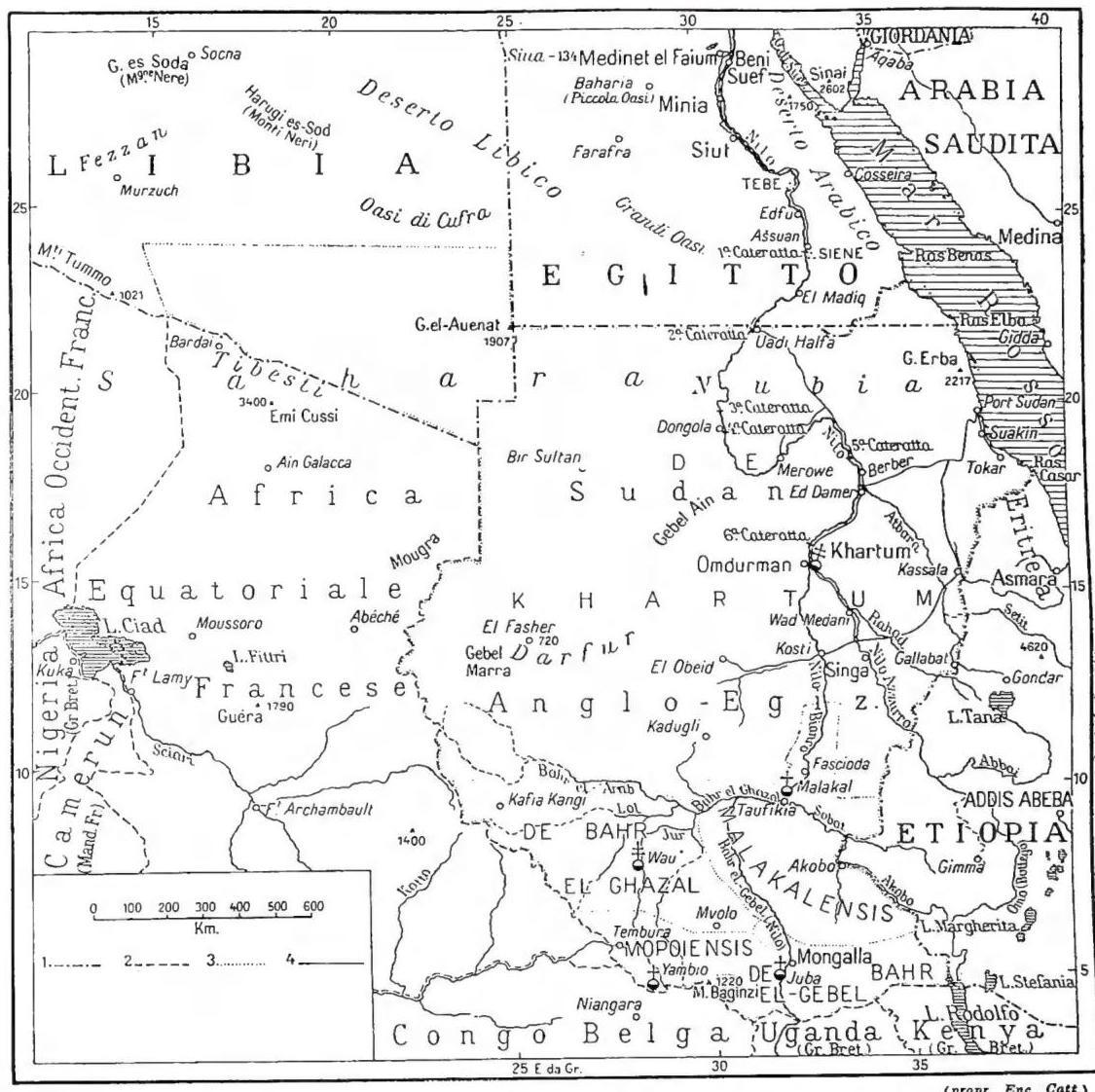
after the defeat of the Mahdists by the English was Msgr. Antonio Maria Roveggio able to begin reconstruction, from 1900 onward. His successor, Francesco Saverio Geyer, was the principal organizer and founder of the missions among the Blacks of the southern S. In 1913 the name of the apost. vicariate of Central Africa Khartum (v.), from which various missions originated.*
The fruit of missionary work in Anglo-Egyptian S. is represented by 77,893 Catholics.
1942. French S
On 6 August 1868, at the request of the archbishop of Algiers, later Cardinal Lavigerie, the apost. prefecture of Sahara and S. was established. Two expeditions of White Fathers, sent by Lavigerie to found-(photo. Enc. Cott.)
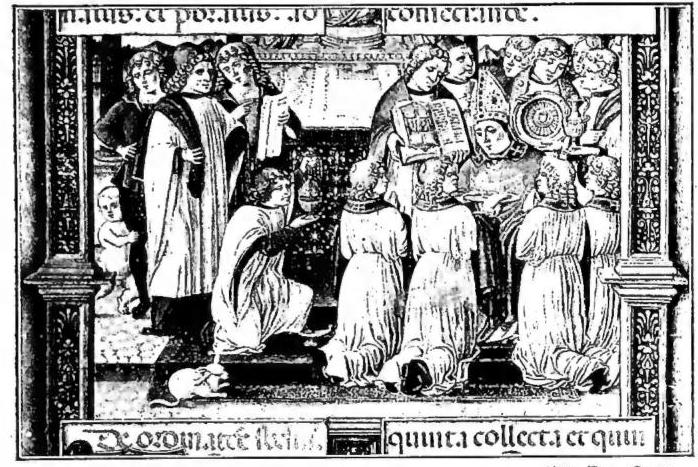
SUDDIACONO — Ordination of the subdeacon. Miniature from the Pontifical of Giovanni Vitez, bishop of Vesprim (1498–1500) — Vatican Library, cod. Ott. lat. 501, f. 15 f.
to found a mission in the Sudan, did not reach their destination: in 1875 the ff. Meneret, Paulmier, and Bouchard, and in 1881 the ff. Richard, Morat, and Pouplard, were massacred in the desert. The Fathers of the Holy Spirit succeeded in penetrating the Sudan from Senegal and in establishing, among the Malinke and the Bambara, not yet affected by Islam, the stations of Kita and Bangassi (1888) and that of Kayes (1893); in 1901 they ceded them to the White Fathers. Meanwhile, the White Fathers were able to enter the Sudan, likewise from Senegal, and establish themselves among various tribes, such as the Bambara, Mossi, Gurunsi, and Bobo, both in the Sudan and in Upper Volta, founding missionary stations. In 1901 Sahara and the Sudan, already raised to an apostolic vicariate in 1891, was divided: the northern part, the Sahara, became the apostolic prefecture of Ghardaia, while the southern part received the name of Sahara in the French Sudan. This latter vicariate was divided in 1921 into two vicariates: Bamako and Ouagadougou, comprising the French Sudan, Upper Volta, and French Nigeria. Further divisions and detachments followed, assigning their own missionary districts to Upper Volta and Nigeria. Thus the French Sudan proper now comprises the following vicariates and prefectures, all entrusted to the White Fathers: Bamako, erected in 1921; Gao, erected in 1942; Kayes, erected in 1947; Nouna, erected in 1947; Ouahigouya, erected in 1947 (also including territories of Upper Volta); Sikasso, erected in