
NIGERIA. — It is the most important of the British possessions in West Africa. The territory comprises the entire lower basin of the Niger, that of its tributary Benue, and the region extending from it toward the NE, as far as Lake Chad. From the low, flat coastal belt (the Niger delta), fringed with swamps and mangroves, and then with forests, the land rises gradually toward the inland plateaus, which are less humid or even arid (savanna and then steppe). The indigenous peoples (Sudanese blacks) who predominate in most of the country give way toward the N. to peoples of Hamitic origin (Fulbe). Palm nuts and palm oil are the principal agricultural products, but groundnuts, cotton, and cocoa are also widely cultivated. The forest resources (mahogany) and livestock raising (in the northern regions) are considerable. Of the substantial mineral resources, only tin, coal, and tantalum are exploited (for the latter, N. ranks first in the world). Considerable progress has been made in recent years in the field of internal communications (more than 3,500 km. of railways and 8,000 km. of roads), which ultimately determine the development of this vast and rich country. Maritime shipping is centered on the ports of Lagos, Port Harcourt, Burutu, and Calabar.
N. comprises a colony (Lagos and the surrounding territory) and a protectorate; the capital is Lagos (180,000 inhabitants), at the southwestern extremity of the territory. In N., the statistics usually also include British Cameroons (97,256 sq. km., with approximately one million inhabitants), extending as a long, narrow strip between N. and French Cameroon.
Regions Area in sq. km. Population in thousands of inhabitants (2946) Density per sq. km. Colony Protectorate: The capital is Lagos (180,000 inhabitants), at the southwestern extremity of the territory. In N., the statistics usually also include British Cameroons (97,256 sq. km., with approximately one million inhabitants), extending as a long, narrow strip between N. and French Cameroon.
| Regions | Area in sq. km. | Population in thousands of inhabitants (2946) | Density per sq. km. |
|---|---|---|---|
| Colony | 3,576 | 450 | 129 |
| Protectorate : | |||
| » Eastern Province | 117,684 | 5,200 | 44 |
| » Western Province | 114,327 | 4,350 | 38 |
| » Northern Province | 729,526 | 12,980 | 18 |
| Total | 965,113 | 22,980 | 24 |
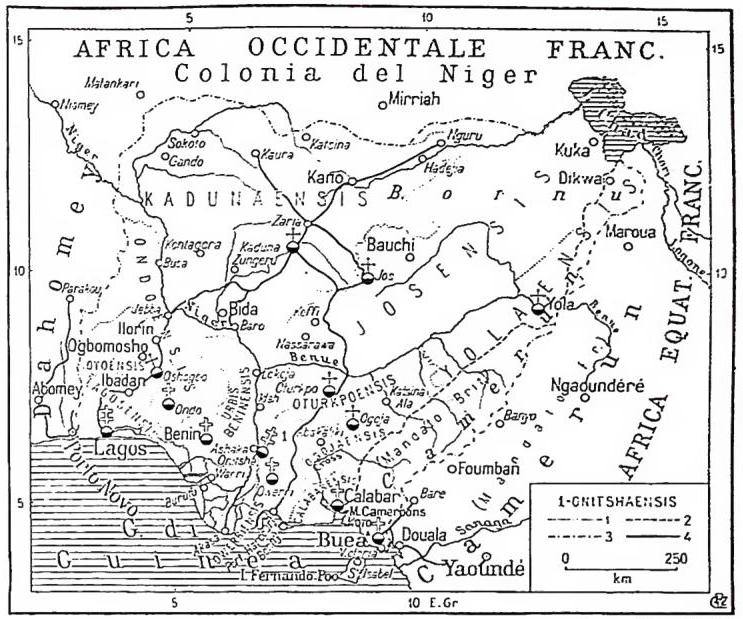
Systematic missionary work truly began only in the nineteenth century. The African missionaries of Lyon settled in Lagos in 1861, and in Benin, part of the vicariate of Dahomey, erected in 1860 and called the Coast of Benin from 1870. In 1884 they advanced as far as Lakoja on the western bank of the Niger. In the same year Propaganda erected the apostolic prefecture of Upper N. The missionaries of the Holy Spirit arrived from Gabon in 1885 in the region east of the Niger, where the apostolic prefecture of Lower N. was erected in 1889. In both missions the results were initially rather meagre. The missionaries of Lyon advanced farther north, where in 1911 the apostolic prefecture of Eastern N. was erected, later called Northern N., and today Kaduna. The predominant influence of the Muslims made the results very slight. In the southern part, however, both in Benin and in Upper N., called Western N. from 1911, once the initial difficulties had been overcome, the results were more substantial. Better results were achieved by the Missionaries of the Holy Spirit in Lower N., the apostolic vicariate of Southern N. from 1920, especially from the time when the apostolic prefect, later apostolic vicar Giuseppe Shanahan, increased the number of catechists and schools. The priests of his own Congregation were assisted by Irish secular priests, who later joined together in the Missionary Society of St Patrick. In 1934 the eastern part of the vicariate was entrusted to this Society, being erected as the apostolic prefecture of Calabar. In recent years the White Fathers and the Hermits of St Augustine have also founded their own missions in N.
On 18 April 1950 the ecclesiastical hierarchy was erected in N.: the archdiocese of Lagos with the suffragan dioceses of Benin and Ondo, the archdiocese of Onitsha with the suffragan dioceses of Calabar and Oweri, and six apostolic prefectures.
ECCLESIASTICAL ORGANIZATION. - The jurisdictions are listed in alphabetical order. Benin City, established as an apostolic prefecture of N. superiore in 1884, was given the name N. occidentale in 1911, became an apostolic vicariate in 1918, changed its name to Asaba-Benin in 1943, and became a diocese in 1950 under the name of Benin City, entrusted to the Society for African Missions. Calabar, established as an apostolic prefecture in 1934, became an apostolic vicariate in 1947
and a diocese in 1950, entrusted to the Society of St. Patrick. Jos, established as an apostolic prefecture in 1934, entrusted to the Society for African Missions. Kaduna, established as an apostolic prefecture of N. orientale in 1911, took the name N. settentrionale in 1929 and that of Kaduna in 1934, entrusted to the Society for African Missions. Lagos, established as the apostolic vicariate of Dahomey in 1860, took the name Costa di Benin in 1870 and that of Lagos in 1943; in 1950 it was elevated to an archdiocese, entrusted to the Society for African Missions. Ogoja, established as an apostolic prefecture in 1938, entrusted to the Society of St. Patrick. Ondo, established as the apostolic vicariate of Ondo-Ilorin in 1943, elevated to a diocese in 1950, entrusted to the Society for African Missions. Onitsha, established as an apostolic prefecture of N. inferiore in 1889, became an apostolic vicariate in 1920 under the name N. meridionale, in 1934 under the name Onitsha-Owerri, and in 1948 under that of Onitsha; elevated to an archdiocese in 1950, it was entrusted to the Congregation of the Holy Spirit. Oyo, established as an apostolic prefecture in 1949, entrusted to the White Fathers. Yola, established as an apostolic prefecture in 1950, entrusted to the Hermits of St. Augustine. - Vedi tav. CXX.