
NUOVA ZELANDA. -
I. GEOGRAPHY
This name—given by S. Cook in 1769 to the lands already discovered by Tasman and christened Terra degli Stati in 1642—designates the Archipelago situated SE of the Australian continent (between 1660 and 1790 E Greenwich); it consists of two major islands (North Island and South Island), the more southerly Stewart Island, and a small number of minor units.Of the two major islands, the northern, the less extensive, consists of an elevated plateau, upon which active volcanic cones rise and lake surfaces (L. Tanpo), likewise of volcanic origin, open out; to the E it is surmounted by ranges of mountains and hills. The region is renowned for the abundance and grandeur of its volcanic phenomena (geysers, fumaroles, solfataras, hot springs, etc.). The South Island, of an entirely different character, is traversed by a series of elevations which, in height (M. Cook, 3764 m.) and landscape, fully deserve the name of New Zealand Alps. The western coast, over which the mountains tower precipitously, is indented by fiords; the eastern coast, toward which the rivers flow, is low and flat. The climate is temperate and uniform (oceanic), with abundant and well-distributed precipitation. Slightly less than half (47.4%) of the soil of N. Z. is covered by natural meadows and pastures, more than a quarter (26.6%) by forests, while arable land is reduced to minimal proportions (2%). The dominant occupation has long been, and remains, livestock raising (32.5 million sheep, 4.7 million cattle; 1.7 million quintals of wool in 1947), but the recent world wars have stimulated every form of activity permitted by an environment possessing extensive mineral (precious metals, but above all iron), water (2 million HP, of which 670,000 installed), and fishery resources; and industry has received a decisive impetus from this (although food industries remain predominant, all industries are represented to a greater or lesser extent).
The indigenous population (Maori) has by now been reduced to just over 50,000; the population (1.9 million inhabitants; 7 per sq. km.) is almost exclusively of British origin, foreigners accounting for no more than 1.5% of the total. The major inhabited centres all lie on the eastern side of the archipelago and correspond to the ports with the heaviest traffic. On North Island are the capital Wellington (200,000 inhabitants) and Auckland (300,000 inhabitants), the most populous city; on South Island, Christchurch (170,000) and Dunedin (90,000).
Since 1907 N. Z. has constituted a Dominion within the English Commonwealth, with broad autonomy and its own Parliament. In addition to a considerable number of annexed oceanic dependencies (the Cook Islands, the Union or Tokelau Islands, Kermadec, and Niue or Savage) or external dependencies (that is, situated within the boundaries of N. Z. but distant from the main islands: the Antipodes, Auckland, Bounty, Campbell, Three Kings, Snares, Manavatavy Islands, almost all uninhabited), since 1920 the administration under mandate of Western Samoa has belonged to the New Zealand Dominion.
| Area in sq. km. | Population (1940) | Density per sq. km. |
|---|---|---|
| North Island 114,680 | 1,270,370 | 11.0 |
| South Island 153,141 | 602,931 | 3.9 |
| External islands 793 | 5 | — |
| annexed 559 | 20,445 | 36.5 |
| TOTAL 269,173 | 1,893,751 | 7.0 |
II. EVANGELIZATION
The first Catholic in N. Z. was the Irishman Tommaso Poynton, who landed at Hokianga in 1828. In 1829 the Congregation of Propaganda, accepting the plan of the priest Henri de Solages, decreed the erection of the apostolic prefecture of the Islands of the South Sea or Great Ocean, comprising the territories “between the equator and the Antarctic Pole, and between Easter Island and N. Z.”; on 20 May 1833 it divided this apostolic prefecture into two apostolic vicariates, namely Eastern Oceania and Western Oceania; and on 23 December 1835 it entrusted the apostolic vicariate of Western Oceania to the Marists. The new bishop, mons. G. B. Pompallier, arrived there with 4 Marist fathers and 3 lay brothers on 10 January 1838. After lengthy and dangerous explorations of his territory, Pompallier established the seat of the apostolic vicariate in N. Z. In 1840 the Catholics, almost all farmers who had come from Ireland, already numbered more than 500, out of a white population of approximately 5,000 inhabitants. In 1851 they numbered 3,472, out of 26,707 whites. From the time of their arrival in N. Z., the Marist Fathers began evangelizing the Maori.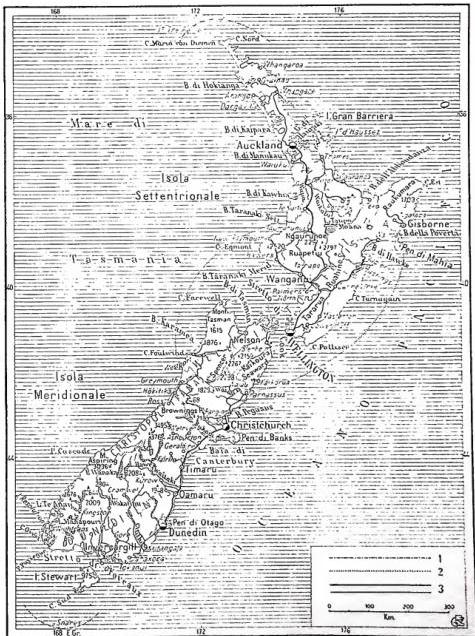
(from Ene. Ital., XXV, map 10)
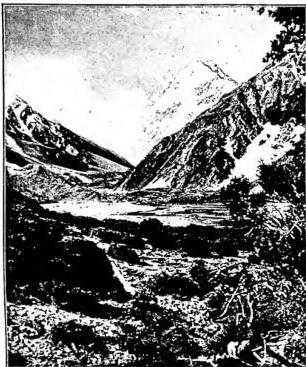
NUOVA ZELANDA – Mount Cook (elevation 3,764 m) – N. Z., South Island.
On 20 June 1848 it was divided into two dioceses: Auckland and Port Nicholson. The former was entrusted to Mgr. Pompallier, the latter to Mgr. Viard. In 1850 the Marists all moved to Port Nicholson, while Pompallier, assisted by a few secular and regular priests, had to witness the almost total ruin of the apostolic vicariate caused by the rebellion of the Maori, which broke out in 1859 against the English government. In 1869, having returned once again to Rome, he resigned his diocese and withdrew to France. On 10 May 1887 the Holy See established the ordinary hierarchy, instituting the archdiocese of Wellington with the suffragan dioceses of Auckland, Christchurch, and Dunedin.
III. THE MISSIONS AMONG THE MAORI
From their arrival in N. Z. (1838), the Marist Fathers began evangelizing the Maori. In 1850, when they left the diocese of Auckland to assume that of Wellington, there were 5044 neophytes in that region. In 1853, the diocese of Wellington numbered approximately 1000 indigenous Christians. These missions continued to flourish until 1850, when the rebellions of the indigenous peoples broke out, closing their territory to all whites: the missions were almost completely ruined. After peace returned in 1871, the Marists resumed their work among the Maori of the dioceses of Wellington and Christchurch. Among those of the diocese of Auckland, the Fathers of the Society of S. Giuseppe of Mill-Hill have been working since 21 June 1888, under the authority of the Ordinary. The work is difficult, because the Maori are scattered in small groups across a vast territory and because it is necessary to contend with the competition of the Protestant missionaries, who are very well supplied with resources. The number of Maori has been declining (50,000, more than 12,000 Protestants). The principal concentration is still found in the district of Auckland.IV. SCHOOL SYSTEM
In 1855 and 1857, primary education was established, and the entire country was divided into thirteen “education districts,” comprising various “school districts.” The latter were divided into “school committees,” whose responsibility it was to elect the Higher Education Council. The Education Act of 1877 established that elementary education was to be compulsory from the ages of 7 to 14, secular, and free. By the Act of 1915, the number of education districts was reduced to nine. The Education Amendment Act of 1921–22 required the registration of all private schools and imposed on their teachers an oath of allegiance to the State. In 1946, an Advisory Committee was established which drew up a report on preschool education, noting the need for the State to assume full responsibility for preschool services and for the dissolution of all private nurseries and kindergartens, while leaving ecclesiastical organizations the sole right to provide religious instruction. Vocational guidance for young people is the exclusive responsibility of the State, which for this purpose has created guidance centres and psychology divisions. For every school pupil, monitoring records have been established reflecting the tendencies and inclinations not only of each pupil but also of the parents.Elementary and secondary schooling is the same as in England. Higher education comprises the University of New Zealand, founded in 1869; University of Otago at Dunedin, founded in 1871; Canterbury College, founded in 1873 at Christchurch; Auckland University College, founded in 1882; Victoria College at Wellington, founded in 1897; and Massey Agricultural College at Palmerston North, founded in 1926. The education of the Catholic clergy takes place in two seminaries. Catholics administer 119 primary schools and 40 secondary schools.