
TANGANICA. – Territory of southern Africa which, together with Ruanda and Urundi, formed (from 1891)
German East Africa; it was later given its present name by the British, who were granted it as a mandate in 1920 and placed it under United Nations trusteeship administration in 1946.
(courtesy of the Consolata Missionary Fathers)
TANGANICA - The former pro-cathedral of Tosamaganga. In the background, the new Cathedral. Apostolic Vicariate of Iringa.
T. is more than three times the size of Italy (936,330 sq. km.) and extends approximately between 1° and 11° S., from Lake Victoria to Lake Nyasa, opening onto the Indian Ocean with a coast of 850 sq. km. It consists overall of a vast plateau (approximately 1,000–1,500 m. in elevation), with a tropical climate moderated by the terrain, except along the coastal strip, which is, moreover, fairly narrow (20–30 km. in depth). Rainfall, which increases from S. to N., is generally concentrated in the summer season in the S. and central regions, and in two wetter periods in the N., separated by two dry seasons. The country is covered for the most part by steppes and savannas, which give way to forests in the lower coastal belt and to mountain pastures in the higher regions. The large fauna of ruminants and feline carnivores is abundant everywhere, as is the avifauna.
The country has considerable agricultural, forest (40% of the total area), and mineral resources. The principal products today are sisal agave, cotton, coffee, and groundnuts, together with not inconsiderable quantities of rice, sesame, tea, etc. Livestock raising is flourishing (6.4 million head of cattle; 3.5 million sheep; 2.3 million goats, etc.), despite the fact that the scourge of the tsetse fly curtails its great potential. Gold, diamonds, tin, and mica are extracted from the subsoil; but the vast reserves of coal near Lake Victoria are still untouched. Considerable progress has been made in recent years in internal communications (2,600 km. of railways), which have given a strong impetus to trade, in which imports everywhere exceed exports.
The population (7.3 million inhabitants) consists almost entirely of Bantu and Nilotic Africans, with Suaheli on the coast; there are approximately 20,000 Europeans and 45,000 Indians. It is divided into 8 provinces, of which the most densely populated are those in the south. There are numerous urban centres, of which the most populous, Dar es Salam (70,000 inhabitants), on the coast S. of the island of Zanzibar, is the seat of government; Ugigi, on Lake Tanganyika (25,000 inhabitants), is the most important in the interior.

EVANGELIZATION. – Setting out from the island of Zanzibar, the Missionaries of the Holy Spirit began the mission of Bagamoyo in 1867, in the present territory of T., establishing schools and orphanages for the numerous young slaves who had been ransomed, and subsequently a Christian village.
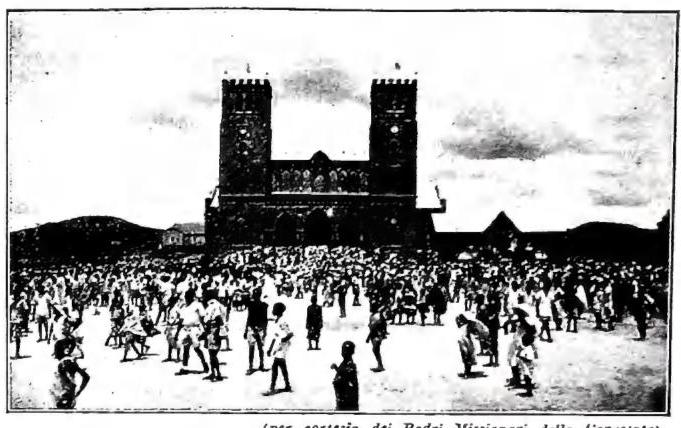
(courtesy of the Conesata Missionary Fathers) TANGANICA - The population of Tozamaganga (diocese of Fringa) before the Cathedral (Easter 1948).
In 1878 the interior of the land around the great Lakes Tanganyika and Victoria Nyanza was entrusted to the White Fathers. The greatest obstacles to effective missionary activity were the hunting of Africans and the influence of the Mohammedans, which was checked by the occupation by Germany and the creation of the colony of German East Africa in 1885. In 1887 the southern part of the coast was entrusted to the Benedictines of S. Ottilia. The missions were then able to make great progress, above all through the systematic founding of schools. A setback to this progress was the rebellion of 1905, during which Msgr. Cassiano Spiss, O.S.B. (S. Ottilia), apostolic vicar of Southern Zanzibar, was massacred together with 2 brothers and 2 sisters, and many stations were destroyed. Another setback was the First World War: the Benedictines, because they were German, were expelled. When the territory came under British mandate, they were succeeded by the Swiss Capuchins and the Swiss Benedictines. In addition, some districts were taken over by the Missionaries of the Consolata (1922), the Passionists (1935), the Pallottines (1943), the Maryknoll missionaries (1950), and the Rosminians (1950). On 25 March 1953 the ordinary hierarchy was established. Thus there are currently in the territory of T. 18 flourishing missions: BAGAMOYO, an apostolic vicariate in 1906, entrusted to the Congregation of the Holy Spirit, now the diocese of Morogo. BUKOBA, an apostolic vicariate in 1929, entrusted to the Society of the Missionaries of Africa (White Fathers), now a diocese. DAR-ES-SALAAM, in 1887 an apostolic prefecture of Southern Zanguebar, in 1902 an apostolic vicariate, bearing its present name from 1906, entrusted to the Capuchins. DODOMA, an apostolic prefecture in 1935, entrusted to the Passionists, now a diocese. IRINGA, an apostolic prefecture in 1922, an apostolic vicariate in 1948, entrusted to the Missionaries of the Consolata of Turin, now a diocese. KAREMA, an apostolic vicariate in 1946, entrusted to the White Fathers, now a diocese. KIGOMA, a provicariate of T. in 1880, an apostolic vicariate in 1887, bearing its present name from 1946, entrusted to the White Fathers, now a diocese. KILIMA-NJARO, an apostolic vicariate in 1910, entrusted to the Congregation of the Holy Spirit, now the diocese of Moshi. MASWA, an apostolic vicariate in 1946, entrusted to the White Fathers, now a diocese. MBEYA, the Tukuyu mission in 1932, an apostolic prefecture in 1938, an apostolic vicariate in 1949 under its present name, entrusted to the White Fathers, now a diocese. MBULU, an apostolic prefecture in 1949, entrusted to the Pallottines, now a diocese. MUSOMA, an apostolic prefecture in 1950, entrusted to the Society of Maryknoll. MWANZA, an apostolic vicariate of Southern Victoria Nyanza in 1894, called Victoria Nyanza in 1915, bearing its present name from 1929, entrusted to the White Fathers, now a diocese. NDANDA, an abbey « nullius » in 1931, entrusted to the Benedictines of S. Ottilia. PERAMIHO, an apostolic prefecture of Lindi in 1913, an abbey « nullius » in 1927, bearing its present name from 1931, entrusted to the Benedictines of S. Ottilia. KAGERA INFERIORE, an apostolic vicariate in 1951, now the diocese of Rutabo. TABORA, an apostolic vicariate of Unyanembe in 1887, bearing its present name from 1925, entrusted to the White Fathers, now a diocese. TANGA, an apostolic prefecture in 1950, entrusted to the Rosminians. - Vedi tav. CXXII.