Machine translation of the 1948–1954 Italian original. The original text is authoritative.
ZANZIBAR. – British protectorate comprising the island of the same name (1,658 sq km) and the nearby island of Pemba (984 sq km), off the coast of Tanganyika.
Both consist of low-lying coral formations and are inhabited by Suaheli, Arabs, and Indians (270,000 inhabitants in all, approximately 3/7 of them in Z.). Pemba and Z. supply 80% of the world’s production of cloves and clove oil; also noteworthy are the exports of coconuts, copra and coconut oil, oranges, and bananas. Z. (45,000 inhabitants) is an important coaling station.
BIBL.: E. O. Oppé, Trades of Z., in Canadian Georg. Journ., 37 (1948), pp. 72–81; G. E. Tidbury, Z. the Clove tree, London 1949. Giuseppe Caraci
THE APOSTOLIC VICARIATE OF Z. — It comprises the British protectorate of Z. and the southeastern part of Kenya.
It is entrusted to the Congregation of the Holy Spirit; it has an area of 96,558 sq. km and a population of more than 1,536,000 inhabitants. Catholics number 75,631, of whom 62,419 are indigenous, 13,115 foreign, and 117 of mixed descent. There are approximately 100,000 Protestants, 800 Jews, more than 390,000 Muslims, and more than 954,000 pagans. There are 34 principal mission stations and 94 secondary ones; 28 churches and 61 chapels, served by 82 foreign priests and 127 sisters, of whom 19 are indigenous; 1 seminary, 5 hospitals, 20 dispensaries; 5 orphanages; 1 leprosarium; 1 home for the elderly; 188 schools. Catholic Action is flourishing (Legion of Mary, Boy Scouts, Girl Guides, etc.).
In 1499 Vasco de Gama took possession of the island of Z. and established an Augustinian convent there; however, the Augustinians seem to have limited themselves to assisting Europeans, also establishing, for the same purpose, residences at Patè and Mombasa; but they were expelled by the Arabs in 1698.
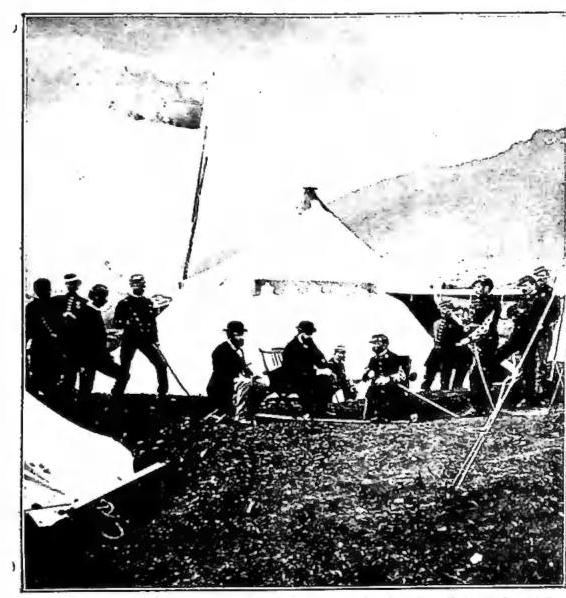
(courtesy of the command of the Uvarola Nobile di San Santità) ZAPPI, GIOVANNI BATTISTA – Gen. Z. conversing with Francesco II during a visit to the training camp at the “Campi di Annibale” (1868).On 26 February 1860, the prefecture of Zanguebar was established and entrusted to the bishop of St-Denis, with jurisdiction over the eastern regions of Africa. In 1862 this establishment was confirmed, and the aforementioned bishop delegated three priests and then called upon the Fathers of the Congregation of the Holy Spirit to collaborate; they arrived in Z. on 16 June 1863. On 9 September 1873, the prefecture of Zanguebar was detached from St-Denis and entrusted to the Congregation of Z. In 1933 the residence of the apostolic vicar was transferred to Nairobi. The apostolic vicariate of Z. was, as it were, the matrix of all the missions of East Africa. At present it offers a very important field of work; but barbarous customs and doctrines of the notorious Mau Mau sect are spreading among the various tribes, especially the Wakikuyu, and have only recently attracted worldwide attention. These are the aims pursued by the sect: 1) the removal of Europeans from the colony of Kenya and the return of the land to the Kikuyu; 2) non-cooperation with the white man in every form of relationship and assistance; 3) no distinction between missionaries and the other white people of the region; 4) open hostility to the Catholic Church. A secret oath, founded on the ancient pagan ritual and administered according to its ceremonies, is imposed upon members, in many cases by force and at night. The members of this secret society, now declared illegal by the government of Kenya, are, for the most part, practically pagans: a large number of adherents of the Protestant Kikuyu Church (independent) have taken the oath. Among Catholics, the Mau Mau cause considerable harm through injunctions and threats of reprisals, but so far in the vicariate of Z. they have not gained many adherents among the faithful, whereas they have done so to a greater extent in the vicariate of Nyeri. Both Ordinaries, however, have repudiated and condemned the movement.
BIBL.: MC, 1950, pp. 178-79; A catholic Directory of East Africa, Mombasa 1950, pp. 3-8; Archives of Prop. Fide, pos. prot. n. 2815/52.
Carlo Corvo
Cite this article
“ZANZIBAR.” Enciclopedia Cattolica, vol. XII (1954), p. 1093. Azione Romana digital edition, https://azioneromana.com/article/zanzibar.