
YEMEN. -
I. GEOGRAPHY
State of south-western Arabia, situated between the Saudi province of ‘Aṣīr and the British protectorate of Ḥaḍramūt. It includes a short stretch of coast on the Red Sea, opposite Eritrea, ending at the Strait of Bāb el-Mandeb with the area of Šejh Sa'id (1622 sq. km. and 1,000 inhabitants).Y. consists of a narrow (40–50 km.) coastal strip, from which one ascends by steep gradients to the plateau, which represents the largest and best-inhabited part of the country. The plateau, like the Eritrean one, consists of masses of volcanic origin, deeply cut by valleys and surmounted by elevations rising to 3,760 m. at Gebel Ḥadur. Inland, clearly defined boundaries are lacking; consequently, the area of Y. is calculated in various ways: the opinion assigning it a total of 80,000 sq. km. may be accepted as approximately correct.
The climate, exceedingly hot on the desolate coastal fringe, becomes less extreme inland with increasing altitude, but is marked by strongly continental characteristics, with pronounced temperature contrasts between day and night. Rains fall in spring and summer, with an average generally below 500 mm. annually on the plateau.
Here, where cultivation is possible, cereals (wheat, barley, sorghum), vegetables, and fruit (bananas, grapes, apricots, mangoes) are harvested; Y. owes its greater renown to its coffee production, which sustains a considerable export trade and is distinguished by its quality (Moca). Little is known of the country’s underground resources; the existence of iron and rock salt has nevertheless been ascertained.
The population, estimated very variously, probably amounts to about 3.5 million inhabitants, almost all sedentary and Muslim of the Zaydi rite. The Sunnis number little more than half a million, and the Jews 70,000. Inhabited centres appear relatively numerous but small: the largest are the capital Ṣan'ā', situated on the plateau at an altitude of 2,200 m., and its outlet on the Red Sea, Hodejdah (30,000 inhabitants). Other ports are Loḥajjah and Moca (al-Maḥā), the latter having greatly declined.
Y. constitutes a principality that became independent from Turkey in 1915; power is concentrated entirely in the hands of the imām, or sovereign, who exercises it through ministers chosen by him.
II. POLITICAL HISTORY
The mildness of the climate and the fertility of the soil, permitting the establishment of a sedentary culture, give the south-western coast of Arabia historical characteristics markedly autonomous in comparison with the rest of the peninsula, which is predominantly desert. Already, and at least from the beginning of the 1st millennium B.C., solid States were established there, in which trade and agriculture developed. These States, united into a single one around the 3rd century A.D., later succumbed to Ethiopian, Persian, and finally, in the 7th century, Islamic occupation, which reduced Y. to a province of the great Empire of the caliphs. The decline and fragmentation of the latter, two centuries later, renewed the autonomous history of the region under local dynasties. Among these, that of the Zaydite imāms gradually prevailed; having passed through various phases of temporaryforeign domination (the principal ones being that of the Ayyubids of Egypt and the two of the Ottoman Turks), they unified Y. under their control in the present century. From the religious point of view, Y. thus presents the phenomenon, unique in the Islamic world, of the predominance of the moderate Shī'ite branch (v. ISLĀM, le sète); whereas Ismā'īlite and Carmathian extremism, though repeatedly attacking the region, has not succeeded in establishing itself.
1. Pre-Islamic Y
a) The sources. - The most ancient history of Y. is known through a body of approximately 4,000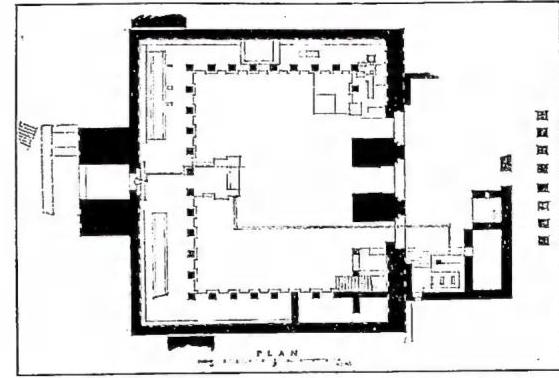
YEMEN - Plan of the entrance hall of the Temple of the Moon, excavated at Mârib in 1951–52. In the front part, a row of columns, followed by a triple doorway leading into the hall, around which there is a peristyle.
inscriptions, discovered from the second half of the nineteenth century onward (the journeys of Halevy and Glaser) up to very recent times (the explorations of the University of Louvain, under the direction of G. Ryckmans, in 1951–52; and of the American Foundation for the Study of Man, under the direction of W. F. and F. P. Albright and A. Jamms, from 1930 onward). It cannot be said, however, that the region has been subjected to systematic archaeological exploration, and consequently the material is very incomplete. The aforementioned inscriptions are written in a script and language of South Semitic type; they contain information concerning historical, administrative (published), economic (public works), and religious matters (votive and funerary dedications).
Alongside these direct sources, indirect information is provided by the annals of the kings of Assyria (two mentions of Sabaean kings in the eighth century), by certain biblical passages (v. SABA), and by classical and Arab historians and geographers, although the latter are of limited reliability.
b) Chronology. - There are two theories concerning the chronology of the pre-Islamic Arab states. The first, known as the “long” chronology, was upheld by Glaser and Hommel and more recently by Philby (cf. H. St. J. B. Philby, South arabian chronology, in Le Muséon, 62 [1949], pp. 229–49), who dates the history of the Minaean state to the twelfth century B.C., that of Hadramût to the eleventh, and that of the Sabaean state to the ninth century. The other theory, known as the “short” chronology, supported by Mordtmann and Rhodokanakis, and more recently by F. V. Winnett (The place of the Minaeans in the history of pre-islamic Arabia, in Bulletin of the American schools of oriental research, 73 [1939], pp. 3–9), K. Mlaker (Die Hierodulenlisten von Ma'in, nebst Untersuchungen zur altidarabischen Rechtsgeschichte und Chronologie, Leipzig, n.d.) and J. Ryckmans (L'institution monarchique en Arabie méridionale, Louvain 1951), holds instead that the histories of the aforementioned states were contemporaneous, beginning in the ninth or eighth century. This second theory is the more widely accepted: in its most extreme formulation (cf. W. F. Albright, in Bulletin of the American schools of oriental research, 119 [1950], pp. 5–15, and the additions subsequently made by the same author, ibid., 129 [1953], pp. 20–24), the history of Saba begins before 750 B.C.; that of the Minaeans around 400, ending around 50 B.C.; that of Qatâbân extends from approximately 400 to 50 B.C.; and that of Hadramût from approximately 450 B.C. to the second century A.D.
c) The states. - The principal states are the following: the Minaean state, in the north, with its capital at Qarnâw (later Ma'in); the Sabaean state, in the central region, with several successive capitals; Qatâbân, east of Saba, with its capital at Timna'; and Hadramût, east of Qatâbân, with its capital at Sabwah.
Of these states, the most important was Saba, which successively absorbed the others. During an initial period (until approximately 450), it was governed by priest-kings, the mkrb (usually vocalized muharrib), and had its capital at Şirwâh (later Marjab, Mârib), where a famous dam was built to contain the river Aḍanat. A period of secular government followed, headed by kings and an oligarchy of military leaders and landowners. The power of the state steadily increased: around 115 the capital was transferred to Zafâr, and the kings added the title of Dû Rajdân to that of Saba. Meanwhile the Himyarite tribe (the Homerites of classical writers) was gaining prominence, and its name eventually prevailed in the designation of the state. Probably shortly before the beginning of the Christian era, the Minaean kingdom was absorbed; it had previously achieved considerable prosperity, extending northward along the trade route through commercial colonies (Dedân, today al-'Ulâ). Shortly thereafter, Qatâbân met the same fate, and around the second century Hadramût was absorbed. The inscriptions of both these states mention the mkrb, suggesting a historical development analogous to that of Saba.
Thus, around the third century A.D., Y. was unified under a national dynasty. This situation, however, did not last long. The introduction of Judaism and Christianity gave rise to internal religious struggles, with the consequent weakening of the state. For much of the fourth century, the region had already been under Ethiopian occupation; when, at the beginning of the sixth century, King Dû Nuwâs began persecuting Christians, Ethiopia again intervened on their behalf, occupying the country (525; V. below).
From 525 to 575 Y. remained under Ethiopia; and despite some expansionist ambitions on the part of its governors (such as the famous expedition of Abraha toward the north, of which a trace has remained in the Corono), it progressively declined, together with its commercial activity. The breaking, in 542, of the famous Mârib dam was not unrelated to this decline. In 575 the region was occupied by the Persians, and around 630 it passed under the Islamic state.
2. Islamic Y
a) Until the occupation by the Ayyubids (630–1173). - For approximately two centuries Y. was governed by caliphal governors. Then, at the beginning of the ninth century A.D., in a phenomenon parallel to that occurring in the other peripheral regions of the Islamic Empire, the governors progressively became autonomous, establishing local dynasties that divided the region until its reunification under the Ayyubids. Four zones can be distinguished in the history of this period. In the region of Zabîd, the following ruled successively: the Ziyadids (819–1018); the Najahids (1021–1158); and the Mahdids (1159–73). In that of Şan'â': the Jafurids (861–997), under whom the Qarmatians briefly established themselves (v.); the Sulayhids (1037–1101), Ismāʿīlīs, who also seized Zabîd from 1062 to 1080; and the Hamdanids (1098–1173). In the region of Şa'dah: the Zaydi imams (called Rassids), the future national dynasty (first series: 893–ca. 1300). In the region of Aden: the Zurayids (1083–1173), Ismāʿīlīs.b) From the occupation by the Ayyubids to the end of Ottoman rule (1173–1918). - Y. was reunified under the occupation by the Ayyubids of Egypt (1173–1228; V. EGYPT). They were succeeded by the national dynasties of the Rasulids (1229–1454) and the Tahirids (1446–1517); Y. was then annexed to the Ottoman Empire.
Two periods may be distinguished in Ottoman rule. The first (1517–1633) was interrupted by the revival of the Zaydi imams who, after being suppressed by the Rasulids around 1300, re-emerged around 1591 and in 1633 succeeded in expelling the Ottomans and seizing Şan'â' (second series, known as the imams of Şan'â', which continues to the present day). The second period extends from 1871, when the Ottomans succeeded in re-establishing control over the region, until 1918, when, following their defeat in the First World War, they definitively lost II.
c) From the end of Ottoman rule to the present day. - Already during the final years of Ottoman rule, the Zaydi imam Jahâ had fought fiercely for the independence of Y. After obtaining it, he established a domestic policy of tolerance toward the Sunni minority, so as not to undermine the unity of the country; instead, he persecuted the remnants of the Ismāʿīlīs, who had caused so much unrest there. In foreign policy, he maintained relative isolation, neither sending nor receiving embassies from European countries and obstructing the entry of their subjects into Y. Nevertheless, he concluded treaties of friendship with various states, first of all with Italy (1926), and then with Russia, the Netherlands, England, and France. He conducted military operations along the borders with the aim of extending his dominion, but without success: in 1928 the English halted his attack against Aden; in 1930 and 1934 Ibn Sa'ūd repelled the attacks against 'Asir and Nağrān, annexing these regions himself.
A development in Y.’s international relations was its entry into the Arab League in 1945, the establishment of diplomatic relations with the United States in 1946, and its admission to the U.N. in 1947.
In 1948 the imām Jābja was assassinated; the author of the coup d’état, ‘Abdallāh al-Wazīr, ascended the throne, but shortly thereafter was defeated and hanged by the imām’s eldest son, Ahmed.
Y. before Islam. Periodical bibliography: S. Moscati, Bibliographie sémitique, in Orientalia, 16 (1947), pp. 103–29; 17 (1948), pp. 91–102; 19 (1950), pp. 446–78 (continued). General works: D. Nielsen, Handbuch der altarabischen Altertumshunde, I. Die altarabische Kultur, Copenhagen 1927; H. St. J. B. Philby, The background of islam, being a sketch of arabian history in pre-islamic times, Alexandria 1947; ‘Alī Gawwād, Ta’rīh al-‘Arab qabla ’l-Islām, I, Baghdad 1951.
II. EVANGELIZATION
Arabia (v.) and particularly in Y. is quite obscure. In view of this obscurity and uncertainty, what follows is reported by different authors with some variation, though not of a substantial nature.It seems that during the pre-Islamic period there were three principal centers of Christian influence in southern Arabia: at Gassān, at Hīrah, and in Y. (v. below). According to one tradition, Y. was evangelized by the apostle St. Bartholomew when he went to India, which borders Ethiopia.
(from D. Gribandi, L'Asia anteriore, in Geografia universale, IV, Turin 1936, p. 270)
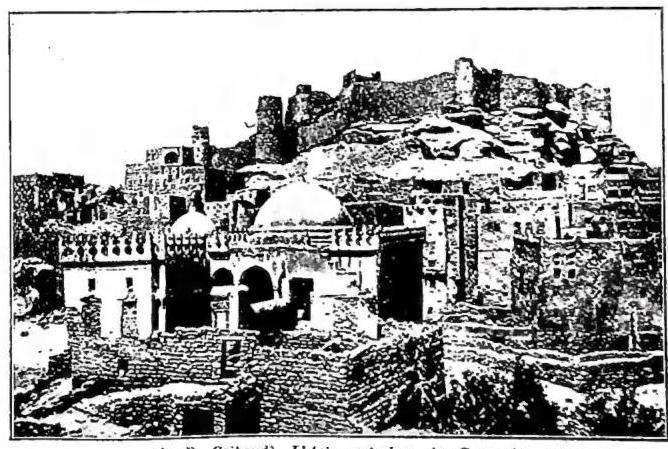
YEMEN - View of el-Hazarī.
(Socrates, Hist., I, 19: PG 67, 125; cf. also Rufinus, Hist. eccl., I, 9: PL 21, 478). Among the other missionaries, the Alexandrian catechist Pantaenus is also said to have preached there, evangelizing the Jewish communities of Y. On his return (according to what s. Girolamo reports on the authority of Rufinus), he is said to have brought with him the Hebrew Gospel of s. Matteo, left in Y. by s. Bartolomeo (PL 33, 651).
During the 4th–6th centuries Christianity had many adherents. Teofilo l'Indiano is said to have preached the Arian heresy there in the 4th century. The expansion of Christianity aroused the resentment of the wealthy and influential Jewish communities of Yemen. Around 530, the Jew Dū Nuwās, governor (according to others, king) of Himjar (Y.), subject to the king of Abyssinia (according to others, independent), rebelled and treacherously seized the town or village of Nağrān, a stronghold of the Christians in the north of Y., where in 563 a church dedicated to s. Elia would be built. Dū Nuwās had the Christians who refused to convert to Judaism massacred there. The bones of Bishop Paolo were exhumed and burned; AREA (v.), together with other notables of the city, was imprisoned and beheaded; the number of those massacred is said to have ranged from 4,400 to 20,000. Although it is difficult to establish even an approximate number, the fact of the persecution is nevertheless indisputable: it is recorded by Nestorian and Jacobite Arab chroniclers; according to some exegetes, it may also have left traces in the Qur’an. News of the massacre quickly spread throughout the Roman and Eastern world. Ella Aṣbeha, king of Abyssinia, took the opportunity to invade Y.
and avenge his fellow believers by killing thousands of Jews and Dū Nuwās himself, and restored the clergy. A few years later, an Abyssinian Christian named Abraha (whom others identify instead with Ella Aṣbeha) seized power and was recognized by the king of Abyssinia. Under him Christianity was able to develop peacefully. At Ṣan'ā', which had become the seat of a viceroy, a magnificent cathedral was built (547); by attracting a large number of pilgrims, it diminished the importance and revenues of the pagan sanctuary of the ka'bah at Mecca.
(from D. Gribandi, L'Asia anteriore, in Geografia universale, IV, Turin 1936, p. 272)
YEMEN - Panorama of Reda.
Between 629 and 630, Bāḏān, viceroy of Ṣan'ā', converted to Islam.
III. CHRISTIAN ANTIQUITIES
The first certain information concerning the spread of Christianity in Y. is provided by the Arian historian Philostorgius (d. in 430) and refers to an embassy sent by the emperor Constantius II (337-61) to the Homerites, led by a certain Theophilus called the Indian: he is said to have obtained permission to build three churches, the first in the capital of the Kingdom, Yāqāṣoʿ (Zafār), the second in 'Ašāʿoʿ (Aden), and the third in the «famous Persian emporium» (Hormuz?). The mission can be dated to 341-46.Later reports speak of the introduction of Christianity into Naḡrān through Nestorian or Jacobite missionaries coming from Syria or al-Hīrah in the second half of the 5th century: they are found in Arabic texts written in connection with the passage of the Qurʾān 85, 4-8. The fertile valley of Naḡrān lies on the caravan route leading from Ṣan'ā' to the Naḡd and thence to al-Hīrah, and this explains the constant relations between the Christianity of Naḡrān and this city: this group of Christians had churches and bishops, some of whose names have been handed down in the texts concerning the persecution they suffered in 525 at the hands of the local ruler, who professed the Jewish religion, especially in the «Book of the Himyarites» published by Axel Moberg, in the letter of the (Monophysite) bishop Simon of Beth Arām to Simon, abbot of Gabbula, and in the Martyrum Arethae, preserved in a Greek text, although its first part is probably the translation of a Syriac work. Further information about this Christian group, as well as other names of bishops, is found in the ecclesiastical history of Theodore the Lector (after 575) and in John Diacrinomenos. Christianity in Y. underwent its greatest development after the second Abyssinian invasion of 525, which brought the Himyarite Kingdom to an end, through an expedition sent by the king of Ašām and led by Abrahah, who became viceroy of the region. To Abrahah is owed a very important inscription dated 543, concerning the restoration of the famous dam of Mārib; it also records the consecration of the church of Mārib, to which a priest was appointed who was to remain in its service: further on, the expenses incurred for the consecration of the church are enumerated. The church is designated by the Arabic name bī'ah, while the priests are given the Syriac name qaṭīf. During the period of Abyssinian rule, another sanctuary must have arisen which remained famous in the history of South Arabia, the church of Ṣan'ā': Arab writers have left detailed descriptions of II. It was called al-Qullays, a corruption of ḗkāyāʾa; it was built of stones of various colors, with gold ornaments and bronze doors, and decorated with marble, paintings, and mosaics which, according to the Arab historian Ibn Hīšām, were sent by the Byzantine Emperor. The church survived for a long time even after the triumph of Islām and the conversion of the region: according to Yāqūt, it was not destroyed until the caliphate of as- Saffāḥ (751-53), or, according to al-Azraqi, under his successor al-Manṣūr. Another famous Christian sanctuary was the deyr Naḡrān, also called Ka'bat Naḡrān. Its foundation is attributed to the chiefs of the dominant tribe in Naḡrān, and it too was adorned with gold and mosaics. It served as a place of asylum, made famous, as Nallino correctly interprets it, by the verses of al-A'ša (d. ca. 629), which perhaps allude to solemn celebrations of the church itself. After the end of the 9th century, there are no further traces of Christianity in Y.
835 and 897; W. Budge, The Book of Governors, I, Londra 1893, pp. 238, 18; II, ibid. 1893, p. 448, and C. Arendonk, De uphamst van het Zeditische Jnamat, Leida 1919, pp. 128 and 309.
Ugo Monneret de Villard