Machine translation of the 1948–1954 Italian original. The original text is authoritative.
YEATS, WILLIAM BUTLER. — Irish poet, born in Dublin on 13 March 1865, died at Roquebrune Cap Martin on 29 January 1939.
His father, an Irish Protestant, was a painter, and the young Y. also studied painting for three years, but soon abandoned it for literature; and although he spent the formative years of his life in London, joining the Aesthetic movement, he nevertheless drew extensively, from his earliest books of poetry, on the folklore of his native Ireland. His experiences of life and culture were highly complex. He led the movement of the «Irish Literary Revival» and, although he did not take an active part in politics, embraced the cause of Irish nationalism. Together with Lady Gregory he founded the «Irish National Theatre Society», although the plays he composed do not stand out for their properly dramatic qualities; rather, alongside the influences of Maeterlinck’s symbolist theatre, they reveal the fundamental lyricism of his inspiration. Other influences he derived from Blake, whose work he edited (1803), from Mallarmé and, in general, from the French Symbolists, both directly and indirectly through their interpreter, Arthur Symons. Nor should one forget the contribution of Shelley, Keats, Spencer, and Morris, especially in his youthful verse. More complex were his esoteric experiences in his mature years and old age: astrology, philosophy, spiritualism, Hermetic writings, and Eastern philosophies, some of which the poet discussed in his autobiographical writings, where an obscure symbolism frequently recurs and allusion is made to a perennial conflict between being and becoming. The poems of his old age contain verses of rare beauty, although sensual and almost brutal motifs abound in them. At the same time, his work assumed an increasingly pessimistic and apocalyptic tone. In one of his poems, The Second Coming, exasperated and almost blasphemous, one seems to read a gloomy portent of the Second World War. Y. won the Nobel Prize for Poetry in 1923.
BIBL.: L. Mac Neice. The poetry of W. B. Y., London 1941; J. Hone, W. B. Y., there 1943; see also: C. Pellizzi, Il teatro inglese, Milan 1934, pp. 234–42, and the Italian translations by C. Linati, there 1945. Augusto Guidi
(by courtesy of Fr. Gasharri)
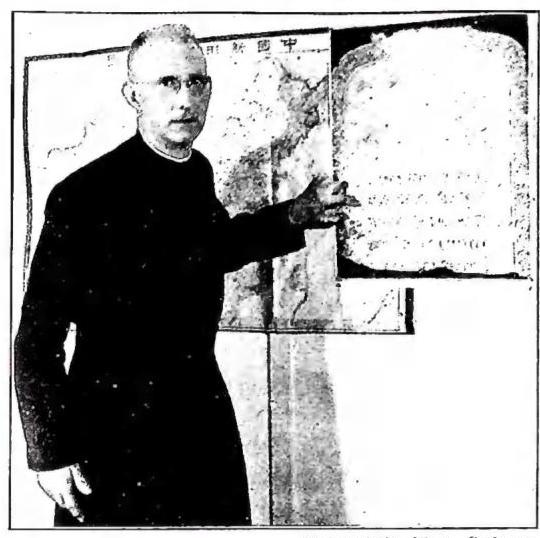
YANGCHOW. APOSTOLIC PREFECTURE of — Fr. Francesco A. Rouleau, S. J., of Bellarmine College in Baguio City, Philippines, points to the rubbing of the gravestone on which the image of the Madonna is engraved at the top. Here is the text of the inscription: ♣ In nomine Domini Amen. Hic jacet / Katerina filja q(uo)ndam domini / Domini di Viljonia que obit in / anno Domini milesimo CCC / XXXXII de mense Junii ♣.
Cite this article
“YEATS, WILLIAM BUTLER.” Enciclopedia Cattolica, vol. XII (1954), p. 1068. Azione Romana digital edition, https://azioneromana.com/article/yeats-william-butler.