
RUSSIA. — In the course of its long historical and political evolution this name has assumed very different meanings.
The general public usually employs it as a synonym for the U.S.S.R. (q.v.), but this is an improper usage: the Soviet Constitution, at least in law, places the Russian element, which with its numerical and political predominance had claimed for itself a position of privilege in the Tsarist State, on an equal footing with all the other ethnic elements that converge in the new federal structure. The R.S.F.S.R. (Russian Soviet Federative Socialist Republic), which constitutes the most prominent unit in every respect within this structure, is sometimes also indicated by the name of R., in contrast to the other 15 units, but this is likewise an unofficial and improper usage (the R.S.F.S.R. embraces, in Asia, many territories that cannot reasonably be called Russian), just as it is improper to equate R. with the whole of those administrative units whose territory lies for the most part west of the traditional boundary between Asia and Europe (first of all because those units take no account of such a boundary, and secondly because non-Russian territories would thereby be included).
It is therefore preferable to preserve for the name R. its traditional value, that is, in the final analysis, a historical-geographical one. R. is the European territory inhabited predominantly and politically organized by the Russian people and which has remained the vital core of the Soviet State.
GIUSEPPE CARACI
I. CIVIL HISTORY
Russia, almost from the first moments when it emerges from the mists of prehistory, presents itself at once as the extreme bulwark of Europe against the nomadic hordes of Asia and as an antagonist to the European state formations that border it to the west. Hence, often, a duality of interests and aspirations, of dreams and realities.Rjurik, the first ruler of Russia, is in a certain way the counterpart of Romulus for the Latins. The dawn of Russian history, like that of other peoples, is illuminated by the light of legend (which will later become a source of poetry): the legend mingled with reality in this case is the “calling of the princes,” namely the sending of Russian envoys to the Varangian princes so that they might come to rule and calm internal discord. The first princes indeed began
the unification of the Russian tribes and the struggle against the barbarian tribes of the steppe: they had their seat first at Novgorod and then at Kiev, which soon became a notable commercial and military center. A very important river route led to Byzantium: the Dnieper. Guerrilla warfare and expeditions against Byzantium, no less than commercial relations with the Byzantine world, were sources of wealth for Russia. Gradually, however, Christianity filtered from Byzantium into Russian lands, and with the conversion to Christianity of Prince Vladimir (988), the Russian people emerged from the opaque anonymity of primitive tribes. The aggressions of the nomadic peoples of the steppe had more or less intense moments: particularly threatening was the invasion of the vigorous horde of the Polovtsy (mid-11th century), which afflicted cities such as Kiev, Chernigov, and Pereyaslavl’. Russian historians have emphasized how the campaigns of 1095 (and the following years) against the Polovtsy coincided more or less with the First Crusade: Vladimir Monomakh, tireless in fighting the steppe tribes, would thus have played, on the historical plane, the same role as Godfrey of Bouillon. The attacks of the Asian tribes and the fratricidal struggles of the princes, however, greatly weakened the “Russian land” and led to the full decline of Kiev. More serious and harsher was, in the course of the 13th century, the invasion of the Tatars. Having subjected Russia, the Tatars transformed it into a province of their empire: the Russian people, however, retained its princes, who became vassals of the conquerors, obliged to “assist” the Tatars in various ways and, above all, to pay regular tribute.
“privilege” proved very advantageous; as the princes of Moscow tended to become the sole rulers of Russia (albeit under the formal domination of the Tatars) and as Moscow appeared a secure and tranquil center, the Russian clergy—accustomed according to Byzantine tradition to side with a strong authority—did not stint moral support to the Duchy (v. MOSCOW, patriarchate of). While Genghis Khan was moving with his hordes from Asia, the western Russian territories meanwhile came into conflict with the Teutonic Order, with the Swedes, and with the Lithuanians (Mindaugas and above all Gediminas, who died in 1341, created the Lithuanian monarchy, with its center at Vilna). The struggle, in broad outline, was already clearly defined for the Russians on two fronts.
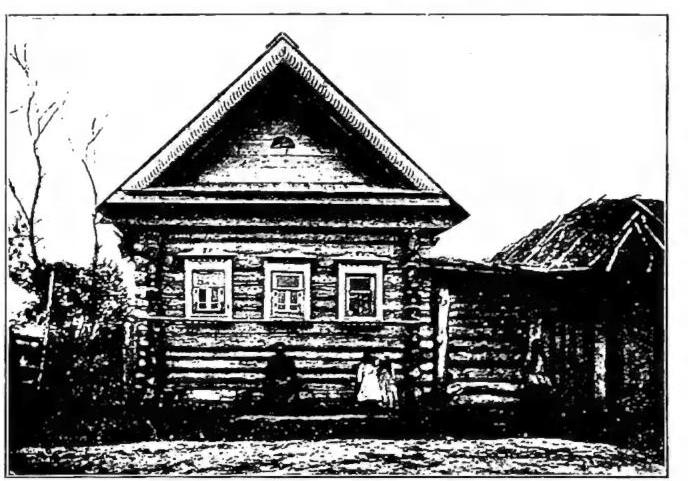
RUSSIA — A Russian isha.
Even more notable successes and expansions of the principality of Moscow coincide, on the European stage, with the epoch of the conquest of Constantinople by the Turks and with the Turkish invasion of Hungary and along the frontiers of Venetian Dalmatia. The position of R. (it is already permissible to use this term) is thereby strengthened, and from the most diverse parts of Europe hopeful glances are turned toward Moscow. With the marriage between Ivan III and Zoe (Sofia), daughter of Thomas Palaeologus, brother of Constantine XI, defender of Constantinople, there arose in a certain way the myth of Moscow as the “third Rome,” which, tinged with a national element, would develop further in the centuries to come and finally reach its fullest flowering in the political and literary thought of the Slavophiles. The wars against the Tatars, the Lithuanians, etc., had meanwhile transformed R. into a kind of fortress, with very limited scope for individual freedom. Under Ivan III the subjection of subjects to the State (that is, to the sovereign) became ever more pronounced.
These aspects — on the one hand of despotism and on the other of military power — come fully to light under Ivan IV, called the Terrible (although the Russian term groznyĭ perhaps more accurately means “the powerful,” “the stern”). Ivan’s reign (which was to make him the first tsar) extended from 1533 to 1584; from childhood he was accustomed to scenes of cruelty and servility about him: he was indeed cruel and merciless, though never without a dramatic, inward yearning for purification and a sincere devotion to the State. He reorganized the civil and military administration of the State, conquered Kazan’, Astrakhan’, and Siberia, anticipated Peter the Great in the desire to “open a window” onto the Baltic, to extricate R. from the “Asiatic” period of its history. The Russians occupied Narva and Dorpat, reaching as far as Riga: the reaction of Sweden and Poland, however, ensured that the successes
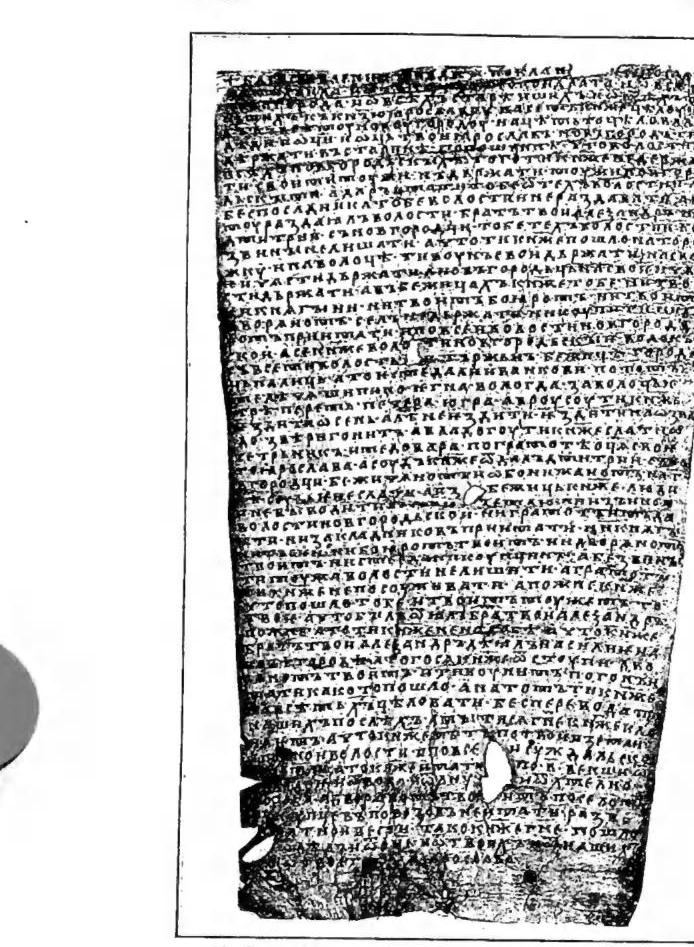
RUSSIA — First treaty between the city of Novgorod and Grand Duke Jaroslav Jaroslavitch (1264–65), in Cyrillic characters on parchment. Moscow, Archive of the Ministry of Foreign Affairs.
Over the years Ivan became increasingly suspicious and jealous of his autocratic position, resolved to crush the boyar class internally, from which he feared manifestations of anti-state selfishness and treachery. Relying on a special bodyguard, the repression carried out by Ivan the Terrible was among the most merciless and barbaric.
At Ivan’s death the internal situation in Russia had become very grave, especially because of the struggle between the opričniki (the tsar’s bodyguard), who sought to maintain their positions, and the remnants of the old boyar class (nobles) who tried to regain the upper hand. The tsar left two sons, Demetrius, aged two, and Theodore, of weak and even infantile temperament, though of age. The “true sovereign” became Boris Godunov, brother of the tsar’s semi-deficient wife. Godunov skillfully exploited for Russia the dissensions among his enemies, built fortifications in the steppe against Tatar incursions, and finally obtained the establishment of the patriarchate in Moscow. Official recognition of his successes was soon overshadowed by grave suspicions regarding his involvement in the sudden death (1591) in the town of Uglič of the young Demetrius. An inquiry by the boyar Sujskij determined that the child, during an epileptic fit, had fallen on a knife; yet whispers persisted that Boris Godunov had had the boy killed to clear his path to the throne. Godunov subsequently displayed the skill of long refusing the throne when urged to accept it; yet this was not enough to silence the insinuations against him. A severe famine that afflicted Russia from 1601 to 1603 worsened the situation and fostered a latent state of brigandage. At this time the rumor spread, evidently by design, that the young Demetrius was not dead. A “False Demetrius,” backed by the aura deriving—among his believers—from his descent from the Rjurik dynasty (and concretely supported by Poland and bands of Cossacks and fugitive serfs), presented himself menacingly before Godunov, whose sudden death (1605) removed every obstacle to the triumph of this clever adversary. The “False Demetrius” reigned only eleven months (1605–1606), disappointing Poland in various hopes placed in him and offending the Muscovites at the same time by his primitive ways and disregard for Russian traditions. The instigator of the plot against him was none other than Basil Sujskij, who had conducted the inquiry at Uglič (and who subsequently became tsar). Meanwhile anarchy flared in ever more tragic forms throughout the country (the so-called “Time of Troubles”), while Poles and Swedes sought to profit from the situation. The rebellion in the land and the struggle of factions and persons within the nobility were quelled only by the election as tsar of the very young Michael Romanov (1613), with whom a family ascended the throne that was to rule Russia until the Revolution of 1917.
From the moment of Michael Romanov’s election Russia’s position again strengthened on the international stage, while new elements of technique and (in part) of European civilization penetrated the country, albeit slowly. Yet Russia was not spared internal disorders. The most serious uprising was without doubt that led by Sten’ka Razin during the reign of Tsar Alexis (1670–72), a figure later romantically exalted in folk songs. Relying on Cossacks, peasants, fugitive serfs, and in part on allogeneic ethnic groups, Razin managed for a time to dominate the middle and lower Volga regions.
Around the turn of the 17th and 18th centuries, with the powerful figure of Peter the Great (v.), Russia underwent profound transformations internally and presented itself in Europe as a leading power. The affirmation under him of “life” and activism, in contrast to “traditions” and “contemplative attitudes,” did not, as in the climate of Western humanism and the Renaissance, signify a return to the values of classical civilization, but instead sometimes took the form of brutal orgies and mockery of religion. Of the Western civilization he wished to introduce into Russia (in the name of his country’s future power), Peter perceived almost exclusively its technical and material aspects. His grandiose reforms always had something improvised about them. His will to industrialize largely coincided with a war economy: in any case, it was the State that ordered the creation of factories in a country with scarce capital, no entrepreneurs, and very few buyers (given the predominance of artisanal production). Urban centers arose not from spontaneous material and spiritual enrichment, but because the State needed administrative nuclei. Schools also arose from which were to emerge officers, road and bridge builders, physicians, officials, engineers, artillerymen. From the moment a student began his studies, he was considered to be “in service” to the State: thus the first characteristic seeds of the intelligentsia developed. The new, despotic, lay State cut beards and forbade caftans; at the same time it sought to open to the bolder and more able young men the world of modern technology (which many of these youths would readily mistake for civilization). Peter’s fierce repressions against his opponents did not, however, preclude in the energetic sovereign—creator of the new capital on the marshy shores of the Gulf of Finland—a profound respect for “public utility” and the interests of the State. Amid military vicissitudes not always fortunate, Peter nevertheless achieved grand military successes, culminating in the victory at Poltava over Charles XII, which effectively removed Sweden from the ranks of the great powers.
Peter the Great’s reforms, however, suffered from the defect common to all reforms imposed violently from above and not matured gradually from the real needs and ideal aspirations of a people (or at least of its most cultured and conscious part). Respect for the interests of the State (and above all for public money) was often succeeded by the caprices and selfishness of despots and “favorites,” mostly of foreign origin. Palace revolutions were the typical index of such a climate. Notable, however, was the figure of Empress Elizabeth, who flung open the doors to art, taste, and French elegance, while at the same time emphasizing her sincere attachment to Russian traditions. With Elizabeth, around the mid-18th century, certain characteristic features of “enlightened absolutism” began to take hold in Russia.
At the dawn of the 19th century, Russia was still little known in the West, but its political importance and military weight began to be increasingly perceived by diplomacy. Under the reign of Alexander I, which lasted from 1801 to 1825, Russia once again passed through an interesting period of reforms: but many reforms remained at the project stage, and from the dissatisfaction this produced arose the first revolutionary attempt. The year 1812 was of decisive importance: Napoleon’s armies invaded Russia, and Moscow was set ablaze so that the invader would find no shelter. After the victory of Russian arms, a new and more “modern” nationalism began to develop among the educated classes: Russian patriotism had until then been identified with a religious (“Orthodox”) and dynastic sentiment; increasingly, under the influence of ideas from France and Germany, Russia was to be assigned a great “mission” in the world. Upon ascending the throne, Alexander I sought to impart a broadly liberal tone to his reign: the residual Enlightenment elements of his education curiously mingled in him with romantic dreams; ideals of freedom drawn from readings of Greek and Latin classics intertwined with the habits of a semi-despotic court. Many young officers who had long believed they were “collaborating” with the Tsar in reformist activity and propaganda (especially regarding the abolition of serfdom) found themselves almost unawares becoming conspirators.
(from T. Espenski), L'art byzantin chez les slaves, Paris 1925, Ier. M. n. 2.
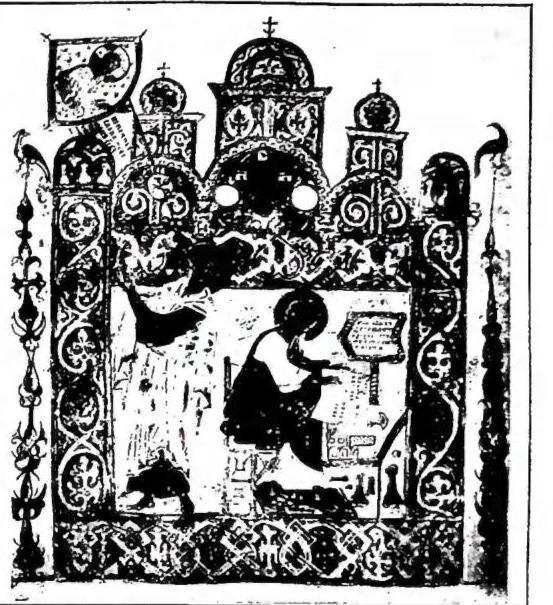
RUSSIA – SS. John and Prochorus. Miniature from the beginning of the 14th century. Frontispiece of the Gospel of Theodore the Black of Yaroslavl. Yaroslavl, Museum.
The reign of Nicholas I (1825–55) began with the crushing of the Decembrist uprising. On the one hand the new Emperor sought to stamp out every germ of revolution; on the other, with the development of modern capitalism in Russia, the spread of industry and railways, the foundations were laid for inevitable social transformations and future agitations. Under his reign Russia seemed impervious to revolution; yet the Crimean War revealed numerous grave technical and material weaknesses, while political and social agitation, though kept subdued, spread ever more widely, especially toward the end of his reign. Nicholas I’s spirit of anti-revolutionary solidarity was stronger than the immediate voice of Russia’s national and state interests (as was seen in his relations with Austria in 1849). A man in a certain sense of one piece, he failed to grasp the necessity of timely political reforms and a transformation and redistribution of social relations. The Polish national uprising (1830–31) and its harsh repression drew deep enmity against Russia from the most diverse and opposed sectors of European public opinion (Catholics, liberals, and left-wing democrats).
Alexander II, who reigned from 1855 to 1881, instead devoted himself to a grand work of reform. The unhappy outcome of the Crimean War and the increasingly explicit orientation of influential sectors of Russian society made large-scale reforms unavoidable. The fundamental achievement was the emancipation of the serfs (1861).
(from N. P. Kondakov, L’icone russe, Prague 1818, pl. 51)
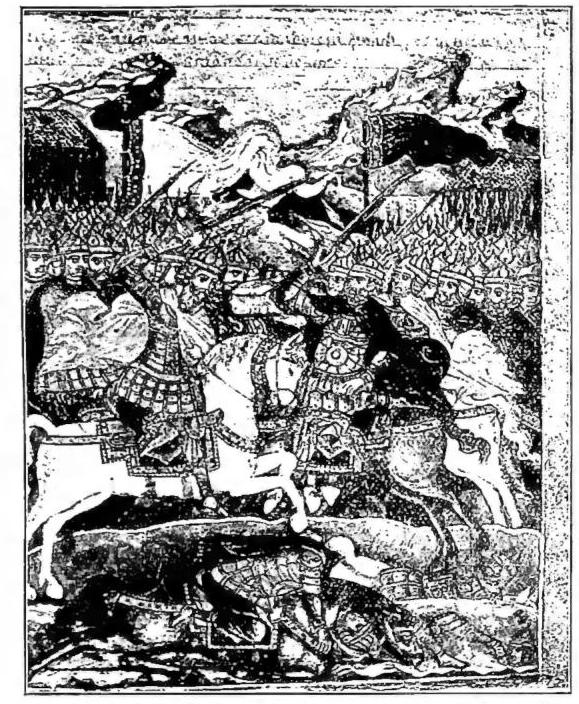
RUSSIA — Battle of the army of Jaroslav against that of Sviato-pold the Cursed. Icon from the beginning of the 16th century — Moscow, Russian Museum.
abolition of serfdom. No less important were the judicial, military and educational reforms, all inspired by a “European” and broadly democratic spirit. Autocracy was not abolished, but within it there were inserted in a certain way decidedly liberal elements and social transformations. The failure of these great reforms was due in part to the hesitations of the Tsar himself, who often stopped at dangerous intermediate solutions; but the chaotic and abrupt rise of a middle class, lacking in tradition, balance and culture, and dominated—especially among its younger elements—by extremist ideas, did the rest. As a brake on democratic reforms there also acted the great Polish rebellion of 1863, which in practice led only to new, harsh repressions.
During the reign of Alexander II the revolutionary movement gained ever more ground in Russia (which in the West was known under the rather generic and imprecise term of “nihilism”). Radical ideas of the French Enlightenment were intertwined in “nihilism” with the most advanced materialistic and democratic ideas of the 19th century, with clear anticipations in a scholastic and collectivist sense. Not only an art “detached from life,” not only a “spiritualist” philosophy, but art and philosophy themselves were rejected by these young revolutionaries, who saw them as a useless “waste of time” in the face of the “concrete revolutionary problems” and the questions posed by science. There was also in their naive and generous souls a feeling of shame in enjoying what the “people” could not enjoy.
Political assassinations became ever more frequent, and the Tsar Alexander II himself fell victim to an assassination in March 1881. His successor, Alexander III, who reigned from 1881 to 1894, wished to impart to Russian domestic policy a more energetic tone, in the hope of eradicating, through a firm stance, the “plague of terrorism.” The regime of Alexander III, however, also experienced oscillations between the rigidly authoritarian and anti-liberal policy of Pobedonostsev and the vague liberalism of Loris-Melikov, who aimed to “isolate” the revolutionaries through gradual constitutional concessions to moderate and reformist currents. Moreover, the further industrialization of the country (especially in certain major centres) and the notable development of railways contributed to swelling the proletarian masses, instinctively and primitively revolutionary. In broad outline, the policy of Alexander III had a decidedly anti-liberal character, in contrast to that of his predecessor; however, in the sphere of foreign policy, Alexander III allied Russia with the French Republic, thus making national interests prevail over the traditional friendship among conservative-leaning empires (Russia, Austria, Germany). The alliance with France meant for Russia a guarantee of aid against any expansionist ambitions of Germany and Austria and opened up to Russia the French financial market.
With Nicholas II, who reigned from 1894 to 1917, the great revolutionary agitations entered their decisive phase. The new Emperor, though a convinced advocate of autocracy, was a weak man. In the face of revolutionary agitations, he made concessions, which he then sought to withdraw (in whole or in part) when the moment of extreme danger seemed to have passed. Of all possible political lines, this was probably the most unfortunate. Corruption and intrigue within the ruling circles had assumed alarming proportions. At court, men of servile and adventurous character, such as the infamous Rasputin, gradually gained influence. Nevertheless, during his reign there were serious attempts to curb the agitations and to improve the finances: mention may be made, for example, of the monetary reform associated with the name of the minister Witte and the subsequent attempt at agrarian reform carried out, perhaps with questionable methods, by Stolypin. The grandiose construction of the Trans-Siberian Railway contributed to the development of internal emigration. Terrorist attacks against members of the imperial family, governors and police officials, however, continued at an alarming rate.
The war against Japan (1904–1905) accelerated the revolutionary tempo. A great power stretching from the Arctic Ocean to the Black Sea, from the Baltic to the Pacific Ocean, Russia was inclined to look toward Asia whenever its expansion in Europe met with setbacks. The meagre diplomatic successes achieved by Alexander II after his victories over Turkey in the Balkan Peninsula (Treaty of Berlin, 1878) in fact pushed Russia—where broad strata of public opinion felt “disappointed”—toward an accentuated expansionism in Central Asia and the Far East. A “minor” war with Japan (from which a brilliant success was expected) could moreover appear as a useful diversion from the now chronic political and social agitations. The disastrous defeat of Russia at the hands of Japan was instead, in a short time, to exacerbate the revolutionary agitation.
Those who represented the most markedly “autocratic” line did not realize that profound transformations of every kind were necessary, especially on the social plane, to remove the water from the mill of revolution. The liberals operated on a semi-legal plane and lacked a mature middle class conscious of the sense of limits: weak and torn by internal struggles, partly monarchist and partly republican, they sometimes encouraged revolutionary agitation only to suddenly reverse course. Nebulous, weak and demagogic was the path traced by vague and indeterminate currents that sought to reconcile the “Orthodox” religious tradition with “progress.” Increasingly decisive, however, were the openly anti-monarchist and more or less revolutionary parties. The so-called “Socialist-Revolutionaries” had their adherents in almost all social classes and exercised a strong fascination over students with their clandestine terrorist formations: romantic and eclectic, they tended toward democratic republics, toward vaguely 1848-style formulae (in the European sense of the term), toward a non-Marxist socialism, exalting “human personality” and sympathizing with the peasantry. The Bolsheviks (v. BOLSHEVISM) were an active minority, authoritarian, organized in a centralistic manner, and at critical moments generally carried a weight far greater than their numerical contribution. The Mensheviks corresponded, in broad outline, to European democratic socialism, but lacked followers because of the absence in Russia of skilled and well-paid workers, because of the extremism that, especially among the young, had become almost an instinct, and because of the slowness and contradictions of governmental reforms and measures.
The outbreak of the First World War soon rekindled the flame of revolution. In the summer of 1914, a vigorous patriotic wave swept across Russia, even winning over numerous popular elements. After the initial victories over the Austrians, however, the Russian armies suffered a series of resounding defeats; vast territories were abandoned to the Germans. Railway communications were inadequate, the army poorly supplied, and food was scarce in the major cities. Among the circles close to the court, more or less vague proposals for a separate peace with the Central Powers were aired. Among the diplomats of the “Entente,” some hoped that a democratic revolution would intensify the war effort. In February 1917, the police proved incapable of suppressing at birth the unrest caused by women and workers due to the lack of food and war-weariness. The disturbances quickly assumed a threatening character. Forced to abdicate, the Tsar was followed, after a few days, by the psychological impossibility even of Michael, the Grand Duke and brother of the former sovereign, ascending the throne. Russia, which had not yet known a European-style constitutional regime, had suddenly become a republic. The “Provisional Government” immediately found itself facing immense difficulties: all social classes in the country were in violent turmoil, the parties lacked political traditions, the ethnic minorities were more or less openly seeking to secede, and the army was in complete disarray, having practically abolished all effective discipline. The leader of the liberals, Miliukov, determined to continue the war alongside the Allies and increasingly suspicious of the extremists, was gradually replaced by the weak and demagogic Kerensky, who also wished the war to continue alongside the Entente but was unable, with his abstract political formulas, to restore order either in the country or at the front (individual, belated measures he took against sabotage and treason only served temporarily to exasperate the extremists without achieving any real results). Meanwhile, Lenin (q.v.), leader of the Bolshevik faction, energetic and decisive in his means and aims, an excellent tactician and strategist of politics, had returned to Russia, making use of the famous “sealed train” made available to him by Germany (which, also weary of the war, hoped for a military collapse of Russia). Soon after, Trotsky (Trotzki [q.v.]), a brilliant and energetic revolutionary who, after some ideological disagreements, had aligned himself with the Bolsheviks, reached Russia. The Mensheviks and Socialist-Revolutionaries were divided into “factions” and often displayed marked feelings of inferiority vis-à-vis Lenin’s party. The feeble and impotent regime of Kerensky was swept away after a few months by the Bolshevik Revolution (7 November 1917, according to the European calendar). A previous right-wing insurrectionary attempt had failed. Kerensky had vainly deluded himself into believing he had “more than sufficient forces” to crush the Bolshevik coup. The Bolsheviks, who had come to power under very difficult conditions, were compelled to sign the Treaty of Brest-Litovsk with Imperial Germany. Soon after, civil war flared up across the country, bringing with it the horrors that always accompany such conflicts. The imperial family was killed in 1918. The peasant masses, who had supported the Revolution in the hope of seizing land, grew increasingly irritated by the requisitions. Yet even the so-called “White” armies lacked unity, and the leaders of the counter-revolutionary forces showed little diplomatic or propagandistic skill. The chaos caused by the so-called “War Communism” in Soviet Russia was partly mitigated by the NEP (“New Economic Policy”): indeed, with a skilful move, Lenin had given a decisive turn to the economy by temporarily allowing certain “capitalist” sectors and a margin for private initiative. Upon Lenin’s death (January 1924), Stalin, a Georgian, increasingly came to the fore. With the beginning of the “Stalin era,” Russia (which after the revolution had become the “Union of Soviet Socialist Republics”) embarked on a series of
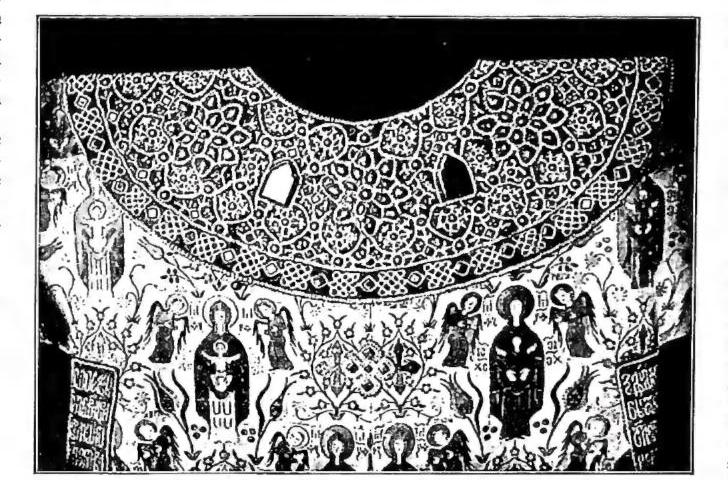
RUSSIA - Embroidered dalmatic (1587) - Moscow, Kremlin, patriarchal sacristy.
(from G. K. Loukowski, Le Kremlin de Moscou et ses trésors d'art. Paris n.d., loc. 58)
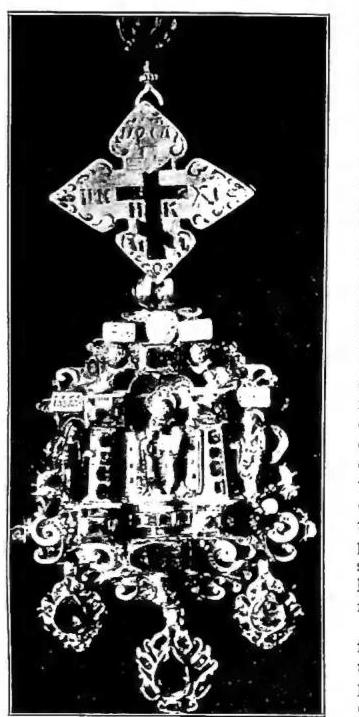
RUSSIA - Pectoral cross (17th cent.). Moscow, Kremlin, patriarchal sacristy.
Moreover, in the West the so-called policy of “popular fronts” also in defence of the “Reds” in Spain. Subsequent negotiations took place between the U.S.S.R., France and England with a view to a common anti-German front. The Western powers, however, showed significant hesitation regarding Soviet desires to strengthen preliminarily, even at the risk of Poland and the Baltic countries, the positions of the U.S.S.R. in Eastern Europe. Thus, in August 1939, on the eve of the German attack on Poland, a German-Soviet agreement was reached, which surprised much of world public opinion. In September of the same year, Germans and Russians partitioned Poland, while Soviet press from 1939 to 1941 was particularly polemical towards France and England. The rapprochement between Germany and R. was, however, not based on stable values. In June 1941, Hitler, fearing the persistence of the Russian unknown factor in the event of a German landing in England, suddenly launched an offensive against the U.S.S.R. In a few weeks, the German armies reached the vicinity of Leningrad and Moscow, destroying much of the Soviet army. The winter, the vast distances, the Russian masses, and the increasingly abundant aid from the Anglo-Saxons to the U.S.S.R. made the Germans’ situation quite difficult; their position worsened further in the course of 1942 and became catastrophic in the two following years. In the spring of 1945, the Russians entered victorious into Berlin and Vienna. Following the victory, R. occupied vast regions of Central and Eastern Europe, quickly establishing regimes of its liking everywhere. A few years later, with the aid of skilful military and diplomatic moves, R. succeeded in bringing about communist victory in Manchuria. This was the prelude to communist victory throughout China and to the achievement of a success of vast scope. Western policy, partly taken by surprise and partly still very well disposed towards the U.S.S.R., initially hardened more and more.
Thus began the Atlantic Pact, the partial rearmament of Western Europe, and, finally, in Asia, the incipient involvement of Japan in a front of Pacific nations.
II. RELIGIOUS HISTORY
For the overwhelming majority of the Russian population, which belonged to the Russian dissident Church, see KIEV, metropolis of; MOSCOW, patriarchate of; RASKOL.1. Latin-rite Catholics
In the 9th century Christianity penetrated Russia even in the form of the Latin rite, but with the conversion of the Grand Prince St Vladimir (980–1015) the Byzantine-Slav rite prevailed.Nevertheless, in the great cities such as Kiev and Novgorod Latin-rite Catholics continued to live, especially foreign merchants. Later, among the artisans, attendants and foreign merchants in the service of the Grand Princes of Moscow, especially from Ivan III (1462–1505) onward, there were also Latin Catholics, who populated (together with Protestants) the Moscow suburb known as the “Nemeckaja sloboda.” Attempts were then not lacking on the part of the Latins to bring Russia to the Catholic Church. In 1586 the Jesuit Antonio Possevino, negotiating the truce between Poland and Russia, had religious disputes with Tsar Ivan IV, but without any success. The hopes placed in the False Dmitry (1605–1606), backed by Poland, likewise came to nothing. In 1658 the Croatian priest Juraj Križanić (q.v.) went to Moscow with the same intent, but ended up being exiled to Siberia (1661–76). In 1702 Tsar Peter I granted freedom of worship, but not of religious propaganda. Emperor Leopold I of Austria (1657–1705) obtained from the Tsar that two Jesuits be allowed to reside in Moscow to provide spiritual assistance to members of his embassy and to the scattered Catholics in Russia. But the school attached to their church attracted too many sons of the Russian nobility; some conversions took place, and so the Jesuits were expelled in 1719. For a time they were replaced by Capuchins and Franciscans.
With the first partition of Poland (1772), besides the Ruthenians (q.v.), about 100,000 Latin-rite Catholics belonging to three dioceses (Vilna, Livonia, Smolensk) found themselves in Russia. In 1772 Catherine II gathered them into a single diocese with its see at Mohilev. The auxiliary bishop of Vilna, Stanislaw Siestrzenciewicz-Bohusz, compliant and devoted to the Empress, accepted the diocese from her hands with the title of metropolitan. It was only in 1783 that the nuncio Lorenzo Litta gave canonical investiture to Siestrzenciewicz. Catherine II prohibited within her dominions the publication of the brief abolishing the Society of Jesus (1773), so that in this way the Jesuits survived in Russia. With the subsequent partitions of Poland (1793–95), Russia acquired further territories inhabited by Latin-rite Catholics, but these had their own hierarchy (see POLAND). The influence of the Jesuits and of French Catholic émigrés led to the conversion of some high-society personalities in Russia, for example Prince Dmitry Golitsyn (1792), Princesses Aleksandra (1800) and Ekaterina (1810) Golitsyn, and Sof’ja Švecina (1815). This provoked a reaction, and in 1826 the Jesuits were expelled from Russia and measures against proselytism were tightened. The concordat concluded in 1847 between Nicholas I (1825–55) and Pius IX did not change the situation; only the new diocese of Tiraspol (1848) was erected for the southern regions of the Empire. Even in the 19th century there were individual conversions to the Latin rite among eminent Russians; some converts became religious and priests (Vladimir Pecorin, d. 1885; Grigoriy Suvalov, d. 1859; the Jesuits Ivan Gagarin, d. 1882, Ivan Martynov, d. 1894, Evgeny Balabin, d. 1893, Pavel Pierling, d. 1922; laypeople: Avgustin Golitsyn, d. 1875, Natalya Naryshkina, d. 1874, etc.). Yet they had to live and work abroad because of Russian laws against proselytism, which were abolished only in 1905. The Bolshevik Revolution of 1917 marked the beginning of a new persecution also for Latin-rite Catholics, who at that time still numbered about 1,600,000 faithful in Russia, with 8 bishops, 810 priests, and 410 churches. In 1923 Archbishop Jan Cieplak (q.v.), administrator of the Mohilev metropolis, was arrested and tried together with 14 priests. Further arrests, deportations, and exiles of other priests followed, along with the closure of churches and the confiscation of ecclesiastical property. Although in 1926 Bishop Michel d’Herbigny secretly consecrated four bishops in Russia, by 1937 only 10 priests and 11 open churches remained in the Soviet Union. Today the organization of the Latin-rite Catholic Church in Russia is practically annihilated, and its scattered faithful lack religious assistance.
The territorial changes in Eastern Europe after the Second World War (1939–45) brought back into the Soviet Union about 4,000,000 Latin-rite Catholics. For their subsequent history see ESTONIA; LATVIA; LITHUANIA; POLAND.
Ethnically, the Latin-rite Catholics in Russia were predominantly of non-Russian origin. The majority came from the western regions of the Russian Empire and were partly deportees or exiles within European and Asiatic Russia, partly they migrated in search of land or work (Poles, Lithuanians, Latvians, Estonians, Baltic Germans). From abroad there immigrated Germans, Czechs, French, etc. Numerically the Catholics of Polish origin were predominant. The practical equation of nationality with religion widespread among Poles and Russians was the main obstacle that prevented Catholics, though numerous, from effectively influencing the religious life of the population properly Russian.
2. Byzantine-Slav rite Catholics
In the 15th century Metropolitan Isidore, who took part in the Council of Florence (q.v.), attempted to introduce into Russia a union with Rome while preserving the Eastern rite, but without success. The Ruthenian united dioceses annexed to Russia with the partitions of Poland (1772–95) were suppressed (see RUTHENIANS). In the 18th–19th centuries individual Russian converts embraced the Latin rite and thereby, in the eyes of Russian public opinion, renounced their own nation.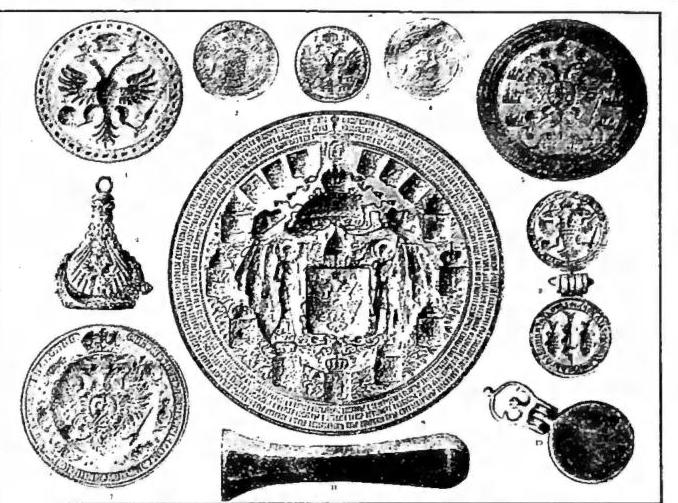
(from Les archives principales de Moscou du Ministère des affaires étrangères, Moscow 1861, inv. 22)
RUSSIA — Imperial Seals: 1) state seal with imperial insignia, used at the coronation ceremony; 2) c. 4) gold medal of Tsar Ivan IV (obverse and reverse); 3) c. 11) campaign seal of Peter the Great (steel); 5) state seal of Peter the Great; 6) seal of Karl Friedrich, Duke of Schleswig-Holstein, and his wife Grand Duchess Anna Petrovna; 7) state seal of Nicholas I (silver); 8) great state seal from the time of Alexander III (steel); 9) c. 10) seal of the “Cour des Vives” (17th cent.) open and closed.
In 1929 a Pontifical Russian College was opened in Rome, where Msgr. Alessandro Evreinov (b. 1877), ordaining bishop for the Byzantine-Slav rite, also resides. The Russian parishes of the Byzantine-Slav rite, except for the Apostolic Exarchate of Harbin (q.v.) in Manchuria, still depend on the Latin Ordinaries, but under the supreme direction of the Sacred Congregation for the Eastern Church.
Giuseppe Olšr
III. LEGAL STATUS OF THE CHURCH (up to the Revolution)
The Russian Empire regulated its relations with the Catholic Church on the basis of the “Code of Ecclesiastical Affairs for Foreign Confessions” (Svod zakonov, vol. XI/1 with supplements up to 1916). According to article 66 of the Fundamental Laws of the State and article 1 of the Code, foreign confessions are granted full freedom: “The predominant and leading religion in the Russian State is the Eastern Orthodox Catholic Church. Yet all subjects of the State and foreigners living in the Russian State who do not belong to this Church enjoy everywhere the free exercise of their faith and worship according to their own rites.”Nevertheless, the Catholic Church in the Russian Empire (dioceses: Mohilev with Siberia and Vladivostok, Tiraspol, Minsk, Kamenetz, Zytomir) has always led a life of diaspora. The solemnly recognized freedom was repeatedly restricted or suspended by specific provisions. According to article 13 of the aforementioned Code, the Church was dependent on the Ministry of the Interior. Article 17 regulated relations between the hierarchy and the Holy See: “All Roman Catholic Christians, both ecclesiastics and laity, who are subjects of the State, for matters pertaining to their confession, are in communication with the Roman Curia only through the Ministry of the Interior. No bull, letter, or instruction may be published in the Empire or in the Grand Duchy of Finland without the permission of His Imperial Majesty, requested by the Ministry of the Interior after prior verification that these acts contain nothing contrary to the decisions, sacred rights, and privileges of the supreme autocratic authority.”
The Catholic Church was permitted to provide religious instruction in schools, to establish diocesan seminaries, and to found the Ecclesiastical Academy of Saint Petersburg. Social activity (care for the poor, the sick, assistance to orphans and the elderly, as well as other charitable and relief organizations) was carried out through confraternities, circles (Vincentian Circle), and religious congregations. To establish such associations, the bishop had to obtain the consent of the civil power, in accordance with a circular from the Ministry of the Interior (1910, no. 1016). The Church was also recognized in principle as having the right to property; however, in this matter there were numerous interventions by the civil power. Without special permission it was forbidden: to send sums abroad; to possess movable and immovable property; to accept legacies and donations. The administration of ecclesiastical goods was supervised by episcopal examiners, but also by secular chancelleries.
IV. RITE
It is the Byzantine rite according to the usage of the Russian Church and its branches.3. Extent
The Russian rite had a first period in common with the Ruthenian rite, which may be called the Kievan period. It lasted until the metropolitan moved to Moscow after 1300, and the princes of that Grand Duchy gained ascendancy in Russia. Some usages began to differ from those of the southern regions; but toward the end of the 17th century, when Kiev entered politically and ecclesiastically within the orbit of Moscow and its patriarch, the rite of Moscow began to impose itself even in Kiev. At the same time its liturgical books were copied by Serbs living in Turkey or sent to those exiled in the Austro-Hungarian Empire. After the third partition of Poland it was imposed on the Ruthenians of White Russia, where the union with Rome was extinguished (1839 and 1875). The Russians, now occupying Galicia as well, where they have abolished the Catholic hierarchy of the Ruthenians, are likely to have imported or to be imposing their rite there as throughout the region up to the Bug.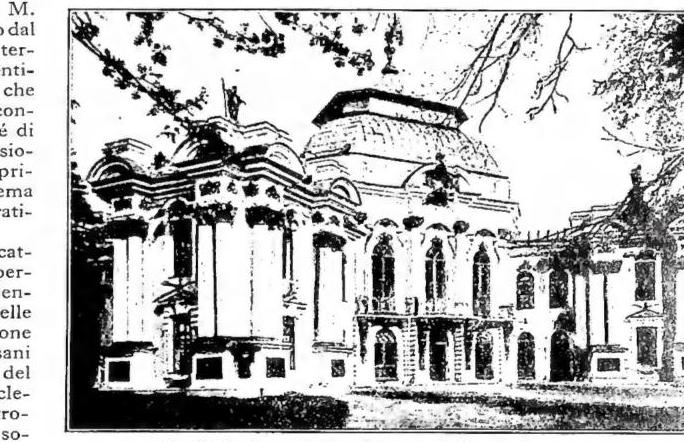
4. Internal development
As far as is known, the first Typicon introduced in Kiev was that of the patriarch Alexis the Studite of Constantinople. The Studite Typicon was also observed in the Kiev Caves Monastery; at the same time or shortly afterward the influence of the Slavic versions of liturgical books already completed by the Bulgarians and Serbs was felt. But around 1400 the metropolitan Cyprian strove to return to the usage of the Greeks of his time, introducing the Diataxis of Philotheus (patriarch of Constantinople, 1354-55, 1364-76) and following the Typicon of St. Sabas, translated by the hegumen Athanasius in 1401. The veneration of Russian saints, a new Serbian influence after the fall of Constantinople (1453), and the lack of central authority allowed many liturgical diversities that the Synod, known under the name of Stoglav (1551), could not eliminate.This diversity became even more apparent when the liturgical books were printed in different cities: Cracow, Vilna, Ostrog, Moscow. But with the advent of the Romanovs and under the impulse of the patriarch Philaret (1619-1633), the true reform began, which reached its climax in the imprudent efforts of the patriarch Nikon (1562-1667), which led to the great schism of the Raskol, i.e., the Old Ritualists. The reform took as its model contemporary Greek books and was favored by the patriarch of
(from E. Lo Gatto, L'opera del genio italiano all'estero. Gli artisti in R., II. Roma 1935, lat. 83.)
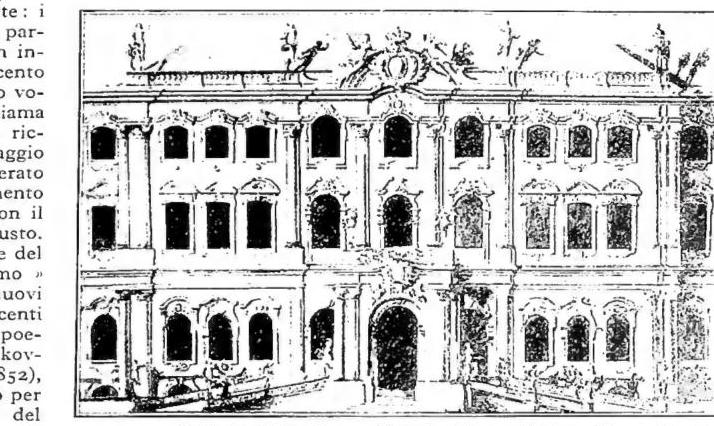
RUSSIA — The Hermitage, arch. by B. Rastrelli (c. 1750) — Leningrad.
Jerusalem, Paisius, and elaborated by Andrew the Greek (Sukhanov), assisted by some monks from Kiev. In the following years the Russian rite, through the influence of the Kievan monks, underwent a certain Latin influence; for example, the Moscow Trebnik (1677) admitted the indicative formula of absolution and in the Marriage service the questions regarding the free consent of the spouses; the Moscow Typicon (1682) prescribed that those celebrating the Holy Liturgy should bow at the words of Christ. After a partial reaction the evolution of the Russian rite came to a halt. Even the books printed in Kiev had to submit to the censorship of Moscow, and the Holy Synod continued with great diligence to publish liturgical books in numerous editions, often very beautiful, sometimes luxurious.
V. LITERATURE
The beginning, in R., of a writing and a literature coincides with the acceptance of Christianity by Prince Vladimir (988). From that moment the Russian people participates, albeit in particular circumstances and ways, in the life of Europe, of an Europe that for centuries would more or less identify itself with Byzantium, on a vast territory that is geographically the continuation of Asia, always open to the invasion of barbaric and primitive tribes. Christianity brought with it religious books: these were written in the Slavonic-Macedonian dialect used by Constantine (Cyril) and Methodius, a dialect that was subsequently called Old Bulgarian or Church Slavonic. The Church Slavonic language penetrated into R., influencing the spoken language and in turn being influenced by II. Russian vernacular and Church Slavonic fully merged into something harmonious — that is, the modern Russian literary language — only towards the end of the 18th century and even more so at the beginning of the 19th, through the work of great writers such as Karamzin, Krylov and Pushkin.The first written documents of Russian literature are to be considered the translations of sacred books. First and foremost, the Gospel of Ostromir, a work by the deacon Grigorij (1056–57). The lives of the saints are contained in the so-called Cheti-Minei and in the Pateriki. Also worthy of mention, among other texts, is the Instruction to the children of Prince Vladimir Monomakh, who reigned in Kiev from 1113 to 1125, an instruction imbued with moral and religious precepts. In the vast Russian plain, covered with forests and steppes, lashed by winds and snowstorms, the monasteries long represented the only cultural centres of any note: it was indeed the monks who zealously collected the most notable events of the “Russian land,” compiling them into chronicles (a tenacious and meticulous work that was to withstand, in part, wars, cataclysms and the invasions of Asian tribes, a work of civilization that thrilled Pushkin in the early 19th century, when Russian literature, rapidly surpassing the models of European romanticism, asserted itself fully with original values among the great literatures). Particularly important is the Chronicle of Nestor, so called from its probable author of the 11th century.
Among the literary documents of this period, the Song of Igor’s Campaign stands out, discovered in 1795, at a time of lively interest in folklore and the medieval climate (though the manuscript was lost in the fire of Moscow in 1812). The song refers to a historical event, namely a battle fought between Russians and the primitive tribe of the Polovtsy (1183), and is characterized by moments of high epic grandeur and authentic lyricism. The discovery of this “song” aroused some suspicions from the very beginning, and recourse was indeed made to Ossian; the French Slavist A. Mazon has recently revived and developed these old doubts, concluding that the Song of Igor’s Campaign is nothing more than a Romantic reworking of the so-called Zadonshchina (a poem somewhat later than the Song and of more modest artistic value). Russian criticism, however, today upholds its absolute authenticity.
The domination of the Tatars was undoubtedly a disaster for Russian culture. Once the Tatars had been defeated and national life had revived, with culture shifting from Kiev to the north, in the political climate of Muscovy a close fusion between state power and religious power took shape: the Stoglav, or Book of the Hundred Chapters, was precisely the record of a Council (1551) convened by Ivan the Terrible to arbitrate on controversial matters of ecclesiastical discipline. In the Domostroi, a work dealing with the organization of the home and the family, there is reflected the harsh, rigid and authoritarian climate characteristic of Muscovy at the time. Yet, amid such images of primitive life and tyranny, there is a note of delicacy and humanity in the Life of Juliana Lazarevskaja, written by her son, Georgii Osorgin.
The rise and spread of religious sects was also reflected in literature, both through more or less “scientific” books by sectarians, sometimes invoking the art of divination and astrology, and through the work of Gennadii, Archbishop of Novgorod, loyal to Moscow. Particularly noteworthy is the Autobiography of the protopope Avvakum, a vigorous preacher who recounts, not without a certain artistic effectiveness, his imprisonment and the persecutions suffered by his sectarians. Alongside the imitation of foreign models and simple translations, there was a growing tendency to produce compositions with original features. Alongside sacred subjects, profane ones are increasingly noted.
The picture, albeit brief and synthetic, of the oldest Russian literature would not, however, be complete if mention were not made of oral literature, handed down for several centuries from generation to generation. The ancient byliny, epic songs, can, in broad terms, be linked to the centres of Kiev and Novgorod. The bogatyrs (heroes) of Kiev are above all faithful warriors in the service of a patriotic ideal, while those of Novgorod (a city of flourishing trade) are especially attracted by wealth. This poetry, rich in local colour and epic vigour, refers back to very ancient heroic figures with pagan traits and to well-known legendary characters: Il’ia Muromets, Dobrynia Nikitich and Alësha Popovich (showing the influence of Christianity).
The environment of Kiev, in the early Middle Ages, had willingly accepted the first wave of Christian and Byzantine civilization: in the course of the 16th and 17th centuries a wave of Western civilization reached Muscovite R. through Kiev. Simeon Polotskii (1629–80) was the most distinguished advocate of a predominantly Latinizing culture.
Meanwhile, with the accession to the throne of Peter the Great, old R. had been profoundly shaken, at least on the surface, by a utilitarian and technicist revolution. Ivan Pososhkov (1652–1726), an intelligent amateur economist, expresses in his treatise On Poverty and Wealth many of the characteristic aspirations of the age. V. N. Tatishchev (1686–1750), author of a Russian History and of the Dialogue on the Usefulness of the Sciences and Schools, expresses in a somewhat naive manner his rationalist and utilitarian tendencies. The transfer of the capital from Moscow to the new metropolis of St. Petersburg seems to epitomize the predominant taste for modernity and Europeanism.
A modern Russian literature begins in fact only with the penetration of French classicism (both directly and through Germany). The skeptical and enlightened 18th century brought to Russia French tastes, fashions and elegances, sympathy for the “Enlightenment,” cosmopolitan tendencies, and humanitarianism; but as Russian power grew and the first pre-Romantic stirrings appeared, the late 18th century also fostered a heightened consciousness of Russian material and spiritual strength, a desire for originality, and vague aspirations that would mature in the following century. Here we need only recall A. Kantemir (1709–44), author of a satire entitled To the Despisers of Learning, echoing the reforming spirit of Peter the Great; M. V. Lomonosov (b. between 1708 and 1715, d. 1765), a truly encyclopedic scholar of world renown; D. I. Fonvizin (1745–92), author of two successful comedies, The Brigadier and The Minor, characteristically expressing the contrast between the old and the new generation; and V. V. Kapnist (1757–1823), author of Slander. Catherine II herself wrote comedies with moralizing intent. The lively, somewhat superficial but intelligent empress fostered the development of journalism and schools; yet in her conservative phase she harshly repressed journalists and writers such as N. I. Novikov (1744–1816) and A. N. Radiščev (1749–1802) who characteristically expressed the “French” ideas of the 18th century and protested against the harshness of serfdom.
The 18th century, which had seen Russia’s military triumphs and the first achievements of a modern literature, was in a sense linked to the 19th—the great “golden age” of Russia—through the names of Deržavin, Karamzin, and Krylov. G. R. Deržavin (1743–1816), descended from an old Tatar family, vigorous and rugged in his artistic expression, won European fame with his philosophical odes God and The Waterfall. N. M. Karamzin (1766–1826) is the typical exponent of “sentimentalism” in Russian literature, echoing English literary tastes and French humanitarian attitudes. Worthy of note in this connection are his Letters of a Russian Traveller and tales such as Poor Lisa and Natalia, the Boyar’s Daughter. Yet the historicist and “national” climate of the early 19th century (after the Napoleonic invasion and Russia’s great awakening) drew Karamzin away from his earlier 18th-century ideals: he became the author of the monumental History of the Russian State, inspired by monarchical spirit and vigorous national feeling. I. A. Krylov (1768–1844) is the author of famous fables still read today as when they were written; his “talking animals” bear an unmistakable Russian accent, and his vocabulary draws on a lively and rich popular language, used always at the right moment and with the rein of good taste.
The tradition of “sentimentalism” merged with new and more vibrant Romantic accents in the poetry of V. A. Žukovskij (1783–1852), best known for his reworking of Gray’s Elegy Written in a Country Churchyard and for a poem entitled The Bard in the Russian Field.
Classicism, in turn, found fresh and new expression in the poetry of K. N. Batjuškov (1787–1855), whose fame rests especially on the elegy Dying Tasso. Dramatically felicitous touches and intolerance for Russia’s crude and backward environment appear in A. S. Griboedov’s comedy Woe from Wit (1795–1829).
Russian literature was to establish itself among the great European literatures through the work of Aleksandr Sergeevič Puškin (1799–1837). His harmonious nature succeeded in blending the light vivacity of the 18th century with the more tormented, more philosophical, more “national” taste of incipient Romanticism. European influences were thus artistically fused, in an original way, with the discovery and revelation of the Russian soul, the Russian landscape, and the naïve yet profound voice of folk song. Appearing to yield only to the “sentimental” predilections of the general public, he in fact created a new type of art. With Puškin, Russia found not only its universal poet but also its great national poet: not only because in Boris Godunov he sang of the struggles, sufferings, and glories of past centuries, but also because in The Tales of Belkin, Eugene Onegin, and his lyrics he awakened to life values that seemed to slumber in the country’s centuries-old torpor. K. F. Ryleev (1795–1825), a poet who took part in the revolutionary activity of the Decembrists, sought to impress upon his verse an ideal of civic virtue and freedom. E. A. Boratynskij (1800–44) holds an artistically notable place beside Puškin; remembered are his poems The Last Death and The Last Poet—a despairing vision of a “future world” in which science and technology would kill poetry. A. V. Kol’cov (1808–42) extolled the countryside and the hard labor of Russian peasants, sometimes achieving a felicitous harmony of typically folkloric elements and lively, original poetic sensibility. Yet only Michail Jurevič Lermontov (1814–41)—who died like Puškin in a duel, too young to develop fully the extraordinary gifts of his genius—was Puškin’s true emulator. Though sometimes succumbing to Byronic fashion, i.e., the debased Romantic manner, he succeeded in The Novice, A Hero of Our Time, and parts of his lyric poetry in finding vivid, original, tormented accents, transcending the formulas of conventional Romanticism and even the skeptical cynicism then in vogue among young intellectuals. In some of his fragments (Princess Ligovskaja) he may perhaps vaguely foreshadow Dostoevskij.
With Lermontov there closed an era of Russian literature that may fairly be called, in a sense, aristocratic and noble, both because of the noble origins of its exponents and because of the tone of its creations. New forces of bourgeois and petty-bourgeois origin now emerged in literature. Romanticism, vague idealism, and an even vaguer liberalism gave way to democratic tendencies and tastes; on the philosophical plane positivism asserted itself, soon to be overtaken by the more combative and revolutionary materialism that in Russia would tend to harden into dogma, with a passionate accent perhaps not unjustly termed “ascetic.”
V. G. Belinsky (1811-48) is the leader of the new critical school, for which literature’s chief task is to fight for social and rational ideals: starting from an incipient idealist position, he soon moved to rationalism and a socialist or at least presocialist stance. Belinsky’s work contains no lack of acute literary insights; the rationalist and materialist tendencies, however, appear in more naïve forms in the work of critics such as Chernyshevsky, Dobrolyubov, and Pisarev, who were of considerable importance in the formation of revolutionary thought. Great poets who, on the whole, remained aloof from any social-content trends (which had increasingly come into fashion) were F. I. Tyutchev (1803-73), A. A. Fet-Shenshin (1820-92), A. N. Maykov (1821-97), Y. Polonsky (1820-98), and A. K. Tolstoy (1817-75). Tyutchev and Fet in particular occupy a foremost place in Russian poetry: little understood in their own time, they were later “rediscovered” at the dawn of the twentieth century by the great symbolist poets. By contrast, the poetry of N. A. Nekrasov (1821-77) reflects a marked social tendency, drawing on certain ideals of Belinsky, without excluding moments of exquisite poetry: one need only think of the long poem Vlas, a rigorous narrative of a sinner who, to atone for his faults, travels across Russia collecting alms to be used in building a church.
In opposition to the “Western” currents from which materialists and revolutionaries had gradually emerged, a “Slavophile” current also developed in literature, inspired by a cult of Russian and Slavic traditions and marked by a preference for folklore (see above,