
STALIN, IOSIF VISSARIONOVIĆ (Džugašvili). — Russian statesman, born at Gori, a small village in the Caucasus, to a Georgian shoemaker, on 21 December 1879. From 1893 to 1899 he studied at the Orthodox ecclesiastical seminary of Tiflis, where, becoming enthusiastic about the socialist idea, he secretly engaged in revolutionary activity. Subsequently, his principal occupation consisted in devoting himself to political action on behalf of the Russian Social Democratic Labour Party, to which he had already belonged since 1898.
In literary or theoretical work he was not as successful as in carrying out audacious revolutionary projects, such as assaults on prisons, the notorious expropriations undertaken to procure the money necessary for the party, and similar activities. This activity earned him two terms in prison and six deportations to Siberia, from which he managed to escape no fewer than five times, only to return there again, and from which he was finally released on the occasion of the Revolution of February 1917.
After the October Revolution, S. sought gradually to rise to increasingly important positions under the friendly protection of Lenin, who valued him as an energetic executor of his designs. Thus, in 1917 he was People’s Commissar for Nationalities; in 1919 he became People’s Commissar for Workers’ and Peasants’ Inspection, a member of the Politburo and of the Orgburo; and finally, beginning with the Eleventh Party Congress, General Secretary of the Central Committee of the Communist Party. He skillfully used this key position to occupy, little by little, the entire party apparatus with trusted persons. It was a systematic undertaking based on cold calculation, consisting in placing men devoted to him in the offices responsible for compiling lists of candidates, sending suspicious persons to distant regions before elections could take place, appointing communists of proven loyalty to direct the Communist press, and so forth. The apoplectic stroke that befell Lenin immediately after the Eleventh Party Congress was meanwhile highly propitious for him. Just before his death, Lenin had expressed in his famous Testament his indignation at the turn events had taken and had violently censured S. But since other party leaders had also been criticized in it, this document was never published by the party leadership.
The first opponent whom S. eliminated in the struggle for power was Trotskij. To the Trotskyist theory of permanent revolution, he opposed the theory commonly attributed to Lenin, namely, the theory that socialism was possible even in a single State. This theory took greater account of the fact that the masses were weary of war and revolution and could therefore be put into practice more easily. In the struggle against Trotskij, S. allied himself with Zinov'ev and Kamenev (the Trojka) and later with Kalinin, Tomskij, Rykov, and Kuibyšev (the Semjorka). After Trotskij had been sidelined, at the Fourteenth Party Congress, held toward the end of 1925, he broke with Zinov'ev and Kamenev, who, together with Trotskij, formed the bloc of the left opposition. Through a new alliance with Bucharin, Rykov, and Tomskij, he succeeded within two years in defeating this extremely dangerous opposition within the party. In October 1927 Trotskij and Zinov'ev were excluded from the Central Committee; moreover, by the unanimous vote of the participants in the Fifteenth Party Congress, Trotskij was expelled from the party on 18 December of that year and exiled to Turkestan, together with ten other supporters, on 19 January 1928. But when, not long afterward, under pressure from the worsening political situation
(phot. Anderson)
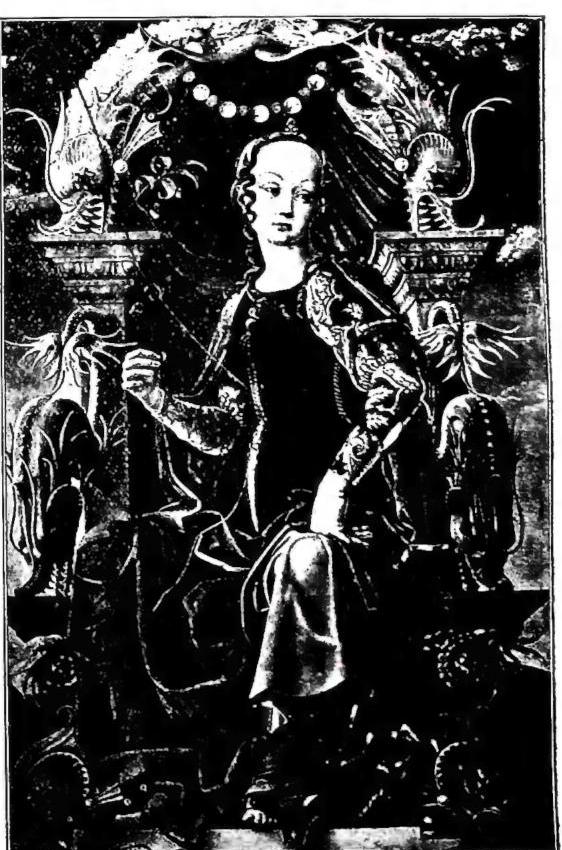
STAGIONI - Spring. Painting on canvas by Cosma Tura (2nd half of the 15th century) - London, National Gallery.
With the Yalta and Potsdam agreements, and with the Sovietization of the territories occupied by the Red Army in Eastern Europe, the Soviet Union attained a territorial extension and a political importance never before achieved by Russia. The distinctive features of S.’s policy in the years following the war were: the division of the world into two clearly separate spheres of influence by means of the so-called « iron curtain »; the unleashing of an ideological campaign against cosmopolitanism, against the inferiority complex in the face of bourgeois culture, and in favor of a Soviet and even Russian chauvinism; an effort to increase Soviet prestige in the countries west of the iron curtain through the so-called « Peace Movement »; the intensification of the party dictatorship in every sector of life, including the cultural and scientific spheres; and finally the propagation or, at the very least, the permitting of a veritable cult of the person of the Great Leader. S., according to an official communiqué of the Soviet government, died on 5 March 1953.
On the ideological plane, S.’s importance was equated by the Soviets with that of Marx, Engels, and Lenin. In reality, it must be said that, dialectical materialism (v.), he merely systematized the doctrines of Engels and Lenin. historical materialism (v.), S. instead went so far as to overturn the materialist conception of history upheld by Marx, because of the great importance he assigned to the influence that cultural superstructures would in turn exert on the economic base. Since the Communist Party, as a political institution, also forms part of the superstructure, it follows logically that the dictatorship of the party, or S.’s personal dictatorship, thereby received a theoretical foundation. On other decisive points too, S. departed from Marx. He rejected the Marxist principle of equality as « a petty-bourgeois reactionary piece of nonsense, worthy of a primitive sect of ascetics, but not of a socialist society organized in a Marxist manner »; from 1934 onward, with increasingly marked emphasis, he replaced Marxist internationalism with Russian Soviet patriotism; he set aside the theory of the gradual disappearance of the state, stressing the necessity of strengthening it so long as the danger of capitalist encirclement lasted; he replaced the collective direction of the state with his personal dictatorship. Whereas Lenin still permitted opposition and free discussion within the party and urged that fraternal blood not be shed, S. instead eradicated all opposition within the party through bloody « purges », bound the worker to the factory and the peasant to the kolkhoz, and introduced the internal passport, the work booklet, and severe punishments for violations of labor discipline.
It must be conceded that S. achieved a great deal by these methods: from an economically backward country he made a great economic and military power, occupying one of the foremost positions in the world. Against this, however, one must set the enormous price paid: forced collectivization in the years 1932–34 caused a famine that cost the lives of several million people (3 million, according to statements by the People’s Commissar Petrovskij; 5 million, according to the cautious calculations of the Menshevik organ Socialističeskij Vestnik; 8 million in Ukraine alone, according to the claims of Bolitzkij, head of the G. P. U.). D. Dallin and B. Nišolaevskij estimate the number condemned to forced labor at approximately 12 million (cf. Forced labor in Soviet Russia, New Haven 1947). During the ten years of the liquidation of the Opposition (1920–39), approximately one million people were shot, and they included not only class enemies. During the « purge » of the years 1917–38, the following were shot or made to disappear by other means: 5 of the 7 presidents of the last Central Executive Committee, 9 of the 11 central ministries of the U.S.S.R., 43 of the 53 secretaries of the central party organizations, 90% of the foreign Communist leaders living in exile in Moscow, 54% of the generals, most of the senior officers of the G. P. U., most of those charged with drafting the new constitution, etc. Of the 22 members of the Central Committee of the party in office in October 1917, only S. and Comrade Kollontai survived the « purges »; 17 had been shot or murdered, only Lenin had died a natural death, while Dzeržinskij and Uritzkij had died mysteriously.
As regards religion, neither Marx nor Engels nor Lenin contains as few unfavorable statements as S. Moreover, his writings contain little that is explicit against religion; his best-known statement is the one made to a delegation of American workers in 1927: « The party cannot be neutral toward religion... since it takes the side of scientific progress, whereas religious prejudices are against science ». Nevertheless, since the time of the ancient Roman persecutions, Christianity has never been forced into so harsh a struggle for existence as that imposed upon it in the name of this man.