
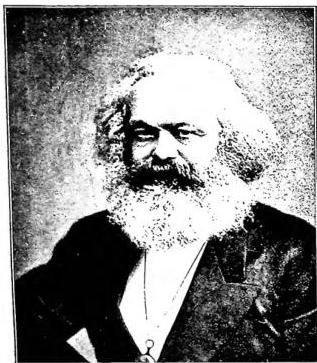
MARX, KARL. — Materialist philosopher, who together with Engels conceived the so-called scientific socialism, b. in Trier on 5 May 1818 to Jewish parents (later his father had himself baptized together with the entire family, in order to avoid the harassment to which Jews were subjected), d. in London on 14 March 1883.
As a boy, M. was influenced by his father’s Enlightenment ideas and by the Romanticism of Baron von Westphalen, a family friend whose daughter Jenny he married in 1843. From 1830 to 1835 he attended the “Friedrich-Wilhelm” Gymnasium in Trier, sympathizing with professors of rationalist and liberal tendencies. In 1835 he enrolled at the University of Bonn and in 1836 at the University of Berlin. Initially anti-Hegelian, in the spring of 1837 he then joined a circle of Young Hegelians of the Left, the Doktorclub.
Subsequently enrolled in the faculty of law at his father’s insistence, after the latter’s death (10 May 1838) he decided to take a degree in philosophy. At the University of Jena he defended his thesis: Differenz der demokratischen und epikureischen Naturphilosophie, in which, under the influence of the Hegelian Left—
Having moved to Bonn, M. turned toward practical activity. He wrote for the Deutsche Jahrbücher, founded by A. Ruge in 1837, and then for the Rheinische Zeitung, whose editorship he assumed in Cologne in the autumn of 1842, fighting for the proletariat and freedom of the press against the government (which threatened to suppress the newspaper). M. took the opportunity to resign as editor on 17 March 1843 and withdrew to study political economy, in which he had recognized his lack of preparation. From these studies would emerge the materialist conception of history and the theory of «surplus value». At the invitation of A. Ruge, M. went to Paris to establish the journal Deutsch-französische Jahrbücher, which ceased publication after two issues owing to its lack of success and the enmity between M. and Ruge. In Paris M. surrounded himself with «left-wing» intellectuals; he became friends with E. Heine and G. Proudhon; the latter, however, because of differences in ideas, became his adversary and wrote against him La philosophie de la misère (1846), to which M. replied with La misère de la philosophie (1846). In Paris, in the summer of 1844, M. ENGELTAL (v.) whom he had met at the editorial office of the Rheinische Zeitung. In 1845, under pressure from the Prussian government, France expelled M., who went to Brussels; there, in the spring of 1845, Engels joined him to discuss together the materialist conception of history that M. had developed in Paris. The fruit of these discussions was the work Die heilige Familie, directed against the «degeneration» of the Hegelian idealism of Bruno Bauer and his friends. Together they also composed «L'ideologia tedesca: una critica della filosofia posthegeliana rappresentata da Feuerbach, Bruno Bauer e Stirner, nonché dal socialismo tedesco secondo i suoi diversi profeti». This work was not printed at the time (discovered in 1920, it was published in 1926 in the Marx-Engels-Archiv and later in the Opere edited by Rjazanov). The Ideologia tedesca is the first exposition of historical materialism: it denies the primacy of the idea in history, replacing it with the economic fact; material activity, or praxis, is the foundation of history and of all human activities—politics, religion, morality, etc. In this way M. and Engels definitively opposed every form of «petty-bourgeois» socialism, basing social ideology on the «new» materialist conception. They took control of the Deutsche Brüsselle Zeitung, worked in the Association démocratique of Brussels, and founded the Deutsche Arbeiterverein, composed of German exiles.
At the end of 1847, commissioned by the «Communist League», M., using a draft by Engels, composed the celebrated Manifest der kommunistischen Partei, published a few days before the outbreak of the 1848 revolution (v. COMUNISMO). Expelled from Belgium, M. went to Paris and, with Engels, fomented the revolution in Germany. He then went to Cologne, where, in June 1848, he assumed the editorship of the revolutionary Neue Rheinische Zeitung, to which Engels, Lassalle, and others contributed. On 19 March 1849 the newspaper ceased publication: M. returned to Paris and, threatened by the government, fled to London.
In London M. suffered family misfortunes and especially great poverty, alleviated in part by the help of friends and by writing articles for various newspapers, for which he was always poorly paid; only the generosity of Engels lifted him from destitution. He was continually engaged in polemics with the exiles in London, owing to differences of opinion and also because of his irascible and eccentric character. In London M. devoted himself to numerous studies, particularly to political economy; the fruit of these was Zur Kritik der politischen Oekonomie (1859), which M. regarded as an introduction to Das Kapital, whose first volume he had printed in 1867. The fundamental idea is the theory of «surplus value» (surplus value); the capitalist, that is, purchases the worker’s labor, incorporated in the commodity, and resells it at an excess price; the excess is the «surplus value», which should go to the worker but is instead collected by the capitalist, increasing his own capital. Posthumously, under the editorship of Engels, the second and third volumes appeared respectively in 1885 and 1889; from 1905 to 1910, under the editorship of Engels, E. Bibbins Aveling, P. Lafargue, and K. Kautsky, the fourth was published: all were composed of M.’s scattered notes and manuscripts. On 28 September 1864 M. attended the international workers’ meeting at St Martin’s Hall, where the foundation of the «International Workingmen’s Association» was decided. M. joined enthusiastically, prevailed in establishing his ideas, actively collaborated in the organization, and engaged in continual polemics with M. Bakunin and other tendencies (anarchism in Spain and Italy, Mazzinianism in Italy, Lassallism in Germany). Because of struggles from abroad, intensified after the Paris Commune, and especially because of internal struggles, M. International (v.) to die, transferring its general council to New York in 1873. From then on M., although he exerted great influence on European socialism, withdrew from agitation. In any case, his work had ruined his health. Generously assisted by Engels, he traveled to celebrated health resorts, but in vain. His wife died on 2 December 1881, and his daughter Jenny in January 1883; a month later he too died. He was buried in Highgate Cemetery in London.
For an in-depth examination of Marxist philosophical conceptions V. MATERIALISMO DIALETTICO; MATERIALISMO STORICO; for the theory of surplus value, V. VALORE; for M.’s influence on socialism, international, communism, and Bolshevism, V. the respective entries.