
BELGIUM. - State of northwestern Europe (30,508 km²; slightly larger than Piedmont), bordering the Netherlands, Germany, Luxembourg, and France.
CONTENTS: I. Geography - II. Historical Events - III. The Church in Belgium - IV. Literature - V. Educational System.
I. GEOGRAPHY
The trough through which the Scheldt and Meuse rivers flow divides its territory into two distinct sections, also oriented, like that trough, from SW to NE. The southern section is a plateau interrupted by hilly groups (Ardennes), with a humid and harsh climate, a sparse population, and a predominantly rural character; the northern section, vast and densely populated, is a plain that slopes gently toward the short (66 km) coastline, where there are also low-lying areas protected by dikes and cultivated (polders), with a typically oceanic climate. The plain, which is rich and abundant in crops in its central and western parts (Flanders), becomes poorer and bleaker toward the east (heathlands of Campine), and is crossed by the Scheldt, modest in length but abundant in water and navigable, on whose estuary lies the largest commercial emporium of Belgium and one of the most active in this part of Europe: Antwerp.The population (8.4 million inhabitants in 1947), which reaches a high density (276 inhabitants per km²; 540 in the central region of Brabant)—indeed, the highest in Europe (though the modest territorial base must be considered)—consists of over half Flemings, speaking a Germanic dialect, and just under half Walloons of French language (with small groups speaking German in the east): the two linguistic domains are roughly divided by the Tournai-Liège line. The vast majority of the country is Catholic; Protestants constitute barely 0.3% and Jews 0.1% of the total. Besides the capital Brussels (approx. 1 million inhabitants, including suburbs), several cities exceed purely national interest due to their economic importance: Antwerp (256,000 inhabitants), Ghent (161,000 inhabitants), the center of the wool industry, Liège (151,000 inhabitants), the main steelmaking center, Mechelen (61,000 inhabitants), Ostend (48,000 inhabitants), etc.
Agriculture and livestock farming, though highly flourishing, take second place in the country's economy to industrial and commercial activity, the former favored by mineral wealth (coal, iron, zinc), the latter by the country's privileged position at the crossroads of communication routes between extra-European regions (beyond England) and Eastern Europe, and between the latter and Western Europe.
The Kingdom of Belgium is a constitutional representative monarchy with a bicameral Parliament. United in a single state with the Netherlands in 1815, Belgium separated from it in 1830.
| Provinces | Area in km² | Population (Estimate) 1945 | Density per km² | Capital pop. in 1000s |
|---|---|---|---|---|
| Antwerp | 2,831 | 1,255,760 | 444 | Antwerp (256) |
| Brabant | 3,283 | 1,773,635 | 540 | Brussels (935) |
| West Flanders | 3,234 | 984,475 | 305 | Bruges (53) |
| East Flanders | 3,002 | 1,207,805 | 402 | Ghent (161) |
| Hainaut | 3,721 | 1,185,904 | 319 | Mons (25) |
| Liège | 3,951 | 928,941 | 235 | Liège (151) |
| Limburg | 2,408 | 443,758 | 184 | Hasselt (29) |
| Luxembourg | 4,418 | 214,105 | 48 | Arlon (11) |
| Namur | 3,660 | 350,121 | 96 | Namur (31) |
| Eupen and Malmedy | 1,056 | 66,854 | 63 | — |
| TOTAL | 31,564 | 8,411,358 | 276 |
II. HISTORICAL EVENTS
It is not necessary to wait until 1830, the year of the revolution that consecrated the definitive separation of the northern from the southern Low Countries, to speak of Belgium. While the formation of the Belgian state does not date back further than that year, the southern provinces had already enjoyed a form of independence under common princes since the Middle Ages. Situated between Neustria and Austrasia, these provinces soon freed themselves from the centralising influence of the kingdom of France and the empire. With the Treaty of Verdun (843), the formation of Lotharingia had tied the Flemings and Picards on the left bank of the Scheldt to French influence, while placing the populations of Walloon and Germanic language living on the right bank of the same river and on the banks of the Meuse under the empire.The families of the counts of Flanders, Brabant, Hainaut, Namur, Limburg, and Luxembourg often united under the feudal regime to preserve their influence beyond their respective borders. Linked by matrimonial ties to the royal families of neighbouring countries, these princes participated in the great politics of their time. Godfrey of Bouillon, one of the leaders of the First Crusade, received in 1099 the title of "Advocate of the Holy Sepulchre." The house of Namur held the Latin Empire of Constantinople from 1217 until its end. The Luxembourgs provided several emperors for the German Empire. The ecclesiastical principality of Liège enjoyed an independent political life and managed to escape the centralising movement of the Burgundians in the 15th century, but the elected bishops often belonged to Belgian comital families, and their jurisdiction encompassed a good half of the provinces of Belgium. Philip the Good succeeded in achieving a first union of the states situated between Frisia and Champagne. This union was maintained, after the death of Charles the Bold (1477), by the arms of Maximilian of Habsburg, husband of Mary of Burgundy. This marriage made the Habsburgs the legitimate sovereigns of the United Provinces. For three centuries, upon assuming power, they had to swear to preserve the rights and franchises of the communes and estates, and were recognised as counts, dukes, or marquises in each of the provinces, definitively united and rendered independent of any vassalage to France or the empire from the time of Charles V. The communes and cities enjoyed broad freedoms and possessed charters of franchise from the 12th century. Taxes and contributions had to be approved each year by the assemblies of the provincial estates, which constituted a limit to the arbitrariness of powerful princes by whom they were drawn into the game of European politics, first under the influence of Spain and then under that of Austria.
Under Charles V and Philip II, the cities of the north were more deeply influenced by Protestantism, first Lutheran and then Calvinist, and together with the southern provinces rose against Spain. The national sentiment, exalted by the desire for political and religious freedoms, seemed for a moment to triumph after the repressions of the Duke of Alba (1568-73) and the failure of Requesens, sent to repair the errors of his predecessor (1573-76). With the "Pacification of Ghent" (1576), the Estates General proclaimed their independence de facto. Don John of Austria and then Alexander Farnese, aided by the Catholic "Malcontents" of the Union of Arras, succeeded in having Philip II's authority recognised in the southern provinces and in undertaking the submission of the northern provinces. William of Orange, leader of the revolt, unable to maintain the national ideal of tolerance of 1576, had to resign himself to defending the Union of Utrecht, grouping the northern states, Flanders, and Brabant. While he lost these two provinces, Holland, Zeeland, Utrecht, Friesland, Groningen, and Guelders continued the struggle, excluding from their territories any confession other than the Protestant one. The majority of the population, though remaining Catholic, was deprived of its priests and thus gradually passed into heresy.
The struggle between the southern Low Countries (Flanders), which had become practically independent from Spain under the Archdukes Albert and Isabella (1598-1623), and the United Provinces continued until 1648 to the grave detriment of both parties. The reign of the archdukes ensured the southern provinces a splendid Catholic renaissance in the fields of education, arts, and letters. The Treaty of Münster (1648) consecrated the definitive separation of the north and the south. Flanders lost the Catholic regions of the Lower Scheldt, northern Brabant, and Trans-Meuse, and saw the port of Antwerp closed. The wars of Louis XIV further deprived the Spanish Netherlands of a good part of the county of Flanders, Artois, Cambrai, half of Hainaut, Tournai, and part of Luxembourg. The Treaties of the Pyrenees (1659), Aachen (1668), and Nijmegen (1678) consecrated these successive amputations. The War of the Spanish Succession once again made the Belgian provinces the main stake of European rivalries and caused extensive devastation. The Treaty of Utrecht and, later, the Convention of the Barrier (Antwerp 1715) transferred these provinces under the authority of the Austrian Habsburgs, after a regime of French and Bavarian influence lasting over twenty years. Peace restored to the Netherlands under the Austrian crown an undeniable material prosperity, and apart from the interlude of the War of the Austrian Succession (1745-48), they were able to develop in tranquillity and order. However, opposition to enlightened despotism had a marked manifestation during the ceremony inaugurating the seminary of Louvain in 1785. In 1789, the discontent hitherto restrained erupted in the Brabant Revolution, leading to the formation of the United Belgian States. But discord among the conservative representatives led to the loss of what had been achieved. The army of Leopold II, who succeeded Joseph II, retook the provinces in 1790 with hardly a struggle. Yet in 1794, the French definitively annexed the Austrian Netherlands and the principality of Liège in 1795.
The union of Belgium, Holland (and the Grand Duchy of Luxembourg, assigned personally to the new king as compensation for the ancestral territories ceded to Prussia) formed, by the Treaty of Vienna, the new Kingdom of the Netherlands under the sovereignty of William of Orange-Nassau. This state could have constituted a kind of ideal buffer between France and Germany and contributed to the maintenance of the European balance. It might have endured for a long time had the Protestant king not leaned too heavily on the Dutch Calvinist minorities, to whom he granted a preponderant influence in the army and ministries. To merge populations so diverse in mentality, religion, and language, a more capable sovereign with more open sentiments than William I of Holland would have been required. He needlessly alienated Belgian Catholics with his ill-advised persecutions against the Bishop of Ghent and his vicars, and with his actions against confessional education and religious Congregations. The law guaranteeing freedom and equality to all cults that did not disturb public tranquility displeased the bishops and was approved only by a minority of Belgian notables: 527 in favor, 796 against, and 280 abstentions out of 1,603 called to express their opinion. Despite this warning, William I still harbored the ambition of shaping a clergy loyal to his ideas through a mandatory philosophical school. To this end, he established a college in Louvain in 1824, which from the outset encountered opposition from the bishops and Catholics, and suppressed the diocesan minor seminaries and the teaching of the Congregations. The conclusion of a concordat in 1827 did not suffice to restore the credibility of the king’s ministers in their attempt to subjugate the Church. The proposal of unworthy candidates for episcopal sees provoked strong opposition. The liberals, on the other hand, attached to freedom of the press, demanded the reinstatement of the jury in trials and sought ministerial responsibility.
In 1828, uniting their efforts with those of the Catholics, they promoted a general petition in favor of liberty. The work of Lamennais greatly contributed to reconciling Catholics and liberals, and this alliance was maintained until the revolution. The king’s personal absolutism, his obstinacy, his misconceptions about the religious value of Catholicism, as well as the servile blindness and sectarianism of his ministers Goubeau and Van Maanen, definitively ruined the fragile state artificially assembled by the Congress of Vienna. The Catholic and liberal press waged a fierce opposition against the government. The July Revolution of 1830 in Paris rekindled resentment and increased the audacity of the opponents. The king’s ministers took no security measures. The performance of La Muette de Portici, an opera depicting the revolt of Masaniello, aroused the enthusiasm of the bourgeoisie and the people of Brussels, an enthusiasm that immediately spilled over into the streets. The house of Minister Van Maanen was sacked, the revolt spread and gained strength, and the provinces rallied to the capital. William I sought to remedy the situation, but it was too late. A provisional government, formed at the end of September, extended its authority over the entire country, proclaimed Belgium’s independence on October 24, and convened the National Congress. The assembly of 200 directly elected members confirmed the government’s decisions as early as November 10 and soon after voted in favor of establishing a monarchy.
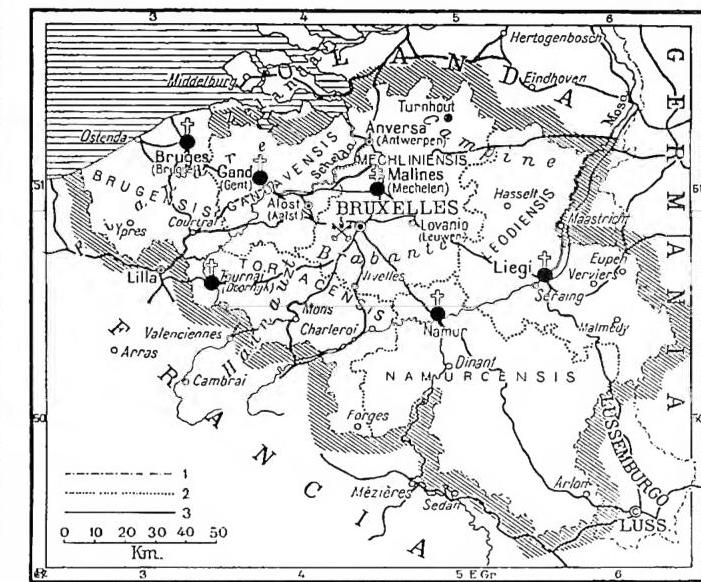
On 3 Feb. 1831 the National Congress elected as king the Prince of Nemours, second son of Louis Philippe, but this candidature was not accepted by the Powers. On 3 June Prince Leopold of Saxe-Coburg was elected; he was related to the English royal family. The new king immediately set about obtaining from the Conference the Treaty of the 18 Articles, which granted extensive compensation to Belgian claims both territorially and financially. The Congress ratified the treaty on 9 July and the king was able to enter Belgium and take the oath to the Constitution on the 21st of the same month.
1. Political Organisation and Parties. — The Constituent Assembly had established a hereditary constitutional monarchy with the separation of powers. The Church enjoyed complete independence, and the ministers of worship were paid by the State.
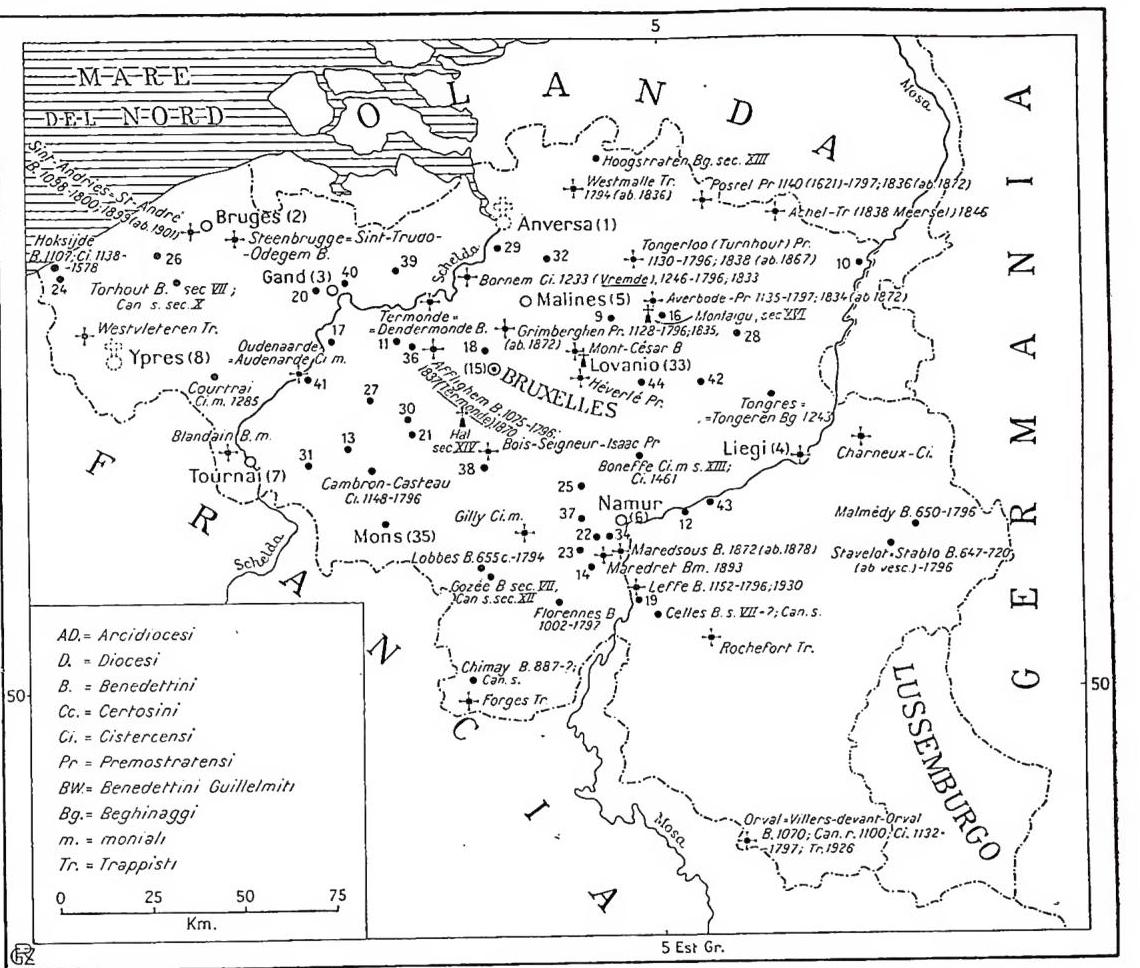
BELGIUM – Historical ecclesiastical map: 1. Antwerp, D. 1559–1801; Pr. 1124–1796; Ci. 1432–1796; Bg. 13th c. – 2. Bruges, D. 1559–1801; 1834. Can. r. 1050; Ce. 1318; Bg. 1244. – 3. Ghent, D. 1559. St-Bavon: B. 7th c.–1536; St-Pierre-du-Mont-Blandin: B. 7th c.–1578–1796; Baudeloo: B. 1197; Ci. 1215–1578; Ghent, 1578–1796. Byloque: Ci. m. 13th c.–1797; Nissenbosch (see), Ce. 1236; Bg. Grand-Beg. 1232; Pr. Beg. 1234. – 4. Liège-Luik, D. (4th c.: Tongeren) 718; Liège. St-Laurent: B. 10th c.–1797; St-Jacques: B. 1015–1797; Robermont: Ci. m. 1215–1796; Vivagnis: 1238–1796; Pr. 1124–1796; B. m. – 5. Mechelen, AD. 1559 (1801) B. 8th–11th c.; Can. r. 1289; Bg. 1259. – 6. Namur-Namen, D. 1559 (1801; 1842). Bg. 1235. – 7. Tournai = Doornik, D. 6th c. (united to Noyon – 1146) (1559, 1801) St-Martin: B. 7th c.–1796; Prés-Porchins: Can. r. m. 1233–1796. – 8. Ypres = Ypern, D. 1559–1801; Bg. 1240. – 9. Aarschot, Bg. 1250. – 10. Alden-Eyck, B. m. 8th c.; Can. s. 11th c.–1571; Bg. 1244. –
11. Alost, BW 1268
12. Andenne, B. m. 692–10th c.; Can. r. m. 1794. – 13. Ath. Ci. m. 1234. – 14. Brogne = St-Gérard, B. 914–1787. – 15. Brussels, Can. s. 1047; Ci. m. 1201. – 16. Diest, Bg. 1247. – 17. Dikkelvenne, B. 734–1081 (later Grammont). – 18. Dilighem, Can. s. 1095 Pr. 1140–1787. – 19. Dinant, B. ? Can. 11th c., Pr. 1152. – 20. Drongen = Tronchiennes, B. 7th c.; Pr. 1138. – 21. Edingen = Enghien, Bg. 1255. – 22. Floreffe, Pr. 1121–1797. – 23. Fosses, B. 7th c.; Can. s. 1008–1796. – 24. Furnes = Veurne B. ? Can. s. 1100; Can. r. 1120; Pr. 1130. – 25. Gembloux, B. 940–1796. – 26. Gistel = Ghistelles, B. m. 1090–1577. – 27. Grammont = Geerardsbergen, B. 8th c. (Dihlefenne), 1081–1797; Bg. 1245. – 28. Hasselt, Bg. 1245. – 29. Hemiksem, Ci. 1237 (1246). – 30. Herne = Hérinnes, Ce. 1314. – 31. Leuze, B. 7th c.; Can. s. 11th c. – 32. Lierre = Lier, Ci. m. 1235; Ce. 1235. –33. Louvain = Leuven, University; ancient: 1426–1797 (1835) new: (1833) 1835
Bg. 1230; B. 1135; Pr. (Parc) 1129; Can. r. 1204; Can. r. m. 1248; Ce. 1489. – S. 15th c., B. m. – 34. Malonne, B. 7th c.; Can. s. 9th c.; Can. r. 1147. – 35. Mons. Ste-Waudru: B. m. 688; Can. s. m. 13th c.; St-Pierre: B.; Can. s. 959; Val-des-Écoliers: Can. r. 1252–1796; Ci. m. 1216–1678; Bg. 1248. – 36. Moorsel, B. m. 8th–10th c.; Ci. m. 1228. – 37. Moustier, B. m. 7th c.; Can. r. m. 13th c. – 38. Nivelles = Nijvel, B. ? m. 640/50; Can. s. m. 10th c.–1798; B. 640/50–?; BW 1270; Bg. 1273. – B. 1070; Can. r. 1100; Ci. 1132–1797; Tr. 1926. – 39. Nieuwenbosch, Ci. m. 1246–1578. – 40. Oudenbosch, Ci. m. 1215–46. – 41. Pamele, Ci. m. 1233. – 42. St-Trond, B. 660; Bg. 1265. – 43. Solières = Ben-Ahin, Can. r.; Can. r. m. 1127; Ci. m. 1231–1796. – 44. Tienen = Tirlemont, Bg.Their number did not exceed thirty thousand. The unionists, under the leadership of Nothomb, Van de Weyer and Theux, held power from 1830 onwards. Nine years later the radical liberals organised a powerful party that broke away from the union, while the Catholics, remaining loyal, prepared public opinion through the foundation of a well-distributed press. A first liberal ministry, presided over by Lebeau, took office in 1840, but the following year it had to give way to the unionist ministry of Nothomb, followed in 1845 by that of Van de Weyer and in 1846 by the ministry of Theux. While the Catholics remained loyal to the unionist party, liberal and radical propaganda succeeded in 1842 in preventing the legal recognition of the University of Louvain and in securing a large parliamentary majority in 1847. With the ministers Charles Rogier and Frère-Orban, political struggle took on a harsh and oppressive aspect towards the Church. The liberals aimed to strip it of the assets of its school foundations, the funds destined for charitable works, and to eliminate its preponderant influence in the field of education. Catholic and liberal majorities alternated in Parliament until 1884. The Catholics, instructed by experience, had abandoned unionism and in 1878 had organised themselves into the Federation of Catholics, maintaining as their principal objective the defence of the principles of Catholicism, while the liberals moved ever further towards an anticlerical and sectarian policy. This direction reached its peak under the liberal ministry of Frère-Orban, which lasted from 1878 to 1884.
The elementary education law of 1879 banned religious instruction from school programmes and established the erection in each commune of a free, agnostic state school. From 1842 a modus vivendi, acceptable to Catholics, had established that religious instruction was official and under the control of the ministers of worship. Breaking the status quo, the liberals entered into open conflict with the bishops, who in turn condemned godless schools and forbade the faithful from attending them. Within a few months the Catholics organised elementary schools in every parish and, submitting to severe financial and personal sacrifices, gathered more than 63% of school-age boys in their free schools. The sectarianism and crudeness of the liberals so inflamed Belgian opinion in this struggle that they permanently alienated the trust of the electorate. In the elections of 1884 the Catholics obtained an overwhelming majority, which they maintained until 1919, despite the considerable extension of suffrage and the appearance of a third party, the socialist party.
When in 1918 a national union ministry was formed, King Albert promised universal suffrage for all citizens who had reached the age of twenty-one, meeting the socialists who had pursued this goal for forty years. Equality in sacrifice gave a right to electoral equality. The constituent assembly of 1919, elected on the basis of this right, recognised universal suffrage, granting women the vote only in administrative elections. A simple law could now extend this right to provincial and national elections. The right, which had remained the largest party, lost the majority it had held since 1884 and was deceived by socialist promises to support them on the issue of women’s suffrage. Subsequently the new party represented by Flemish nationalists, and then that of the Rexists in 1925, greatly reduced the right’s numbers, while the communist party made inroads within the socialist contingent. This situation for a long time gave the liberal party, reduced to about twenty-five deputies, the role of arbiter in the coalition governments that divided power between the two wars. In 1948 women’s suffrage was extended to all elections. In the current Chamber there are ninety-two deputies of the Social Catholic Party, sixty-five socialists, twenty-one liberals and twenty-three communists. In the Senate the Social Catholic Party holds almost half the seats. The government, presided over by Spaak, a socialist, has included representatives of the Social Christian Party and socialists since 1947. The socialist-liberal-communist coalition, which had taken power in July 1945, ceased to exist because of the monarchical question.
2. Economic and social issues. — If the field of struggle of the parties during most of the 19th century had been almost entirely limited to the doctrinal sphere, this was because, from an economic and social point of view, the propertied electors, grouped in the Catholic and liberal parties, were almost entirely in agreement.
Faced with this industrial prosperity, the condition of those workers who could not defend their rights through associations was precarious, and the reports of the Catholic congresses at Malines in 1863 reveal the existence of numerous abuses in the organization of workers’ lives. Yet the liberal spirit was still too strong to allow a successful appeal to the coercive intervention of the State. The liberal myth of the harmony of interests impeded the action of well-intentioned men.
Socialist propaganda found fertile ground among the masses of workers uprooted from their homes, poorly housed, and forced to conceal their movements of solidarity within mutual aid societies. The right to strike and to organize was legally recognized in 1866. The inquiry of 1866 enabled the Catholic ministry of Beernaert to grasp the gravity of the situation and prompted it to undertake progressive social legislation that placed Belgium at the forefront of Europe. The principal laws addressed the following areas: prohibition of child labor and of the employment of women in mines and unhealthy industries; limitation of working hours in mines and, subsequently, in factories; protection of wages and safety measures against workplace accidents; insurance against accidents and provision for old age; construction of workers’ housing; and, finally, reform of the electoral code.
The socialist unions, which were the first to be organized, included many Catholic workers. An impressive network of cooperatives and mutual aid funds supported the movement, which had two major daily newspapers and a strongly disciplined and united political party capable of effectively pursuing its goal of universal suffrage. The Catholics, who had recognized the existence of the social question as early as the Malines congress of 1863, waited a long time before taking action. It would not be until 1895—five years after Rerum novarum—that a formal response was forthcoming. The time lost in this deplorable delay was never fully recovered. The working masses were won over by socialist propaganda, especially in Wallonia, and the efforts of Christian democrats led by G. Kurth and Abbot Pottier were exhausted in sterile polemics with conservative right-wingers. The heroism shown by Christian trade unionists in making up for lost time can never be sufficiently emphasized. In 1901 they numbered 11,000; in 1914, 123,000; in 1939, 350,000; and today they number 500,000. The majority of members come from the Flemish regions. Today, though the Christian labor movement in Wallonia is not negligible—especially since the intervention of the J.O.C. (Jeunesse Ouvrière Catholique)—it remains far behind the ranks of socialist unionism. In the Walloon regions there are approximately 60,000 Christian union members compared to 350,000 socialists. Flemish workers have Het Volk, a well-edited and widely circulated newspaper. It should also be noted that the average age of workers enrolled in Christian unions is below forty, whereas those in socialist unions are distinctly older. The mutual aid societies at the beginning of the nineteenth century were exclusively inspired by Christian principles, and their members long remained within the old frameworks. For thirty years the socialists have directed their efforts toward this sector. The membership of socialist societies stood at 723,203 on 31 December 1946, while that of Christian organizations amounted to 681,710.
If Catholics suffered an undeniable setback in organizing the working class by remaining for too long opposed to unions, they did, in compensation, succeed in grouping the vast majority of farmers in the Flemish-speaking regions into the Boerenbond (q.v.), or Farmers’ League. In 1880 farmers had been struck by a severe agricultural crisis. Within a few years, however, Belgian agriculture overcame the crisis, doubling and in some cases even tripling production per hectare, and shifted toward more profitable industrial crops or selected livestock breeding.
The establishment of agricultural cooperatives for sales, purchases, and credit by the Boerenbond (q.v.) saved Belgian agriculture, securing it one of the leading positions in Europe.
3. The Flemish Question. — In 1830, reaction against Dutch laws on language had led the constituent assembly deliberately to ignore Flemish in political life, administration, and even the courts, despite the fact that the majority of the population in the northern provinces did not speak French. Beginning in 1840, a broad literary revival movement emerged in Flanders, leading to demands for equality between the two national languages. The first manifestations within Parliament occurred in 1856. In 1886, the Catholic ministry of Beernaert founded the Flemish Academy, thereby eliminating every trace of the inferiority of Flemings before the courts. The democratization of the electorate led to a Chamber of Deputies ignorant of French and placed the language question on a broader plane: the Flemish question became one aspect of the social question.
The Fransquillons, bourgeois of the Flemish cities tied for centuries to French culture, disdained the popular language and neglected knowledge of the literary language, which impeded the cultural emancipation of the Flemish masses. The campaign of the Flemish advocates soon took on a sentimental and romantic character, animated by a lively nationalist sentiment. Catholic youth and the clergy actively participated in this movement for the vindication of Flemish rights and linguistic parity, which was directed more against the Fransquillon classes than against the Walloons. The demands were: exclusive use of Flemish in education and administration, regional recruitment with entirely Flemish units. These demands, supported in Parliament by part of the right wing and a few deputies from other parties, were gradually realized, provoking passionate controversies. During the German occupation of 1914–18, the German authorities attempted to exploit the Flemish movement to divide the country and impose administrative separation, making Ghent University Flemish—the only higher institution reopened under pressure from the occupying authorities. The controversies that followed poisoned Belgian domestic politics for many years.
Under the pressure of these movements, Flemish Catholics were compelled to support the relevant legislative measures. The present situation is as follows: regional monolingualism, bilingualism in the Brussels agglomeration and in the general administration, and bilingualism in Parliament. The legitimate demands of the Flemings have thus been gradually satisfied, and the Flemish nationalist party, compromised by its ties with the occupier during the Second World War, has ceased to exist. The linguistic difficulties that had weighed so heavily on Belgian life have thus been definitively resolved.
The population of Belgium has been steadily increasing despite the losses caused by the last two wars. In 1831 it numbered 3,786,000 inhabitants; a century later, in 1913, 7,639,000; and in 1948, 8,450,000. The birth rate remained below 3.2% until 1880, then gradually declined to 1.4%, rising again to 1.7% in 1947. The demographic crisis and the influence of neo-Malthusianism are particularly strong in the large urban centres and in the Walloon regions.
III. THE CHURCH IN BELGIUM
The Christian conquest of Romanized Belgium (which formed part of Gallia Belgica) was relatively late, and few traces remain. The bishop of Tongres, Servatius (Servais), appears at the Council of Rimini in 359, while Superior, bishop of the Nervii, is mentioned in a Council of the Gauls in 356. The figures listed in the earliest episcopal catalogues of Tongres and Tournai, which date back to the time of the disciples of St Peter, are legendary. To obtain other names of bishops that offer secure historical guarantees, one must wait until the 6th century.
Falco, bishop of Tongres, and Vedastus (Vaast), bishop of Arras, were contemporaries of Clovis. Eleutherius appears at Tournai around 531. These bishoprics do not seem to have lasted long: Arras was united to Cambrai until 1094, and Tournai was annexed to Noyon until the 12th century. From Maastricht, the see of Tongres was transferred to Liège after the death of St Lambert in 705. A bishopric founded at Thérouanne by St Audomar (Omer) in 663 extended its jurisdiction over western Flanders. The boundaries of the dioceses, fixed at that time according to those of the Roman political divisions, remained unchanged until 1559.
St Amandus, St Remaclus and their monks were the principal evangelizers of Belgium until the 7th century. Numerous abbeys were founded at Ghent, Stavelot, Fosses, St-Trond, Lobbes, St-Hubert, Andenne, and Nivelles.
Irish and Anglo-Saxon monks assisted them in re-establishing Christianity. Hagiographic legends provide the biographies of these valiant pioneers, but they are too late or conventional to offer an exact picture of this slow work. The Danish, Norman and Hungarian invasions of the 9th century often destroyed the monasteries. The parishes established under Charlemagne were developed by Bishop Walchand of Liège, who took care of the religious instruction of the faithful and the formation of their pastors. In the 11th century, therefore, parochial centres multiplied in the towns and villages, and alongside the ancient parish churches, castle or demesne churches arose. Chapters and collegiate churches were established in the boroughs: in 1122 their number reached 90. The dioceses were divided into archdeaconries and deaneries governed according to customary law. In the 12th century there was a new flourishing of monasteries: Floreffe, Averbode, Tongerloo, St Michael’s at Antwerp, founded by St Norbert; Villers, Orval, Aulne, founded by St Bernard. These abbeys fostered the formation of the clergy and of parishes or ensured the cultivation of abandoned lands. The abbeys, chapters, and lords exercised extensive patronage rights over the parish churches of their domains, collected tithes, and seriously contested episcopal authority. Of the 3,587 churches then counted in Belgium, 465 are dedicated to the Blessed Virgin, 230 to St Peter—especially the oldest ones—and 350 to St Martin.
Bishops Notker of Liège (972–1008) and Erluin of Cambrai obtained recognition as counts and princes of the empire and established important principalities within their dioceses. Their successors were likewise involved in feudal conflicts, and their sees became objects of political ambition. Bishops and
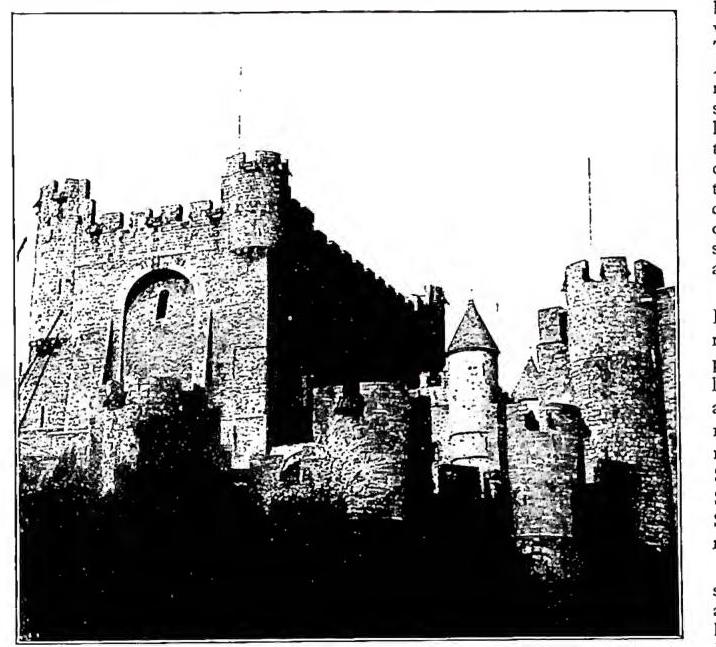
BELGIUM - Castle of the Counts of Ghent. Founded around the 10th century, expanded at the end of the 12th century. Restored in modern times.
From the beginning of the 13th century, Franciscan and Dominican convents arose in most cities, dedicating themselves to preaching and filling gaps in the ministry of secular clergy. Female monasteries multiplied as well: first the Norbertines, then the Cistercians, the Beguines, and later the Franciscans. There were numerous vocations among mystics: Beatrice, Hadewijk, and Juliana of Cornillon, to whom we owe the celebration of the feast of Corpus Christi, instituted in 1248.
Of the early Middle Ages, the churches of Nivelles, St. Bartholomew in Liège, Hastière, and Celles remain as monuments, their style linked to Rhenish Romanesque. Liège and Tournai were centers of goldsmithing and ivory carving in this period. In the 13th century, the cathedrals of Tournai, St. Bavo in Ghent, and St. Gudula in Brussels were built. Hugo d’Oignies created masterpieces of goldsmithing with the reliquaries of St. Hadelin of Visé and St. Gertrude of Nivelles. In the 14th and 15th centuries, buildings of great artistic value arose, such as the church of St. Rumbold in Mechelen and the abbeys of Orval and Villers. Liège and Tournai were notable intellectual centers in the 11th and 13th centuries.
The Burgundian period was disrupted by the Great Schism. The hierarchy dependent on France sided with Avignon, while the people of Liège and Flanders remained faithful to Rome. From a religious standpoint, the poor choice of bishops—benefit-seekers appointed by the Avignon popes and later by the dukes of Burgundy—accelerated religious decline, which persisted into the 16th century. The foundation of the University of Leuven in 1425 fortunately provided a valuable bulwark and exerted a profound influence on the country, fostering a common intellectual mindset and well-educated pastors. The Lutheran error was condemned in Leuven as early as September 1520, even before the Roman Church intervened. Lutheranism initially had little success, except in Antwerp and a few other cities. The Anabaptists made deeper inroads among the common people, while Calvinism was more widely embraced by intellectuals in Hainaut and Flanders, though never to the extent seen in the northern provinces of Holland and Frisia. The most critical moment came in 1565, during the period of iconoclastic excesses. The bloody repression by the Duke of Alba hardened opposition further, and it was only through the reaction of the Walloons and the successes of Alexander Farnese that Catholic worship regained its freedom in the counties of Flanders and Brabant.
The principal reform consisted in the creation of 14 new bishoprics in 1559 at the request of Philip II. From 1565 onward, the new bishops were able to implement the decrees of the Council of Trent and oversee their observance as soon as Farnese’s armies had pacified the region. Assisted by the Jesuits, Capuchins, Recollects, Benedictines, Carmelites, and Oratorians, they prepared the magnificent Catholic revival under the Archdukes. Heretics were absorbed or forced to leave the country. By the 17th century, the number of Calvinists in the Catholic Netherlands had dwindled to a few scattered representatives. The nunciature, established in Brussels in 1596, collaborated with the bishops’ efforts, particularly in the campaign to bring exempt chapters into line.
Order and harmony were soon disrupted, however, and even the faith was endangered by the controversies stirred by the spread of Jansenist doctrines (1642). The bishops of Mechelen, Ghent, and Ypres, along with a large portion of the theological faculty at Leuven, rose against the condemnation of Jansenius, bishop of Ypres, who had always remained in communion with the Church, attributing the condemnation to Jesuit hostility, and refused to submit to the Pope’s decision of 1643. Vigorous action by Archbishops de Proceciano (1690–1710) and Philip d’Alsace (1716–65) was required to eliminate all remaining opposition within the clergy. The latter’s work in securing acceptance of the bull Unigenitus and recognition of papal authority was so highly regarded that he was made a cardinal in 1719. Jansenism nevertheless remained powerful in councils and continued to exert influence in the state’s opposition to clerical privileges.
The bishops of the Austrian period were generally active and spared their faithful the deleterious influence of the French Encyclopedists. The suppression of the Society of Jesus and its numerous colleges under Maria Theresa, followed by the abolition of many contemplative convents under Joseph II, along with the other anti-clerical laws of that monarch, provided tangible proof of the decline in Catholic influence. The Brabant Revolution was one of its consequences. By the last years of the 18th century, it was estimated that 30 to 40 percent of people in Brussels did not receive Easter communion.
De-Christianization was intensified by the French invasion. The French confiscated and sold Church property; they abolished 9 bishoprics, 3,400 parishes, 12 seminaries, 25 chapters, 110 abbeys, and 275 convents with more than 17,350 religious. Persecution reached unprecedented levels. Under the Concordat of 1802, the dioceses were profoundly transformed. In addition to the archbishopric of Mechelen, the bishoprics of Ghent, Tournai, Liège, and Namur were restored. The Rhenish dioceses of Aachen, Trier, and Mainz were united with the metropolitan see; the “Forests” department, the former Luxembourg, was assigned to the diocese of Metz. Napoleon appointed French bishops everywhere, who immediately aroused suspicion among part of the clergy for their submission to the Organic Articles; nonetheless, they managed to reorganize worship and recover undivested property. But the imposition of the imperial catechism in 1806, followed shortly by the rupture with Pope Pius VII, sparked violent opposition. The bishops of Tournai and Ghent were imprisoned for upholding their clergy’s position at the Council of Paris in 1811. By the time of Belgium’s liberation in 1814, only one bishop—of Namur—remained in office. The bishops of Tournai and Ghent, once restored to their sees, opposed the adoption of the constitutional law of the new Kingdom of the Netherlands and the oath associated with it, which they had good reason to view with suspicion from a religious standpoint. The conflict intensified further when, in June 1825, William I abolished free secondary education and made the philosophical college of Leuven—under government control—compulsory. The conclusion of the concordat in 1827 and the appointment of new bishops, after lengthy negotiations with Rome and the unsuccessful presentation of unworthy candidates, did nothing to dampen the zeal of the petitioners. William delayed the repeal of the educational laws until 1829. Belgian liberals, allied with Catholics, supported the overthrow of the regime in 1830.
In the full possession of all the freedoms guaranteed by the Constitution of 1831, the new bishops—strengthened by the appointment of Sterkx as archbishop of Mechelen (Malines) and by the restoration of the bishopric of Bruges in 1834—were able to reorganize Catholic education. With the founding of a university at Mechelen in 1834 and at Leuven in 1835, they secured for Belgian Catholics the means for higher scientific formation. Religious congregations took full advantage of the freedom of association. The same was true of numerous hospital and educational congregations, which secured for Belgian Catholics almost a monopoly over middle-school female institutes and charitable institutions. As in the time of the Archdukes, a genuine Christian revival took place. The seminaries, once again filled, supplied numerous and enthusiastic recruits to the diocesan clergy. The ideas of Lamennais, which had made a strong impression on the Belgian clergy before his condemnation in 1832, were gradually abandoned or modified, thanks to the good sense of the bishops and despite the anxieties of Leopold I and Roman circles. At Leuven, however, traditionalism still had ardent partisans.
While Belgian Catholics knew from the outset how to benefit from the freedom of education, they neglected too much the freedom of the press, allowing themselves to be outpaced by strongly anticlerical liberal newspapers, which waged a fierce campaign against the Church. One of the most burning issues to arise under the early liberal ministries was the secularization of charitable institutions and cemeteries. Cardinal Sterkx and, after him, Cardinal Dechamps, his successor, fought in vain to obtain recognition of the civil personality of convents and pious works. It was necessary to wait until the law of 1912 on nonprofit associations for Catholics to achieve satisfaction on this point. The struggle to defend Catholic positions was supported by the bishops Malou of Bruges and De Montpellier of Liège. The difficulties it had to overcome reached their peak in the school battle that broke out in 1879. The bishops, with their intransigence, galvanized the resistance of Belgian Catholics and emerged victorious from the crisis of 1884. Apostolic activity is marked by the congresses held at Mechelen in 1863 and in subsequent years, and from the social point of view by the congresses of Liège in 1886 and of Mechelen in 1898 and 1909. Parochial missions and retreats for workers were among the most effective means of slowing the progressive process of de-Christianization that struck the Belgian Church from 1890 onward. The tactic subsequently adopted by the clergy and the faithful was to organize as many works as possible specifically directed to the needs of individual social groups. These works were strongly encouraged by the episcopate under the inspiration of Cardinal Goossens (1883–1906) and Cardinal Mercier (1906–26). The latter was also the inspirer of the Belgian Catholic Youth Association, whose dynamism and the great congresses of Charleroi and Liège in 1928 awakened so many hopes among Belgian Catholics. In the working class, the J.O.C. (Jeunesse ouvrière catholique), founded by Abbot Cardijn, provided a new formula for the reconquest of working women. One of the most painful concerns of the laborious apostolate of the Belgian clergy, both secular and regular, is certainly the phenomenon of de-Christianization in working-class centers. The curve of de-Christianization is on the rise, al-
(photo: Paul Gaffin, Brussels)
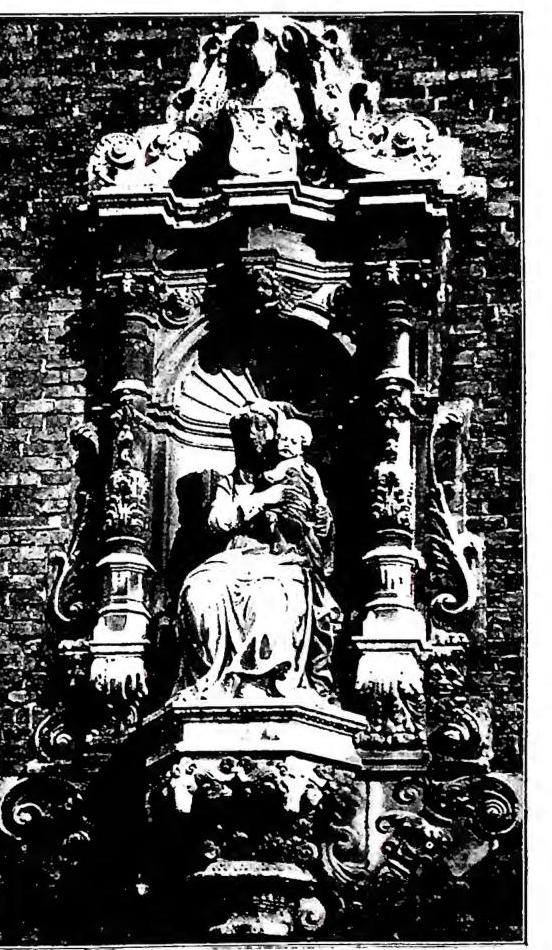
BELGIUM - Statue of the Virgin on the façade of the town hall (late 16th century) - Bruges.
The population of Belgium on January 1, 1948, was 8,450,000 inhabitants, very unevenly distributed among the various dioceses. The archbishop of Mechelen counts 3,500 priests for more than 3 million inhabitants. The population of each of the other dioceses generally exceeds one million, except Namur, which has fewer than 600,000 inhabitants and 1,200 priests. The same disproportion is found in the parishes. It is not uncommon to find in the diocese of Mechelen parishes with more than 25,000 inhabitants, while some parishes in the diocese of Namur have only 250.
Each diocese has one or more minor seminaries and a major seminary. The number of vocations, which for a long time was sufficient for the needs of the Belgian Church, is now beginning to decline, although overall it remains quite high. The diocese of Tournai, which had suffered in recent years from a shortage of vocations, is gradually recovering. Clerics are subject to military service, which is performed in homogeneous medical units. During their year of service, seminarians and religious can continue their theological studies under the direction of their military chaplains and special professors. Two houses dependent on the episcopate allow a certain number of seminarians and young priests to pursue their university studies in Leuven. However, the demands of parish ministry restrict the number of those who can be granted permission to continue higher studies. The Belgian College in Rome houses a number of priests and clerics studying in pontifical institutes.
The fidelity and attachment of the Belgian episcopate and Catholics to the Holy See have never wavered since 1830. It was in the diocese of Ghent that, in 1859, the work of the Peter’s Pence was founded, intended to assist the Holy See in defending its sovereignty. Many Belgians fought among the Papal Zouaves organized by the Minister of Arms of the Papal States, Monsignor De Mérode. In the doctrinal field, the intervention of Cardinal Dechamps, archbishop of Mechelen (1865–83), was among the most notable. The constitution Dei filius of the First Vatican Council took up the essentials of his argument. All the Belgian bishops supported the definition of papal infallibility, a traditional doctrine of the University of Leuven. Cardinal Mercier, archbishop of Mechelen, and his successor, continued the tradition of the attachment of the Belgian Church to that of Rome. The representatives of the Holy See in Belgium, internuncios from 1835 to 1841 and then nuncios from 1841 to 1880 and from 1880 to the present day, have discharged with honor the delicate task of mediators, especially when liberal and sectarian governments, from the beginning of independence, clashed with combative and energetic bishops. In the school conflict of 1879, the latter were victims of the sectarianism with which the struggle was conducted, and, due to the intransigence of the liberals, relations with the Holy See were interrupted for five years. When the Catholic ministry of 1885 restored normal relations, the nuncios pursued a policy of pacification that earned them the gratitude of the Belgians on several occasions. The most famous of the former nuncios was Monsignor Pecci, who later became Pope as Leo XIII. The nuncios have never ceased to participate intimately in the life of Belgian Catholics and have valiantly defended them during the difficult period of foreign occupation.
Stavelot-Malmédy, in Terre wallonne, 10 (1924); Th. Ploegserts, Les moniales cisterciennes, 4 voll. (Aywieres, La Ramée, Florival e Wauthier-Braine), Bruxelles 1925-26; J.-M. Canives, L'ordre de Cîteaux en Belgique des origines (1930) au XXe siècle, Forges-les-Chimay 1926; Fl. Prims, Geschiedenis van Antwerpen, Bruxelles 1927; A. Poncelet, Histoire de la Compagnie de Jésus dans les anciens Pays-Bas, 2 voll., ivi 1927-28; L'université de Louvain à travers cinq siècles. Etudes historiques, pubblicati sotto la direzione di L. Van der Essen, ivi 1927; Autori vari, Histoire de la Belgique contemporaine, 3 voll., ivi 1928-30; L. Jadin, Procès d'information pour la nomination des évêques et des abbés des Pays-Bas, de Liège..., 3 voll., Roma 1928-31; L.-E. Halkin, L'héroïne et sa répression au pays de Liège avant la Réforme, Tongres 1929; F. Willock, L'introduction des décrets du Concile de Trente dans les Pays-Bas et dans la principauté de Liège, Louvain 1929; U. Berlière, Coup d'œil historique sur l'ordre bénédictin en Belgique dans le passé et dans le présent, in Revue liturgique et monastique, 14 (1929), pp. 458-522; V. Fris, Histoire de Gand, Gand 1930; S. Tassier, Les démocrates belges de 1789. Etude sur le vœu-rhisme et la révolution brabançonne, Bruxelles 1930; H. J. Elias, Kerk en Staat in de zuidelijke Nederlanden onder de redeering der artshertogen Albrecht en Isabella (1595-1621), Anversa 1931; A. Verhaegen, Le card. de Franckenberg, Lilla s. d.; E. de Moreau, Belgique, in DIIG, VII, coll. 520-736.
L. Jadin
IV. LETTERA-
In Belgium, part of which was annexed to France under Louis XIV, the two ethnic groups—the Flemish, who speak Dutch, and the Walloons, who speak French—have their own literatures. These, however, through coexistence and intermarriage, harmonize in expressing, with a richness of color (the first more than the second, refined by the Latin genius), profound sentiments and aspirations for well-being, sometimes too material or sensual.
34. Flemish Literature
In the 13th century, didactic poetry in Flemish is represented by Jacob van Maerlant, translator of French and Latin works, and mysticism by the religious Beatrice of Nazareth and Hadewijch, whose work in the 14th century was surpassed by the greatest mystic of the Low Countries, Bl. John van Ruysbroeck (d. 1381), with his masterpiece Die cierheit der gheesteliker Bruloch (“The Adornment of the Spiritual Marriage”). The “Chambers of Rhetoric” (rederijkamers), associations whose purpose was the recitation and performance of mysteries, dramas, miracles, etc., persisted until the 17th century. The Renaissance with its individualism, Humanism with its return to classical antiquity, the Reformation with the rupture of religious unity, religious and political struggles, and finally the separation of the northern United Provinces (Holland) from Flanders all greatly influenced the literature of the 16th and 17th centuries. It fell to Classicism and later to other French cultural currents to act upon the Flemish literature of the following century, which, however, marked a decline.After Belgium became independent in 1830, Flemish literature flourished again in reaction against French influence and could boast of Jan Frans Willems (d. 1846), the father of the movement itself, and Canon Jan David (d. 1866), as well as writers both Romantic and Realist, such as Hendrik Conscience (d. 1883), author of the famous De Leeuw van Vlaanderen (“The Lion of Flanders”), and August Snijders (d. 1904), among the most prolific and widely read. A host of writers followed, mostly of unmistakably Catholic faith and particularly interested in social issues; they were poets, playwrights, novelists, short story writers, critics, and historians. To West Flanders belong Guido Gezelle (d. 1899), a poet comparable to Vondel, the poet Albrecht Rodenbach (d. 1880), the short story writers Hugo Verriest (d. 1922) and Stijn Streuvels (pseud. of Frank Lateur). Among those who wrote in this century, mention should also be made of Edward Vermeulen, Karel van de Woestijne (d. 1929), August Vermeylen (d. 1945), Maurits Sabbe (d. 1938), Maria Belpaire (d. 1948), Cyriel Verschaeve, Ernest Claes, and Felix Timmermans (d. 1947), whose volume Pallieter was translated into various languages.
The development and dissemination of Flemish literature were also significantly aided by the journals Van Nu en Straks (founded in 1893) and Dietsche Warande en Belfort (founded in 1900), the latter distinctly Catholic. The study of asceticism and mysticism flourishing in the Low Countries up to 1750 is instead the focus of the journal Ons geestelijk Erf (founded in 1927).
35. French Literature
Apart from works written in Picard and Walloon dialects, French literature in Belgium begins in the 13th century with the chanson de geste of Adenet le Roi and the rhymed chronicle of Philippe Mousket, continuing in the 14th century with the chronicles of Jean le Bel and Jean Froissart (d. 1404), his brilliant continuator. Generous patrons in the 15th century were the four Dukes of Burgundy, from Philip the Bold (d. 1404) to Charles the Bold (d. 1475), who also possessed rich libraries. Notable historiographers of that century include Georges Chastellain (d. 1475), Jean Molinet (d. 1507), Jean Lemaire de Belges (d. 1524), and Philippe de Commines (d. 1511), the latter a truly modern writer. The same factors that influenced the evolution of Flemish literature in the 16th and 17th centuries also affected contemporary French literature; the Prince de Ligne (d. 1814) is the most important among writers of the 18th century.With the establishment of the kingdom (1830), a renewal of literature followed, which in the last century boasted the poet André Van Hasselt (d. 1874), the moralist Octave Pirmez (d. 1883), the novelist Charles De Coster (d. 1879), author of La légende d’Ulenspiegel; the historians Louis Gachard (d. 1885), Joseph Kervyn de Lettenhove, and Léon Vanderkindere; the orators Charles
(courtesy of the Commissariat général du Tourisme)
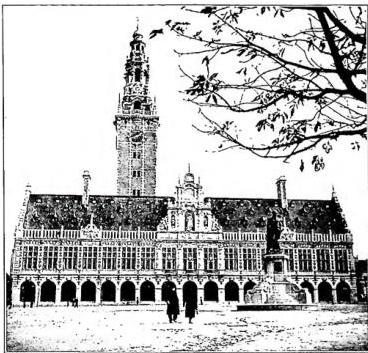
BELGIO — The University of Louvain, founded in 1425.
Among the most illustrious figures in Belgian public life in the 19th century were Charles Rogier (d. 1885), Hubert Frère-Orban (d. 1896), Auguste Beernaert (d. 1912), and Msgr. Charles Cartuyvels (d. 1907); the theologian Cardinal Victor Dechamps (d. 1883), a Redemptorist and Archbishop of Mechelen.
Among the finest writers of this century, though not always respectful of the Catholic faith and morality, should be noted Camille Lemonnier (d. 1913), a naturalist novelist; the eminent poet Émile Verhaeren (d. 1916); and the celebrated playwright Maurice Maeterlinck (d. 1920). We may also recall the poets Hector Hoornaert, Georges Rency, and Alphonse Hardy; the playwrights Fernand Crommelynck and Gustave Van Zype; the novelists Edmond Picard (d. 1924), Edmond Glesener, Georges Virrès, Léopold Courouble, and Henri Davignon; the short-story writer Paul Demade; the critics Eugène Gilbert (d. 1919), Msgr. Schyrgens (d. 1937), and Firmin van den Bosch (d. 1949); the orators Auguste Beernaert (d. 1912) and Charles Woeste (d. 1922); the historians Godefroid Kurth (d. 1916) and Henri Pirenne (d. 1935); and the philosophers Maurice De Wulf (d. 1948) and Cardinal Désiré Mercier, Archbishop of Mechelen (d. 1926).
For art, see FIAMMINGA, ARTE.
V. EDUCATIONAL SYSTEM
Belgian schooling is based on interconfessionalism and neutrality. Religion is compulsory, but exemption from religious instruction is granted to anyone who requests II. Ten percent of pupils are exempted.Preschool instruction is provided in kindergartens, which are divided into 1,290 municipal, 1,040 Catholic, and 1,336 private.
Schooling comprises primary, secondary, and university education. Primary schools include 5,077 “écoles communales,” 1,971 “écoles adoptées,” 1,295 “écoles adoptables,” and “écoles privées.” The “école communale” is neutral and interconfessional; the “école adoptée” is a Catholic school under state jurisdiction, required to provide free instruction to a certain number of children; the “école adoptable” is a private school not under state jurisdiction, with teachers paid by the state; the “école privée” is not under state jurisdiction.
Secondary schools are divided into lower and upper levels, both for boys and girls. Lower secondary schools for boys comprise 89 state, 7 municipal, 6 patronal, 41 religious, and 23 private schools. Lower secondary schools for girls include 46 state, 10 municipal, 252 religious, and 26 private schools, lasting two years. From lower secondary schools, students proceed to upper secondary schools called “athénées” or “collèges.” There are 26 athénées, 4 municipal collèges, 9 patronal collèges, 61 episcopal collèges, 41 collèges of religious orders, and 19 private collèges.
There are four universities: the Catholic University of Louvain, founded in 1835, which revived the ancient traditions of the university founded in the same city in 1425; the Flemish University of Ghent, founded in 1806; the Liberal University of Brussels, founded in 1834; and the State University of Liège, founded in 1816. There are four state conservatories in Brussels, Antwerp, Ghent, and Liège, in addition to numerous municipal conservatories in major centers.
Teachers are trained in “écoles normales primaires,” which last five years and are divided into male and female normal schools. The former include 9 state, 5 municipal, 17 episcopal, and 1 run by a religious order; the latter include 7 state, 7 municipal, 36 episcopal, and 8 run by religious orders. The Catholic clergy are educated in the six episcopal seminaries and at the Faculty of Theology of the University of Louvain.
Young people intending to go to the colonies are trained at the Colonial University of Antwerp. — See Pl. LXXIV.