
MAASTRICHT. - Ancient diocese in Holland, now within the diocese of Ruremonda.
As the name indicates, the city owes its origin to a boat or a ford across the Meuse: «trajectum ad Mosam». Later, a bridge joined the two banks, and along it ran the great military road of Gaul, through Bavay, Tongres, and M. to Cologne. The same settlement, dating back to prehistoric times, had already extended beyond both banks by the 2nd century A.D., without yet being surrounded by walls. During the upheavals of the 3rd century, M., like other places, acquired its castellum to defend the bridge, which had presumably been rebuilt at that time.
S. Servatius, bishop of Tongres, found a secure residence here; thus M. became the first episcopal city of the Netherlands and remained so for the 21 successors who had their see at M., until S. Bertus transferred it definitively to Lüttich in 722. His successors, who often continued to style themselves bishops of Tongres, retained their rights over M. and shared them with the Frankish kings, who had a palatine county at M., where they also collected customs duties. This situation gave rise to the long struggle between the «familia a Lamberti» and the «familia a Servati», that is, between the bishop’s party and that of the emperor. The «Oude Caerte» led to an arbitration between the bishop of Lüttich, Giovanni IV of Flanders, and his brother-in-law Giovanni I of Brabant. This pact remained in force until the French Revolution, although in 1632 the Dutch Republic intervened in the rights of the duke of Brabant. After the restoration of the monarchy and the union with the Southern Netherlands, M. became the capital city of the province of Limburg, and in 1830 remained loyal to the king, so that, together with half of the territory of Limburg, it remained united with the Netherlands.
The bridge of S. Servatius is famous (built between 1280 and 1298, restored from 1684 to 1714 and in 1934–35); beside it, the Wilhelmina Bridge was built in 1935. The Town Hall was built by the Hague architect Pieter Post between 1659 and 1664 and is also known for its tapestries and paintings.
But the churches are more renowned. The Romanesque church of S. Servatius has massive towers of the 11th century on its western side, while the great southern portal dates from the 13th century and, with its proto-Gothic forms, contrasts with the rest.
The church of the Virgin dates from the 11th century, but the front section with its towers is from the 10th century. It is entirely Romanesque. Particularly beautiful is the upper choir, surrounded by a double colonnade, beneath which lie two crypts. In a chapel beside the Basilica is the marvellous image of the Virgin, Stella del Mare. Behind the chapel are cloisters from the 10th century, part of which is used as a treasury for the numerous relics.
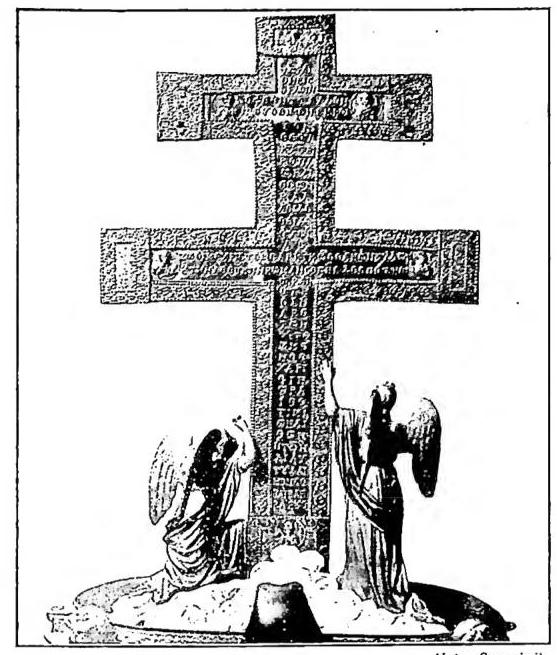
(photo Sanssini)
MAASTRICHT — Reliquary of the True Cross of M. Rear side with the Greek inscription in iambic metre (10th or 11th century) — Basilica of S. Pietro, Treasury.
On the front are affixed five medallions representing G. Cristo, the praying Madonna, the archangels Michele and Gabriele, and S. Demetrio. On the reverse, an inscription in Greek iambic metre, dating from the time of the emperor Romano II (959–63) or Romano III (Argiro, 1028–32), is engraved on the gold plate; it was published as early as the fifteenth century. The staurotheca was donated to Gregorio XVI, who in 1837 placed it among the distinguished relics of the Vatican Basilica, enclosing it in a silver reliquary.