
LUIGI FILIPPO, Duke of Orléans, King of the FRENCH. - B. Oct. 6, 1773 in Paris, d. Aug. 26, 1850 at Claremont Castle, County Surrey (England).
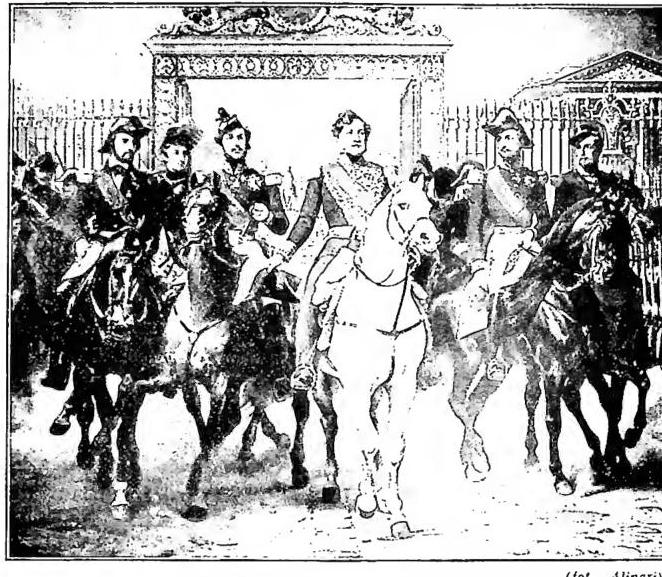
(from H. Kehrer, F. de Zurbaran, Munich 1918, tab. (1)
Upon the death of Louis XVIII, Charles X conferred upon him the title of Royal Highness. Following the promulgation of the four ordinances by Charles X, which triggered the outbreak of the July Revolution, the Duke of Orléans, with the support of Thiers, became regent on July 30, 1830. On Aug. 7, in a joint session of the two Chambers, he was proclaimed King of the French and took the oath on the new Constitution. The new King immediately found himself faced with two opponents, the legitimists and the republicans. To keep them in check, he relied on ministries supported by the parliamentary majority, but after the Parisian insurrection of June 1832, put down by the army, L. F. interfered increasingly in political affairs and in the government of the country, settling into a form of conservatism tending to guarantee the bourgeoisie that had brought him to power their acquired advantages, shunning any program of reforms. A chasm thus came to be created between the legal country and the real country, between Parliament and public opinion, which led on Feb. 24, 1848 to the abdication of the King and the proclamation of the Republic. The foreign policy of France during this period was subject to the same evolution. At first the Sovereign supported national movements in Europe, and during the Italian uprisings of 1831 proclaimed the principle of non-intervention, but subsequently, after 1840, he drew closer to Austria (whose armed intervention in the Papal States he had instead opposed in 1832 with the occupation of Ancona to counter Vienna's political influence in the peninsula), and also adopted in foreign policy the rigid conservatism of his domestic policy. Too skeptical to become a persecutor, L. F. in his relations with the Church was essentially a prisoner of the political forces that had led him to power, to the extent of finding himself constrained, during the second part of his reign, to adopt, on the school question and toward the Jesuits, a policy contrary to the Catholic religion and the Holy See.