
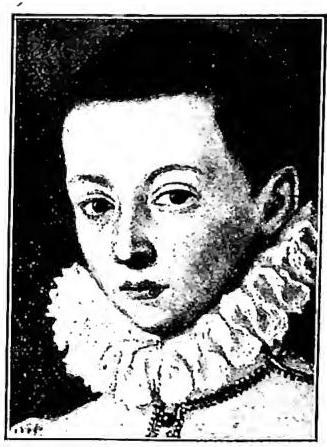
LUIGI GONZAGA, saint. — Born on 9 March 1568 in the Castle of Castiglione delle Stiviere near Mantua, the firstborn son of Ferrante G., prince of the Empire and marquis of Castiglione, and of Marta Tana Santena of Chieri; died on 21 June 1591 in Rome. At the age of five he followed his father to the military camps at Cremona, learning the life of a soldier. In 1577 he was in Florence with his brother Rodolfo, a page at the court of Francesco de’ Medici, grand duke of Tuscany. There, in the church of the Most Holy Annunciation, before the celebrated image of the Virgin, he vowed to God perpetual virginity.
Taking an illness as his opportunity, L. devoted himself to austerity through the practice of fasts and penances, which he combined with long hours of prayer. In 1580 he received his first Communion from the hands of s. Carlo Borromeo, who had passed through Castiglione on a pastoral visit; from then on he felt an immense affection for the sacrament of the Eucharist, attending Holy Mass every day and receiving Communion on every feast day. In 1580–81, at Casale Monferrato and at the shrine of Crea, established through the work of the Barnabites and Capuchins, he resolved to embrace the state of perfection, already beginning to lead a religious life at court. In the autumn of 1581 he accompanied the Empress Maria of Austria with his relatives to the court of Philip II in Spain, where he remained for two years as a page to Don Diego, studying philosophy, of which he gave a public demonstration at the University of Alcalá. Reading fra’ Luigi of Granada’s Compendio de la doctrina espiritual, he devoted himself increasingly to mental prayer, which he sometimes prolonged for five or more hours a day. In 1583 he decided to enter the Society of Jesus. After a long and painful conflict with his father, who left nothing undone to dissuade him from that resolution, sending him to various courts, finally, after settling difficult affairs in Milan with great judgment and ability, L. succeeded in wresting his consent and, renun-
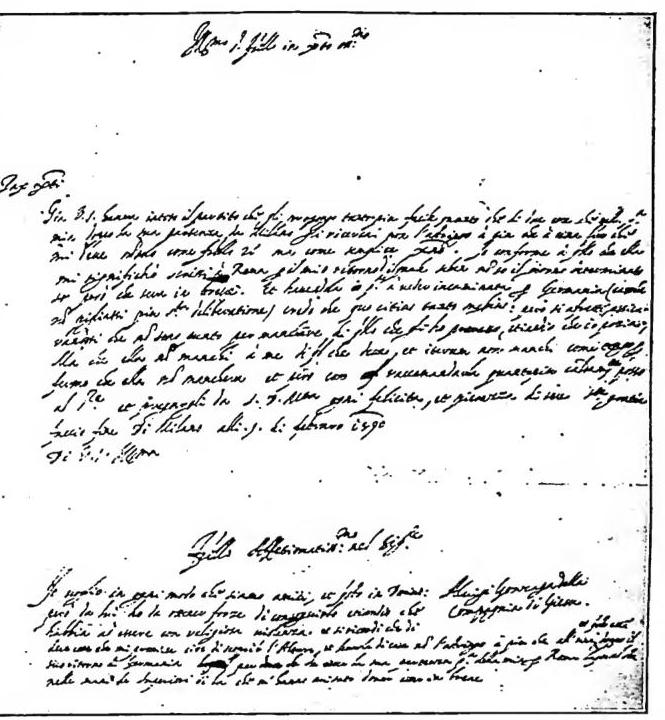
catechism to the poor. He always nourished the desire to go as a missionary to India. When conflicts arose within the family between the duke of Mantua and his brother, who were disputing the lordship of Solferino, L., at the request of his relatives, was sent by the superior general to Castiglione, where he reconciled the family members and also resolved the situation of his brother, who had married a woman of lower social standing. Returning to Rome, when an epidemic broke out, he volunteered to care for the sick and, while transporting a plague victim, contracted that pernicious fever which, lasting three months, caused him to die a victim of charity, in the early hours of the octave of Corpus Christi (21 June 1591), at the age of twenty-three years and three months.
Paul V granted him the title of blessed (1605); Benedict XIII canonized him in 1726 and in 1729 proclaimed him patron of youth, especially students. His bones rest beneath the altar dedicated to him in the church of S. Ignatius in Rome. His head is preserved in the basilica of S. Luigi in Castiglione. An ampulla containing his blood is preserved at the Gesù Vecchio in Naples. An Aloysian museum is maintained beside his room at the Roman College. On the second centenary of his canonization (1926), Pius XI reconfirmed him as patron of youth. Feast day: 21 June.
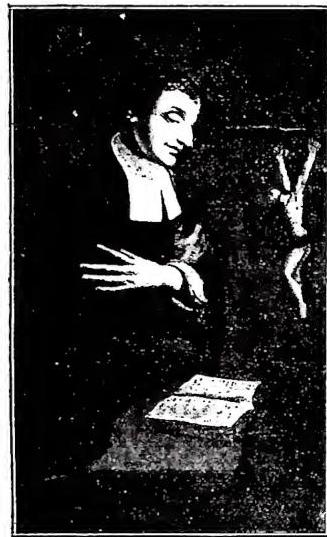
(courtesy of Fr. Le Baili)
After achieving immense success through his missions, and having been removed from the Hospital and the diocese because of the intrigues of libertines and Jansenists, he made the pilgrimage to Rome on foot to obtain light and counsel from the Vicar of Christ. Clement XI dissuaded him from departing for foreign missions, appointed him apostolic missionary, and assigned France to him as his field of apostolate. From then on he devoted himself unceasingly, until the end of his life, to the work of the missions (1706–16), especially in Brittany, Poitou and Aunis. Everywhere he preached the Cross and the Rosary, the total consecration of oneself to Jesus through the hands of Mary; he erected Calvaries, restored churches and established confraternities, with the result that faith has remained extremely vigorous in the regions he evangelized down to the present day. Heroic in poverty, mortification, obedience and love of the poor, persecuted relentlessly, the victim of several attempts on his life and rejected by many dioceses, he was always protected by the two great anti-Jansenist bishops of Luçon and La Rochelle (Jean-François-Valderie de l'Escure and Etienne de Champflour).
L. M. wrote: Traité de la vraie dévotion à la Ste Vierge (manuscript discovered in 1842, 1st ed. Luçon 1843; phototype ed., Rome 1942; 1st Italian translation, Turin 1851), L'amour de la Sagesse éternelle (Paris 1856), Le secret admirable du T. S. Rosaire (ibid. 1912), Lettre aux amis de la Croix (Nantes 1875), Secret de Marie (Montreal 1899), as well as various canticles (cf. the critical ed. by F. Fradet, Paris 1929).
He regards the spiritual life as total consecration to Jesus, Incarnate Wisdom, through the hands of Mary, and complete dependence upon this Divine Mother, so that man, moved by Mary and living in her, with her and for her, may also live more perfectly with Jesus, in him and for him. In order to perpetuate the work of the
edited by E. Reitz V. Frentz, there 1928); M. Meschler, Leben des h. Aloysius, Freiburg im Br. 1891 (with similar success: Italian translation, Turin 1923 and 1926); F. Goldie, St. Aloysius, London 1891; J. Croiset, St Louis de G., parfait modèle de la jeunesse chrétienne, Lille 1921; A. Lambrette, St Louis de G., sa mission, son âme, Louvain 1926; C. Martindale, The vocation of Aloysius G., London 1927; French translation by E. Delpierre-A. Noché, St Louis de G. et la Renaissance italienne (1568-1591), Le Puy 1946. Cf. E. Rivière, Bibliogr. du 3e centenaire de St Louis de G., Paris 1891. Arnaldo Lanz