
CREMONA, DIOCESE of. – In Lombardy, on the left bank of the Po, a suffragan diocese of Milan, and the provincial capital (area 943.8 sq. km.). Formerly a Roman colony founded in 218 B.C. and a center of resistance of the Roman army against Hannibal, C. became a municipium in 90 B.C. After the death of Caesar and Octavian’s victory over Antony, the territory of C. was divided by the conqueror among his veterans
(40 B.C.). In the struggle between Vitellius and Vespasian (A.D. 69), the city was destroyed, but rose again at the victor’s command. After the fall of the Gothic kingdom, it was garrisoned by the Byzantines in the second half of the sixth century until it fell into the hands of Agilulf, king of the Lombards (603). C. resumed its life under the rule of the bishops during the Carolingian period and then also under the Ottonians, who granted them powers of temporal sovereignty; this marked the beginning of political struggles between the bishops and the people, which ended in 1098 with the establishment of the free commune. In the struggle between the Communes and the Empire, C. sided with the latter and became a stronghold of Ghibellinism, favored by Frederick Barbarossa and Frederick II. In the late Middle Ages it came under the rule
of the Pallavicini, Bovara, Cavalcabò, Visconti, and Sforza families, under the last of whom it became part of the duchy of Milan. Occupied by Charles V in 1525, it remained in Spain’s possession until 1702, when it passed to Austria, from which it was taken by the French in 1796 and 1800. The Church of Cremona was the last in Lombardy to be hierarchically constituted. Its establishment probably belongs in the final years of the episcopate of s. Ambrose, or else between the fourth and fifth centuries. In any case, certain information is available only from the middle of the fifth century; at the Milanese provincial Council of 451, Giovanni, bishop of C., is recorded as being present, just as Eustasius, also titular of the see of Cremona, was present at the Roman Synod of 501, which judged Pope Symmachus. After him, few other bishops were appointed, until the end of the eighth century. From then on, the succession of the bishops of Cremona has been uninterrupted.
To fill the gaps among the bishops between the fifth and eighth centuries, and once again to connect the origins of the Church of Cremona with the supposed preaching of s. Barnabas, not a few Cremonese historians, in place of documentary evidence, substituted conjectures, invented names, and falsified acts and inscriptions, managing to present a list of bishops with the years of their episcopates; this list was subsequently shown to be untenable by more recent studies (e.g., L. Cavitelli, A. Campo, B. Rossi, A. Dragoni, G. Bresciani; cf. Savio, op. cit. in bibl., pp. 1–30).
Famous names are found among the approximately 80 bishops who have governed this Church. Among them are s. Silvinus (approximately the middle of the eighth century), Liutprand (v.), ambassador of Otto II to Constantinople and the most important historian of the tenth century, Sicard (1185–1215, v.), chronicler, canonist, and liturgist; Cacciaconte da Somma (1261), who built the cathedral bell tower; Bartolomeo Capra (1405–12), secretary to Innocent VIII; the influential and powerful cardd. Ascanio Sforza (1486–1505, v.), Pietro (1524–1529), and Benedetto Accolti (1529–49); Niccolò Sfondrati (1560–90), cardinal and later pope under the name of Gregory XIV; his nephew Paolo Sfondrati (1607–10); Cesare Speciano, formerly s. Carlo Borromeo’s secretary and agent in Rome, and on several occasions papal nuncio to the courts of the Habsburgs; and, most recently, Geremia Bonomelli (1871–1914).
The Church of Cremona was distinguished by the holiness of some of its sons: OMOBONO, SANTO (v.), the holy merchant of the twelfth century; Antonio M. ZACCARIA, SANTO (v.), a saint of the Catholic restoration of the sixteenth century, founder of the Con-
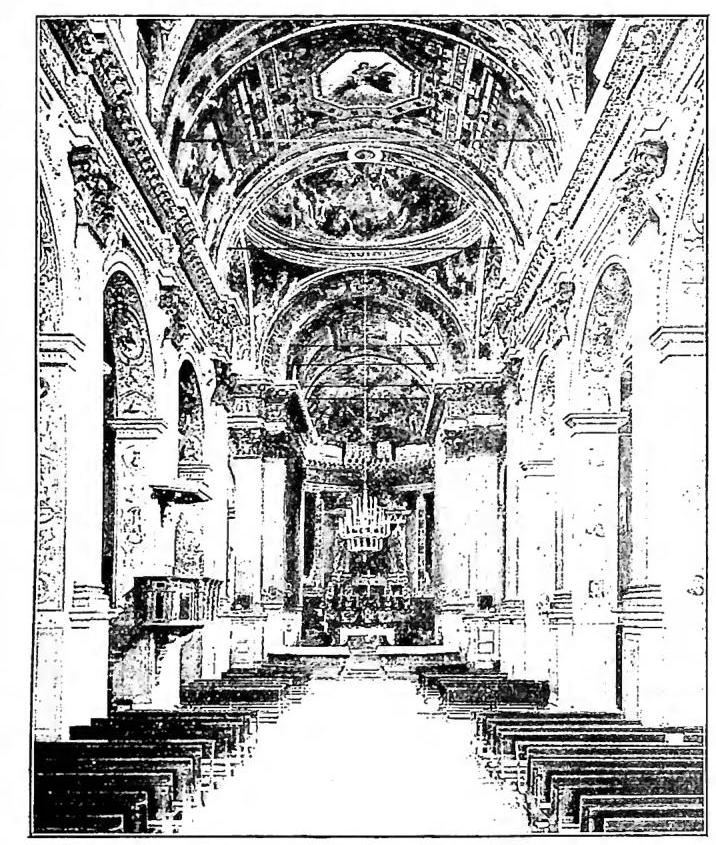
CREMONA - Interior of the church of S. Pietro (16th century). (Alinari photograph)
The diocese of C., once considerably larger, saw the territory of Upper Cremonese detached from it in 1579 for the establishment of the diocese of Crema, and the area beyond the Po was incorporated into the diocese of Fidenza in 1601. Its territory extends not only through the province of the same name but also through the provinces of Bergamo, Mantua, and Milan; it is divided into 25 vicariates and 234 parishes, with a population of approximately 400,000 inhabitants. The diocesan clergy comprises 446 secular priests and 51 regular priests. The seminary, founded in 1565, possesses a rich library with a noteworthy collection of manuscripts and incunabula, as well as an art museum. Various religious orders and congregations carry out their activities in the city and diocese: the Franciscan Friars Minor, the Capuchins, the Camillians, the Barnabites, the Missionaries of S. Francesco Saverio of Parma, the Brothers of the Pious Institute of S. Giuseppe, the Visitation nuns, and 30 congregations of women religious with 165 religious houses.
Until the period of the Josephist and subsequently Napoleonic suppressions, various religious communities flourished in C., with churches, convents, and hospitals. Notable were the monasteries of S. Lorenzo, belonging to the Benedictines (10th century); S. Pietro al Po (11th century), initially Benedictine and later incorporated into the Congregation of the Lateran Canons; and S. Agata, founded in 1077 and belonging to the Hospitaller Canons, at first secular and later regular. It was an autonomous canonry, enriched with jurisdictional prerogatives and honorary privileges, transformed in 1464 into a prepositure and secular collegiate church, and in 1789 placed under episcopal jurisdiction.
The cathedral is the most distinguished monument of art and piety belonging to the people of Cremona. Dedicated to the Blessed Virgin of the Assumption and to SS. Inerio and Omofono, the city's patrons, it contains marvelous works from every age and period of art, combining Gothic and Romanesque elements in an exceptionally successful harmony of lines, light, and color. Construction began in 1107; originally raised in basilical form, it was later transformed into its present Latin-cross shape. The principal façade is adorned with a majestic prothyrum and loggia bearing statues of the Virgin and the patron saints; in front is a portico of Bramantesque character, which the people of Cremona call the «Bertazzola». The finest Cremonese painters, along with others from the 16th century, were summoned to decorate the interior of the cathedral. Boccaccino's Majesty of the Redeemer dominates the apse, at the center of which is Gatti's great altarpiece of the Assumption; a series of 34 frescoed paintings on the vault of the central nave and on the rear wall, the presbytery, and the choir illustrates the life of the Madonna and various episodes from the life, Passion, and death of Jesus. These are the work of B. Boccaccino, G. F. Bembo, A. Melone, G. Romanino, G. A. Corticelli, called il Pordenone, whose is the Crucifixion, a large fresco occupying the entire rear wall, B. Gatti, Antonio and Giulio Campi, and G. Diotti of the last century. Histories of the saints appear on the panels of Omodeo's pulpits and in the area of SS. Marcellino and Pietro by Briosco. A series of 12 grand Flemish tapestries illustrating the life of Samson, hung from the columns, admirably completes the decoration of the church. Flanking the cathedral are the baptistery, from the 12th century, with its great octagonal Romanesque-style cupola, and the torrazzo (bell tower), erected in the 16th century and crowned by a graceful garland terminating in an exceptionally slender spire, reaching a height of 112 m.
Other distinguished monuments of art are the churches of S. Pietro al Po, S. Michele Vecchio, S. Abbondio, S. Agostino, and S. Agata. The church of S. Sigismondo in the suburb of the same name, erected by Bianca M. Visconti in 1463 and frescoed by C. Boccaccino, Antonio, Bernardino, Giulio, and Galeazzo Campi, and B. Gatti; good canvases adorn the altars. Beside the church is the cloister, formerly the seat of the monks of S. Girolamo and now a house for spiritual retreats. Also worthy of mention in the diocese are the churches of Casalmaggiore, Castelleone, Soncino, and Rivolta d'Adda, and the Marian sanctuaries of Caravaggio (v.), Castelleone, and Casalmaggiore. - Vedi tav. LI.