
ROMANINO, GIROLAMO DI ROMANO, DETTO IL

ROMANINO, Girolamo di Romano, detto il. - Pittore, n. a Brescia fra il 1484 e il 1487, mortivi ca. il 1566.

ROMANINO, Girolamo di Romano, called il Romanino. — Painter, born in Brescia between 1484 and 1487, died there ca. 1566.

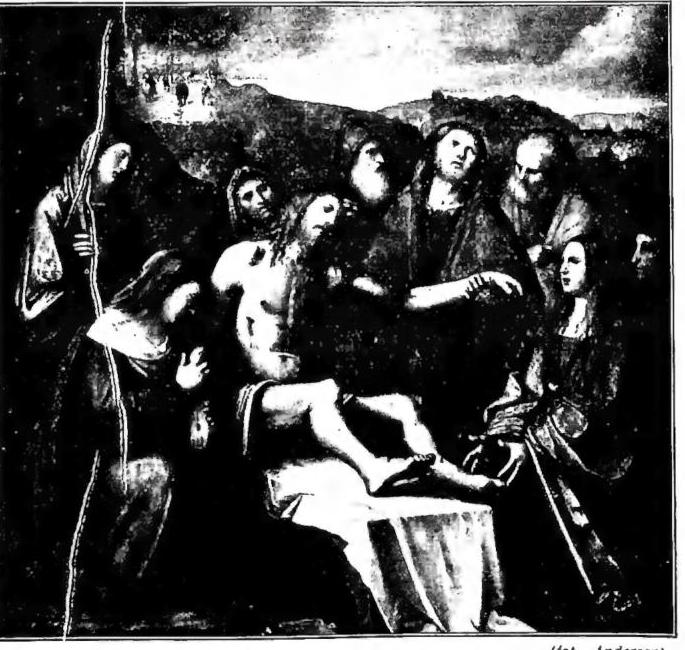
His earliest dated work is the *Deposition* in the Galleria dell’Accademia in Venice (from the church of S. Lorenzo in Brescia), of 1510; in this, and in the few paintings that can be considered close in time (the altarpiece of S. Rocco in Brescia), together with local characteristics and memories of the moving Boccaccino, the artist reveals knowledge of Venetian art; yet the colour already has vibrations of an intensity that is distinctly his own. In 1513, the monks of S. Giustina in Padua commissioned him to paint the altarpiece for the high altar of their church (now in the Museo di Padova), which shows how much influence the frescoes that Titian had executed two years earlier for the Scuola del Santo had exercised upon him.
Article illustration
(from *Trésors d’art du moyen âge en Italie*, Paris 1892, pl. 2)

ROMANICA, ARTE — Bronze lectern, with lion’s head (11th–12th cent.) — Susa, Tesoro del Duomo.

Vitality that in Lombardy assumes a tone of more intense popular characterisation, while in Venice it adopts a greater refinement under the influence of the direct knowledge that one had on the shores of the lagoon of the modes proper to the eastern neo-Hellenism. Meanwhile, in the other regions of the peninsula, the same naturalistic spirit that animated the sculpture flourishing in the Po valley encountered elements of the traditional classical culture. Thus in Apulia, in Sicily, in Campania, in Latium.

In Tuscany, where marbles were carved in which the new expressiveness of the images is concentrated in balanced relationships of form and content. And from this culture, in which the concept of the antique often clearly becomes synonymous with the beautiful, there emerged the greatest sculptor who, in the mid-13th century, announced new times for Italian art: Nicola da Apulia, Nicola Pisano (v.).

Similar movements were taking place in the field of painting. Here too the problems that arise for anyone wishing to trace as clear a schema as possible of this development are infinite and extremely complex. For an almost infinite number of frescoes, museums, painted panels bear witness to the liveliness and richness of a production that was often of the highest quality. So numerous and varied are these testimonies that one might say that between the 11th and 13th centuries the practice of covering the walls of churches and palaces, and even grottoes, with vivid colours had become common among the Italians. A land of painters, then, was Italy, painters who knew how to narrate with vivid accents and clarity the stories and miracles of the saints and also human actions and activities, in compositions where the human figure, the essential motif of the representation, was rendered with expressive immediacy, both spontaneous and supremely skilful. Naturally, in Italian painting at that time, as in contemporary architecture and sculpture, the elements of earlier and contemporary cultures often had essential value.

---

ROMANINO, Girolamo di Romano, called il Romanino. — *The Deposition* — Venice, Galleria dell’Accademia.

Saint, and how from his knowledge of Titian he drew compositional balance and learned to discipline, without diminishing it, his extraordinary chromatic splendour. To this moment, the artist’s happiest, belong also the altarpiece of the church of S. Francesco in Brescia, and probably that in the Berlin Museum. These works must have aroused great admiration at home, since soon after (between 1516 and 1518) Moretto, painting the organ shutters for the old Brescian Duomo, followed so closely the manner of the R. that for a long time he was confused with him. But the restraint exercised by Titian waned when the artist, summoned in 1519 to Cremona to paint in the Duomo the Stories of the Passion, found himself working near Pordenone. It was like a gust of Baroque that crowded and disrupted the compositions, in which a certain taste for the grotesque reveals northern influences.

Not even when, in 1521, he collaborated with the severe and composed Moretto in S. Giovanni Evangelista in Brescia did R. regain the equilibrium of his early works; instead, he crowded the spaces by thickening the figures into a single plane; yet the colour, fluid and fused, of unrivalled intensity and splendour, attained expressions of impassioned lyricism (*Assumption of the Virgin*; *St Matthew*). Reminiscences of Pordenone (*Triptych in the National Gallery, London*; *St Anthony in the Duomo of Salò*, of 1529) and Savoldo (*Christ Carrying the Cross* in the Martinengo Gallery in Brescia) and even of Lotto (*SS Faustinus and Jovita*) alternate in his later works, without ever extinguishing the breath of Titian. In 1531 he worked for Cardinal Clesio in the Castello del Buonconsiglio in Trent, where he came into contact for a short time with the Dosso brothers, and for longer with Fogolino, whose proximity revived his tendencies toward a northern expressionism, which also appear in the organ shutters for the new Duomo of Brescia, painted between 1539 and 1541. After this, no dated works of R. are known until 1557, when the artist, now more than seventy years old, painted for the church of S. Pietro in Modena *The Preaching of the Baptist*, composing an image in an unusual classical infancy, perhaps due to the pervasive influence of Giulio Romano.

BIBL.: R. Longhi, *Cose bresciane del Cinquecento*, in *Arte*, 1917, p. 99; S. G. Nicodemi, *G. R.*, Brescia 1925; Venturi, IX, III, p. 792; S. G. Longhi, *La pittura bresciana del Rinascimento*, catal. della mostra, Brescia 1939, p. 218

---

ROMANOS the Melodist (Romanos Melodos). — A Christian poet of Greek language, born in Emesa (Syria) at the end of the 5th century, died in Constantinople in the second half of the 6th century.

Having converted to Christianity during the last years of the reign of Anastasius I (491–518), he became a deacon in the church of the Virgin, where he was later buried. His death must be placed not long after the middle of the 6th century.

According to biographical sources, R. would have composed about a thousand kontakia, a number certainly hyperbolic: in the manuscripts about 85 kontakia remain (among which some twenty are apocryphal), of which a comprehensive critical edition is still lacking.

The basis of R.’s literary sources is, obviously, the Old and New Testaments: but he also drew upon his countryman St Ephrem, upon Greek Christian orators, and upon the Lives of the Martyrs.

R. is almost unanimously considered the greatest Byzantine Christian poet. Without doubt, he succeeded in drawing from his profound religiosity a sincere poetic inspiration, which often manifests itself in an intimately dramatic form and is not oppressed by the mechanical structure of the kontakion, but unfolds broadly and powerfully in effective descriptions, employing a new, agile and lively language, marvellously suited to his always clear thought. In short, he truly created a new poetry, new in form and spirit, which interpreted the needs of his time and, within the framework of the sumptuous and impassioned Byzantine liturgy, gave voice to the yearning of the adoring multitudes; which, finally, had decisive importance in the evolution of religious poetry, not only Byzantine.

Yet, alongside these merits, one cannot overlook the oratorical tone that sometimes weighs down the poetry with theological disquisitions and polemics; a certain tendency to seize and depict, from the same religious inspiration, rather the outward aspects than the inner spirituality; the precious and heavy preciosity of many images; and above all, in the corpus of his work, a sense of monotony, generated not by the necessarily monochromatic inspiration, but rather, one might say, by the difficulty of varying the substance of the song internally.

BIBL.: Krumbacher, pp. 663–71; id., *Studien zu Romanos*, Munich 1898; P. Maas, *Die Chronologie der Hymnen des Romanos*, in *Byz. Zeit.*, 15 (1906), pp. 1–44; G. Cammelli, *R. il M.*, Florence 1930; E. Mioni, *R. il M.*, saggi critici e dieci anni interi, Turin 1937; R. Cantarella, *Poeti bizantini*, II, Milan 1948, pp. 106 ff.