
PORDENONE, GIOVANNI ANTONIO SACCHI (de Lodesanis, de Sacchis), known as il. — Painter, born in Pordenone in 1483–1484, died in Ferrara on 12 January 1539. A complex artistic figure, yet one readily identifiable through the various phases of his activity, beginning with the training he received in the mainland Venetian milieu associated with Montagna and dominated by Giovanni Francesco di Tolmezzo, which would always remain the foundation of his diverse experiences.
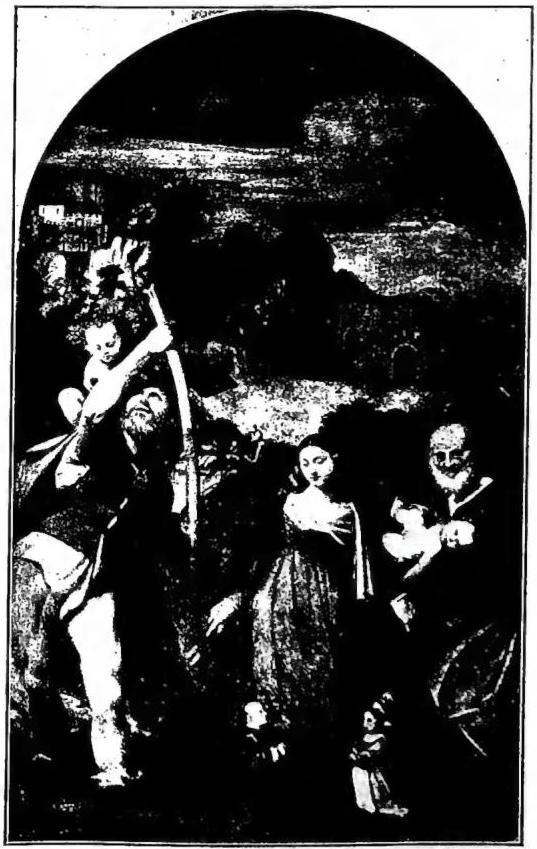
(Alinari photograph)
PORDENONE, GIOVANNI ANTONIO - The Mystical Marriage of S. Caterina; at the sides, SS. Pietro and Paolo - Piacenza, church of the Madonna di Campagna.
A journey to Rome, undertaken by P. around 1516, marks a new phase in his painting, in which the vigorous plasticism of Tolmezzo origin, which alongside the Venetians had assumed a chromatic form, was strengthened through contact with the works of Raffaello and Michelangelo, together with a new sense of space. P. would then express himself in an almost violent manner, clothing the figures in a colour dominated by chiaroscuro and imparting to the images a movement that foreshadows Baroque visions. The frescoes of the parish church of Rorai, of the cathedral of Treviso (1520), and of that of Cremona (scenes from the Passione, 1521–22), the altarpiece of Torre (1520–21), and the Schizzi altarpiece (1522) belong to this period. Perhaps the most significant work of this moment, together with the organ shutters of the cathedral of Spilimbergo and the two Saints in the church of S. Rocco in Venice (1528), is to be found among these works; while he expresses himself in a more restrained language in the frescoes of S. Maria di Campagna in Piacenza (1529–31) and in the Giustiniani altarpiece in S. Lorenzo in Venice, executed in the same years, reaching his final Parmigianino (v.). At this point it is worth recalling the importance P. had in spreading the Emilian Mannerist language in Venetian territory, a language so rich in consequences for the subsequent development of art in Venice (v. TINTORETTO). All the influences he underwent remain clearly legible in the extensive and uneven production of this master, who nevertheless, through his eclecticism, succeeded in arriving at a personal language made up of colours and compositional rhythms of great effect, sustained by a fervent imagination which, although weakened in his final years, still enabled him to create a masterpiece in his last work, the Noli me tangere in the cathedral of Cividale.