
TREVISO, DIOCESE of. — The city of T. is the capital of the province of the same name (pop. 29,377); the diocese is a suffragan of the patriarchate of Venice, with 541,500 inhabitants, 2,193 sq. km., and 238 parishes, of which 37 are in the province of Venice, 19 in that of Padua, and 2 in that of Vicenza; it has 612 diocesan priests and 180 religious priests, a major and a minor seminary, 27 male and 240 female religious communities (Ann. Pont. 1953, p. 430).
I. HISTORY
An Eneolithic-Terramare settlement on the southern edge of the Brenta’s springs, Tarvisium acquired its paleo-ethnographic character and, probably, its name from the Illyrian tribe of the Taurisians. Military laterculi, inscriptions, and coins establish it as a municipium of ius latinum (perhaps from 91 B.C.), enrolled in the Claudia tribe and enlarged after the fall of Altinum.The late and contaminated legend (12th century) of the «apostolic mission» of s. Peter and of the «proto-episcopate of Padua» of s. Prosdocimus (titles respectively of the Cathedral and of an ancient adjoining chapel) cannot be accepted, since there is no evidence that an episcopal see existed at T. before the 4th century (Bishop Giovanni, 396). At that time it was probably necessary for the Aquileian metropolitan see to confront the Arian challenge through more finely divided jurisdictions; indeed, connected with this are also the Altinum traditions of the preaching and cult of the bodies of s. Liberalis the Confessor (d. in 434) and of the itinerant Gothic martyrs, the bishop Theonistus and the deacons Tabra and Tabrata (d. in 396), who were received as the principal patrons of the diocese.
The uncertain catalogue of the first bishops (with gaps from 541 to 564 and from 590 to 743), together with the conflicting disguises imposed by later chronicles, prevents an adequate reconstruction of diocesan religious life in the early Middle Ages, when T. was successively a Gothic fondaco and county stronghold (Cassiodorus, Procopius), the seat (with a mint) of a Lombard duchy (Paul the Deacon, Venantius Fortunatus), and a Frankish county of the March of Friuli (815), of the Veronese March, and of the Trevigiana March (867).
The territorial upheavals affecting the neighboring dioceses of occupied Padua (the bishop of T. held that title as well from 605 to 743), and of Altinum and Oderzo, destroyed by the Lombards (647; 671); the feudal investitures of bishops of German nationality and imperial allegiance (1047–1124), in opposition to simultaneous apostolic legates and particularly to the detriment of the county (hereditary in the Collalto family from its origins [958]); and, in addition, the incorporated temporalities of the former (589–827) and extinct episcopate of Asolo (diploma of Otto I, 969), not only enlarged the boundaries of the bishop’s spiritual jurisdiction (bull of Eugenius III to Boniface, 1152), but raised his feudal power to the rank (though not the title) of «dominus dux comes et marchio», with a vast defensive system and a considerable body of allodial and feudal possessions and fiscal rights. From these, historically and legally, the lordly character of the present so-called parish «quartesi» also derives (Statute of 1231). This period also saw the earliest traces and records of the vanished small monasteries of SS. Peter and Theonistus at Casier (777, Zenian), of S. Fosca, and of S. Paul at Lansago (898, Nonantolan); of the rural Cassinese abbeys of S. Maria at Mogliano (995), S. Maria del Pero at Monastier (1017), S. Eustace at Nervesa (1062), and S. Euphemia at Villanova (1085); of the leprosariums of S. Peter and Vito in Foro (991) and S. James dello Schiral (11th century); of the first Chapter Library (catalogue of 1135); and of the oldest parish churches.
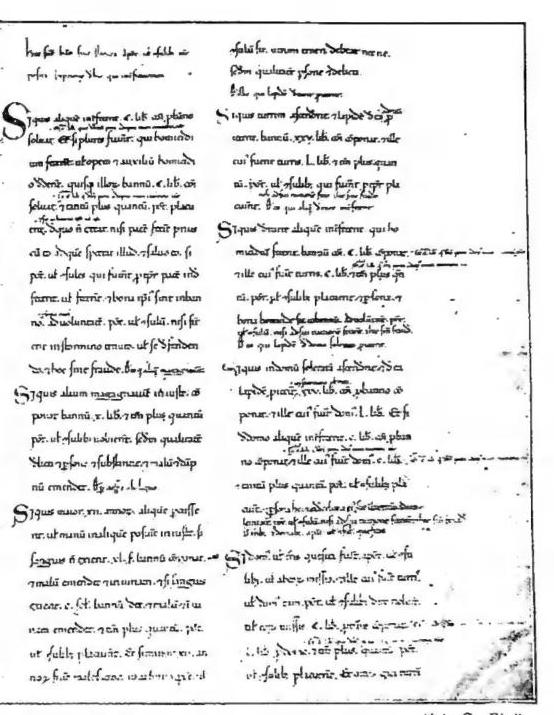
The presence of only the lesser ecclesiastical feudal nobility and of the legal bourgeoisie in the earliest evidence of civic participation in government, and, on the other hand, the almost universal origin of the rural Commune in the particularly ecclesiastical practice of livellary and judicial grants to district communities (plebi, vicinis, etc.), do not permit the exact determination of the part unquestionably played by the Church in the establishment and legal recognition of the first urban Commune (beginning of the 12th century). In any case, the hierarchy’s influence on the policies and ordinances of the already fully autonomous Commune, under a podestà regime (1176) and wholly intent on replacing the various particular jurisdictions—especially those of the count and the bishop—with its own, was indirect and not officially attested (Pusterla Statutes, 1193–94). This is suggested, at least, by the fact that the oldest statutory compilation (original codex, 1207–18) contains no regulation of relations with the Church; by the serious financial crisis through which the bishop’s temporalities passed under Ambrogio (1199–1207) and Tiso (1209–1245), gradually confiscated or ostensibly ceded to the Commune (1218) and reduced from 322 fiefs in 1178 to 63 in 1189 and 15 in
1209; and, finally, by the significant tendency of the religious sentiment of the time toward extra-hierarchical forms and institutions of greater spirituality, such as the new mendicant Orders of the Dominicans and Friars Minor, whom the Commune then invited and subsidized (statute of 1231) to build the great churches and convents of S. Nicholas and S. Francis in the city. The ambitious expansionist policy of the oligarchic and anti-corporatist Commune (statute of 1231), and the struggles between the Caminesi and the Ezzelini for predominance in the government and lordship over the city and district, reduced the so-called «joyous march» first to the hands of Ezzelino IV, the excommunicated imperial vicar (1237), and then under the dark and savage tyranny of his dissident brother Alberico (1239–60). The Commune succeeded in freeing itself only through the crusade proclaimed in Venice by the exiled bishop Alberto (1257) and through the macabre popular justice of 24 August 1260 at the castle of S. Zenone. These events were among the causes of the penitential movements (1262) from which later arose the school and hospital of S. Maria dei Battuti (statute of 1299) and the lay order of the Cavalieri Gaudenti (1261). Until then, great spiritual influence throughout the region had also been exercised by the Friar Minor s. Anthony of Padua (Camposampiero, 1231), the Benedictine b. Giordano Frozatè (Ezzelino’s hostage at S. Zenone, 1237–38), the Camaldolese s. Parisio of Bologna (d. at T. in 1267), and the Benedictine b. Giuliana da Collalto (d. at Venice in 1264). In exchange for political independence (original statute of 1284), the gloomy and ostentatious Guelph lordship of the «good Gherardo» da Camino bestowed splendid prosperity upon the State, as well as public, though not always sincere, religious deference (cf. G. Biscaro, La correità di Gherardo e Rizzardo da Camino nell’uccisione di Jacopo del Cassero, 1298, vesc. di Feltre, Venice 1915; id., Eretici e inquisitori nella Marca Trivigiana, 1280–1308, Turin 1921), and gave the papacy one of its countrymen: b. Benedict XI (Niccolò Boccasiini, Dominican).
The diocese, then restored by Tolberto Calza and of the same extent as today, comprised 35 monasteries and hospitals, 56 parish churches, and 208 chapels (cf. Rationes decimarum Italiae, Venetiae [Studi e testi, 132], Vatican City 1941, 129, 1295). After the fierce Rizzardo fell into the ignoble “snare” (1312)—the sumptuous mausoleum of the Caminesi in S. Francesco was destroyed in 1612—a bloodless revolution by Bishop Salomone Castellano (1310–22) saved the city from the treachery of his brother Guccellone to Can Grande della Scala: T. then experienced the brief existence of the restored Commune of the Arts (1315–18), proud of its incomparable Statuta, of a much sought-after Universitas studiorum, and of well-attended public schools of philosophy, theology, and law among the Hermits, Conventuals, and Dominicans (1313–1797); and it witnessed the extraordinary death, the great amnesty, and the popular cult that immediately flourished around the thaumaturgical remains of the b. woodworker Enrico da Bolzano (10 Oct. 1315), to whom the city dedicated a carved shrine in the Cathedral and Boccaccio a skeptical novella in the Decameron. During the successive Gorizian (1318–28), Scaliger (Can Grande died in the episcopal palace in 1329), Venetian (1338–81), and Austrian (1381–84) dominations, there occurred: the foundation of the charterhouse of Montello (1340); the last episcopal election by the clergy (P. Paolo Dalla Costa, 1336); and the long and industrious episcopate of Fr. Dom. da Baone (1359–84), a friend of Petrarch, witness to his death and author of a Vita b. Henrici, founder of a confraternity and boarding school of S. Liberale (1365) for the instruction of priests and notaries. Violent, rapacious, and sacrilegious was the five-year Carrarese occupation, which circumvented the aged Da Baone, seized his successor, Nic. Beruti (1386–94), in Padua, and left T. nothing but noble Petrarchan offshoots and the remains of Francesco Petrarca buried in S. Francesco, where the funerary monument of Pietro di Dante, who also died here in 1364, has now likewise been reassembled.
The Reformation gained more proselytes in the Trevisana than elsewhere: the Augustinian fra Muses, promoter of the imposing anti-Lutheran Synod of 1526 (800 fathers), was himself accused and acquitted of suspected heresy in 1537; in 1542–43 Luther was corresponding by letter with the “fratres deditissimi” of T.; and between 1547 and 1576, some fifteen localities were found to be infected with Moravian anti-Trinitarian Anabaptism—
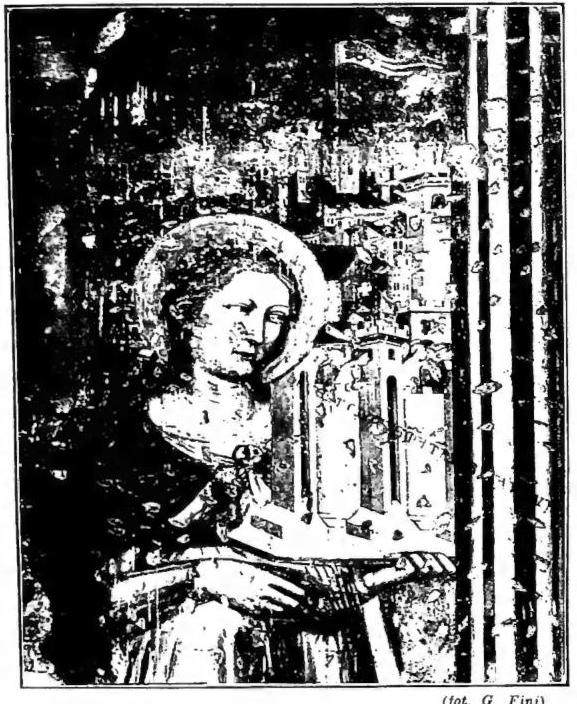
(photo G. Fini)
The Tridentine Restoration (anything but superfluous: cf. Processus et decreta of the apostolic visitor Cesare De Nores, 1584) found an exceptional interpreter in T. in Giorgio Corner (1564–67), a friend of Borromeo and—together with his uncle Francesco Pisani, dean of the S. Collegio—a father who signed the Council’s decrees in the final session, which he himself closed with the Mass of the Holy Spirit (3 Dec. 1563). To him are owed, among other things, a classic I Sinodo postridentino (1564); the School of Christian Doctrine, with the first Libretti (= Catechisms); the Regole (reforms) of the women’s monasteries; and, above all, the Tridentine Seminary, opened in 1566 in the canonical buildings of the Duomo. Paul V’s interdict against Sarpi’s Venetians (17 Apr. 1606) produced neither apostates nor martyrs in T., since in general people felt less the force of the principle being asserted than the questionable nature of the political motive. Even the learned, pious, and patrician bishop Fr. Giustiniani (1605–23), threatened with deposition by Rome and reprisals by Venice, yielded to pressure from intimidated relatives and abandoned the diocese to the mercy of the civil power; all the religious communities, except the Jesuits, Capuchins, Reformers, and a few other isolated groups—immediately searched, deprived of their revenues, imprisoned, or expelled—submitted to the Senate; the secular clergy were compelled to make a declaration of conformity that can still be read in the registers of certain parishes; and the populations continued in good faith with the practices of worship, only to rush, once the interdict was lifted, to the penitentiaries to have the censures removed.
Until the middle of the eighteenth century, when, with the suppression of the patriarchate of Aquileia (bull of 6 July 1751 by Benedict XIV), the diocese passed to the ecclesiastical province—
Until the mid-eighteenth century, when, with the suppression of the Patriarchate of Aquileia (Bull of 6 July 1751 of Benedict XIV), the diocese passed to the ecclesiastical province of Udine, the Church enjoyed freedom and protection from the State, including in the administration of the public schools (the only ones in existence before the Napoleonic reforms), entrusted to the Somaschi Fathers (grammar and rhetoric, 1624–1806) and to the Seminary (humanities and philosophy, 1668–1797); and, thanks also to the stature of the blessed Barbarigo and of Bishops Morosini, Zacco, De Luca, and P. Giustiniani (1710–87), the last Venetian bishop, it remained almost entirely free from Jansenist influences. The municipalist interlude of 1796–97 inaugurated the series of secularizations and transfers to the public domain, later perfected, during the brief episcopal government of Bernardino Marini (1788–1817), by Napoleon (1806) and the Kingdom of Italy (1810). The Austrian restoration (1813), having reserved to itself the right to appoint the bishop (1818–80) and having imposed on the diocese a six-year vacancy because of the failed imperial candidacy of Jappelli, looked favorably upon the firm administration of Bishop G. Grasse (1822–29), kept Sebastiano Soldati under futile surveillance (1829–49), was not alarmed by the pious Baron G. A. Farina (1850–60), and did not find the hoped-for « instrumentum regni » in the « pro-Austrian and temporalist » theologian of the Basilica Marciana—rapporteur of the Commission « de Fide » of the First Vatican Council—Federico Zinelli (1861–79): bishops of the Risorgimento; the latter, through learning and charity, succeeded in making even the local sectarianism forget the Austrian bayonets and infernal machines among which he had entered the diocese; he was especially deserving for having given to the hierarchy, in the person of his most faithful interpreter and collaborator, Canon Giuseppe Sarto, the blessed Pius X.
II. SHRINES
S. M. Maggiore (Assumption): of very ancient origins; in 780 in the hands of the Nonantolani, then of the Can. Reg. of S. Salvatore, and now of the Somaschi, because s. Gerolamo Emiliani deposited there, on 27 September 1511, the fetters and the key to the fortress of Quero. Rebuilt in 1474 in Venetian Gothic style, it preserves an image of the Virgin (the third), restored by Tomaso da Modena (1352). It has been a basilica since 1917 and is the most frequented shrine in the diocese.III. ILLUSTRIOUS FIGURES
Rambaido dei conti Azzoni Avogadro (born 2 November 1719, died 23 September 1790), munificent primicerius of the Cathedral and highly learned librarian of the Chapter Library, which he largely rebuilt, enlarged, and endowed. He was the author of 33 printed works, including: Memorie del b. Enrico; Trattato della zecca e delle monete che ebbero corso in Trevigi; Considerazioni sopra le prime notizie di Trevigi; a monumental handwritten Raccolta manoscritta di spogli dell'Arch. capitolare, in 20 vols.; and an original Carteggio with the most illustrious contemporaries, in 27 vols. (Bibl. capit.).IV. ART
Above the city’s modest architectural panorama rises, unrivalled, the Gothic mass of S. Niccolò (m. 88 x 27, 50 x 33.35), standing out for the pronounced verticality of its brick-faced structure, lightly banded with stone. Begun by public decree, according to a more modest design, in the mid-thirteenth century, and continued slowly throughout the following century on the present model—perhaps with the assistance of Cardinal Niccolò Boccassino (1305), whose monument, the work of G. Comin, stands in the presbytery—the building remained incomplete in the height of the central nave until 1858. Like the contemporary churches of S. Francesco and S. Margherita, and their cloisters, S. Niccolò was for a long time a church of distinguished burials, of great occasions, and of crowded Dominican preaching.The present structure of the Duomo results from elements joined together in different periods: the crypt of the ancient Romanesque cathedral, with the urn of the ss. Fiorenzo and Vendemmale; the Renaissance reconstructions (the chapel of the Immaculate Conception, by the Lombardi, 1481–88), with the cenotaph of Bishop Zanetto, by P. Lombardo, and that of Alessandro VIII, by Bonazza; the chapel of the Sacrament, by Bregno, with its Lombardesque monument to Bishop Niccolò Franco (1501–1514); the chapel of the Annunciation (1519–23), with frescoes by Pordenone and the altarpiece by Titian, benefactions of Canon Vicar Broc. Malchiostro, who is buried there; and the eighteenth-century body of the church, adapted to the terminal chapels by G. Riccati, replacing the three Romanesque naves, by then in ruins (the atrium dates from 1836). The hagiographic frescoes (choir) are by Seitz; the apotheosis of Pius X (presbytery), by Biagetti.
The oldest pictorial testimony in T. is provided by the Byzantine-Romanesque frescoes in the apse of S. Vito (Christ and the Apostles, twelfth century); but T. preserves the largest and most characteristic portion of Tommaso da Modena’s work (1349–60): the frescoes in the churches of S. Francesco, S. Maria Maggiore, S. Lucia, S. Niccolò, S. Caterina, and the former S. Margherita (Stories of s. Orsola, now in the Pinacoteca), as well as—splendid for the truth and variety of its psychological studies and for its expressive realism—the gallery of forty distinguished figures of the Dominican Order in the former Chapter House of S. Nicolò (Seminary). In the adjoining monastery of S. Teonisto (Benedictine), there remained until 1692 the enormous lunette (7.60 x 3.79) of the Marriage at Cana by P. Veronese (1580), now in Montecitorio; and from the same church the Calvary by J. Bassano has recently been transferred to the Pinacoteca.
The diocese possesses a considerable artistic heritage: paintings and sculptures, including works by the greatest masters; vestments, furnishings, and goldsmiths’ work from the thirteenth to the eighteenth centuries (Cathedral Treasury).
The art of papermaking, imported from Fabriano, gave rise at an early date in T. to a flourishing printing industry, thanks also to the arrival of skilled foreign masters (Gerardo de Lisa, Flemish, 1460–86), who enriched the city’s libraries of the period (now the Capitolare and the Comunale) with splendid editions, including woodcut and illuminated works.
The Duomo’s Cappella musicale likewise boasts glorious traditions. Established in the mid-fourteenth century, it became famous, especially between 1500 and 1633, for its composer-masters, organists, and singers (Gabrieli, Anerio), for polyphonic and orchestral performances at home and abroad, and for its rich repertory of unpublished codices and rare editions, some of which were lost in the burning of the Capitular Library and Archive (bombing of 7 Apr. 1944). The other precious collections of codices and parchments from the tenth to the sixteenth centuries are divided between the Capitolare and the Comunale, including the most complete original series of ancient municipal statutes in Italy (1207–1555). - Vedi tav. LI.