Machine translation of the 1948–1954 Italian original. The original text is authoritative.
LOMBARDI, FAMIGLIA. — A dynasty of architects and sculptors, originating in the Canton of Ticino, whose surname Solari was almost always replaced by the generic name Lombardo or L. Venice was their principal center of activity, but their eminently decorative taste, both in architecture and sculpture, spread during the final decades of the fifteenth century and the early decades of the following century throughout the Veneto, Lombardy, Ferrara, and the Romagna, with a combination of craftsmanlike qualities that Cosmati (v.) in the region of Latium.
The most notable of the L., for originality of invention and technical expertise, was PIETRO di Martino, born in Carona,
(fot. Alinari)
LOMBARDI, FAMIGLIA – Façade of the church of the Miracles, work of Pietro L. – Venice.
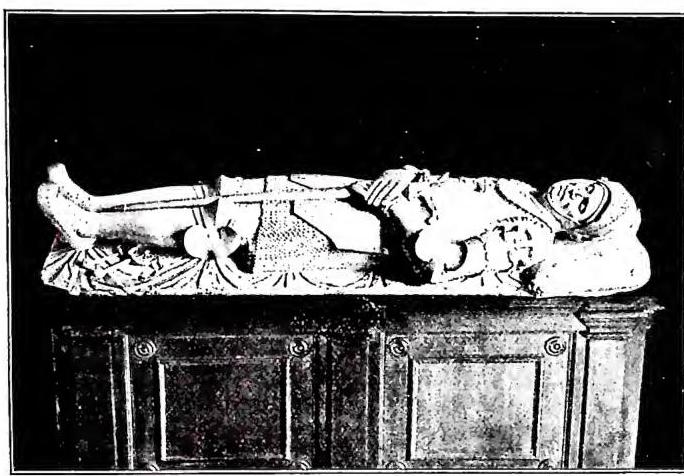
(Anderson photograph) LOMBARDI, FAMIGLIA - Reclining figure of Guidarello Guidarelli, work of Tullio L. - Ravenna, Istituto di Belle Arti.on Lake Lugano, around 1435, and d. in Venice in June 1515. Having absorbed certain elegances of contemporary Florentine sculpture, he began his activity as a sculptor with the Roselli tomb at the Santo in Padua (1464–67), followed, in Venice, by the more complex and ornate tombs of several doges, in the churches of SS. Giovanni e Paolo, the Frari, etc.; these remain typical of a florid and graceful tendency, called “Lombardesque,” though certainly neither profoundly expressive nor structurally rigorous. His serene genius found better expression in architecture, in works that are especially significant of the process of classical renewal undergone by Venetian Gothic building, without renouncing its original Oriental polychromy. His masterpiece in this field is the church of S. Maria dei Miracoli (1481–89), where the use of multicolored marble revetments, oculi, disks, pilasters, and friezes is combined with a clear and simple functionality of linear structures. Pietro L.’s extremely industrious and devoted collaborators were his sons TULLIO (b. around 1455 and d. in Venice on 17 November 1532) and ANTONIO (b. about 1458 and d. perhaps in Ferrara in 1516). The former produced numerous works in the Veneto and in Mantua, among which, beyond the relief of S. Antonio and the ivory heart on the Arca del Santo in Padua, and the Bacchus and Ariadne in the Museo Estense of Vienna, the funerary statue of the young warrior Guidarello Guidarelli in the Museo civico of Ravenna stands out for its composure of line and elegiac abandon. Antonio left, among other works, the relief depicting a Miracle of s. Antonio on the Arca del Santo in Padua, which, through its purity of form, seems to anticipate neoclassical models (1505); from 1506 to 1516 he also carried out a flourishing activity in Ferrara around the famous “alabaster studioli” of Duke Alfonso I, in the Castello Estense, with opulent sculptural friezes, preserved for the most part in the Stieglitz Museum in Leningrad (a seated Mars is found in the Galleria Estense of Modena). Antonio’s son was GIROLAMO, also called da Ferrara (b. in Ferrara around 1504 and d. around 1590), who was influenced by Andrea and Jacopo Sansovino; he first worked successfully on the Sansovinian Libreria and Loggetta in Venice (1532–1540), then, having moved to Loreto in 1543, on the Holy House there, where his four statues of prophets are especially admired. Around 1550 he moved to Recanati and cast there in bronze some of his finest works: the ciborium, in the form of a Roman temple, for the high altar of Milan Cathedral, the tabernacle of Fermo Cathedral, and the reliefs of the doors for the Holy House of Loreto, on which his son ANTONIO collaborated (b. around 1550 and d. in 1610). The brothers of Girolamo, AURELIO (b. in Venice in 1501 and d. in Recanati on 9 September 1563) and LUDOVICO (b. around 1507 and d. in 1575), also executed appreciable works in marble at Loreto, always in an austere Sansovinian style.
BIBL.: L. Planiscig, Venezianische Bildhauer der Renaissance, Vienna 1921; id., Deux reliefs en marbre de Pietro L., in Gaz. des beaux arts, 1930, pp. 1–10; id., Pietro L. e alcuni bassorilievi veneziani del 400, in Dedalo, 10 (1929–30), pp. 461–87; id., Per il quarto centenario della morte di Tullio L. ..., ibid., 12 (1932), pp. 901–24; A. Callegari, Pietro L. e il lombardismo nel basso padovano, ibid., 9 (1928–26), pp. 357–85; A. Venturi, Pietro L. e alcuni bassorilievi del Quattrocento, in L'arte, 1 (1930), pp. 191–205; A. Moschetti, s. V. in Thieme-Becker, XXIII, pp. 341–45.
Alberto Neppi
Cite this article
“LOMBARDI, FAMIGLIA.” Enciclopedia Cattolica, vol. VII (1951), p. 901. Azione Romana digital edition, https://azioneromana.com/article/lombardi-famiglia.