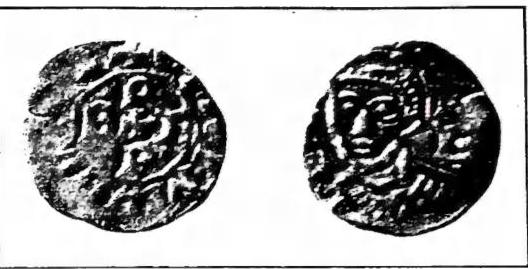
OTTONE I, EMPEROR and king of Germany. — The Saxon dynasty had been so firmly established in Germany through the work of Enrico I that his son O. was able to succeed him at the age of twenty-four without encountering opposition. Tall, robust, and poorly educated (he did not know Latin and did not learn to read until he was thirty-five), he was first and foremost a warrior; and, surrounded by scribes among whom the idealized memory of Carlomagno was kept alive, he would strive to revive the tradition of the great Emperor. Enthroned at Aachen on 7 Aug. 936 before the bishops and dukes, eager to serve him, he would soon, once consecrated, gather in his person all the other traits that contemporaries considered essential in an emperor: victorious leader, sovereign of many peoples, protector of the Pope.
Like Carlomagno, O. appeared before his subjects as the defender of the Christian people. Saxony, formerly a centre of barbarism and paganism, had become the champion of the Christian order. Against the Slavs O. resumed the tradition of military and missionary expansion, occupied Brandenburg and Lusatia, encouraged the apostolate of Bosone of Merseburg, and founded the bishopric of Oldenburg and the archbishoprics of Magdeburg and Hamburg, metropolitan sees of new Christian communities (955–68). He struck his heaviest blows against the Hungarians, who, after 937, had spread terror on one side as far as Capua and on the other as far as Reims and Aquitaine. Supported, in fact, by all the forces of Germany, he confronted them in Bavaria on the banks of the Lech (10 Aug. 955) and annihilated them. Their strength thus broken, the Hungarians settled down and founded a state which thirty years later, under s. Stefano, would enter the Christian world.
Meanwhile O. applied himself above all to rebuilding the cohesion of Germany, fragmented into so many national duchies. Victorious in two great rebellions (938–39 and 953), he recovered the lands usurped from the royal domain, compelled the princes to remain loyal, and, when necessary, replaced them on his own authority with members of his family: thus he established his son Landolfo in Svezia, his brother Enrico in Bavaria, and his son-in-law Corrado in Lorraine, while retaining Franconia for himself. And, in order to remove from each the temptation to rebel, he had his vassals supervised by the palatine counts. With regard to the German Church, O.’s policy consisted in making himself master of the bishoprics and enriching the prelates in order to secure their support. He intervened constantly in elections, carried out the investitures himself, regarded the bishops as lords, developed their feudal prerogatives, and at times ceded to them comital powers; thus at Magdeburg, Cologne, and Speyer. Although he often chose loyal persons and relatives, the bishops appointed by him generally gave convincing proof of genuine religious zeal: for example, his brother Brunone, archbishop of Cologne, and Ulrico of Augsburg.
O. also devoted himself to gathering the other Carolingian countries under his sceptre. In France he exploited the dissensions between Luigi IV d’Oltremare and Ugo il Grande, son of King Roberto, both his brothers-in-law, acting now as mediator and now as protector of the Carolingian in distress; while the Council of Ingelheim (948) afforded him the opportunity to concern himself with the ecclesiastical affairs of the Kingdom of France. But his activity in the West was confined to this. In the regions of the Rhône, O. intervened to keep the Kingdom of Burgundy in the hands of the young King Corrado, threatened by the claims of Ugo di Arles, who had previously possessed the crown of Italy. The anarchic situation of the peninsula particularly favoured the ambitions of the German King. In the north, the former Lombard Kingdom was prey to several rival dynasties: the dynasties of Arles and Burgundy, both of them displaced by Berengario, marquis of Ivrea, whom O., during a first intervention (951), had been obliged to recognize as king of the Lombards. In the south, the Byzantine possessions were infested by the Saracens. In the centre, the Papal State was beset by the disturbances caused by the double succession of the « principal senator of the Romans » Alberico (954) and of Pope Agapito (955), both of which devolved upon Alberico’s son, Ottaviano, barely sixteen years old and pontiff under the name of Giovanni XII, inexperienced and of poor reputation. Called to his aid by the Pope, O. descended into Italy (961), placed the iron crown on his head at Pavia, and came to camp on Monte Mario (31 Jan. 962); two days later he received the imperial crown in St Peter’s.
O. I’s elevation to the imperial dignity sharpened his desire to restore the tradition of Carlomagno. Bearing, like him, the title « imperator augustus », he intended to legislate for the entire Frankish people and to revive the imperial rights over the Eternal City, despite all Giovanni XII’s efforts to maintain the principle of the pre-eminence of papal power. While the conciliar decrees of 963, ratifying O.’s ecclesiastical policy in Germany, recalled the Pope’s right ultimately to regulate religious organization, the Privilegium Othonis (13 Feb. 962) confirmed the territorial donations of Pipino and Carlomagno and renewed the Constitution of 824: control of the administration of the Papal States through the missi dominici, and the Pope’s oath of allegiance to the Emperor. The misunderstanding between Pope and Emperor grew worse when Giovanni XII sought the support of Berengario d’Ivrea and his son Adalberto. O., the stronger, returned to Rome, presided over a Council at St Peter’s which deposed Giovanni (Nov. 963), and set up against him the antipope Leone VIII (4 Dec. 963). A revolt by the Romans restored Giovanni XII to the see; but he died soon afterwards (May 964), and O. was fortunate enough to capture and deport his ephemeral successor Benedetto V (June 964), and finally, after the death of Leone VIII (965), to impose upon the Romans a Pope of his own choosing, Giovanni XIII. In order to consolidate his power over Italy and the Papacy more effectively, O. remained in the peninsula for six consecutive years, presided in Rome itself over a great assembly in 967, and demanded from the Pope the imperial coronation of his son Ottone II at Christmas of the same year. At the same time O. I asserted his claims to dominate southern Italy; he compelled the dukes of Benevento and Capua to pay him homage and the basileus Giovanni Zimisce to recognize his imperial title and to give Ottone II in marriage a « porphyrogenita » princess, Teofano.
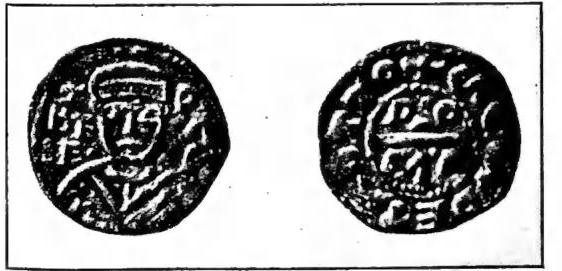
(from C. Serafini, Le monete e le belle plumbee del Medagliere Vaticano, IV, Milano 1907, pl. 164 A.8)
OTTONE I, Emperor and king of Germany — Silver coin.