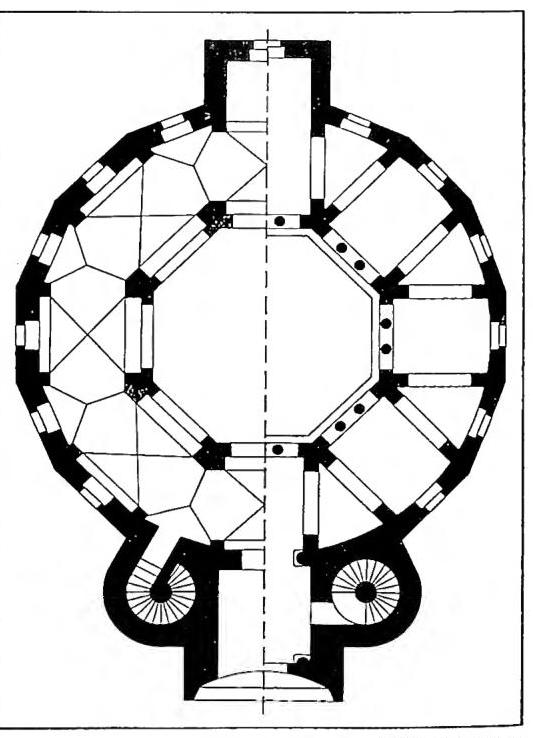
AQUISGRANA (AACHEN), DIOCESI of. — In western Germany; it has 1,152,490 Catholics, 504 parishes, with 967 secular and 190 religious priests. The city itself had, in 1939, 160,200 inhabitants, of whom 144,500 were Catholics.
From a deity, probably named Granus, the place where healthy springs emerge received
the name Aquae Grani. The use of those springs never ceased. Charlemagne favored A. and built there a magnificent Pfalz (residence), with a palace, church, and all the appurtenances. A medieval town soon developed there, and from 813 to 1531 it was the place of coronation of the Romano-German kings and emperors. In the thirteenth century the city became a free imperial city (Freie Reichsstadt). The peace of 1668, which ended the War of Devolution (Raubkrieg), and the peace of 1748, which brought the War of the Austrian Succession to a close, were concluded there. In 1797 A. was incorporated into France; in 1815 it returned to Germany (Prussia). In 1818 the Congress of A. was held there. From 1918 to 1929
the city was occupied by the Belgians; during the final phase of the Second World War, in the winter of 1944–1945, it was almost entirely destroyed.
In 1801, under French rule, A. was erected into a diocese, replacing Cologne, which was then suppressed. But it had only one bishop, Mario Antonio Berdollet (1802–1809). In 1821 the diocese of Cologne was reestablished. However, owing to the enormous increase
in population following the industrialization of the region, in 1930 (13 August) it was once again erected into a bishopric, this time as a suffragan of Cologne.
A.’s greatest glory is its Cathedral, the Marienstift. The central and oldest part consists of Charlemagne’s palatine chapel, built from 798 to 804 by Odo of Metz. It is a grandiose structure, seven-sided on the exterior, with an octagonal interior, galleries for women, and a dome rich in marble, modeled on S. Vitale of Ravenna, but with important variations. Charlemagne also had much of the material brought from Italy. The chapel was connected to the palace by means of a great portico. On the eastern side, in the Middle Ages (as early as 1355), a grandiose Gothic nave with choir was added; of the western side there remain a Romanesque atrium and the tall modern tower. The whole forms a fantastic ensemble of incomparable effect. The town hall should also be noted, a Gothic palace from the first half of the fourteenth century.
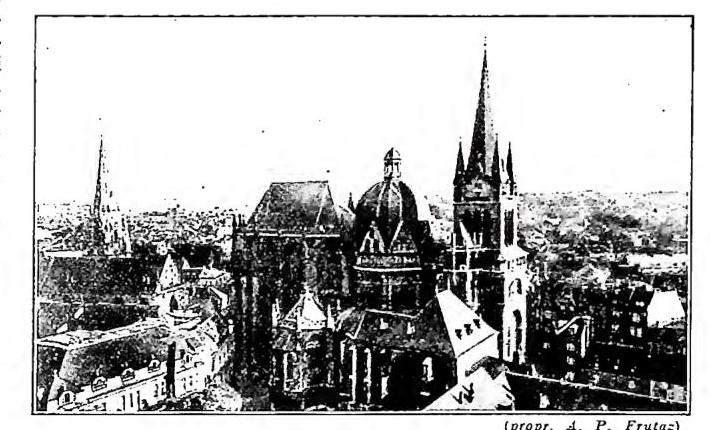
Special mention must also be made of the celebrated “Treasury” of the Cathedral. It is preserved in the chapel of the Holy Souls in Purgatory and contains, among many precious objects, gifts from Otto III, such as an illuminated Gospel book, a golden altarpiece, and an ivory holy-water stoup; the cross with a cameo of Augustus, donated by Lothair III; from the thirteenth century are the reliquary casket of Charlemagne (1215) and that of Mary (1237). Among the many reliquaries, those of Anastasius (a Byzantine work) and Simeon (the work of a local goldsmith) deserve mention; as do various works of Eastern and Western goldsmithery; textiles, especially Eastern ones; liturgical vestments of the
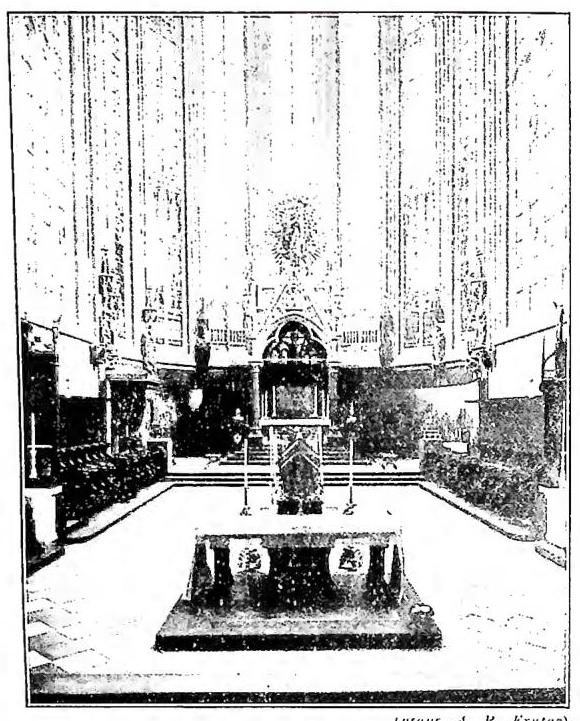
(propr. A. P. Frutac). AQUISGRANA – Choir of the Cathedral (14th century).