
METZ, DIOCESE of. — Capital city of the Moselle department, at the confluence of the Seille and the Moselle, which branches out to form, in the north, the islands of St-Symphorien, Sauley, and Chambière. It has an area of 6,227 sq. km. and a population of 705,000, of whom 660,000 are Catholics, distributed among 59 deaneries comprising 589 parishes and 128 vicariates served by 139 diocesan priests; it has 2 seminaries, 12 male and 25 female religious communities. The patron of the diocese is the protomartyr St Stephen. The diocese is directly subject to the Holy See.
M. is the Gallic “Divodurum” and under the Romans was the capital of the Mediomatrices; after the death of Clovis it became the capital of Austrasia, under the name of Mettis (from Mediomatrices). The Treaty of Verdun in 843 assigned M. to Lothair, but little by little it became a free city of the Empire, defending itself against the powerful dukes of Lorraine. M. was occupied in 1552 by King Henry II and was defended by Francis of Guise against the siege of Charles V.
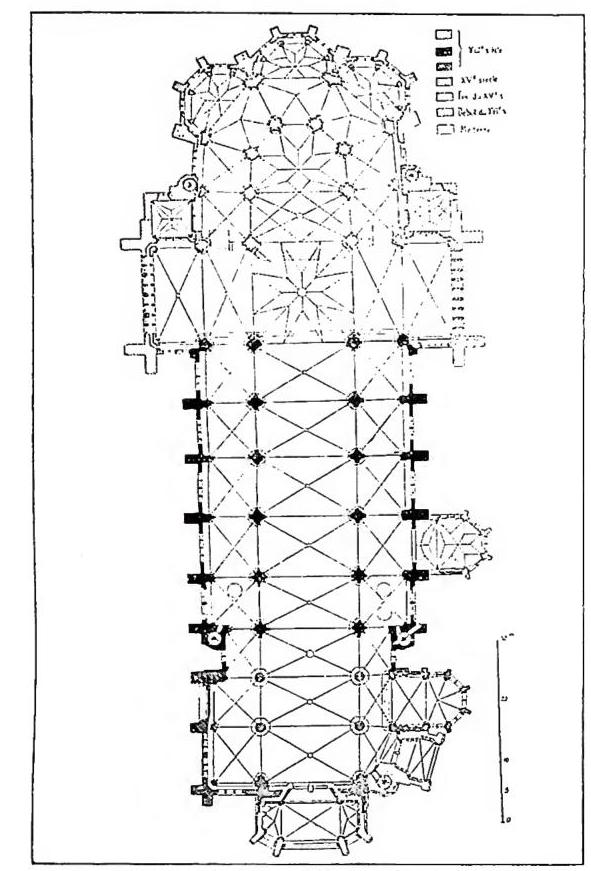
(from M. Aubert, La cathédrale de M., Paris 1931, p. 269) METZ, DIOCESE of — Plan of the Cathedral (13th–14th centuries).
exordio in Mettensi civitate successerunt (MGH, Script.,
II, p. 261: PL 95, 709). L. Duchesne holds that the foundation
of the Church of M. may date back to the end of the 3rd century,
since the fifth or sixth bishop, Victor I or II, occupied the see
of M. in 346. M. was invaded in 451 by the hordes of Attila,
perhaps during the episcopate of Bishop Auctor.
Bishop Esperius took part in the Council of Auvergne in
535; Villicus is mentioned by Fortunatus (Carm., VI, 8
and XIII, 13). Gregory the Great wrote to Agilulf (Jaffé–
Wattenbach, 1831), who was succeeded by his nephew Arnoald.
Arnulf was an adviser to King Dagobert and attended the
Council of Clichy in 627; he then withdrew to Castellum Haben-
dum (Remiremont), where he died. Sigibald founded the mona-
steries of St-Avold (Cottineau, III, col. 2603) and Neuviller
(id., loc. cit., 2063), and died ca. 741. He was succeeded by Crode-
gang (742–66; H. Reumont, Der heilige Chrodegang, Bi-
schof von M., in Festschrift Georg von Hertling zum 70.
Geburtstag am 31. August 1913, Munich in Bavaria 1913,
pp. 202–15). He established the liturgical stations at M. in a way
similar to what he had observed during his stay in Rome. The list
has been found at the end of a Gospel book in the National
Library of Paris (ms. lat. 268; Th. Klauser, Eine Stationsliste der
Metzer Kirche aus dem VIII. Jahrhundert, in Ephemer. liturg.,
44 [1930], pp. 162 ff.). In addition, he introduced the Roman
liturgy, Gregorian chant, and capitular organization at M.; ca. 760
he constituted the clergy of his cathedral as a group of canons
(v. CANONICI REGOLARI DI SANT'AGOSTINO. AGOSTINO). After more than two years
he was succeeded by Angilram (d. in 791). Then came Gondulf, Drogo
(823–75), buried at M. in the church of S. Giovanni; Avenzius
(858–75); Wala (876–82); and Robert (883–917).
The inhabitants put out Bishop Bruno’s eyes, and the bishop
withdrew to Einsiedeln (927). Under Adalbert (928–62) the civil
power of the bishops of M. increased; he was succeeded by
Dietrich II (946–84), Adalbert II (984–1005) and III (1006);
Dietrich III (1006–47), Adalbert IV (1047–1072); Hermann
(1073–90) was deposed by the Emperor; after the Concordat of
Worms, Bishop Stephen of Bar governed (1120–63), followed by
Bertrand (1179–1212) and Conrad I of Scharfenberg (1212–24),
who welcomed the mendicant Orders into the diocese; John
d’Aspremont (1224–38) was elected by the Cathedral Chapter;
then came James of Lorraine (1239–60). Also remembered are
Adhemar of Monteil (1327–61), Dietrich IV (1365–84), Rudolph
of Coucy (1387–1415), Conrad II (1415–59), and George I
(1459–84); then came the succession of bishops from the house
of Lorraine: Henry II (1484–1505), Cardinal John IV
(1518–43 and 1548–50), Cardinal Robert of Lenoncourt
(1551–55); Cardinal Louis of Lorraine (1568–78), Cardinal A. of
Givry (1608–12), and Henry of Bourbon (1612–52). M. then
passed to France through the Treaty of Westphalia, and the
“province des trois évêchés” was formed, comprising M., Toul,
and Verdun.
Among the bishops are remembered G. of Aubusson (1668–97),
E. C. of Cambont (1697–1732), and C. of Rouvray St-Simon, who
became prince-bishop of M. (1733–60), succeeded by Cardinal
L. of Montmorency (1761–1802). In 1874 M., which under the
Concordat of 1801 had become a suffragan of Besançon, became
directly subject to the Holy See; in 1871 M. had reverted to
Germany, but the Catholic institutions suffered serious damage
because of the Kulturkampf. In 1919 M. returned to France.
During the Middle Ages many synods were held at M. Among its
more recent bishops are G. Jauffret (1806–23); F. J. Besson
(1824–42); P. G. M. Dupont des Loges (1843–86); F. L. Fleck
(1886–99); and the Benedictine W. Benzler (1901–19).
The Cathedral, dedicated to s. Stefano, was begun around 1220, and was built so as to incorporate, in its first three bays towards the façade, the 8th-century church of S. Maria Rotonda, to which a choir and an apse were added. The interior is 123 m. long, 31 m. wide, and reaches almost 42 m. in height. The central nave is separated from the two side aisles by piers with columns supporting pointed vaults, partially decorated with paintings of the 14th-16th centuries. On the entrance wall opens a large rose window with stained glass by Ermanno di Münster in Westphalia (d. at M. in 1392). In the right aisle, the former choir chapel of S. Maria Rotonda is now the chapel of Notre-Dame-du-Mont-Carmel, with paintings from the beginning of the 14th century; moreover, the former chapel of the bishops has been transformed into the chapel of the S. Cuore. In the left aisle there is preserved a large porphyry basin, from the baths, long used as a baptistery. The transept is illuminated by a series of stained-glass windows executed by Valentino Bousch and Teobaldo di Lixheim in the 16th century; in the southern part are fragments of 13th-century stained glass. The choir is raised, with an apse having five chapels and likewise with 16th-century stained glass. Three chapels open off the ambulatory, containing the tombs of the bishops of M., mons. Dupont des Loges (1886), of mons. Fleck, his successor (1899), and of card. A. di Givry (d. in 1612). Two large towers flank the building; the taller one, to the south, is the tour de la Mutte, named after the bell. In the tower known as that of the Chapter is a decoration of bas-reliefs executed about 1275, representing David and Goliath, David and Saul, the empress Elena and Costantino, the translation of the S. Croce to Costantinopoli, and the S. Croce raising a dead man to life, as well as the histories of s. Stefano and s. Margherita.
The Treasury preserves: the so-called mantle of Carlo Magno, in 11th-century Byzantine fabric; a portable altar of the 12th century; ivory croziers of the 12th and 14th centuries; an enamelled casket of the 17th century, etc. The church of S. Martino dates from the beginning of the 13th century. The ancient abbey of S. Clemente, razed during the siege of 1552, was rebuilt in 1668; its façade dates from 1737; the abbey is now used as a college. S. Sinforiano, originally dedicated to the ss. Innocenti, was dedicated to the Saint when bishop Adalberone brought his relics there in 608 (PL 139, 1551; 140, 443). S. Vincenzo, a Benedictine abbey, was founded by bishop Teodorico in 968; the church dates between 1248 and 1316 (PL 135, 880; 143, 659; 151, 452; 155, 1651). The church of Ste-Ségolène, of the 11th century, has a fresco from the end of the 13th century, depicting the legend of the three living and the three dead after the type of the miniatures of the Arsenal (ms. 3142 f. 311°), and a crypt attributed to the 10th century. The church of Notre-Dame is the former Jesuit church, erected in 1665 with a façade of 1740. Remains have also been found of the church of St-Pierre-aux-Nonnains, belonging to the ancient abbey of Benedictine nuns (11th-15th centuries), also furnished with a cloister; recent explorations have brought to light remains of a much older building. The former convent of the « Petits Carmes », now used as a museum, contains archaeological, sculpture, painting, natural-history, and numismatic collections (including coins of the bishops of M. from the 10th to the 17th century); also the Migette collection, with enamels and ivories from the 13th to the 16th century. The municipal Library consists largely of collections confiscated from religious institutions during the Revolution and of that of barone di Sales. Part of the books is housed in the former chapel of the « Petits-Carmes », erected in 1686 by the Italian architect G. Betto. Unfortunately, many manuscripts, incunabula, and books were destroyed by the Germans in 1944. The former Jesuit church (1665) is today dedicated to Notre-Dame. During the 9th century a school of miniatures and ivory reliefs flourished in M., under the influence of Reims. Particularly noteworthy are the Sacramentario di Drogone, numerous Gospel books and the cover of the said Sacramentary, with liturgical scenes, and a Gospel book now in the Biblioteca nazionale di Parigi (ms. lat. 9388). - Vedi tav. LVIII.