
MICHEA (Hebr. Mikhah). — Prophet of Judah, a native of Môrešeth, in the šéphélâh (Mi. 1:14), south of Bejt Gibrin. A contemporary of Isaiah, he carried out his activity under the kings (ibid. 1:1) Ioatham, Achaz, and Ezechia (ca. 740–700 B.C.). The book gives only the essential themes of his oracles; it is therefore not possible, on the basis of questionable internal criteria, to reduce M.’s activity to the reign of Ezechia alone. M. contributed greatly to the reform of this pious king (II Reg. 18:3–7; cf. Ier. 26:18 ff.); the fall of Samaria (722), which he had foretold, made a profound impression on the people of Judah, who had to fear the same fate, likewise threatened them by M. Thus Ezechia was able to carry out his reform without serious difficulty (II Par. 30:1–12). It nevertheless had limited effects and duration.
The popular religion (religious syncretism, idolatry, and moral depravity), which in the Northern Kingdom had reached its perverse perfection in the time of Osca, was already developed in Judah. The Sinai covenant was by then understood in the same way as the external cultic relations that bound other peoples to their deities: a reciprocal obligation—sacrifices on the one hand, an automatic pledge of salvation and protection on the other; the mere presence of the Temple and the ritual immolation of victims carried out there sufficed to keep every threat far from Judah (Mi. 2:7; 3:11). M., like the other prophets, combats this deviation.
The book of M. was composed by the prophet himself or by one of his disciples (cf. Ier. 26:18 ff. = Mi. 3:11 ff.). It is divided into three parts. The first contains the announcement of the imminent destruction of Samaria (Mi. 1:2–9a): a warning for Judah’s own destruction (ibid. 1:5, 9b–16), for which M. now reserves the terms Israel and Jacob, as the sole heir of the covenant (ibid. 1:14 ff.; 3:1, 8b, 9a, in close parallelism with Sion and Jerusalem, V. 10). Judah’s crimes, rapacity and violence (ibid. 2:1–6), cannot remain unpunished, despite the assurances of the false prophets (ibid. 2:7–11). A remnant, however, will be saved and brought back to its homeland by Jahweh (ibid. 2:11 ff.). M. denounces and vehemently attacks those responsible for Judah’s moral depravity: leaders and magistrates (ibid. 3:1–4), and false prophets (ibid. 3:5 ff.). Sion will become a heap of ruins (ibid. 3:8–12).
In the second part the perspective is grand and magnificent: from Jerusalem the covenant extends to all the nations (ibid. 4:1–5 = Is. 2:2–4); it is the triumph of Jahweh, achieved against the coalition of the peoples (Mi. 4:6–14 [Volg. 4:6–5:1]), through the Messiah, of Davidic stock, who will be born in Bethlehem (ibid. 5:3–4). Through him, Judah is freed from the foreign yoke (ibid. 5:5 ff.) and rules like-
(phot. Alinari)
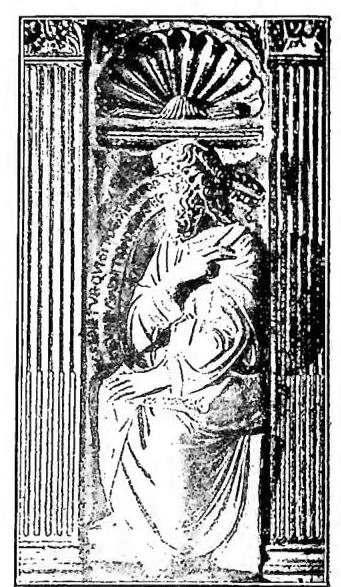
MICHEA — The prophet M. Bas-relief by A. di Duccio (ca. 1455) — Rimini, Tempio Malatestiano.
[Non-Text]
the lion over the beasts of the forest (ibid. 5, 7 ff.; cf. Gen. 49:9). Messianic characteristics: sovereign peace and an immaculate worship (Mi. 5:10-14).
In the third part, we return to the depravity of Judah. History of the covenant of Sinai: benefits bestowed by Jahweh, faithful to his promises, and the wickedness of the chosen people (ibid. 6:1-5). The quantity of the victims (with the insane practice of human sacrifice adopted from the Canaanites: cf. F. Spadafora, Ezechiele, Torino 1948, p. 164 ff.) is abhorred by God; the practice of justice and obedience to the precepts of the covenant should be restored (Mi. 6:6 ff.). Instead, fraud, violence, and falsehood reign (ibid. 6:9-12); punishment will therefore descend inexorably (ibid. 6:13-16). In view of it, the nation laments the corruption of its children (ibid. 7:1-6); in a song, an echo of the poetry of the Psalms, it expresses firm hope in the mercy and goodness of Jahweh toward his people; the nations will recognize the power of the true God (ibid. 7:7-20).
The text (especially 1:10-14) is the most corrupt among the prophetic books, after that of Oscar; and the versions are of little help. Criticism recognizes the authenticity of the first part; it has reservations about the third; and it was particularly hostile (especially the Wellhausen school) toward the second. Besides their false assumptions concerning the essence of the Sinai covenant and the study of Israelite religion, these critics fall into an error of perspective: they consider the prophetic book as though it were a doctrinal treatise. Instead, we have only fragments of a varied and multifaceted preaching. M.’s style is vivid and dramatic. So profound was the impression he produced on his contemporaries that even a century later the elders of Jerusalem remember him as a splendid example of holy boldness (Jer. 26:17-19).