
MESSIA E MESSIANISMO. — From Hebr. māšīah = anointed, a leader sent by God to govern his people. In the Old Testament the term is applied to the priests (Ex. 28, 41), who received the power and special mission of guiding or ruling Israel. Every instrument of God was therefore, in this sense, a m. (Ps. 115, 15). The term, used in Ps. 2, 2 to designate the king and founder of the new covenant, promised by Jahweh, later became, in apocryphal and rabbinic literature (Henoch, 48, 10; Ps. Sal., 17, 36; 18, 6, etc.), his exclusive title: the anointed one par excellence, hammāšīah, claimed by the Redeemer himself (Mt. 16, 15 sgg.; Mc. 15, 61), or “the Christ,” the Greek equivalent of the Hebrew passive participle.
This late specification does not prevent the grouping around the same subject of the different prophecies in which the one chosen to accomplish Jahweh’s great work is called: “David my servant” (Ex. 37, 25), “Jahweh our justice” (Ier. 23, 6; 33, 16), “servant of Jahweh” (Is. 52, 13), “Shepherd” (Ex. 33, 23; cf. Mi. 5, 3), “shoot, branch” (Is. 4, 2; 11, 1; Ier. 23, 5) (M.-J. Lagrange, Le judaïsme... [V. BIBLICA.], p. 365).
The M. is inseparable from his kingdom; the two realities are joined both in expectation (Old Testament) and in realization (New Testament). Word and concept are exclusive to Judaism and Christianity; they constitute the central point of encounter (in prophecy) and of opposition (in realization) between the two religions (A. Vaccari, s. V. in Enc. Ital., XXII, p. 953). The essential lines of messianism, or the doctrine concerning the M., are as follows:
a) Yahwism, concretized in the covenant of Sinai, is the only true religion, but it will flow into a more perfect and definitive covenant, extended to all peoples; b) Israel will be its guiding instrument; c) a descendant of David will bring it about and will be, eternally, its king and high priest (J. Touzard, Juif, peuple, in DFC, II, col. 1614 sg.).
The first messianic revelation goes back to the very origins of humanity. Satan’s attempt to make man his permanent follower against the Eternal is thwarted by God: from that moment the human race is his enemy and will inflict upon Satan a total and definitive defeat (Gen. 3, 14 sg.). Unanimously, Jewish tradition (Targum of Onkelos, Septuagint, etc.) and Christian tradition rightly identify this victory (of the “woman’s offspring” = the human race, but pre-eminently Christ) with the redemptive work of Jesus, as subsequent revelations will specify and its realization demonstrates (A. Bea [V. BIBLICA.], pp. 198-204; L. Dennefeld, Le messianisme [V. BIBLICA.], pp. 15-20; F. Ceuppens, De Proto-Evangelio, Roma 1932). This is the “Proto-Gospel,” the first announcement of the good news. It defines the spiritual and universal nature of the future triumph. Thereafter, increasingly detailed and varied specifications follow. For this victory God will make use of the descendants of Shem (Jahweh is called the “God of Shem”), whose spiritual goods the nations (Iapheth) will share with him and through him: “Let Iapheth dwell in the tents of Shem” (Gen. 9, 25 sgg.; cf. Rom. 1, 16; 11, 13-27). Among the Semites he chooses the race of Abraham, which will be “a source of blessing for all the nations” (Gen. 12, 1-3; cf. 13, 14-17; 17, 1-9; 18, 18 sg.; 22, 16 sgg.), and he makes with it a solemn covenant (ibid. 15, 8-21; 17), for whose realization he pledges his omnipotence. He confirms the universality of salvation and the intermediary mission of the people descended from Abraham through the line of Isaac and Jacob (ibid. 26, 3 sgg.; 27, 28 sgg.; cf. A. Bea [V. BIBLICA.], pp. 203-206). In the blessing of Jacob (Gen. 49, 8-12), everything is restricted to the tribe of Judah. It will retain spiritual supremacy (= scepter, staff of command: V. 10) until the M., “to whom šellāh belongs: Ex. 21, 32 [Volg. 27]),” this sovereignty and “to whom the nations will obey” (v. 10 b), has founded the new kingdom. The Temple of Jerusalem, seat of the worship of Jahweh, was the visible expression of the above-mentioned supremacy; its destruction (70 A.D.) was to demonstrate to the Jews that the M. had come and that his kingdom had already begun (A. Bea [V. BIBLICA.], pp. 206-12); vv. 11 sg. belong to the secondary and transitory element of messianism (Bea [V. BIBLICA.], p. 211 sg.): the prediction of extraordinary material happiness and prosperity, which is often the actual fruit of Jahweh’s blessing upon the nation chosen for the mission indicated above, when it is faithful to him; but ordinarily it is a symbol of the abundance of spiritual goods in the kingdom of the M. At Sinai the nation arises as “Jahweh’s special portion,” his “royal reserve”; and by the covenant, which takes up and specifies the one with Abraham, Israel’s mission is sanctioned: to be the people and worshiper of the one true God, Jahweh (Ex. 19, 5 sg.; 20, 1-17; cf. L. Cerfaux, Regale sacerdotium, in Revue des sciences philos. et théol., 28 [1939], pp. 5-39). The temporary character of the covenant is indicated in the sanction (Ex. 20, 5; cf. Lev. 26; Deut. 28; 34, 29 sgg.).
The other books of the Pentateuch and the historical books up to David contain no messianic references, except for Num. 24, 15-19 and Deut. 18, 15-19; they narrate the realization of the covenant of Sinai by Jahweh (Exodus-Joshua), and Israel’s alternating and defective response (Judges-I Samuel). With the monarchy, more precisely with Jahweh’s covenant with David, messianic hopes are revived and strengthened. In Nathan’s prophecy (II Sam. 7), “Israel is established forever as the people of God,” governed forever by the dynasty of David.
The devout David, taking up the thread of the ancient promises, understands Jahweh’s design and, divinely inspired, celebrates the mysterious liberator whom God associates with himself for the realization of his kingdom: Ps. 2; 21 [22]; 71 [72]; 109 [110]. Son (Ps. 2, 7; Hebr. 1, 5) and equal of Jahweh (Ps. 99 [100], 1: Jahweh invites him to sit at his right hand = Hebr. 1, 13; Mt. 22, 41-46), sovereign of Israel and of the nations (Ps. 2, 6, 8; 71, 8-11); priest forever (Ps. 109, 4 = Hebr. 5, 6; 7), exemplar of justice (Ps. 71, 7), he will perfectly realize the kingdom of God in humanity. The priesthood of the M., clearly distinct from that of Levi, temporary like the covenant of Sinai, shares in the stability of the kingdom of God; it is eternal and definitive. Finally, the M., as a descendant of David (II Sam. 7, 16), is a man; and David describes his sufferings (Ps. 21 [22]) and his Resurrection (Ps. 15 [16]; cf. Act. 2, 25-32; 13, 35 sgg.; A. Vaccari, La Redenzione, Roma 1934, pp. 165-90). Certainly the contemporaries of the great King and, at times, the prophet himself (Sum. Theol., 2a-2ac, q. 173, a. 4), besides failing to perceive how these various aspects of the future liberator would be realized, did not understand the full significance of the individual predictions.
From the death of Solomon to the prophets of the eighth century there extends a sad period of disorientation. The tribes of the north abandon the covenant of Sinai and, after Samaria is destroyed (despite the final appeal of Jahweh’s justice [Amos] and love [Hosea]), are absorbed into the idolatrous world. The covenant of Sinai was effectively restricted to the kingdom of Judah alone (= the covenant with David). Nor did the latter understand the lesson of Samaria’s terrible collapse (Ex. 16, 44-52; 23); indeed, it grew worse in the path of idolatry, injustice, and immorality (Is. 1, 5 ff.; Mi. 3; 7, 2-6; Ier. 2; 5, 19-31; Ex. 4-6, etc.), reducing its relations with Jahweh to external worship alone (like the other peoples with their divinities) and utterly neglecting the precepts of the covenant: monotheism and the moral law (Os. 2; Mi. 6, 6 ff.; Is. 1; 5, 1-7; Ier. 2; 7, 11; Ex. 15; 16; 20; 22; etc.). The prophets, therefore, in combating these deviations, illustrate the essence of the Sinaitic covenant, announce its consequences, and indicate its ultimate end: a) Judah, for the honor and justice of Jahweh, must be destroyed (Ex. 7; 14, 12-21; 15; 16; etc.; Ier. 8, 4-12; 11, 9-17; 16, 10-17; etc.); b) in order to accomplish his designs (Is. 48, 9 ff.; Ex. 20, 22-44; 36, 21-32), Jahweh nevertheless does not annihilate it; he preserves a « remnant », which he will purify during the long exile and bring back to Palestine in order to reconstitute the new Israel; in due time this will be elevated and absorbed into the kingdom of the M., the end of the entire divine economy (Am. 4, 11; 9, 9; Mi. 4, 6 ff.; 7, 19; Is. 1, 9; 7, 3; 10, 20 ff.; 40-66; Ier. 3, 14, 16; 23, 3; 24, 6; 30-31; 33; Ex. 11, 13-20; 34; 37, 12; etc.). The prophets therefore describe the return from exile, the theocratic restoration, and messianic salvation as closely united, the first being the prelude and immediate preparation for the last. Dan. 9 expressly specifies this. The restoration foretold by Ier. 25, 11 ff.; 29, 10 (cf. II Par. 36, 21) will begin after 70 years from 605 B.C., but will take place slowly. Three periods precede it: the first ends with the edict of Cyrus (538 B.C.); the second, longer period sees the rebuilding of the Temple and Jerusalem amid every kind of adversity, and will close with the murder of Onias III (171 B.C.); the third sees the persecution of Antiochus Epiphanes with the profanation of the sanctuary (abominatio desolationis), for three and a half years, and ends with the persecutor’s death and the beginning of the worship restored by Judas Maccabee (Dan. 9, 25 ff.; cf. 2, 7-12). The restoration will be complete only with the coming of the kingdom of the M., when «every sin shall be erased and everlasting justice shall reign» (ibid. 9, 24). This connection remains intact even in the exegesis that extends the 70 weeks to the death of Christ.
This clearly demonstrates that the covenant with David is ordered solely toward the future M.; for this reason Judah cannot perish (Is. 7, 7; A. Pohl, Historia populi Israel, Roma 1933, p. 133 ff.); this is why the prophets give their most beautiful messianic prophecies immediately after announcing the devastation and ruin of the kingdom (Is. 4, 1 ff.; 7, 14 b after V. 25; 8, 5-8; 8, 23-9, 1 [Hebr.]; 11, 1; Ez. 17, 22 ff.; etc.). It is a logical connection and in no way a temporal one; the same is true of the other connection, between restoration and the kingdom of the M. Nor does this represent a new orientation in the messianism of the prophets, but only an enrichment and clearer formulation.
The characteristics of the M. will be: a) he is of the lineage of David: Is. 11, 1; Ier. 23, 5; 33, 15; Ez. 17, 22 (cf. Lc. 1, 32); b) he will be born in Bethlehem: Mi. 5, 1 = Mt. 2, 6; c) of a Virgin: Is. 7, 14 b = Mt. 1, 23; cf. Mi. 5, 2 (the pearl of the messianic prophecies; the sign offered to Achaz is the son of Is. 7, 3, 16 [Sē'ār jātiūb], like the other son in Is. 8, 4; «before he reaches the age of discretion, that is, within a few months, the lands of the two feared kings will be devastated»; vv. 21 ff. announce the prosperity and abundance [also in the texts of Rās Samrah: cf. R. Dussaud, Les déconverters de R. S..., Parigi 1937, p. 79 ff.] of messianic times; d) he will be filled with the spirit of Jahweh: Is. 11, 1-5; 42, 1 (cf. 61, 1 ff. = Lc. 4, 18 ff.; divine power granted temporarily, which in the M. is a permanent gift for his exalted mission: cf. P. van Imschoor, in Ephem. theol. Lovan., 16 [1939], pp. 357-67); e) he will be the «servant of Jahweh», that is, his supreme worshiper: Is. 42, 1; 49, 3-5; 52, 13; to whom he will give full glory (ibid. 49, 3), faithfully accomplishing the spiritual mission (ibid. 42, 1, 6 ff.; 59, 3, 6; 50, 4; 53, 11) entrusted to him, namely: to establish the definitive covenant with Israel (ibid. 42, 6 ff.; 49, 5, 8; 53, 8), extended to all nations (ibid. 42, 1, 3; 49, 6 ff.; «It is too little that you should be my servant to restore the tribes of Jacob and bring back the survivors of Israel; I will make you the light of the nations, so that my salvation may extend to the ends of the earth»); to announce the divine law that is its norm (ibid. 42, 1, 3); to redeem humanity by offering himself to unheard-of moral and physical tortures (ibid. 49, 4, 7; 50, 6 ff.; 52, 14; 53, 2 ff. 5, 7 ff.), culminating in capital punishment (ibid. 53, 8 ff.). The nations will learn later, with astonishment (ibid. 53, 1), of the sacrifice of the «Servant of Jahweh», his vicarious expiation, and the wondrous consequences that followed from it; they will hasten to the chosen one whom Jahweh will exalt (ibid. 49, 7; 52, 13-53, 12). The Jewish people will atone for the killing of the M. with national mourning: Zach. 12, 8-13, 1 (= Mt. 24, 30; Io. 19, 37). V. ADADREMON.
The M. will have a divine nature: he will be called (the name expresses the nature) «wonderful counsellor, mighty God, eternal father, prince of peace» (Is. 8, 8; 9, 5); he will possess knowledge of hidden thoughts: «he will not judge according to what his eyes see, nor pass sentence according to what his ears hear»; he will have divine power: «he will strike the violent ('arīš) with the rod of his mouth and with the breath of his lips he will put the wicked to death» (ibid.
11, 3 ff.); he will be king forever (Ez. 37, 25); cf. Mi. 5, 1, whose terms are so strong as easily to lead to the conclusion that the M. preexisted, although in themselves they express only a very remote origin; Dan. 7, 13 ff. declares him to be of heavenly origin.
His kingdom will be universal, definitive, and spiritual: Is. 11, 10; 42, 1-7; 49, 5 ff.; 61, 1 ff.; Ier. 31, 31-34 (=Hebr. 8, 8-12); Dan. 7, 14-27; 9, 24; its center of diffusion will be Zion (Os. 2, 19-24; Is. 2, 2 ff.; Mi. 4, 2 ff.; Ier. 31, 33; Ez. 16, 60 ff.; 17, 23; etc.); it will be a source of blessings for all nations (Ez. 34, 26 = Gen. 12, 2). Characteristics of the kingdom of the M. are: remission of sins and holiness: Is. 56, 6; 57, 13; Ier. 31, 23-34; Ez. 36, 25-28; etc. (cf. Lc. 1, 77 ff.); peace, the perfect order in each person’s relations with God and with his neighbor: Is. 9, 6 ff.; Mi. 5, 5; Ez. 34, 25 ff.; etc.; the abundance of spiritual goods, expressed symbolically through the most vivid images of extraordinary fertility: Is. 7, 21 ff.; 9, 3, 6; 32, 1-5.15-18; Ez. 47, 1-12; etc. (cf. the image of the prepared banquet: Mt. 22, 4; Lc. 14, 15-24). To the reborn Israel, Jahweh’s assistance (Is. 40-66) assures triumph over present enemies (Ez. 35-36) and future ones (Ez. 38-39; Dan. 7-12), as well as every prosperity (Is. 31, 10-14; Ez. 34, 25-29; etc.).
Such marvelous promises preserved among the exiles their Yahwism and their hope in the glorious future of their nation. Certain that they were the “remnant” or “holy seed” that Yahweh had reserved for himself (Esd. 2, 26; 9, 8.13 ff.), those who undertook the long journey through the desert to return to their homeland (537 B.C.) thought that these promises would be fulfilled in them in their entirety; the difficulties they encountered (cf. Ezra-Nehemiah) shook their enthusiasm (cf. Ps. 125 [126]; 84 [85]). Haggai and Zechariah rekindled their spirits with messianic hope; and, together with Joel and Malachi, they brought to completion the work tirelessly conducted by Ezra and Nehemiah. It is true that the returnees are the prophesied “remnant” (Agg. 1, 12; Zach. 8, 6.11; cf. 2, 9.14 [Vulg. 2, 5.10]), the Israel of the promises (Zach. 1, 7-17; 2, 5-17 [Vulg. 2, 1-13]; Mal. 1, 1-5; Ioel 2, 18 ff. 26 ff.), the heirs of the Sinai or Davidic covenant (Agg. 2, 5; which now finds its full realization: Zach. 2, 16; 8, 8; Ioel 2, 17; 4, 2.16 ff. [Vulg. 3, 2.16 ff.]), and that they are blessed by Yahweh (Agg. 2.18 ff.; Zach. 8.14 ff.), while Edom and all those who rejoiced at the ruin of Judah are about to be punished (Zach. 1, 7-17; Mal. 1, 1-5; Ioel 4, 4-8). But the present is only a shadow of future greatness: the reconstituted theocracy is the preparation and prelude to the kingdom of the M. (Agg. 2, 6-9; Zach. 6; Mal. 1, 11; 3, 1; Ioel 4); therefore it cannot perish until it has fulfilled its mission, despite the final attempt of the pagan forces (Agg. 2, 20-23; Ioel 4, 9-18; which reflect Ez. 38-39). The visions of Zechariah and the prophecies of Joel have as their central idea this perpetuity of reborn Israel.
The Chronicler, in his history of the theocracy, demonstrates that Yahweh has a particular plan in the development of humanity and that, toward this end, he directs the nations and Israel as an absolute sovereign. This divine plan begins to be realized in the covenant with Abraham (I Par. 16, 15 ff.), develops in that of Sinai (II Par. 5, 10; 6, 11), and becomes concrete and focused in the covenant with David, as king of Judah (I Par. 17, 16-27; 28, 4-8). This covenant, now enacted in the restored theocracy, leads to the kingdom of the M., the sole and ultimate object intended by Yahweh (I Par. 17, 10-14). The post-exilic prophets emphasize: a) the triumph of the M., the meek king who comes upon a donkey and will rule peacefully over the whole earth: Zach. 9, 9 ff. = Mt. 21, 5; b) a single perfect, immaculate sacrifice, offered to Yahweh throughout the world, will take the place of the Mosaic sacrifices: Mal. 1, 11; c) a precursor will immediately prepare the people for the work of the M. (Mal. 3, 1 ff.; cf. Is. 42, 6; 49, 8; Agg. 2, 9). This precursor, Elijah (v.) is the type, will “turn the hearts of the fathers toward their children” and vice versa (Mal. 4, 5 ff. = Lc. 1, 16 ff.; Mt. 11, 10; 17, 10-13). There are also references to messianic hope in Eccli. 36, 6-22; 45, 22, etc.; and in Sap. 18, 4; 14, 11-14.
The Maccabean period, with its struggle against the Seleucids, directed the Jews toward an erroneous interpretation of the M., which became established in apocryphal and rabbinic literature. Their never-extinguished particularism, as the book of Jonah (v.) demonstrates, found in that political situation a new and decisive impetus. Messianic salvation was directed wholly toward the sole benefit of Israel, the elect; and it was understood, almost exclusively, as its political domination over all the nations. The essential ideas of messianism were neglected, and the perishable and accessory element was put in their place, through a literal exegesis often exaggerated to the point of ridicule (S. Szekely, Bibliotheca apocrypha, Freiburg im Br. 1913, pp. 69-74; V. APOCALITTICA). The prophecies of Daniel, published and disseminated during that period (cf. Dan. 8, 26; 12, 4, 9), probably served as the basis for this transformation. The kingdom of the M. is described there as an empire that replaces the preceding ones. From this simple chronological succession, people passed to an analogy concerning its nature, assimilating it, in origin, form, and government, to the empires of the nations (cf. Lc. 17, 20 ff.). The M. was therefore considered, predominantly if not exclusively, a warrior and conquering king (cf. Io. 6, 15; 18, 34 ff.). Forgiveness of sins was entirely disregarded (H. L. Strack-Billerbeck [V. BIBLICA.], I, p. 493), as was redemption, and the sufferings of the M. were categorically denied (cf. Mt. 16, 21 ff.; Mc. 8, 31 ff.; 9, 31 ff.; Lc. 18, 34; 24, 21; Io. 12, 34).
In the apocrypha, the M. still possesses supernatural and divine characteristics (Henoch 49, 1-4; 52, 5-9; 71-72; Ps. Sal. 17; Test. Patr., Levi, 18; etc.; cf. J. Bonsirven [V. BIBLICA.], I, pp. 362, 370-74); the rabbis, on the other hand, assimilate him to a mere man, even if adorned with the gifts of the Spirit of Yahweh (Is. 11, 1 ff.; Sanhedhrin, 93 a b; midhrāt on Ruth 3, 15; etc.); they did not see how else to preserve the dogma of monotheism (cf. Did. c. Tryph., 49-50). His Davidic origin was undisputed (Ps. Sal. 17, 5, 23; IV Esd. 12, 32; Sanhedhrin, 97 a, 98 a; cf. Mt. 22, 41-46); he will appear suddenly (cf. Io. 7, 27), discovered and consecrated by Elijah, who, among other things, will gather the Israelites scattered throughout the world with the M.’s trumpet (Sanhedhrin, 10, 3; etc.; cf. Mt. 17, 10). The advent of the M., considered imminent and ardently awaited, will be preceded by a period of grave tribulations (from Dan. 12, 1 ff.; cf. Henoch 80, 7 ff.; 100; Apoc. Bar., 70, 2-8; etc.; H. L. Strack-P. Billerbeck [V. BIBLICA.], IV, pp. 977-86). Palestine and Jerusalem, after the triumph over the nations, will be physically transformed; the inhabitants will possess every wealth and long life, free from every evil (Apoc. Bar., 29, 3 ff.; 73; Henoch 10, 16-19; Syb. 3, 371-80; 710-26; etc.; H. L. Strack-P. Billerbeck, I, p. 593 ff.). For the apocrypha, the kingdom of the M. will be eternal (Ps.-Sal. 17, 4 ff.; etc.; cf. Io. 12, 34); the rabbis assigned it different durations, expressed in figures (from 40 to 365,000 years) that were perhaps symbolic.
The opposition between the Revelation accomplished by Christ and the dominant Jewish interpretation could not have been more striking; it proved fatal to Israel, which remained outside salvation (cf. Mt. 8, 11 ff.; etc.).
The source of messianism is divine Revelation. The impossibility of providing any other plausible explanation makes this clear. According to the school of J. Wellhausen (K. Marti, B. Stade, and, at a distance, with no better method or success, A. von Gall), it arose after the Exile from three factors: the national disaster, the influence of Persianism during the Exile, and the return, especially the victory of the Maccabees. The ancient prophets were merely messengers of misfortune; they could not offer guilty Israel the rosy messianic promises. The prophecies attributed to them are later insertions. But the arbitrary evolutionist scheme could not withstand the archaeologist’s pickaxe; ideas and institutions of the Old Testament, which Wellhausen had defined as “recent,” proved to correspond to those attested in the ancient Near East.
“At the beginning of the twentieth century, the comparative school (H. Gunkel, H. Gressmann) reversed the terms; the idea of a saving M. is among the most ancient elements of the prophetic message; it has its roots in the mythology of cosmic origins (Babylon). The world must end as it began: with the victory of a creator god over the op-
poste forze demoniache; finirà con la vittoria di un dio salvatore sopra i malefici avversari per iniziare un mondo nuovo » (A. Vaccari). Gli Israeliti avrebbero preso (II millennio a. C.) tali idee mitologiche, purificandole, trasformandole, applicandole ai destini della loro nazione: lo sconvolgimento cosmico avrebbe rovinato i pagani, mentre avrebbe dato a Israele la felicità definitiva. « Questa teoria è una pura chimera » (L. Dennefeld, Le messianisme, p. 256): non esiste una escatologia babilonese; non c'è nulla in Babilonia e in Egitto (ibid., pp. 268-78), che possa in qualche modo avvicinarsi al messianismo biblico (redenzione spirituale della umanità, opera affatto particolare di Jahweh, realizzata dal suo « servo » il M.), dal quale esula ogni escatologia cosmica. Contro l'influenza del mazdeismo persiano (asserita da R. Reitzenstein), che sarebbe possibile soltanto dopo l'esilio, sta l'antichità del messianismo e delle fonti ebraiche.
« Un'origine indigena, pur con lontana dipendenza da Babilonia, asseri S. Mowinckel (G. Holscher, H. Schmidt). Nel tempio di Gerusalemme si sarebbe celebrata al primo giorno dell'anno civile la festa della regalità di Jahweh, a simiglianza di simile festa celebrata a Babel in onore di Marduk. Il regno di Jahweh, drammatizzato nella liturgia di quel giorno, non vedendosi realizzato al presente, fu proiettato nel futuro, e così serse l'idea messianica ancora ai tempi della monarchia. Si suppongono (anche in questa brillante teoria) più cose senza solide basi. Nessuna traccia presso gli Ebrei di una festa di Jahweh-re; né a Babel la festa di capo d'anno aveva il senso datole qui: si onorava Marduk come distributore del destino per il nuovo anno » (A. Vaccari). Troppo artificiale per essere vera, infondata dal punto di vista storico ed esegetico, essa è psicologicamente inverosimile: il culto suppone, non crea le idee religiose; le rende più intense, non le trasforma.
Il M. e il suo regno è l'ultimo scopo inteso da Dio nel « patto » del Sinai, che precisa e determina l'antico « patto » con Abramo, la « promessa » (ἐπικητελία; Rom. 4, 13-16; 9, 8; Gal. 3, 16-29; 4,28) formulata per la sua posterità. Il mirabile e vario sviluppo del messianismo, con gli arricchimenti e le precisazioni posteriori, avvenuti saltuariamente, e pur così armoniosamente convergenti in un unico quadro, senza contrasti e contraddizioni, nonostante i diversi aspetti su notati, rimane inspiegabile senza la Rivelazione di Jahweh. I profeti ne sono coscienti e convinti assertori. La rispondenza mirabile tra le predizioni dei profeti e la realizzazione è, infine, l'ultimo suggello dell'ispirazione divina (Is. 41, 22 sg.; 44, 7 sg.; 44, 26; 45, 21; 46, 10 sg.).
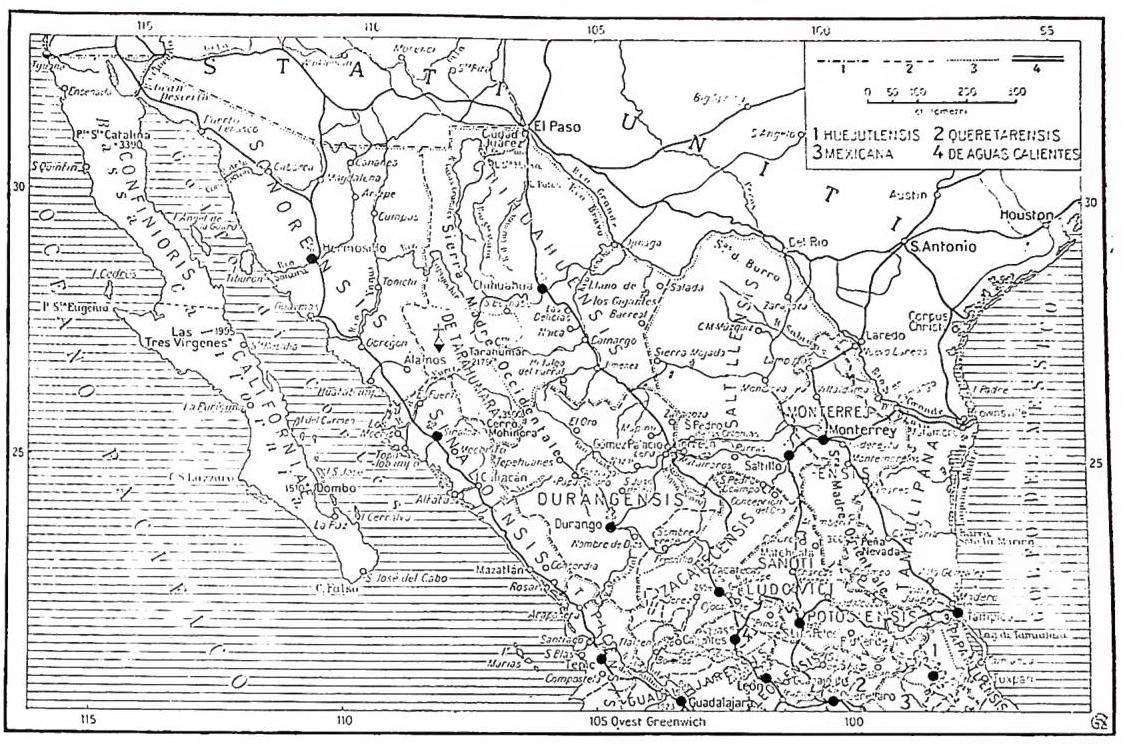
MESSICO - 1) Confini di Stato; 2) confini di regione; 3) confini di circoscrizione ecclesiastica; 4) ferrovie.
M. BRUCH, De messianismo in « Documentio Zadugueo », in Verbum Dom., 16 (1936), pp. 89-96, 142-37, 188-92, 212-45; L. Köhler, Theol. des Alt. Test., Tubines 1936, pp. 217-30; W. Möller, Bibl. Theol. des Alt. Test. in heiltgeschichtl. Entwicklung, Zwickau 1938, pp. 497 sgg., 513-19; J. Budn, Semah Jahweh, in Biblica, 20 (1939), pp. 10-26; A. Noordtali, Les intentions du Chroniste, in Rev. bibl., 49 (1940), pp. 161-68; A. G. Herbert, The throne of David, Nuova York 1942; J. Schildenberger, Weissagung und Erfüllung, in Biblica, 24 (1943), pp. 107-24, 205-30; G. F. Beavan, The hope of Israel in the post-captivity period, Dallas 1945; H. Koch, Der Gottesgeist und der Messias, in Biblica, 27 (1946), pp. 241-68, 376-403; D. Deden, De messiaanse profetieen, Roe 1947; S. Grill, Doppelbedeutung der altstamamentlichen Messiasnamen, in Klerusblatt, 80 (1947), p. 182 sg.; J. Obersteiner, Die Christusbotschaft des Alt. Test., Vienna 1947; G. Fidoux, Le Dieu qui vient. Espérance d'Israël, Neuchâtel 1947; L. Rost, Sinnibund und Davidbund, in Theologische Literaturzeitung, 72 (1947), pp. 29-34; C. Schedl, Die Sehnsucht der ewigen Hügel. Christus im Alt. Test., Graz 1947; H. Duesberg, Les valeurs chrétiennes de l'Ancien Test., Maredsous 1948; F. A. Herzog, Probleme der messianischen Weissagung, in Schweizerische Kirchenzeitung, 1948, pp. 193-96, 206 sgg.; A. F. Knight, From Moses to Paul: a christological study in the light of our hebraic heritage, Londra 1948; F. Spadafora, Ezechiele, Torino 1948, pp. 95-137, sgg., 144 sg., 258-61, 275 sgg. Francesco Spadafora