
SERVANT OF JAHWEH (Heb. 'Ébhedh Jahweh). -
A figure described in four hymns of Isaiah:
I) 42:1–7 (9); II) 49:1–7 (9); III) 50:4–9; IV) 52:13–
53:12. He is called “servant” by Jahweh; he is his
beloved, to whom, from his mother’s womb, he entrusts the mission
of proclaiming justice (the law) to the nations, of enlight-
ening and saving them, of bringing back the “Remnant of Israel”
and of consoling the afflicted; he is gentle with the weak. Instructed
by Jahweh as a disciple, he is obedient to him in teaching and
in enduring unheard-of blows and humiliations in order to fulfill
his mission. Jahweh reveals the amazement of the nations at the
enormity of his passion and the grandeur of his consequent exal-
tation (cf. Is. 50:5–6; 52:14; 53:1–22). The pro-
phet describes the wretched life and the disfigurements which the body
of the S. of J. undergoes in expiation of the sins of the perverse
people who condemned and violently put him to death, despite his
innocence and gentleness, and buried him with the wicked and with
the rich. Jahweh grants him immense posterity and accepts his expia-
tion and intercession for sinners.
not a few critics attribute them to Deutero-Isaiah. The question is
debated whether the hymns of the S. of J. were originally a distinct
poem, and what their order, extent, and dramatic form may have
been. There are innumerable hypotheses concerning the identification
of the S. of J. C. R. North classifies as follows the various identifications of the S. of
J. proposed by those who do not follow the messianic interpre-
tation: a) historical Israel, ideal Israel, pious Israelites,
the order of the prophets. b) A historical personage; Isaiah,
Ozia, Ezechia, Iosia, Geremia, Ezechiele,
Giobbe, Mosè, Ioachin, Ciro, Sassabasar, Zorebabel,
Melullam (Is. 42:19), Neemia, Elezzaro, an unknown doc-
tor of the law, an unknown contemporary of the author.
c) The author of the hymns, who would have had to predict his own death
or would not have composed the fourth hymn. d) A mythological repre-
sentation modeled on the myths of Tammuz–
Adonis, or a derivation from the Babylonian rite of the humilia-
tion of the king at the New Year festival. e) An ideal
and abstract figure; recent authors draw comparisons with the myths
of Râs
Samrah (Nyberg, Engnell), or with the Teacher of Righteousness of
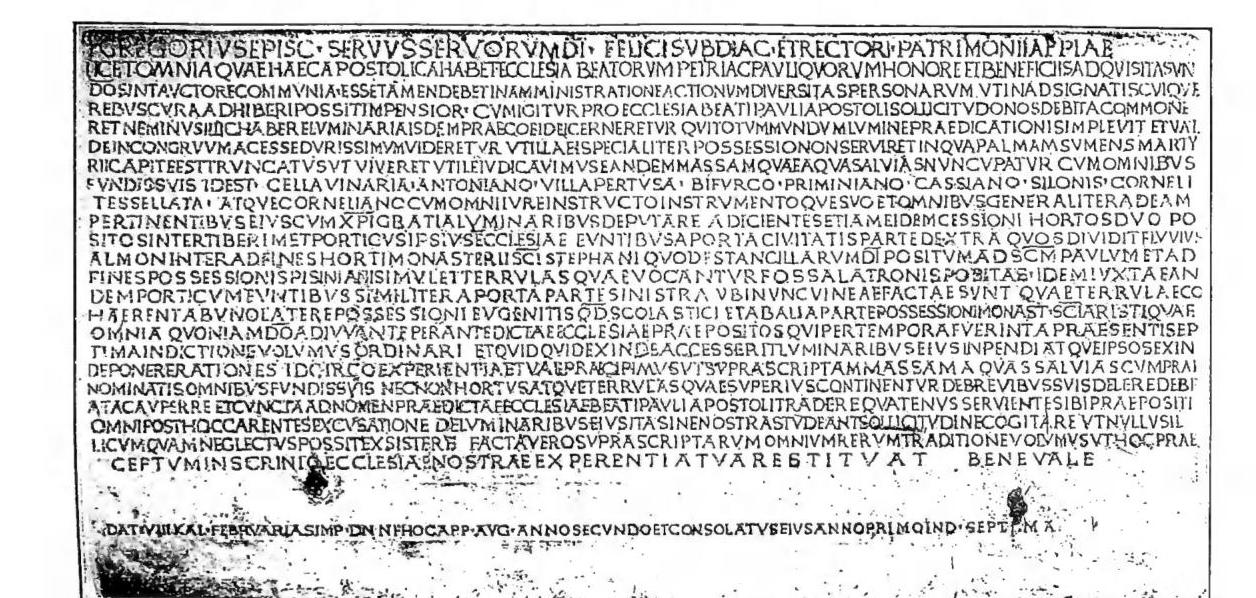
(from A. Silvagni, Monumenta epigraphica christ., I. Rome, Vatican City 1943, par. 12. 1)
SERVUS SERVORUM DEI — Inscription with the s. s. D. of the Praeceptum of St. Gregory the Great to the subdeacon Felix, rector of the patrimony of the Appian Way, by which he assigns the estate at “Aquas Salvias” to the basilica of St. Paul (25 January 604) — Rome, Lapidary Gallery of the monastery of St. Paul Outside the Walls.
the Dead Sea documents (Dupont-Sommer), or consider him an allegory such as that of the prodigal son.
Others interpret the S. of J. according to the context of the second part of Is., others detach him from it, while still others give a certain fluidity to the meaning of the S. of J. Some distinguish two servants: Israel in 41:29–42:4 and 41:1–4, 9 and 49:1–7, and then the Messiah in 52:13–53 (Kissane); or Ioachin for the first three songs and Sedecias as a figure of the Messiah in the fourth (Coppens). For others, the S. of J. is polyvalent, that is, he indicates Israel as the servant whose development leads to the idea of an individual servant par excellence, without abandoning the idea of an Israel that is still servant (H. H. Rowley); or he is an ideal personification of the Messiah, bearing the features of the prophet of Deut. 18:15, of the teacher, and of the savior who emerge from Is. 9 and 11, from Jeremiah and Ezekiel.
The messianic interpretation is still the soundest. In its favor are the Jewish tradition (the Septuagint, the Targum, the Talmud), the explicit testimony of the sacred writers of the New Testament, and the undisputed Christian tradition at least until the time of Grotius (cf. J. Knabenbauer, Comment. in Is. prophet., p. 347 ff.). As for the writers of the New Testament, it is enough to compare Mt. 12:18–21 with Is. 42:1–4; Rom. 15:21 with Is. 52:15; Jn. 12:38 with Is. 52:1; Mt. 8:17 with Is. 53:4; Acts 8:32–35 with Is. 53:7–8; Lk. 22:37 with Is. 53:12. In these passages one observes fulfilled in Christ what is said of the S. of J. (cf. also Lk. 2:32 — Is. 42:6; Mt. 11:5 — Is. 42:7; Rev. 19:13–15 — Is. 49:2; Mt. 26:67 — Is. 50:6). Jesus applies Is. 53:12 to himself (Mk. 15:28; Lk. 22:37). No one can doubt that the figure and mission of the S. of J. correspond fully only to Christ; indeed, they correspond to him so clearly that Isaiah may be proclaimed the evangelist of the Passion. The objections (the S. of J. must lead Israel back from exile to its homeland [49:5], and therefore he would have lived during the Exile; his passion is projected into the past, his glorification into the future; the idea of a suffering Messiah is unknown in the Old Testament; the term “servant” is used several times of Israel) can be resolved with relative ease. None of the other hypotheses withstands rigorous critical scrutiny.