DIVINE POWER. — It is one of the divine attributes, also known by the name of omnipotence.
P. is the capacity to receive or to do something; insofar as it is passive capacity, p. is opposed to act as the perfectible is opposed to perfection. But as active capacity, p. is the ability to produce an effect, to actualize. Evidently p. cannot be attributed to God in the first sense, because God is pure act, but it properly belongs to God in the sense of a realizing force proportionate to pure actuality.
According to a well-known principle of Thomistic philosophy, a being is all the more capable of acting the more it is in act, and therefore God, who is pure act, possesses an infinite capacity for action, that is, he is omnipotent. Divine omnipotence is strongly exalted throughout Sacred Scripture and in tradition; the Church’s magisterium has made it an article of faith in its Creed and in its definitions (cf. Vatican Council, sess. III, chap. 1: Denz-U, 1782).
In every divine action, knowledge, will, and omnipotence concur according to distinct modes: knowledge as directive, will as command, omnipotence as realizing force. By virtue of omnipotence, God can do everything that he wills and that, consequently, does not imply a metaphysical contradiction. Evil and sin, for example, being rather non-beings, cannot be effects of the First Cause, which is being in an absolute manner.
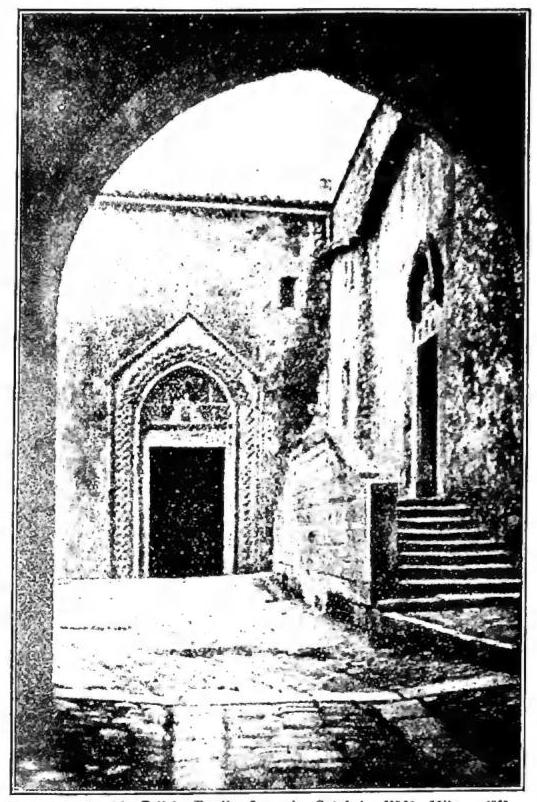
(from T.C.I., Puglia, Lucania, Calabria, VIII, Milan 1912, p. 181, fig. D)
POTENZA E MARSICO NUOVO, DIOCESI di — Castle of Lagopesole. Entrance to the Chapel (13th century).