
PROPHET. —
I. IN HOLY SCRIPTURE
(Hebr. nābhi; Lat. propheta from the Gr. προφήτης). One who, by divine vocation, speaks in the place and in the name of God (Deut. 18:18 ff.; II Reg. 3:9; Ier. 1:6, 9 ff.; Is. 52:6, etc.; cf. Ex. 7:1 ff.), communicating to the people to whom he is sent whatever the Lord, through supernatural action, commands and reveals to him (Ier. 1:7 ff.; Am. 3:7 ff.; 7:14 ff.; Ez. 2–3; etc.): « nihil aliud esse prophetam Dei, nisi enuntiatorem verborum Dei hominibus » (St. Augustine, Quaest. in Hept., 17: PL 34, 601).This is the certain meaning of Hebr. nābhi, rendered exactly by the Greek προφήτης (πρό « in the place of », φάνος « to speak »; Aeschylus, Eumen., 19; Pseudo-Euripides, Reso, 972; Plato, Resp., 366; idem, Tim., 62; idem, Phedr., 262 d.; etc.), even though its etymology remains uncertain. It was commonly connected with the Arabic nabā'a, « to announce », or the Akkadian nabā', « to call, to speak ». W. F. Albright (v. op. cit. in bibl., p. 301 ff) rightly holds that it is of Akkadian origin; the meaning of nabā, however, is that of « vocare », in the passive participle « vocato », one who has received a mission (cf. Code of Hammurabi, Prol., 1, 52; 1, 49; Epilogio, 24 R 40 ff., and the proper name Nabā-ilūtu, « he who has been called by his god »). This etymology confirms the passive form of nābhi, already maintained by W. Gesenius (cf. the cognates naẓir, maṭṭah) and supported by the fact that the verbal forms derived from nābhi are passive only: niph'al and hithpa'd, « to act as a nābhi », to prophesy. The prophet also announces the future, but the common meaning of « to predict the future » is only secondary; the etymology on which zā, « forward », and qāwāw, « to appear », are based (St. Isidore of Seville; St. Thomas, Sum. Theol., 2ᵃ-2ᵃc, q. 171, a. 1) is erroneous (P. Synave–P. Benoit [V. op. cit. in bibl.], pp. 16 ff., 226).
The other two principal terms, rā'eh, « seer » (used only of Samuel [I Sam. 9:9, 11, 18 f.; I Par. 9:22; 26:28; 29:29], of Hanani [II Par. 16:7, 10], and in Is. 30:10, although the verb rā'eh frequently indicates the « visions » which the prophet receives from God), and the synonym hāveh, « contemplative », used chiefly in poetry, express the means or manner of divine communication. The ancient term nābhi, from the time of Samuel, prevailed almost exclusively over rā'eh, as the editorial note at I Sam. 9:9 states concerning Samuel, who is called both nābhi and rā'eh (ibid. 3:20 and 9:11). In Am. 7:1–15 these three expressions appear as synonyms. Other appellations express the prophet’s intimate union with God (mal'ahh Jahweh, « messenger of J. », 'ēbhedh Jahweh, « worshipper of Jahweh », 'is 'Elāhim, « man of God ») or the various aspects of his mission among the people (rā'eh, « shepherd », lāmēr, « guardian », 'āphelh, « vigilant sentry », etc.).
Against the institutions and idolatrous practices of divination and magic, Jahweh, from the beginnings of the chosen nation, established the prophets as the sole spokesmen and interpreters of his thought and will (Deut. 18:9–22; Num. 23:23; cf. Am. 2:10 ff.; Ex. 7:25; Zach. 7:12; Neh. 9:30), giving them, as an unmistakable sign of recognition, in addition to moral worth, fidelity to Jahweh and to his precepts, the charism of predicting the future (Deut. 18:22; Is. 41:22 f.; 44:7 f.; 46:10 f.) and at times of performing other miracles. The beginning of the prophetic mission is the sudden vocation from God, which gives a new aspect to the existence of the one called (Ex. 3:7–4:18; Am. 7:10–15; Is. 6; Ier. 1:4–9; 20:7–18; Ex. 2–3; etc.). For this reason Abraham too is called a prophet (Gen. 20:7), together with the other Patriarchs (cf. Ps. 104:15).
The biblical sources recall, after Moses, the great prophet (Os. 12:14 [Vulg. 13]; Num. 11:25; 12:6; Deut. 18:15, 18; 34:10): his sister Miriam (Ex. 15:20; Num. 12:2; cf. Mt. 6:4); during the period of the Judges, Deborah and an anonymous nābhi (Iude. 4:4; 6:8), and an anonymous « man of God » who announces to Heli the downfall of his House (I Sam. 2:27); Samuel (v.), after whom, because of the grave dangers threatening Yahwism and the related vicissitudes of the nation, the prophetic message continued uninterruptedly as a permanent ministry (I Sam. 3:1; Act. 3:24; Hebr. 11:32). In the time of David: Gad (I Sam. 22:5; etc.) and Nathan (II Sam. 7:2; etc.); under Solomon: Ahijah (I Reg. 11:20; etc.); Shemaiah under Rehoboam; an anonymous « man of God » under Jeroboam; Jehu under Baasha (ibid. 12:22; 13; 16:1); Hanani under Asa; Jehu, Jahaziel, Eliezer under Jehoshaphat (II Par. 16:7–10; 19:2; 20:14, 37); Elijah (v.); Micaiah, son of Imlah (I Reg. 22:8–28); Elisha (v.); Jonah, under Jeroboam II (II Reg. 14:25). Then come the prophets whose writings have been preserved (« writing prophets »): Amos, Hosea, Isaiah, Micah, Nahum, Zephaniah, Habakkuk, Jeremiah, Baruch; during the exile: Ezekiel, Daniel; after the exile: Haggai, Zechariah, Obadiah, Joel, Malachi. There is no information about other prophets (cf. I Mach. 14:41) until John the Baptist (Mt. 11:9 f.; Le. 7:26 f.), forerunner of the prophet par excellence, Jesus (Act. 3:20 f. = Deut. 18:15–19; Io. 1:21, 45; 6:14; 7:40; Act. 7:37; Hebr. 1:1 f.; A. Clamer, Ste Bible, II, Paris 1940, p. 634 f.).
The Bible also uses the term nābhi and its derived forms, both for certain particular religious manifestations and for false prophets (whether of false divinities or falsely presenting themselves in the name of Jahweh).
The spirit of Jahweh descended upon the elders, Moses’ assistants, and they “began to prophesy,” nor did the phenomenon recur thereafter; two were in the camp and “they too prophesied,” that is, they became agitated in a characteristic manner. Moses regarded this manifestation as a divine gift: “Would that all were partakers of such a gift” (Num. 11, 25-29). In the eleventh century, in the time of Samuel, this phenomenon of collective prophecy reappeared (I Sam. 10,5 f. 9-12; 19, 18-24), and seems to have reached its culmination under Elijah and Elisha (ninth century), only to die out almost immediately afterward. In Samuel’s time, bands of Israelites took part in worship and proceeded together, employing song and music to prepare for and accompany the collective ecstatic manifestations of their exaltation. Probably carried away by religious enthusiasm and dominated by an irresistible overexcitement, with flushed faces, in more or less rhythmic movements of the entire body, perhaps also in impassioned utterances, they expressed their vivid Yahwistic sentiment. Perhaps the phenomenon was similar to the glossolalia described in Act. 2, 1-21; 10,44 f.; 19,6; I Cor. 14. The exaltation sometimes spread to those standing by, owing to some predisposition or to a particular divine intervention (cf. I Sam. 19, 20-24): in these manifestations, attributed to the action of Jahweh, it may perhaps be impossible to exclude every supernatural character. In the time of
Elijah and Elisha (I Reg. 17 ff.; II Reg. 1 ff.) these prophets (“sons of the prophets” = members of such associations: I Reg. 20,35; II Reg. 2,3; etc.), in various localities (Galgala, Bethel, Jericho), formed colonies where, to a certain extent, they led a common life (II Reg. 2; 4,38 ff.; 6,1-5); the followers of this professional prophetic movement had no supernatural vocation. In the most critical moments for the very existence of Yahwism, against the deleterious influence of Canaan, the official advance of Phoenician Baalism, and the open imposition of Iezabel, these pious associations, under the guidance and direction of the great inspired figures Samuel (who was probably their founder), Elijah, and Elisha, were among the living forces of the pure religion, stirring the people to fidelity toward Jahweh. Many of them were killed by Iezabel (I Reg. 18,13). The great prophets also made use of them for missions received from God (cf. I Reg. 20, 35-43; II Reg. 9, 14-11); they were sometimes present at their ecstatic manifestations, but never took part in them by prophesying as the others did (cf. I Sam. 19,20).
The false prophets of Baal (prophecy in the strictly Syro-Phoenician sense) are described in Elijah’s challenge on Carmel (I Reg. 18, 26-29); the Egyptian account of Wenamon (ca. 1100 B.C.; Golénischeff papyrus) and the writer Heliodorus, of Syrian origin, agree with II. Among the manifestations of Canaanite liturgy, in religious exaltation, a strange frenzy would seize some professional nābhi' and soon spread to the others. “To the agitated sound of the lyres, they danced, now with light leaps, now repeatedly bending the knee to the ground and then turning around on themselves like the possessed” (by a spirit: Heliodorus, Aethiopica IV, 17). With swords or knives they wounded themselves, uttering scarcely articulate sounds in which the suggestible worshipers recognized the words of the god. As the excitement grew, it became frenzied; some finally lost control of themselves. There were mutilations in honor of Baal, god of fertility, and the temporary consecration of young women to sacred prostitution (L. Desnoyers [V. op. cit. in bibl., I, p. 246 f.]; A. Pohl [V. op. cit. in bibl., p. 24 f.]). At the end of the seventh century, Jeremiah (Ier. 27, 3-9) attests that there were nābhi' in Edom, Moab, Ammon, Tyre, and Sidon, consulted by the kings of those states. And at the rise of the New Testament, such ecstatic performances were widespread in the Greco-Roman world (Virgil, Aen., VI, 45-51.77-80; Lucan, Phars., V, 161 ff., etc.).
Finally, nābhi' were called those who spoke in the name of Jahweh without having received any mission from him. In conflict with the authentic prophets, they adapted themselves to the king’s wishes, whom they flattered, indulged the illusions of the crowd, and sought money and popularity (I Reg. 22, 6-28; Mi. 2, 7-11; 3,5 ff.; Ier. 23, 9-40; 28; 29, 21-32; Ez. 13). Ezekiel (chap. 13) gives the most accurate description of them. These “prophets of their own minds,” who draw everything from their own thoughts, act as nābhi' in Israel (presenting themselves as called by God). They give lying divinations; they go about saying: “Oracle of the Lord,” although the Lord has not sent them and has not spoken. They do nothing to heal the wounds of the people and prepare it for the terrible events threatening II. “They deceive my people by saying: ‘All is well,’ while all is going badly,” ready to validate every fantastic hope of theirs. And concerning the “prophetesses of their own minds,” Jahweh complains: “You have compromised me (by using my name) before my people, for handfuls of barley and a few pieces of bread, lying...”. The facts would soon give a resounding denial to their words; the people would see them exemplary punished by Jahweh (cf. I Reg. 22; Ier. 28).
Rationalist criticism, lumping together the various and disparate elements set forth above, has attempted in different ways to provide a unitary explanation of Israelite prophecy that eliminates from it every distinctive action of God. Assigning excessive importance and scope to the editorial note I Sam. 9,9, it has advanced the hypothesis (from A. Kuenen through H. Gressmann, R. Kittel, G. Hölscher, A. Causse, etc.) that prophecy arose in Israel more or less in the time of Samuel (in this connection they also cite Act. 3,24; Hebr. 11,32, which speak only of the continuing succession of prophets from Samuel onward; while
Already Am. 2,10 f.; Ier. 7,25 trace the institution of prophetism back to Moses [Os. 12,14]. Evolving from ecstatic prophetism, through Elia and Eliseo, one would arrive at Amos, who introduced an entirely new type of prophecy. The earlier prophets would have been leaders or members of confraternities, whereas after Amos they were isolated; the former would have been visionaries and miracle-workers, the latter writers and thinkers; those would have been inspired men driven by ecstasy, these intellectuals and realists. They maintain that the prophets were originally possessed men; by artificial means (music, dance, etc.) they attained such exaltation that they felt themselves transformed and carried away by a higher power; then the spirit of the god, having taken possession of them, spoke through them: a religious phenomenon found in other religions as well. In its highest manifestations, from Amos onward, prophetism would be explained either by the sudden irruption into the prophet’s field of consciousness of subconscious ideas slowly elaborated in the subliminal consciousness (the psychological hypothesis: W. James, A. Reville, etc.), or by the intuition and profound knowledge of the human heart possessed by brilliant minds (A. Causse, etc.).
The sources, however, establish beyond question the sharpest and most decisive distinction between the manifestations of ecstatic, collective, and professional prophetism, and the divine institution of these “called by God,” from Moses to Malachia. None of these arose from the aforementioned associations of collective prophetism. In this prophetism some points of contact with similar phenomena among other peoples are undeniable; but the considerable differences cannot be overlooked. They lack, for example, the Syro-Phoenician characteristic of incisions; the passage adduced to support the contrary (I Reg. 20, 35-43) is not probative; the member of the prophetic association who goes to meet Achab has himself wounded in the face in order to appear as a soldier who had taken part in the battle just ended. What clearly distinguishes them is their zeal for Yahwism and the exclusion of every form of cultic abomination.
Ecstatic and professional or voluntary prophetism is a phenomenon strictly circumscribed in time. Only one who denies all the sources preceding Samuel can cast doubt on the existence of prophets from the very origins of Yahwism. Very soon ecstatic and professional prophetism developed unhealthy offshoots. Many prophet-disciples degenerated; after waiting in vain for the Lord’s call, they appointed themselves to the prophetic mission. Their conduct (I Reg. 22, etc.) is a valuable argument for understanding the nature of true supernatural inspiration. It is therefore a glaring contradiction to derive from the same source the true prophets who vigorously oppose them (Am. 7, 14; Ez. 13) and these false prophets who are their counterfeit.
Amasia, the priest of Bethel, enslaved to the Ichuite dynasty, says to Amos: “Seer, go away to Judah, and there earn your livelihood with your prophecies.” And Amos replies: “I am neither a nábhi' nor a son of a nábhi'. Yahweh took me from behind the flock and commanded me: Go, be a nábhi' to my people Israel” (Am. 7, 14). No natural disposition or preparation, neither a professional nábhi' nor a member of pious associations; rather, the sudden action of God upon the soul of this owner and shepherd of flocks, who is “taken” by Yahweh, removed from his normal occupations and from his Judah, and sent as the spokesman of divine justice into the Kingdom of Israel, then prosperous and at peace, to the very “royal” sanctuary of Bethel, served by a courtly priesthood enslaved to the dynasty. Amos, like all the prophets, is always conscious of himself, even under the action of Yahweh (Ier. 20, 9). Only the identity of the term remains; hence Amos can assert that he is not a nábhi' and immediately afterward categorically affirm that he is one. It is easy to understand the extension of the ancient term (cf. Gen. 20,7; Deut. 13, 2; 18,15; 34,10; Indc. 4,4 etc.) to cases that at least apparently seemed to imply a vocation and mission from Yahweh (Num. 11,25 ff.; Deut. 18,15; etc.). “You enticed me, Lord, and I let myself be enticed—you were the stronger and you prevailed. And I became a continual object of derision, the laughingstock of all. For whenever I speak I must cry out,
proclaim oppression and destruction; and thus the word of Yahweh becomes for me a reproach, a disgrace. I therefore resolved: I will forget it; ah, I will no longer speak in his name. But his word was in my breast like a devouring fire, shut up in my bones. I tried to contain it, but could not” (Ier. 20, 7-9). It is the supernatural, powerful action of God that seizes the prophet; cf. Am. 3,8: “The lion roars; who is not frightened? Yahweh speaks; who does not prophesy?” Ezechiele repeatedly expresses it: “The hand of the Lord came upon me and his word was addressed to me” (Ez. 1,3; 3,22 etc.). S. Tommaso (Sum. Theol., 2ᵃ-2ᵃ, qq. 171-74) systematically ordered the biblical and patristic elements, illustrating the nature of this divine action, which is essentially a supernatural illumination of the prophet’s intellect, strengthening it and becoming in him an active principle of knowledge. Whether it be a purely intellectual vision, or infused images illumined by supernatural light, or merely the divine light given in order to judge natural knowledge by means of it, the prophet responds vitally to the judgment he formulates and sometimes also to the prior elaboration of the intelligible species. The prophetic charism is given to him in a transitory manner; his vision is fragmentary and intermittent, and ceases when the light from above ceases to illumine him (cf. the examples of Nathan and Isaia; Geremia [42,7] waits 10 days for Yahweh’s answer; Eliseo: II Reg. 4,27). If Am. 3,8 and II Pt. 1,21 might suggest a lack of freedom in the prophet, Ier. 20,9 with 1,6; Ez. 1,3; 3,22; 8,1 with 3,17-21 attest to the prophet’s full consciousness and autonomy of mind and will under divine action (v. ISPIRAZIONE; cf. A. Bea, in Studia Anselmiana, 27-28 [1951], pp. 47-65).
Authentic prophetism is a unique phenomenon in the history of religions; it is characteristic of Yahwism (from its origins and without deviation) and of the Christian religion. It is impossible, in fact, to find any affinity in Egypt (the alleged prophecies of Ipuwer are descriptions of the past: A. H. Gardiner, A. Wiedeman), in Babylonia (the Babylonian hārā is a diviner, but has nothing in common with the Israelite prophet), or in Arabia, with the activity and mission of Moses, Elia, Eliseo, Amos, down to Malachia. Prophecy, the exact foreannouncement of future events and interpretation of God’s thought in history, is the inimitable and unmistakable effect of divine action upon its spokesman (E. König, V. op. cit. in bibl., pp. 55-62).
Every naturalistic explanation therefore conflicts with the evidence. The gradual development posited by the immanentists is contradicted by this sudden action or communication of Yahweh, which is repeated and is the efficient cause of every intervention of the p. in his mission. Besides the example of Amos, the calling of the young Samuel (I Sam. 3) is instructive; Nathan encourages David in his plan to build the Temple and is enthusiastic about it, but the following morning he communicates to him Yahweh’s contrary command (II Sam. 7); Isaiah announces to Hezekiah his imminent death, but immediately afterward turns back to communicate to him, on Yahweh’s behalf, his healing (II Reg. 20, 1-5). Genius, intuition, and profound knowledge of the human heart are qualities found more or less everywhere in the history of humanity. But prophetism is a unique phenomenon (E. König, op. cit. in bibl., pp. 70-78). Prophetism is the highest element of the religion of the Old Testament and one of the greatest spiritual movements of humanity as a whole. All the philosophers, all the legislators, and all the founders of religions in antiquity, taken together, did not enunciate as many lofty and sublime ideas as did the few p. of Israel (L. Dennefeld, V. op. cit. in bibl.). Nor were all the p. geniuses or learned men. Eliseo is a wealthy peasant, Amos a shepherd, Geremia and Ezechiele timid priests. They foretell unforeseeable events, in stark contrast with all historical and political expectations. Amos announced Israel’s ruin while the Kingdom was at the height of its power. Ezechiele foretells in detail the siege and destruction of Jerusalem (Ez. 4,5-21); and when everything seems lost, he predicts the return of the exiles, the establishment of the new Israel (ibid. 37,40-48), and the victory it will achieve over the assault of the gentiles (Antioco Epifane: ibid. 38-39). These are not meditations or intuitions
Divine communications occur through vision: a) purely intellectual, without the aid of any image, and this is the most frequent kind (cf. Ezechiele: «the word of God was addressed to me in these terms»); b) and sensible: while speaking to the intellect, God also acts upon the imagination and the internal senses, with sensible images (Is. 6,1; Ier. 1,1; Ez. 1-3; 8,10 etc.), and rarely upon the external senses (cf. ibid. 3,4). At times the external senses perceive nothing more of what is around them because they follow the faculties of the mind and the internal senses, which are extraordinarily active under the action of the Lord: this is ecstasy; vivid inward attention withdraws the p. from every external influence (ibid. 8,9; F. Spadafora, V. op. cit. in bibl., pp. 27, 75 ff., 271). All the faculties of the p. are active and conscious, while he receives the divine communications motionless; such ecstasy has nothing to do with the morbid and Corybantic excitement of pagan ecstaticism, produced by noisy actions. At times, for his communications, God makes use of dreams; thus with the Patriarchs (cf., for S. Giuseppe, Mt. 1,20; 2,13). Finally, in his action, God adapts himself to the mentality of the p.; he chooses images familiar to him. Divine suggestions were associated with the ideas and sentiments proper to the p., which varied according to individuals, time, and environment; each p. has his own character and personal stamp. Whatever the means chosen, the Lord leaves the p. with an unshakable certainty concerning the divine nature of the communication received; and he instills in him an irresistible impulse to transmit it to its recipients.
The p. fulfilled their office as spokesmen of the Eternal chiefly through the living word: they were, first and foremost, preachers. Very often, in order to make what they announced more vivid, effective, and intelligible, they performed symbolic actions. Already in Solomon’s time, Ahia, in prophesying the division of the Kingdom, tore his new mantle into twelve pieces and gave ten of them to Ieroboam (I Reg. 11,29 ff.; cf. Is. 20; but especially Geremia, Ezechiele, with four visions and eleven symbolic actions: F. Spa-
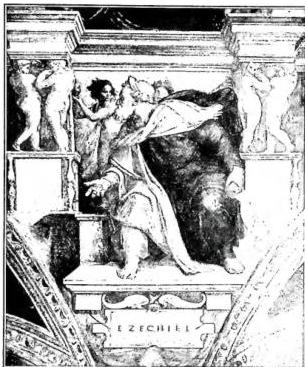
PROFETA - Il p. Ezechiele. Dipinto di Michelangelo nella volta della Cappella Sistina (1508-12).
porti con la nazione. Combattono la superstiziosa fiducia riposta dai loro contemporanei nel rituale esterno, che ha preso il posto e l'importanza assegnati, nello statuto dell'alleanza (il Decalogo), al monoteismo e all'osservanza delle leggi morali. L'insegnamento profetico si può sintetizzare sotto due aspetti: uno, positivo, illustra l'essenza dell'alleanza, le verità fondamentali, costitutive dell'antico jahwismo; uno, negativo o polemico, combatte energicamente le deviazioni. Nella loro opera, nei loro scritti, tutto si riduce a chiarire la natura dell'alleanza con Jahweh; sia l'interesse mostrato e l'azione svolta nella vita politica e per la giustizia sociale; sia l'atteggiamento assunto contro il culto, talvolta contro un sacerdozio indegno e venale, e i falsi p.
L'alleanza abbracciava, nei suoi riflessi, tutta la vita civile. I p. combattono i legami politici con altri popoli. Tali alleanze erano fonte immediata e diretta di contaminazione religiosa: « La politica imponeva il riconoscimento almeno ufficiale delle divinità del paese con il quale si trattava » (L. Desnovers, V. op. cit. in bibl., III, p. 149). Jahweh, d'altronde, si era impegnato a dare la Palestina agli Ebrei e a conservarli nel possesso di essa. La nazione non deve perciò temer nulla; deve solo aver cura di attuare le condizioni del patto. Dio è fedele alle sue promesse. È una condizione privilegiata ed unica: il Regno d'Israele non può essere che teocratico.
Pertanto, una dinastia che operi contro l'alleanza, come fecero le varie dinastie del Regno di Samaria, non è legittima; o, comunque, non può contare sull'appoggio dei p. e dei fedeli jahwistici. Così l'opposizione e la condanna espressa da Os. 7, 3-7; 8,10,15; 13,10 sg. non sono contro l'istituzione monarchica, per un regime di libertà; ma contro la politica sincretistica e scismatica dei re del nord. I p., in molti casi, ungono i re o li eleggono. Il disegno messianico, e perciò lo stesso piano salvifico, è connesso dai p. con la famiglia e la dinastia davidica (Is. 9,5 sg.; 11,1; Ier. 23,5 sg.; 33,15 sgg.; Ez. 17 ecc.).
Infine, l'entrare nel gioco delle forze politiche, poggiando sulle proprie armi e su alleanze potenti, significa non aver più fede incondizionata in Jahweh, fiducia nella sua potenza (cf. II Par. 28, 22-25).
I p. sono i continuatori del levitismo, per la purità e la conservazione del puro jahvismo (A. Neher, V. op. cit. in bibl.). Il profetismo, con l'annunzio esatto del castigo nazionale, con la visione della futura rinascita, svelando il disegno divino su Israele, impedi la scomparsa del popolo eletto, ne preparo il ritorno a Dio, e la rinascita e la continuità dopo l'esilio. I p. furono gli organi per eccellenza della Rivelazione divina, i teologi, i solerti pastori d'Israele; difensori dei sovrani diritti di Jahweh nel campo politico; avvocati dei poveri e degli oppressi nel campo sociale. La loro è la possente voce della vigile scolta che, dinanzi al disastro, richiama alla purezza delle origini, alla continuazione dell'opera del grande p. Mosè; nulla innovano, ma tutto illuminato, a tutto restituiscono il suo giusto valore. È la stessa voce di Dio; perciò i loro accenti scuotono ancora e soggiogano, inculcando il santo timore della somma giustizia, e l'immensa fiduciosa gratitudine verso l'infinita misericordia dell'Eterno.
BIBLI: cattolici: A. Condamini, Prophétisme israélite, in DFC, IV, coll. 386-425; C. C. Anders, De profeten des Ouden Verbands, Kampen 1918-19; L. Desnoyers, Hist. du peuple hébreu, I, Parigi 1922, p. 246 sg.; H. ivi 1930, pp. 165-83; M. A. Van den Oudentijn, De vocabolis quhundanis terminis nabi' synonimii, in Biblica, 6 (1925), pp. 204-311, 406-17; id., De prophetiae charismatis in populo Israelit. II. quatuor, Roma 1926; L. Dürr, Wollen und Wirken der alttestamentl. Propheten, Düsseldorf 1926; H. Junker, Prophet und Seher in Israel, Treviri 1927; J. Ziegler, Die Liebe Gottes bei den Propheten (Alttest. Abhandl., 11, 11), Münster in V. 1930; J. Chaine, Introduct. à la lecture des prophètes, Parigi 1932; E. Tobac - J. Coppens, Les prophètes d'Israël, I, 2e ed., Malines 1932; A. Pohl, Hist. populi Israel, Roma 1933, pp. 32-50, 64-71, 93-97, 132 sg.; G. Ricciotti, Stor. d'Israele, I, 2e ed., Torino 1934, pp. 381-95; E. F. Siegman, The false prophets of the Old Testament, Washington 1939; M. Sales-G. Giotti, La S. Bibbia, VII, Torino 1942, pp. 5-102; H. Höpfl - A. Miller - A. Metzinger, Introductio specialis in Vetus Testamentum, 5e ed., Roma 1946, pp. 383-408; L. Dennefeld, Les grands prophètes (La Ste Bible, ed. L. Pirot, 7), Parigi 1947, pp. 7-12; R. de Vaux, Les prophètes de Baal sur le Mont Carmel, in Bull. du Musée de Beyrouth, 5 (1947), pp. 1-20; P. Synave - P. Benoit, La prophétie (St Thomas. Summe théologique), Parigi-Roma 1947, pp. 269-378; G. Boson, I p. d'Israele, Brescia 1948; H. Simon - J. Prado, Vetus Testamentum, I, 6e ed., Torino 1949, pp. 360-83; H. Bacht, Wahren und falsches Prophetentum, in Biblica, 32 (1951), pp. 237-62. Acattolici: E. Sellin, Der alttest. Prophetismus, Lipsia 1912; G. Hölscher, Die Propheten. Untersuchung. 2. Religionsgesch. Israels, ivi 1914; H. Gunkel, Die Propheten, Gottinga 1917; B. Duhm, Israels Propheten, 2e ed., Tubinga 1922; W. Jacobi, Die Extase der alttestamentl. Propheten, Monaco 1923; E. König, Theol. des Alten Test., 3e-4e ed., Stoccarda 1923, pp. 50-84, 92-102; C. H. Cornill, Der israelit. Prophetismus, 13e ed., Berlino 1924; I.M.P. Smith, The prophets and their times, Chicago 1925; A. Lods, Rech. récentes sur le prophétisme, in Rev. de l'hist. des religions, 104 (1931), pp. 279-316; id., Les prophètes d'Israël, Parigi 1935; A. Jepsen, Nabi'. Sociolog. Studien, Monaco 1934; P. Humbert, Les prophètes d'Israël ou les tragiques de la Bible, Losanna 1936; A. Cousse, Du groupe ethnique à la communauté religieuse, Parigi 1937, pp. 61-113; W. F. Albright, Von der Steinzeit zum Christentum, trad. ted. sulla 2e ed., Berna 1949, pp. 271-331; A. Neher, Amos. Contribution à l'étude du prophétisme, Parigi 1950.
Francesco Spadafora
II. ICONOGRAPHY
The prophets were early represented in ancient Christian art both individually, as in the catacomb of Priscilla: Balaam (v. BALAAM) or Isaiah (v. ISAIA), Daniel (v. DANIELE), Jonah (v. GIONA), the last two frequently appearing in other cemeteries as well, and in Domitilla also Micah (v. MICHEA). They are likewise found in Christian sarcophagi, where Daniel is sometimes accompanied by Habakkuk. The most notable group representation is the mosaic series in the church of S. Apollinare Nuovo in Ravenna, where the sixteen prophets appear above the martyrs between the windows on the walls of the central nave. Depicted as venerable old men of marked and majestic moral steadfastness, they hold scrolls inscribed with texts—a motif repeated in later iconography. Notably, in these mosaics the prophets’ heads are adorned with aureoles; this practice, common in Byzantine-influenced art, would disappear in Western European art, where the nimbus was reserved exclusively for saints. Later, the sixteen prophets appear in the mosaics of the Greek monastery of Daphni (v. DAFNI).
A complete series of prophets, according to Byzantine concepts, was frescoed in the second half of the 11th century in the church of S. Angelo in Formis, above the columns on the lateral walls of the central nave, and in the contemporary church of S. Pietro ad montes near Caserta Vecchia. The 12th century introduces representations of the prophets in the mosaics of the church of La Marmorana, in the frescoes of the Palatine Chapel in Palermo, in the attic of S. Paolo in Spoleto (late 12th century), and in the transept of S. Maria Maggiore in Rome. They also appear in the mosaics of the dome above the high altar in the basilica of S. Marco in Venice. From the first half of the 13th century, we have the mosaics of the ceiling in the scarsella of the Florentine Baptistery, where among eight figures of the Old Testament the four major prophets (Jeremiah, Ezekiel, Daniel, and Isaiah) are depicted. The twelve minor prophets, also in mosaic, are represented on the arch rising between the scarsella and the octagon of the Baptistery. In Lombard art of the 12th–13th centuries, sculptures of the prophets adorn the portals of churches, such as in the frames around the main door of Modena Cathedral and in the Baptistery of Parma, a work by Benedetto Antelami from 1196.
In France, the prophets were painted in the 11th century in the chapel of the Grottes de Jonas near St-Pierre Colamine (Puy-de-Dôme; M. Thibout, Les Grottes de Jonas et les peintures murales de leur chapelle, in Cahiers archéolog., 2 [1947], pp. 115–28 and pls. 15–19), at St-Martin du Vic near Nohant-Vicq (Indre) at the beginning of the 12th century (J. Hubert, in Congrès archéol. de France, Bourges 1931, pp. 556–576), at St-Aignan-de-Brinay (Cher) in the 12th century (P. Deschamps - M. Thibout, La peinture murale en France. Le Haut moyen âge et l'époque romane, Paris 1951, pp. 117–118), at Notre-Dame-la-Grande in Poitiers in the 12th century (ibid., pp. 64–65, 69–71, 94; P. Deschamps, Les peintures du chœur de Notre-Dame-la-Grande de Poitiers, in Comptes rendus de l'Acad. des Inscr. et belles lettres, 1949, pp. 288–293), and at St-Savin-sur-Gartempe (Vienne) at the end of the 11th century (P. Deschamps - M. Thibout - A. Grabar, Observations sur les fresques de St-Savin-sur-Gartempe, in Cahiers archéolog., 4 [1949], pp. 135–47; P. Deschamps, La date des peintures de St-Savin-sur-Gartempe, in Comptes rendus de l'Acad. des Inscr., 1949, pp. 73–80; id. - M. Thibout, La peinture murale en France, pp. 71–86).
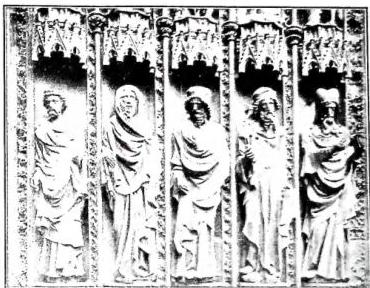
Several Gothic cathedrals in France feature full-round sculptures of the entire series of prophets near their portals, as at Bourges, Chartres, and Reims. A magnificent example of this type, possibly dating to the late 14th century, adorns the main portal of Strasbourg Cathedral. In Germany, similar sculptures appear at Bamberg.
The prophets are frequently represented in illuminated manuscripts, from the Codex Sinopensis to those of Catalonia, from the Bible of the Charterhouse of Calci (now in Pisa) to that of the Biblioteca Palatina in Parma (from the Monastery of S. Valentino near Amelia), from the Bible of Todi to that of S. Maria ad Martyres and another from S. Cecilia in Trastevere, all three now in the Vatican Library (Vat. lat. 1040s, Vat. lat. 1298s, and Barb. lat. 587).
In Pisa, they appear in Nicola Pisano’s pulpit; in Rimini, in the Malatesta Temple, Agostino di Duccio depicts them alongside the sibyls. Pinturicchio includes them in the Borgia Rooms in the Vatican, and Perugino in the Sala del Cambio. In late medieval Italian painting, it became common to depict certain prophets in miniature form in the cusps of Gothic polyptychs, as in Duccio’s polyptych (Siena Gallery). In the Maestà, however, six prophets were painted in the predella (four of which are still preserved in the Opera del Duomo in Siena, and two in the Kaiser Friedrich Museum in Berlin).
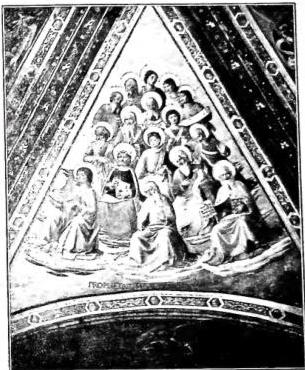
Highly characteristic are the prophets frescoed by Pietro Cavallini in S. Maria Donna Regina in Naples and by an anonymous Emilian master in the mid-14th century on the walls of the chapter house in the Abbey of Pomposa. In a compartment of the ceiling in the Chapel of S. Brizio in Orvieto Cathedral, Fra Angelico, assisted by Benozzo Gozzoli, frescoed in 1447 the group of all sixteen prophets, labeling them with the inscription: “Prophetarum laudabilis numerus.” Additionally, Fra Angelico’s hand is seen in the depiction of nine prophets adorning the frame of the magnificent Crucifixion frescoed in the chapter house of the convent of S. Marco in Florence. Twelve statues of prophets, sculpted by various late medieval and Renaissance masters, stand on the façade of Orvieto Cathedral, paired and flanking the rose window. Similarly, on the façade of Siena Cathedral, around the rose window, are figures of all the prophets, together with other Old Testament figures.
Jacopo della Quercia placed five prophets in the compartments of the tabernacle of the baptismal font in S. Giovanni in Siena. Lorenzo Ghiberti depicted some prophets in the vertical friezes of his second door of the Florentine Baptistery. However, the most famous representation of the prophets is undoubtedly that by Michelangelo, who placed seven of them (Jonah, Jeremiah, Ezekiel, Joel, Zechariah, Isaiah, Daniel) on the ceiling of the Sistine Chapel, interspersed with five sibyls. Among the prophets painted on the pillars of the church of S. Agostino in Rome, only Isaiah is by Raphael (1512); the others were added in the mid-19th century by Pietro Gagliardi. The prophets in the church of S. Maria della Pace in Rome, frescoed above the four sibyls by Raphael, are not by him but perhaps by his early master, Timoteo Viti. Marble statues of the four prophets—Isaiah, Ezekiel, Moses, and David—decorate the pedestal of the Column of the Immaculate Conception in Piazza di Spagna in Rome, erected in 1856 according to the design of L. Politi.
III. THE PROPHET ACCORDING TO ETHNOLOGY
Religious ethnology speaks of prophets and prophetesses, that is, of persons who foretell future events, claiming to know them through a personal and direct revelation from God or spirits, or from a particular spirit. This highly complex phenomenon has been reduced by evolutionist ethnologists to a morbid and pathological phenomenon.For example, Tylor, the classical author of ethnological evolutionism, considers prophecy, as well as ecstasy, visions, and other similar religious manifestations—both pagan and Christian—as an effect of a state of depression or overexcitement produced in a person by prolonged and exhausting fasting, the use of narcotics, or practices that produce the same effects, such as hallucination. To support his theory, Tylor presents examples more or less arbitrarily drawn from certain peoples of North America (Ojibwa, Plains Indians, Abipones, those of Haiti, the Zulu, Malays, the Yogis of India, Greeks, Romans, and even Christians). Regarding Christianity, he refers particularly to medical descriptions of the scenes provoked by fanatics during the period of religious revival in England, Ireland, and America "within Protestantism." Frazer then reached such an exaggeration regarding primitives as to say that "the savage, unable to distinguish between the visions of dreams and the realities of the waking state, confuses the appearance of a dead person during sleep with the real presence of a spirit."
These evolutionist theories, which conceive the development of human civilization in a uniform, humiliating manner—from the lowest, semi-bestial, to the highest, from the inferior to the superior—have been proven false by modern ethnology (v. ETHNOLOGY); and Frazer's assertion, in particular, has already been subtly and irrefutably criticized by Lévy-Brühl. Durkheim, basing himself on Codrington and Howitt, had already noted of Australian primitives: "The Dieri distinguish between what they consider a vision and a simple dream. The latter is called opiccia, a mere imagination."
One must then distinguish prophecy from divination. The latter presents the revelation of future or hidden things in various ways, among which it also takes dreams into account (v. DIVINATION). Now, the dream may also fall within prophecy if the revelation of future things is not derived from the object dreamed but occurs during the dream as a direct personal revelation, which properly distinguishes prophecy. Tylor did not comprehend the great and intricate complexity of prophetism because he sought to reduce it to a morbid manifestation and failed to distinguish morbid phenomena from those that are not at all so. Moreover, regarding Christianity, Tylor should have known that the Catholic Church has the ability to judge true from false mystical phenomena, and that Catholic theology provides sound rules in this regard (v. BIBLICA). Among primitive peoples, despite their great cultural diversity, prophetic facts are observed that are not related to fasting but to prayer. It suffices to cite the example recounted by K. Rasmussen, who was both participant and witness when the Eskimos of the Barren Grounds of North America wished to give him a farewell feast. During the feast, it was announced that the prophetess Kinalik wished to invoke Sila, the Supreme Being, to obtain a safe journey and protection from dangers for the departing guest. When she returned to herself after concentrating all her strength to devise and implore something good in favor of the one about to set out on a journey, and had regained her normal expression with a cheerful and radiant appearance, she recounted, says Rasmussen, that the Great Spirit had granted her request and that all dangers would be far from his life, and that whenever they needed meat, they would find successful hunts.
From the important information given to Schoolcraft by Chingwauk, an Algonquin chief versed in mystical traditions and an admirable reader of his people's hieroglyphics, Tylor—who nonetheless reports them—could have deduced that even primitives demand guarantees and set certain conditions before believing in a prophet and his prophecies. Chingwauk relates, among other things, that the prophet begins to exercise his powers in secret, taking care to have only one confidant near him, whose testimony is necessary in case of success. He then draws and symbolizes on bark or other material the figures of his dreams or revelations and often spends an entire winter compiling the catalog of his principal revelations. If what he has predicted comes to pass, the confidant hastens to announce it, and reference is made to the said catalog as proof of his talent and prophetic faculty. Finally, he communicates his Kee-Kee-Wins, or the record of his dreams, to the elders of the tribe, who gather to examine them, for the entire nation believes in his revelations. The elders usually end by giving their approval and declaring that the petitioner is endowed with the gift of prophecy, that he is full of wisdom, and that he can influence the opinions of the people.
The figure of the prophet, moreover, is highly complex: ordinarily, he is also a soothsayer, exorcist, healer, magician, and invoker. In ancient feudal China, for example, shamans and shamanesses existed everywhere, who could also be called sorcerers and sorceresses (sui and sui-ni). They held an important place in the religious life of the people; they were considered intermediaries with the world of gods and spirits. Of a sorcerer from the state of Zheng, it is said not only that he could predict even the day of death of those who consulted him but also that he could heal illnesses and knew what was auspicious and what was inauspicious. In the different seasons of the year, the shamanesses (sau-sé) had to drive away pestilential emanations and evil influences and make libations. When a great calamity struck the country, they sang, wept, and begged for the cessation of the scourge. The shamans gathered together with their leader, and in the case of a great drought, they performed dances to obtain rain.
It is interesting to note that the power possessed—or believed to be possessed—by sorcerers is attributed to a pact they have made with a spirit that assists them, a belief also found in the invocation formula of the spirit, as Leroy revealed, showing a surprising analogy with civilizations scattered across the globe. The supplication of the sorcerer of the Fang of West Africa always begins with the renewal of the pact: "Spirit, you who are my Lord and to whom I have given myself, strong and powerful spirit, it is I who call you." Here is the formula used in the presence of the missionary Huc by a Tibetan sorcerer: "I know you, you know me. Come now, old friend, do what I ask. Bring water and fill the vessel I present to you. Fill a vessel with water, what is that to your great power? I know you charge dearly for a vessel of water, but no matter; do what I ask and fill this vessel I present to you. Later we will sing together. On the appointed day, you will take what is yours." The same belief is found among European sorcerers.
The revelation of the future made by the spirit to which the sorcerer is bound occurs in various ways, of which there are abundant accounts both in the travel books of explorers and in the reports of missionaries; generally, the revelations occur after a period of shouting, clamor, beating of instruments, etc.
Among the ancient Chinese, under the Chou dynasty (1122-1259 B.C.), magicians and sorceresses, as Maspero has noted, entered into relation with spirits through a true obsession, so much so that they were often also called possessed (ling-pao); the spirit descended into them, such that «the body was (that) of the sorceress, but the heart was (that) of the god». It was the god who spoke through their mouths, as the soul of a prince declared at the end of a first apparition to his old charioteer: «In seven days at the side of the new enclosure (of k'ii-ru) there will be a sorceress and you will have an interview with me». Sometimes the spirit was not content merely to speak but acted through its magician, as did that hungry spirit (li) which, furious at the little care the prior—charged with offerings to the souls without posterity of Ku of Kuan—took in fulfilling the duties of his office, suddenly took possession of a medium and made him kill the prior on the altar with blows from a stick. Before the evocation of the spirit, the ancient Chinese sorceress purified herself by washing her face and body with water of special herbs and dressed herself in magnificent garments. When the offerings were ready, she sent her soul to seek the deity and led it with her to attend the sacrifice, mimicking this journey with a dance accompanied by music and song.
From what has been said, it is easy to form an idea of the complexity of the prophetic phenomenon. Each case must be judged individually to discern what is natural, preternatural, or supernatural, what stems from morbidity or cunning. Ethnology lists such a diversity of prophetic facts that they cannot in any way be judged simply as morbid phenomena, in the manner of Tylor. Among the Hebrews, moreover, the nābhi recall in certain aspects the dervishes and certain manifestations of some Muslim confraternities. The nābhi have been called voluntary prophets and rightly distinguished from prophets of vocation; the latter, moreover, are such characteristic figures that they cannot be reduced to any known prophetic figure among other peoples.
PROFETI (ebraismo)
Il termine nābhi (pl. nĕbhî'îm), che nella Bibbia designa il profeta, è di etimologia incerta. Secondo alcuni deriverebbe da una radice nb' che significherebbe "bollire, ribollire" (in senso fisico e morale), donde il significato di "colui che è agitato, invasato"; secondo altri, invece, da una radice nb' che significherebbe "chiamare, annunziare", donde il significato di "colui che è chiamato, l'annunziatore". La prima etimologia sembra più probabile, perché più rispondente alla realtà storica dei profeti biblici, i quali appaiono spesso in uno stato di esaltazione e di estasi. Tuttavia, non si può escludere che il termine abbia avuto un'evoluzione semantica, passando dal significato di "agitato" a quello di "annunziatore", come è avvenuto per il termine greco prophētēs, che originariamente significava "colui che parla in luogo di un altro" e poi è passato a significare "colui che parla in nome di Dio".
I profeti biblici non sono semplici indovini o maghi, ma uomini chiamati da Dio a una missione speciale: quella di essere i suoi messaggeri presso il popolo eletto. Essi sono i depositari della parola divina e i custodi della legge, i quali, in nome di Dio, richiamano il popolo alla fedeltà all'alleanza, denunciano le ingiustizie e le infedeltà, annunziano i castighi e le benedizioni divine. La loro missione è essenzialmente religiosa e morale, anche se spesso si intreccia con la politica e la storia del popolo d'Israele.
PROFETI (cristianesimo)
Nel cristianesimo, il profeta è colui che parla in nome di Dio, non solo per annunziare eventi futuri, ma anche per interpretare la volontà divina e richiamare i fedeli alla conversione e alla fedeltà al Vangelo. Il profetismo cristiano si distingue da quello ebraico per il suo carattere escatologico e cristologico: i profeti cristiani annunziano la venuta di Cristo, la sua morte e risurrezione, e la salvezza portata da Lui all'umanità. Essi sono, inoltre, testimoni della presenza dello Spirito Santo nella Chiesa e strumenti della sua azione.
Nel Nuovo Testamento, il profeta è spesso associato all'apostolo e al maestro (cfr. 1 Cor 12,28; Ef 4,11). San Paolo, in particolare, sottolinea il ruolo dei profeti nella edificazione della Chiesa (1 Cor 14,3-5) e li considera come un dono dello Spirito Santo (1 Cor 12,10). I profeti cristiani non sono solo coloro che predicono il futuro, ma anche coloro che, illuminati dallo Spirito, interpretano la parola di Dio e la applicano alle circostanze concrete della vita della Chiesa.