
KINGS, I and II (III and IV). - Two books of the Old Testament, which summarize the history of the Hebrew people from the final years of David (d. in 970 B.C.) to the Babylonian exile (587 B.C.); the Jews placed them among the «prophetae priores».
In the Vulgate, four books bear the name «Books of Kings» (Libri Regum), called in the Septuagint «Books of the Kingdoms» (Ἐκασιλεῖον) (cf. the comment of St. Jerome, in Prof. Gal., against this designation), whereas in the Masoretic text the first two are called «Books of Samuel» (v.) and the others «Kings (Book of) First and Second». The Hebrew designation is preferable, according to which I and II Kings correspond to III and IV of the Vulgate (and Septuagint). Originally the two Books of Kings formed a single book, like the two of Samuel. This unity is maintained in the Syriac version. The division into two books, introduced by the Septuagint, passed into the Latin versions and, later (15th century), into the Hebrew Bible, first in manuscripts and then in the printed edition prepared by Felice da Prato and published by Daniele Bomberg (Venice, 1516–17).
The Books of Kings encompass three clearly distinct periods: a) the united kingdom under David (his final days) and Solomon (I Reg. 1–11); b) the two kingdoms of Israel and Judah (I Reg. 12; II Reg. 17); c) the kingdom of Judah from the fall of Israel to the Babylonian exile (II Reg. 18–25).
I. DAVID’S FINAL DAYS AND THE REIGN OF SOLOMON, 970–930 (?) (I Reg. 1–11). - Adonijah attempts to replace the aged and infirm David (I Reg. 1, 1–4), but Nathan’s timely intervention, through Bathsheba, secures the kingdom for Solomon (1, 5–53). Adonijah arouses new suspicions by asking to marry Abishag, and Solomon has him put to death (2, 13–25). Abiathar, the high priest, is then deposed, and Joab, both supporters of Adonijah, is killed: Zadok succeeds the former and Benaiah the latter (2, 26–35); by the hand of the latter Shemei also meets his end (2, 36–46). Solomon’s marriage to the daughter of the Pharaoh of Egypt (3, 1 ff.). God grants Solomon wisdom, which immediately manifests itself in the well-known judgment (3, 4–28). Organization of the kingdom and other manifestations of Solomon’s wisdom. Construction of the Temple and the royal palace, and furnishing of the Temple (4–7). Transfer of the Ark, Solomon’s speech and prayer, his blessing of the people, and the offering of sacrifices (8). A second divine appearance with promises and threats; the cession of certain cities to Hiram, new undertakings, and new burdens (9). Visit of the queen of Sheba (10, 1–13). Solomon’s splendor and luxury (10, 14–29); led astray by his pagan wives and concubines and rejected by God, who raises up enemies against him, among them Jeroboam; summary of Solomon’s reign and his death (11).
II. THE TWO KINGDOMS OF ISRAEL AND JUDAH, 930–722–21 B.C. (I Reg. 12 – II Reg. 17). - Schism, provoked by the discontent of the northern tribes, excessively burdened with taxes, and by the imprudence of Rehoboam; Jeroboam becomes king of the ten dissenting tribes (I Reg. 12, 1–20). Relations between the two kingdoms are almost always hostile, except during a period of agreement between the two ruling houses (approximately 875–842 B.C.), until the fall of Israel (842–722–21 B.C.). The account centers on the rulers of the two kingdoms (the most probable chronology is indicated in this outline).
KINGS OF JUDAH
REHOBOAM (17 years: 930–914), attempts to subdue the rebellious tribes and suffers the invasion of Shishak of Egypt (I Reg. 12, 21–24; 14, 21–31).
ABIJAH (3 years: 914–912) (15, 1–8).
ASA (41 years: 912–872), a pious king (14, 9–24).
KINGS OF ISRAEL
JEROBOAM (20 years: 930–911; or 22: 932–911), after the political schism completed the religious one, organizing worship at Bethel and Dan and bringing condemnation upon his house through the mouth of the prophet Ahijah (I Reg. 12, 25–14, 20).
NADAB (2 years: 911–910), son of Jeroboam, was killed by Baasha (15, 25–32).
BAASHA (25 years: 910–887), usurper, at war with Asa (15, 33–16, 7).
ELAH (2 years: 887–886), killed by Zimri (16, 8–14).
ZIMRI (7 days: 886), usurper, overcome by Omri, killed himself (16, 15–20).
OMRI (12 years: 886–875), founded the capital Samaria and brought prosperity to the kingdom (16, 21–28).
AHAB (22 years: 875–854), wicked, married the idolatress Jezebel, introduced the worship of Baal, and was opposed by Elijah (16, 29–22, 40).
AHAZIAH (2 years: 854–853), a worthy son of Ahab (22, 52 ff.; II Reg. 1, 1–2, 25).
JEHORAM (12 years: 853–842), fought against Mesha of Moab and against Ben-hadad of Damascus. Activity of Elisha (II Reg. 3, 1–27; 4, 1–8, 15).
JEHU (28 years: 842–815), executed judgment upon the house of Ahab and destroyed the worship of Baal; he was defeated by Hazael of Syria (9, 1–10, 36).
JEHOAHAZ (17 years: 815–798), Israel, oppressed by the Aramaeans, obtained a deliverer (Adad-nirari?) (13, 1–9).
JOASH (16 years: 798–783), defeated the Aramaeans (13, 10–25).
JEROBOAM II (41 years: 783–743), under him Israel attained its greatest power and extent (14, 23–29).
ZECHARIAH (6 months: 743), killed by Shallum (15, 8–12).
SHALLUM (1 month: 742), overthrown by Menahem (15, 13–16).
MENAHEM (6 [10] years: 742–737), paid a heavy tribute to Tiglath-pileser III (15, 16–22).
PEKAHIAH (Pāqahjāh) (2 years: 737–736), killed by Pekah (15, 23–26).
PEKAH (Peqah) (4 [20] years: 736–732), overthrown by Hoshea (15, 27–31).
HOSHEA (9 years: 732–724), having rebelled against Assyria, was imprisoned; Samaria fell after a three-year siege, 722–21. Origin of the Samaritans (17, 1–41).
III. THE KINGDOM OF JUDAH FROM THE FALL OF SAMARIA TO THE EXILE
HEZEKIAH, a pious king, threatened with invasion by Sennacherib and miraculously delivered; healed of a mortal illness; imprudently showed his treasures to Merodach Baladan (II Reg. 18-20). MANASSEH was wicked almost until the end of his 55-year reign (697[696]-642) (21, 1-18). AMON, wicked like Manasseh, after reigning for two years (642[641]-640) was killed in a court conspiracy; the people executed the assassins and proclaimed the pious JOSIAH king (31 years: 640[639]-609) (21, 19-26). He restored the Temple and promoted a radical religious reform; he died at Megiddo while attempting to resist Pharaoh Necho (22, 1-23, 30). JEHOAHAZ (three months: 609) was taken prisoner by Necho, who placed Eliakim on the throne under the name of JEHOIAKIM; he reigned for eleven years (609[608]-598), tributary to Nebuchadnezzar (23, 31-34, 7). The latter also imprisoned his successor JEHOIACHIN after three months of reign (598) and made Mattaniah king under the name of ZEDEKIAH (598[597]-587). Jerusalem was besieged in the ninth year of Zedekiah and fell in the eleventh (587); Zedekiah (v.) had his sons killed and his eyes put out. The deportation of the people, the plundering of the Temple, and the killing of the notables followed (24, 8-25, 21). Gedaliah, placed in charge of those remaining in Judah, was killed, and the people fled to Egypt for fear of the Babylonians (25, 22-26). Jehoiachin’s imprisonment was eased by Evil-merodach (25, 27-30).After recounting the last days of David and the reign of Solomon, the narrative proceeds according to a constant pattern, especially in its parallel treatment of the kings of Judah and Israel. The introductory formula contains: a) a synchronistic indication of the year of accession to the throne, with reference to the reigning king of Israel (I Reg. 15, 1, 9; 22, 41 etc.) or of Judah (ibid. 15, 25, 33; 16, 8, 15, 23, 29; 22, 52 etc.); b) the duration of the reign (ibid. 15, 2, 10, 25, 33; 16, 8, 15, 23, 29; 22, 42, 52 etc.); c) a judgment on the sovereign’s character with regard to fidelity, and especially to religion. In this respect, the kings of Israel are all compared with Jeroboam, who caused his people to sin (ibid. 15, 26 sgg., 34; 16, 26 etc.). The kings of Judah are judged according to the model of David, pre-eminently faithful. Some are utterly wicked: Abijah (ibid. 15, 23 sgg.), Ahaz (II Reg. 16, 2 sgg.), Manasseh (ibid. 21, 9) etc.; many substantially practiced David’s religion, but tolerated the worship at the high places (so also Jehoshaphat: I Reg. 22, 44); very few deserve unqualified praise for practicing the pure and simple religion of Yahweh (Hezekiah: II Reg. 18, 3 sgg.; Josiah: ibid. 22, 2). The concluding formula contains: a) an indication of the source, to which the reader is also referred for more extensive information (I Reg. 14, 29; 15, 7, 25, 31; II Reg. 8, 23; 10, 34 etc.); b) death and successor (I Reg. 14, 31; 15, 8, 24; II Reg. 8, 24; 10, 35 etc.). Non-constant elements are the indication of the age of the sovereign at the beginning of his reign (I Reg. 22, 42; II Reg. 14, 23); the name of the mother for the kings of Judah (II Reg. 8, 26); and the place of burial (I Reg. 16, 28; 22, 51).
IV. HISTORICITY
The book of K. is undoubtedly a historical work; but it is a history with a thesis, insofar as it seeks to demonstrate through facts that the happiness of the chosen people depends upon observance of the divine law, just as calamities for the house of Judah and that of Israel result from its non-observance (cf. II Kings 17:7-23). Consequently, the religious element occupies the foremost place in this history. The activity of the prophets, moreover, is illustrated with particular care (the extensive narratives forming the cycles of Elijah and Elisha: I Kings 17-II Kings 1; II Kings 2-13), because they were the defenders of religion, authorized to call back to it both the people and their kings and priests. Another characteristic is the dynastic one, namely, the demonstration of the legitimacy of the single Davidic dynasty reigning in Judah, as against the many schismatic dynasties succeeding one another in Israel. Even the captive king Ioachin, whose “head” Evilmerodac “raises” (II Kings 25:27), acquires almost the value of a symbol and a pledge for the future of the deported people. Opposed to the single house of David in Judah (the parenthesis of Athalia soon closes with the accession of David’s surviving heir) stand no fewer than nine reigning families in Israel, over a period of two hundred years. The two books of K. bear evi-IOSAPHAT (25 years: 872-849), good but weak, so much so that he gave his son Ioram in marriage to Achab’s daughter, Athalia (22:41-44, 47-51).
IORAM (8 years: 849-842), an impious king (II Kings 8:16-24).
OCHOZIA (1 year: 842): he fought with Ioram, king of Israel, against the Arameans and was killed by Iehu (8:25-29; 9:14-30).
ATHALIA (7 years: 842-836), a usurper through the slaughter of all the members of the royal house; but Ioas escaped her; by order of the high priest Ioiada she was killed (11:1-20).
IOAS (40 years: 836-797), restored the Temple; he was killed (12:1-22).
AMASIA (15 [29] years: 797-783): he was defeated by Ioas of Israel and fell victim to a conspiracy (14:1-22).
AZARIA (Uzzia, Ozia: 27 [52] years: 783-757): good, but stricken with leprosy, he left the government to his son Ioatham (15:1-7).
IOATHAM (16 years: 757-742), a pious king.
ACHAZ (16 years: 741-736), a king inclined toward paganism, obtained Assyria’s aid against the Syria-Israel coalition (16:1-20).
EZECHIA (29 years: 726 [725]-697).
dent signs of compilation. The author sometimes confined himself to juxtaposing documents without taking care to avoid duplications, resulting from the fact that the different sources contained the same information. Among the various cases of this kind, note: I Kings 5:1 and 5:4 (the extent of Solomon’s dominion); ibid. 5:6-30 and 10:23-36 (Solomon’s wealth and magnificence; tributes paid to him); ibid. 9:28 and 10:11 (riches imported from Ophir); II Kings 13:12 ff.
and 14:16 ff. (the end of Ioas). Nevertheless, this does not detract from the unity of composition, attested by the schematism governing the book, by the spirit animating it, and by the demonstrative purposes served by the narrative. Certain recurring formulae are likewise indications of unity of composition, such as: “sin of Ieroboam” (eight times in I Kings and nine in II Kings); “to do what is evil in the eyes of the Lord” (thirty times in the two books); “for the sake of David my servant” (I Kings 13:32, 34; 15:4; II Kings 8:19; 19:34; 20:6); “mingens ad parietem” (I Kings 14:10; 16:11; 21:21; II Kings 9:8; elsewhere only in I Sam. 25:22, 34).
The following sources are explicitly cited: the Book of the Deeds of Solomon (I Kings 11:41); the Annals of the Kings of Judah (fifteen times, first for Roboam [I Kings 14:29], last for Ioachin [II Kings 24:5]); the Annals of the Kings of Israel (eighteen times, first for Ieroboam [I Kings 14:19], last for Phacee [II Kings 15:31]). It is dis-
puted whether these sources were official or private. If they were official, there would be an additional reason for supposing the existence in K. of other sources that would explain the accounts of facts and judgments scarcely honourable to the sovereigns, which sources inspired by courtly interests could not have contained; but it is more probable that they were private compilations that had made use of official sources.
Of the sources not explicitly cited in the book of K., some must have been of courtly origin, from which would derive the list of Solomon’s ministers and prefects (I Kings 4:2-19), the panegyric of his greatness (ibid. 4:20-34), and the account of the visit of the Queen of Sheba (ibid. 10:1-29); others were of priestly origin, recounting the construction of the Temple (ibid. 6:1-7:50), the revolt against Athalia organized by the high priest Ioiada (II Kings 11:1-20), the restorations of the Temple under Ioas (ibid. 12:1-16), the religious reform of Giosia (ibid. 22:3-23:27), etc.; and others, finally, were of prophetic origin, whence derive the invective of a prophet against Ieroboam and the altar built by him at Bethel (I Kings 13:1-23), the rebuke
of Achab (ibid. 20:1-45). To this latter category belong as a whole the cycles of Elijah (I Kings 17 - II Kings 1) and Elisha (II Kings 2-13), which have clearly defined outlines in style and in the spirit informing them. Perhaps not all these sources were written: some may have reached the compiler through oral tradition.
That the books of K., as they presently stand, are several decades later than the fall of
V. AUTORE
Nothing positive can be said concerning the author. The view that he was Jeremiah, according to the rabbinic tradition (Bābhā' Kathrā', 15 a), taken up by s. Isidore (De eccl. off., I, 12, 1; PL 85, 747), by Sixtus of Siena (Biblioteca sancta, I, Venice 1575, p. 31), by Cornelius a Lapide (Comm. in Scripturam S., III, Ios. - III Reg., Paris 1866, p. 251), and regarded favorably among modern scholars by R. Cornely (Historica et critica Introductio in utriusque Test. libros sacros, II, 1, 2nd ed., Paris 1897, pp. 293 ff.), M. Hetzenauer (Theologia biblica, I, Freiburg 1908, p. 351), and some others (cf. H. Höpfl - A. Miller - A. Metzinger [V. BIBLICA.], p. 167 ff.), may be explained by a certain analogy in the way the two books of R. and the book of Jeremiah conceive and judge matters, but especially by the identity of content between II Reg. 24, 18-25, 21, 27-30 (25, 22-26 are a summary of the account in Ier. 40, 7-41, 18) and Ier. 52. It is more probable, however, that a redactor of Jeremiah’s oracles borrowed from the book of R. material that formed a suitable conclusion to the prophetic book, demonstrating the fulfillment of the predictions.(courtesy of Senator G. Treccani)
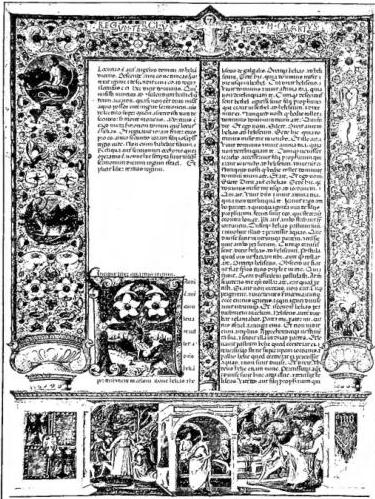
RE. LIBRO dei - Explicit of I. III. Incipit of I. IV dei R. Miniature from the Bible of Borso d’Este, executed between 1455 and 1461 - Modena, Biblioteca Estense, vol. I, f. 153 V.
The constant reference to the sources is already a good criterion for judging the reliability of the information. The content of R. also finds frequent confirmation in other historical books and in the prophetic books (cf., among many instances: Os. 7, 7; 8, 4 = II Reg. 15, 10, 14, 25; Os. 5, 13; 7, 11; 8, 9; 12, 2 = II Reg. 15, 17-20; Am. 7, 10; 4, 1-6 = II Reg. 14, 23-29; II. 7, 1-12 = II Reg. 16, 5; II. 36, 1-37, 38 = II Reg. 18, 13-19, 37, etc.). The Egyptian, Assyrian, Neo-Babylonian, and Palestinian documents and monuments brought to light by excavations have often provided striking confirmations of the historical value of the biblical narrative. Thus, to limit ourselves to a few examples, an inscription from the Temple of Amun at Karnak records the victories of Shoshenq (945-924 B.C.) in Syria and Palestine, with the names of various cities either conquered or subjected to tribute; he is the Shishak who plundered Jerusalem according to I Reg. 14, 25 ff. The inscription of Shalmaneser II (859-826 B.C.)—the Black Obelisk—lists among the kings who paid tribute also Iehu of Israel. Neo-Babylonian documents confirm the statement of II Reg. 25, 27 ff. concerning the food supplied to the dispossessed king Ioachin from the table of Evil-merodach (cf. E. F. Weidner, Jojachin, König von Juda, in babylonischen Keilschrifttexten, in Mélanges syriens offerts à R. Dussand, II, Paris 1939, pp. 923-35; A. Bea, König Jojachin in Keilschrifttexten, in Biblica, 23 [1942], pp. 78-82). The inscription of Mesha, king of Moab, confirms II Reg. 3, 4-27. Much light has also been shed on the books of R. by the excavations at Samaria, Lachish (the Lachish letters = Tell ed-Duweir), and Megiddo (Mageddo = Tell-el-Mutesellim). At Megiddo, I Reg. 9, 19 (Solomon’s stables) finds impressive confirmation. Cf. H. Lusseau-M. Collomb (v. BIBLICA), pp. 209-22; H. Höpfl - A. Miller - A. Metzinger (v. BIBLICA), p. 169.
Various problems arise from the chronological data in the books of R., and numerous hypotheses have been advanced to resolve them. Difficulties arise from the relationship between the duration of the individual reigns and the regnal year of the contemporary king of Judah or Israel, since the number of years does not coincide in periods that should have been of equal duration. In the periods extending from Roboam to Athalia’s usurpation and from Ieroboam to Iehu’s accession, which should coincide perfectly, the kings of Judah reign for 95 years and those of Israel for 98. In the subsequent period, extending to the fall of Samaria, the years of the various reigns in Judah total 165, while those in Israel total 143. Moreover, since Iehu paid his tribute to Shalmaneser III, according to the Assyrian documents, around 842, and Samaria fell in 721, this period should be further reduced to approximately 120 years. To resolve these and other difficulties, recourse has been had to the hypothesis that in one of the two kingdoms the years of a monarch’s reign were reckoned according to the accession-year system, while in the other the postdating system was followed: in the first case, the entire year of accession to the throne was assigned to the new monarch; in the second, his regnal years began to be counted from the beginning of the new civil year. It has also been suggested that in one kingdom the new year began in the month of nisāu and in the other in the month of ṭīrī. There may have been co-regencies, with the result that the same years were counted twice. Some errors may be attributed to copyists and careless correctors. Overcoming the distrust of s. Jerome (Epit. 72 ad Vitalem; PL 22, 676), who regarded the task of harmonizing the dates in the books of R. as an occupation for idlers, many modern scholars have devoted themselves to this thankless work, with results that are partly satisfactory but far from definitive.
The Hebrew text of R. has been preserved relatively well, with the exception of chaps. 6 and 7 of I Reg., where the Greek version of the Septuagint offers a much clearer and more orderly text. In general, this version is an excellent instrument for correcting the Masoretic text, especially in the form preserved by the Lucianic recension, which was less influenced than the original recension by the influence of the original text. The ancient Latin version almost invariably agrees with the Lucianic recension of the Septuagint. The Vulgate is the first fruit of the labor of s. Jerome, translator of the Bible from Hebrew: a faithful and elegant translation.
BBL.: among the more recent commentaries; Catholic: N. Schlögl, Vienna 1911; E. H. Šanda, 2 vols., Münster 1911-12; M. Sales (La S. Bibbia. Il Vecchio Test., 3), Turin 1924, pp. 5-236; S. Landersdorfer, Bonn 1927; A. Vaccari - A. Parenti (La S. Bibbia tradotta dai testi originali, 3, 1, I libri storici), Florence 1947, pp. 311-479; A. Méchielle (La Sti Bible, di L. Pirot-A. Clamer, 3), Paris 1949, pp. 563-800; R. De Vaux, ibid. 1949; S. Garofalo, Turin-Rome 1951. Non-Catholic: R. Kittel, Göttingen 1910; J. Skinner, London 1904; W. E. Barnes, Cambridge 1908; F. H. Hennessy, ibid. 1922; H. I. Carpenter, London 1927; J. A. Montgomery, Edinburgh 1951. For the introduction: H. Lusseau - M. Collomb, Manuel d'études bibliques, II, Paris 1934, pp. 193-228; H. Höpfl - A. Miller - A. Metzinger, Introductio specialis in Vet. Test., in Introductionis in sacro-utritique Testamenti libros compendium, II, Rome 1946, pp. 150-73. For chronology cf., among the many studies: V. Coucke, Chronologie biblique, in DBs, I, cols. 1245-69; A. M. Kleber, The Chronology of 3 and 4 Kings and 2 Paralipomenon, in Biblica, 2 (1921), pp. 3-29, 170-205; F. X. Kugler, Von Mos: 3 bis Paulus, Münster 1922, pp. 134-200; J. Lewy, Die Chronologie der Könige von Israel und Juda, Giessen 1927; H. Händer, Die biblische Chronologie des 3. Jahrhunderts V. Chr., in Bibl., 10 (1929), pp. 257-74, 377-98; 11 (1930), pp. 63-80; S. Mowinckel, Die Chronologie der israelitischen und jüdischen Könige, Leiden 1932. Teodorico da Castel San Pietro