
QUIRINIUS (Κυρίνας, Κυρήνας), PUBLIUS SULPICIUS. – Imperial legate in Syria in the time of Augustus, also known on account of Lk. 2: 2: “this census (ordered by Augustus) [which was the] first, took place while Q. was governing Syria”; he belonged to a modest family of Lanuvium and died at Rome in A.D. 21.
His military qualities (Tacitus, Ann., III, 48), above all, opened the way for him to the consulship in 742 of Rome (= 12 B.C.). Strabo (XII, 6, 3) recalls him in speaking of King Amyntas of Galatia, killed by the Homonadenses, who were subsequently defeated by Q.; for this he received the triumphal ornaments (Tacitus, loc. cit.). Flavius Josephus (Antiq. Iud.,
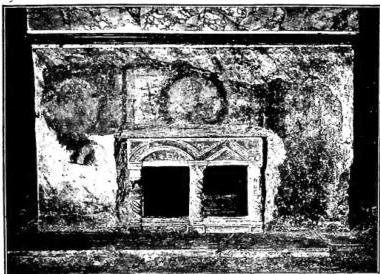
(photograph Pont. comm. arch. sacra)
Q. is connected with evangelical chronology because of the census recalled by St Luke (2: 2), as the date of Jesus’ birth. But this synchronistic indication says little, because of the uncertainty surrounding the circumstances of the census; indeed, it is rather from the approximate data concerning Christ’s birth that one begins in order to establish the period of the census. For the legation during which Q. conducted the census of Palestine (cf. Act. 5, 37) is too late (A.D. 6), since Jesus was indisputably born several years before the death of Herod the Great (750 of Rome).
This does not mean that the historical value of the information transmitted by Lk. 2: 2 can be denied. A census of the entire Empire, including the confederate or allied kingdoms, is in fact very probable: in compiling the Breviarium or Rationarium Imperii, Augustus certainly needed, in addition to the censuses of Roman citizens carried out in the years 726, 746, and 767, other operations of this kind; and censuses carried out in Gaul, Spain, and Egypt are positively attested. Nor does the fact that Jewish customs were followed (Lk. 2, 3) in a census imposed by the Romans create any serious difficulty; nor does the fact that this census was conducted in the kingdom of Herod the Great, since there are other examples of censuses carried out in the territory of allied kings; all the more so because, in the final years of his reign, Herod no longer enjoyed Augustus’s confidence. The sole question at issue here is whether a census that, in order not to conflict with the certain data of the chronology of Jesus’ life, must have taken place before 749 B.C., can be attributed to Q. in his capacity as legate of Syria.
It would seem necessary to suppose that Q. at that time possessed authority over Syria only on account of the war against the Homonadenses, which gave him the right to levy soldiers from that province. This, in reality, would have been the purpose of the census conducted by Santius Saturninus, as Tertullian explicitly states (Adv. Marc., IV, 19), but on Q.’s instructions. The existence of a dual authority in the province (civil government and military government) is not unique; and it is highly probable in the present case, since the campaign against the Homonadenses would have occupied the legate’s activity for a long time, preventing him from attending to the province. This also avoids supposing in Q. a circumstance more unique than rare: the assignment, twice, of a province to the same governor by the same prince.
In conclusion: Augustus’s edict for a census of the whole world would be nothing other than the will expressed by him on various occasions to enumerate all the subjects, all the forces, and all the possessions of the Empire and of the “allied” kingdoms, or alternatively, the order issued by a representative of imperial power. Q. would be named by Lk. 2: 2 on account of the special power with which he was invested; consequently, the proconsular legate of Syria, probably Santius Saturninus, did nothing more than carry out his will.