
BREVIARIUM (BREVIARIUS). - They mean compendium (like breviculum and breviculus) and already in the classical age they are often used as the title of books (Augustus had a B. imperii drawn up and Eutropius wrote a B. historiae romanae); they then recur in the patristic age; cf. the Breviculus collationis cum Donatistis of St. Augustine.
Some of these works, of uncertain authorship, are often cited anonymously, and are especially: 1) B. fidei adversus by V. Leroquais, Les breviaires manuscrits des bibliothèques publiques de France, Paris 1911, (av. X)
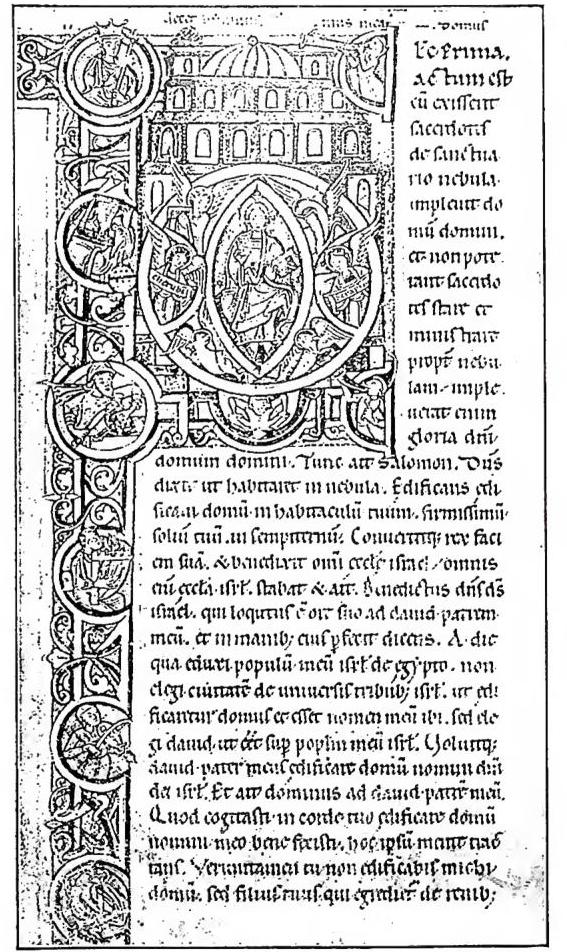
BREVIARY - Letter F with Christ in glory. R. de Montéramey (12th cent.) - Paris, National Library, ms. lat. 796, f. 235.
Arians (PL 13, 653; 55, 182), perhaps to be identified with the Libellus adversus Arianos et Macedonianos that Gennadius ascribes to Faustus of Riez (v. Schanz, IV, II, p. 544); 2) B. de Hierosolyma (ed. P. Geyer: CSEL, 39, p. 153 ff.), a brief description of the city, from the 6th century, which has come down to us in two recensions; 3) B. in psalmos (PL 26, 821), which circulates under the name of St. Jerome and certainly contains much that is Jerome's. The author made use of the Saint's Commentarioli (conceived as brief supplementary notes to Origen's Enchiridion on the Psalter) and of at least 63 homilies on the Psalms. Both works were traced in the manuscripts by G. Morin and published in Anecdota Maredsolana, III, I, Maredsous 1895; III, II, ibid. 1897. See also Moricca, II, p. 1328; 4) B. super quattuor evangelistas, one of the best ancient Latin commentaries on the Gospels, attributed for the most part to St. Jerome (PL 30, 531), but also to Walafrid Strabo (PL 114, 861), with whom, however, it has nothing to do. More probably it is to be seen as the commentary on the Gospels attributed by St. Jerome to Fortunatianus of Aquileia (v.). See Moricca, op. cit., p. 590.