LUKE, EVANGELIST, saint. - Author of the third Gospel (in the order of the Vulgate) and of the Acts of the Apostles (q.v.).
I. HIS LIFE
He was born at Antioch in Syria (Eusebius, Jerome), of a pagan family (Col. 4.10–11). He practiced the profession of physician (Col. 4.14).His writings show that he was not unacquainted with technical vocabulary (A. Harnack, Lukas, der Arzt, Leipzig 1906, pp. 122–37), yet he always uses it with discretion. His clinical observation is exact: his diagnosis is clear (Lk. 4.38); he perfectly characterizes functional disorders (ibid. 22.14); when dealing with paired organs he does not fail to indicate which side is affected by the illness (ibid. 6.12; 22.50); he sharply distinguishes disease from diabolical possession even in cases where both occur simultaneously (D. Bardet, St Luc médecin et navigateur, in Bulletin de la Société St-Luc, 1949, pp. 107 ff.). One perceives that this physician is a cultured man of letters who reads not only medical writings but also the great authors of antiquity, especially historians.
In 49 or 50 he accompanied the Apostle Paul on his second missionary journey from Troas to Philippi (Acts 16.10–40). About 57 or 58 he again followed Paul from Philippi to Jerusalem during the third apostolic journey (Acts 21.1–17). He was present at Paul’s arrest and imprisonment (Acts 21.18–26; 21.32). Later, when the prisoner was transferred from Caesarea to Rome, L. accompanied him (Acts 27.2–28.29). He was beside Paul, though perhaps not continuously, during the two Roman imprisonments (Col. 4.14; Phil. 24; 2 Tim. 4.11).
After Paul’s death, L. left Rome. Thereafter his traces are lost. The indications fixing his ministry in Achaia (St Gregory Nazianzen), his prolonged stay in Boeotia (anonymous prologues), and his death in the Thebaid (Symeon Metaphrastes) are uncertain. Late and questionable texts (the earliest is by Theodore the Reader, writing in 530: cf. C. Henze, Lukas der Muttergottesmaler, Louvain 1948) attribute to L. an icon of the Mother of God. Yet the true portrait of Mary drawn by L. is found in the infancy gospel narrative, based on data communicated by the Virgin Mother. L. is symbolized in iconography by the ox, because his Gospel begins at the moment of the offering of sacrifice in the Temple. St L. is venerated by the Church as a martyr (cf. Martyrologium Romanum, p. 481). His feast is kept on 18 October.
II. THE THIRD GOSPEL
From unanimous tradition (Irenaeus, Tertullian, the Muratorian fragment, etc.), the third Gospel is attributed to St. Luke. Internal evidence confirms this assertion. It is easily noted that the author is a Christian from the Gentiles, whose concerns go beyond the problems of legalism and ritualism in Israel, and who views with satisfaction the universalist character of Redemption. He reflects a Pauline mentality, which perfectly suits a man who, like Luke, had close and frequent relations with the Apostle of the Gentiles. His style reveals a physician and a man of letters, confirming the indications of ecclesiastical authors regarding Luke.The exact place and date of composition cannot be determined with certainty. It is, however, certain that the third Gospel is earlier than the Acts of the Apostles (c. 63), which forms the second volume of the history of salvation, addressed, like the third Gospel, to the “most excellent” Theophilus. This Gospel is later than those of Mark, which it clearly uses, and of Matthew, which it presupposes. This points to the years 60–63. It seems that Luke composed his work in Rome, as noted in some manuscript subscriptions (an opinion now current), or in Caesarea (some modern scholars), but not in Achaia (anonymous prologues, Jerome) or in Alexandria (Syrian documents).
Luke addresses his work to Theophilus, who may have supported the book and covered its expenses, and through him to certain Christians of Gentile origin. Thus he often omits what is specifically Jewish, as shown by comparison with parallel passages in Mark. When he mentions customs unknown to his readers, he explains them. He occasionally interprets an Aramaic term (Lk. 6:15) and clarifies obscure Semitic expressions (ibid., 21:20–24: the siege and capture of Jerusalem by the Gentiles replace “the abomination [v.] of desolation”). Messianism is not considered in its national perspectives, but in its worldwide repercussions. Luke gladly reports what is particularly favorable to the Gentiles (Lk. 1:1–10; 17:11–19). He shows consideration for Roman authorities (ibid., 2:1–2; 3:1; 7:2–9).
Luke relies on solid information. He consulted written documents and orally transmitted accounts. His dependence on Mark is evident in the so-called “Markan sections” (Lk. 4:31–6:19; 8:4–9:50; 18:15–21:38). Yet, while using Mark’s Gospel, he retains his own personal manner of composition. It has been observed (E. Osty [V. BIBLICA.], pp. 10–16) that Luke, in his narrative of Mark, makes cuts (for literary reasons, delicacy, and religious reverence), additions, revisions (for the same reasons and also to emphasize his favorite themes: praise, prayer, the sufferings of Christ, universalism, the Holy Spirit, poverty, and asceticism), transpositions (for verisimilitude, symbolism, literary order, or logical parallels), and introduces hints (e.g., on the nocturnal character of the Transfiguration: Lk. 9:28–37).
It may be supposed that Luke treated the fragments of Matthew’s Gospel (or the documents that served as his sources) with the same flexibility and freedom, which in one form or another seem to have come to his knowledge. The prologue (Lk. 1:1–4) alludes to valuable but fragmentary biographical accounts of Jesus, which Luke consulted before composing his own work.
Luke drew, at least indirectly, from the treasury of Mary’s memories (Lk. 2:19, 51). He had the opportunity to receive valuable information from circles connected with John (ibid., 9:54), from Peter (ibid., 22:8), from Cleophas (ibid., 24:18), from the deacon Philip (Acts 21:8), who were particularly well-informed about Samaria (Acts 8:5–8; Lk. 9:52–56; 17:11–19). The pious women (Lk. 8:2–3; 23:55), Martha and Mary (ibid., 10:38) may have informed him of episodes that concerned them in particular. Manaen, Herod’s foster-brother (Acts 13:1), may have told him of Jesus’ appearance before the tetrarch (Lk. 23:7–12).
The composition of the third Gospel is highly characteristic. The work includes a prologue (1:1–4), the Infancy Gospel (1:5–2:52), then the public life of Jesus framed in four traditional parts of oral catechesis: the ministry of the Precursor (3:1–4:13), Jesus’ activity in Galilee (4:14–9:50), the journey to Jerusalem (9:51–19:27), and the end in Jerusalem (19:28–24:53).
The Infancy Gospel aims to establish the heavenly origin of the Saviour. This narrative, which has a distinctly Aramaic flavor and is remarkable for its religious depth, is constructed as a double parallel between John the Baptist and Jesus: the first is framed by the two Annunciations (1:5–25 and 26–38), followed by the story of the Visitation (39–56); the second compares the two nativities and summarizes the infancy of John in the desert and of Jesus in Nazareth (1:57–80 and 2:1–52). While agreeing on essential points, Luke’s and Matthew’s accounts almost never coincide in the choice of episodes. The perspectives of the two Evangelists are in fact very different: Matthew centers his narrative on Old Testament oracles, the fulfillment of which in the infancy of the Saviour establishes his messiahship and divinity. Luke highlights the Virgin Mary; Matthew presents Joseph in a vivid light.
For the account of the public life, Luke proceeds as follows: he inserts the sections that are peculiar to him or that come from other sources of information, either before or after the Markan sections or between them. When he adds to Mark, he does not take all of Mark, omitting whole passages that do not suit his purpose (e.g., Mk. 6:45–8:26).
The Galilean ministry is presented as follows: up to the choice of the Twelve (4:14–6:11), Jesus preaches in synagogues or among sympathetic crowds, but already the Pharisees take a stance as adversaries. Between the choice of the Twelve and their first mission (6:12–8:56), Jesus’ preaching and miracles provoke popular enthusiasm. From the first mission of the Twelve onward, the Galilean ministry reaches its climax (9:1–50): multiplication of the loaves, Peter’s confession, the Transfiguration. This section contains few discourses. It includes many formulas that are intentionally approximate, imprecise, and vague (5:12, 17; 9:28). The geographical perspective is conventional, since the author is concerned to eliminate from his narrative the Galilean cities whose action seems sufficiently specified to him, and he does not hesitate to transpose, group events, or remain silent about localization if he deems it necessary. Thus the reader’s eye passes over Nazareth (4:16–30), Capernaum (4:31–7:10), and Nain (7:11–18).
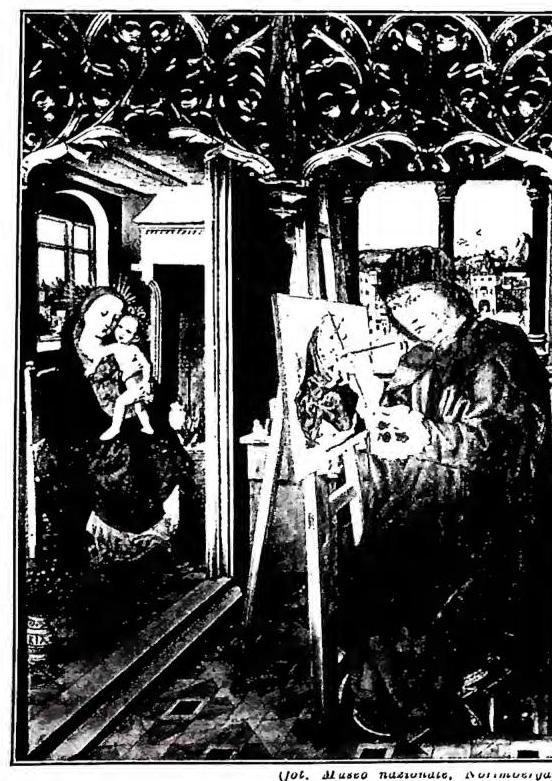
LUCA, Evangelist, saint — S. L. depicting the Virgin. School of Nuremberg (ca. 1487) — Nuremberg, National Museum.
forms the principal nucleus of the doctrinal teaching of Jesus. The discourses are therefore exceedingly abundant, the parables noteworthy: the Good Samaritan, the Prodigal Son, the Rich Man and Lazarus, the Pharisee and the Publican, etc. Action is reduced to a minimum, as is the external setting. Yet by placing all this complex material “under the sign of Jerusalem” and within the context of a journey toward the Passion, Luke gave a keen dynamism to this section of his Gospel.
In Jerusalem, Luke follows Mark very closely up to the celebration of the Last Supper. He then resumes greater originality. He alone speaks of the bloody sweat in the garden of agony (Lk 22:43–44) and of the disciples on the road to Emmaus (ibid. 24:13–35). He says nothing about the appearances in Galilee. This stems from the general development of his narrative, which is entirely oriented toward Jerusalem: the Third Gospel proceeds from Galilee, through Samaria, to Jerusalem; the Acts of the Apostles will show the Apostles departing from Jerusalem to evangelize Samaria and then the entire world.
The story of Jesus is thus presented in a literary form. The connection to events of profane history is established “from the beginning” (Lk 1:5, 26; 2:1–4; 3:1–2). Thereafter, the psychological reactions of Christ’s audience to the preaching of the word are highlighted. Luke’s compositional techniques (groupings of a literary or doctrinal nature) serve to emphasize the import of the message without in any way compromising the historical solidity of the information and testimony.
Certain passages in Luke’s Gospel have been contested. Nothing warrants suspicion regarding the infancy narrative, which all textual witnesses present and which Marcion wished to suppress for tendentious reasons. The account of the bloody sweat (Lk 22:43–44) seemed unworthy of the Savior; the Arians abused this text in their disputes. This may explain its absence from certain witnesses such as A, B, R, T, W; yet it is found in the majority of other manuscripts, in Justin and Irenaeus. Its primitive authenticity must be maintained.
The doctrinal features of the Third Gospel are the insistence on the universality of salvation, the Savior’s mercy toward sinners, prayer, joy, and the necessity of renunciation. Of Christ, Son of Man and Son of God, Lord and Savior,
Luke has presented an unforgettable image. In his work he has exalted the Kingdom and the Sovereignty of God.
Luke writes in uneven Greek: nearly classical in the prologue, replete with Aramaisms in the infancy narrative, more in keeping with Hellenistic Greek and the style of the Septuagint in the body of the Gospel, yet not without a certain number of expressions drawn from classical Greek. The work is of perfect taste and reveals in its author a great delicacy of soul.
The Biblical Commission, in its response of 26 June 1912, provided several clarifications regarding the authenticity of the infancy narrative and the passage on the bloody sweat (n. 3), the composition of Luke’s Gospel after those of Matthew and Mark (n. 5), the date of composition: before the destruction of Jerusalem (n. 6), before the Acts and thus prior to the end of Paul’s imprisonment referred to in Acts 28:30–31 (n. 7), its origins (n. 8), and its historical value (n. 9; cf. Enchiridion Biblicum, Rome 1927, nn. 410–16).
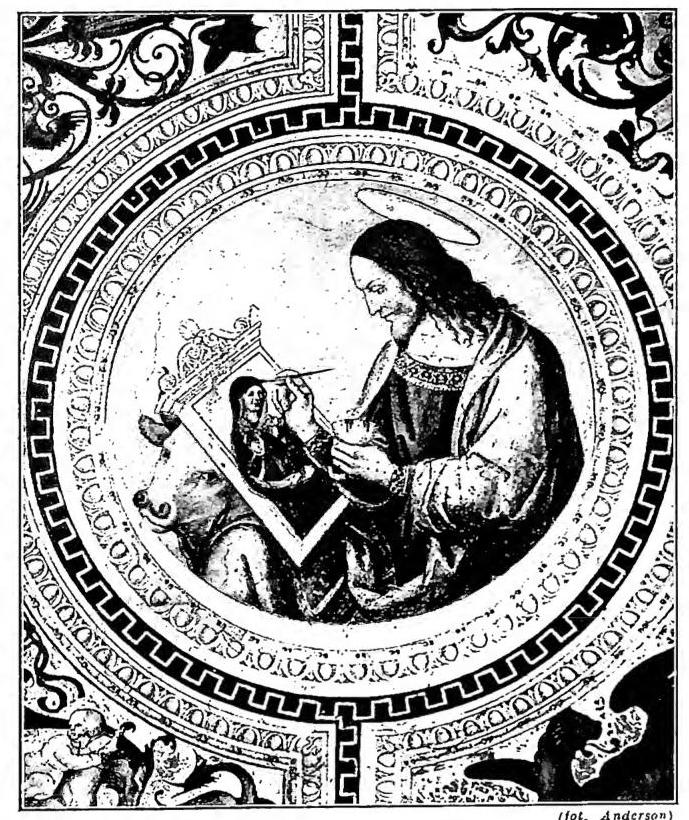
(photo: Anderson)
LUCA, Evangelist, saint — St. Luke portraying the Virgin, fresco by Pinturicchio — Rome, church of Santa Maria del Popolo.