
ACTS OF THE APOSTLES. — Book of the New Testament, placed after the Gospels, which presents itself as the continuation of the Gospel of Luke.
SUMMARY:
I. The subject
II. The author
III. The purpose
IV. The date of composition
V. The sources
VI. The historical value, particularly of the speeches
VII. The text called “Western.” — VIII. The decree of the Biblical Commission.I. THE SUBJECT
The title best attested in the Greek codices (πρᾶξει ἀποστόλων “acts, or deeds, of apostles”) indicates that the book does not speak of all the apostles, nor of the apostles in general, but of some of them. In reality, it deals especially with two: up to chapter 12 Peter predominates; from chapter 13 to the end, Paul.The most evident division of the parts seems to us to be the following:
1. Connection with the Third Gospel (1, 1-11). Prologue with dedication to Theophilus and reference to the Ascension of Christ (cf. Lk. 1, 1-4 and 24, 44-53).
2. The Beginnings of the Church of Jerusalem (1, 12-8, 3). The election of Matthias in place of Judas, the descent of the Holy Spirit, and the first discourse of St. Peter. The healing of a cripple performed by Peter leads to a trial before the Sanhedrin, at which Gamaliel’s good sense prevails and secures the release of Peter and John. Within the community (where possessions were freely held in common), the tragic end of Ananias and Sapphira, guilty of imposture and fraud, serves as a salutary warning. To assist the apostles in caring for the Hellenist widows and orphans, seven deacons with Greek names are ordained. The first of these, Stephen, seals his preaching with his blood: Saul guards the garments of the stoners.
3. The Expansion of the Church in Judaea and Samaria (8, 4-11, 18). The faithful, scattered by the persecution, extend the field of evangelization: the deacon Philip preaches Christ in Samaria, where the apostles Peter and John, by laying on their hands, confer the Holy Spirit on the neophytes, who manifests his presence through miracles; Simon Magus, who wishes to buy this power, is rejected by Peter. Philip meanwhile converts and baptizes an Ethiopian eunuch on the road to Gaza. Saul the persecutor is miraculously converted on the road to Damascus. Peter performs conversions and miracles at Lydda and Joppa; at Caesarea he converts and baptizes the centurion Cornelius, opening the doors of the Church to the pagans without making them pass through Jewish circumcision.
4. The Church Extends to Antioch (11, 19-13, 3). There Barnabas and Saul accept Jews and pagans alike, and the faithful are called “Christians.” Barnabas and Saul carry the collection of the Antiochenes to the brethren of Jerusalem, where persecution had been added to the famine. Herod (Agrippa I, king from 37 [41] to 44) had put the apostle James the Greater to death and held Peter prisoner. The latter, miraculously freed, “went to another place” (12, 17: Rome?). Herod dies tragically; Barnabas and Saul return to Antioch, where they are consecrated through the laying on of hands.
5. Paul’s First Missionary Journey (13, 4-15, 35). From Antioch to Seleucia, then to Cyprus, where he converts the proconsul Sergius Paulus: from this point onward (13, 9) Saul is called Paul. At Perga Mark withdraws. Paul and Barnabas continue evangelizing Pisidian Antioch, Iconium, Lystra, and Derbe, which they visit again on their return, appointing presbyters there. From Syrian Antioch they go to Jerusalem to report on the conversion of the pagans to the assembly of the Apostles, which sanctions freedom from the “Law” for converted pagans.
6. Paul’s Second Missionary Journey (15, 36-18, 22). From Antioch Paul, having separated from Barnabas on account of Mark, returns with Silas to visit the communities founded in Asia Minor. At Lystra he takes Timothy with him. Having crossed Phrygia, the Galatian region, and Mysia, they descend to Troas. At this point the narrative proceeds in the first-person plural until the stop at Philippi (16, 10-17). The mission continues through Thessalonica, Beroea, Athens, and Corinth, where Paul remains for eighteen months and meets the proconsul Gallio (in the year 51 or 52). On the return journey comes the itinerary Ephesus (Jerusalem?) - Antioch.
7. Paul’s Third Missionary Journey (18, 23-21, 18). From Antioch Paul travels through the Galatian region and Phrygia, stays at Ephesus for nearly three years, and proceeds to Greece, where he remains for three months. In the account of the return through Macedonia, the first-person plural reappears and continues in the itinerary through Troas, Miletus, Tyre, Ptolemais, and Caesarea, up to the arrival in Jerusalem (20, 5; 21, 18).
8. Paul a Prisoner in Jerusalem and Caesarea (21, 19-26, 32). Arrested in the Temple on the accusation of having profaned it, Paul defends himself before the people, asserts his rights as a Roman citizen against the tribune Lysias, who wishes to have him scourged, and defends himself before the Sanhedrin; he is then sent with a strong escort to Caesarea, to the procurator Felix. There he remains imprisoned for two years, until the arrival of the procurator Festus (in the year 60), from whose tribunal he appeals to Caesar (Nero).
9. Paul’s Journey as a Prisoner to Rome (27, 1-28, 31). This account too is in the first-person plural: the imprisoned Apostle, accompanied by the centurion Julius, touches at Sidon, Cyprus, and Myra in Lycia aboard an Adramyttian ship, then (having transferred to an Alexandrian ship) at Cnidus and several ports of Crete. Against Paul’s advice, the crew continues the voyage, and the ship, battered by the storm, is wrecked without loss of life near the island of Malta. After the winter, the journey continues on an Alexandrian ship to Syracuse, Rhegium, and Puteoli; then by land, along the Appian Way, to Rome, where Paul remains under guard for two years.
II. THE AUTHOR
Ancient and modern scholars agree in attributing Acts to the same author as the Third Gospel.Clear evidence of this is provided by the similarities of vocabulary and style, of medical technique and narrative method, as well as by the connection between the prologues of the two books (lógos). Since it is established that Luca (v.), physician and disciple of Paolo, is the author of the Third Gospel, the Lucan origin of Acts is implicitly demonstrated. This conclusion, confirmed by the explicit testimony of tradition, which has been uninterrupted and unanimous since the second century, is accepted, besides by Catholics, by moderate Protestants (Blass, Zahn, Plummer) and by many rationalists (with Renan and Harnack).
The systematic denial of the Lucan origin of Acts began with the Tubingen rationalist school of C. F. Baur (v.), which regarded it as a tendentious work composed at a late date (second century), in order to demonstrate that there was no disagreement between the Petrine (Judeo-Christian) current and the Pauline (universalist) one. This system, more or less modified by the various followers of the school, was refuted within the non-Catholic camp itself by the conservative current of Ritschl and by the ultra-radical current of B. Bauer and the Dutch school (cf. A. Omodeo, in Enc. Ital., V [1930], pp. 268–71). Other systems, under the influence of Wellhausenian criticism (J. Wellhausen, Kritische Analyse der Apostelgeschichte, Berlin 1914), attempted to distinguish the sources of the book. Many maintain that the work resulted from the fusion of two sources of different value: one Judeo-Christian or Petrine, the other Gentile-Christian or Pauline. E. Jacquier deals at length with these mutually destructive systems, often founded on arbitrary hypotheses concerning the origin of the Church and of the hierarchy (Les Actes des Ap., pp. xv–iv).
We shall mention the principal among the most ancient testimonies of tradition. The anti-Marcionite prologue of the second century (in Lucam) attests: «Et tamen postremo scripsit idem Lucas Actus Apostolorum» (text of d. de Bruyne, in Revue Bénédic., 40 [1928], p. 197). The Muratorian Canon (second century), according to the best reconstruction, reads: «Acta autem omnium apostolorum sub uno libro scripta sunt. Lucas optimo Theophilo comprehendiit quae sub praesentia eius singula gerebantur ecc.» (lines 34–39). S. Irenaeus cites many passages, attributing them to Luca, and quotes the speeches of Pietro, Paolo and Giacomo as they are read in Acts (Adv. Haereste, III, 12: PG 7, 892 ff.; etc.). Tertullian: «Porro cum in eodem commentario Lucae et tertia hora orationis demonstretur...» (De Ietunio, 2, 10, cf. Act. 2, 15). Clement of Alexandria cites Act. 17, 23, “as Luca recalls in the Acts of the Apostles” (Stromata, 5, 12, 82: PG 9, 124). Origen: “Luca, who wrote the Gospel and Acts” (in Eusebius, Hist. Eccl., VI, 25: PG 20, 585). Eusebius lists Acts among the books ὁμολογούμενοι, whose authenticity and canonicity were never disputed (Hist. Eccl., III, 25: PG 20, 268).
As early as the first century and the beginning of the second, implicit testimonies abound in the Didache, s. Clement Romano, s. Ignazio Martire, s. Policarpo and s. Giustino (E. Jacquier, op. cit., pp. cci–cciv).
The unity of the book, composed by a single author, emerges from the fact that throughout all its parts one observes the same use of characteristic words and phrases and the same method of composition. The differences of style observed in certain passages, especially in the first chapters, where Semitisms abound, are easily explained by taking into account the various oral or written sources consulted.
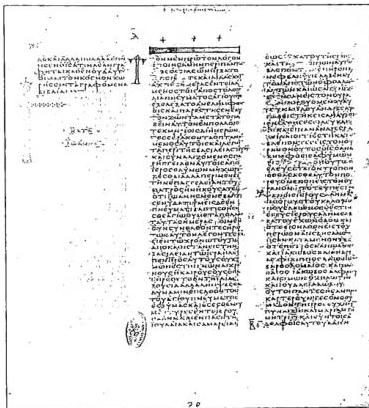
ATTI DEGLI APOSTOLI - Codex Vat. Greek 1209 (B), 4th century. End of the Gospel of s. Giovanni and ch. 1, 1–15 of the A. - Biblioteca Vaticana.
present in Rome in the letters of the imprisonment, can be none other than the “beloved physician Luke” (Col. 4:14; Philem. 24), not named in the A., yet present, a member of the educated class and a faithful collaborator of Paolo.
III. THE PURPOSE
The work begins with the prophetic words of Jesus: «You will receive the power of the Holy Spirit, who will come upon you, and you will be my witnesses in Jerusalem and throughout Judea and Samaria, and to the ends of the earth» (1:8). And the author wishes to prove that the Apostles were truly witnesses of Jesus, first in Jerusalem, then in Samaria and the rest of Judea, and thereafter in the other regions, as far as the capital of the empire, always under the guiding influence of the Holy Spirit.In addition to this primary purpose, which emerges from the manner in which the material is presented in the A., s. Luca must have had other secondary purposes: to confirm Teofilo and the readers in the faith (cf. Lc. 1:4), to demonstrate Paolo’s innocence in the face of the accusations of the Jews, and also to emphasize the doctrinal agreement between the two great Apostles Pietro and Paolo (cf. 9:27; 14:4-14; 21:18).
IV. THE DATE OF COMPOSITION
The last chronological indication, contained in the truncated conclusion of the book, allows us to glimpse the date at which the work was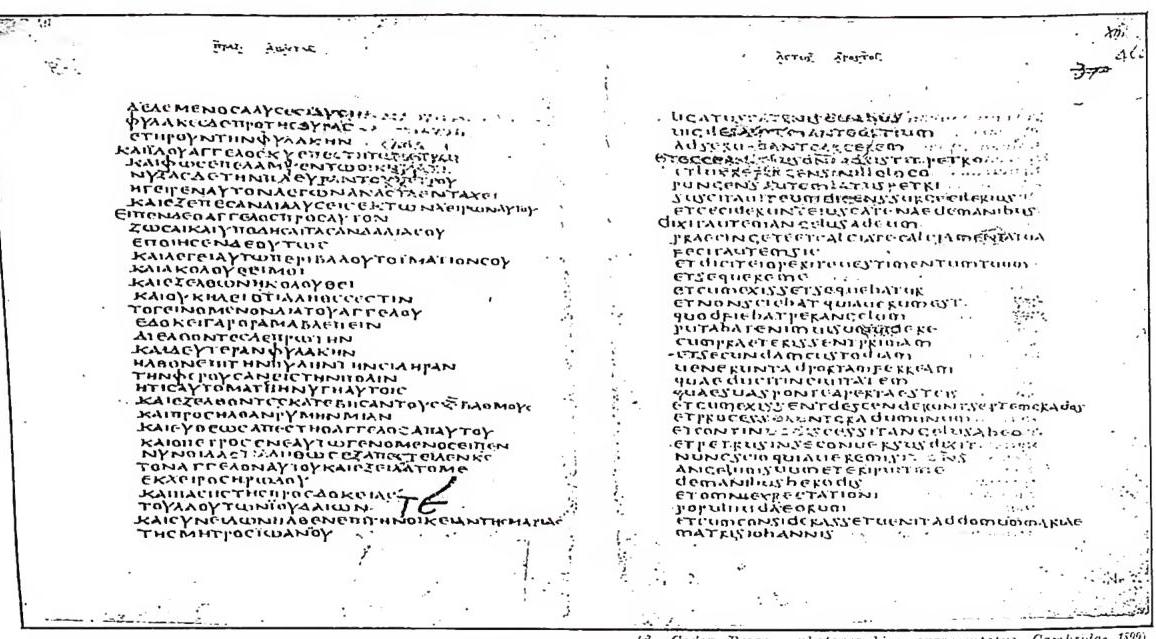
If the A. had been written later, for example, after Paul’s martyrdom (A.D. 67), the author, who intended to prove that the Apostles were witnesses of Christ, would have had to speak of this supreme testimony of the Apostle; after Paul’s final journey to the East (II Tim. 4:13, 20), the words he addressed to the Ephesian presbyters on his return from the third missionary journey would not have remained unexplained: “I know that none of you will ever see my face again” (20:25). Nor is there the slightest allusion to the destruction of Jerusalem (A.D. 70) or to the beginning of the Jewish war (A.D. 66); there is not even any trace of the persecution of Nero, which broke out in the summer of 64; indeed, throughout the work there emerges a certain optimism regarding the emperor and his magistrates.
All these data converge in fixing the date of the book in 63. S. Luca must have left it with the Romans as a remembrance of Paul, who was preparing to bear witness to Christ “to the ends of the earth” (to Spain?).
The thesis of certain exegetes (with Zahn) therefore appears untenable: namely, that when Luca wrote the prologue to the A., calling his Gospel πρῶτον λόγον (“primum sermonem,” not πρότερον: priorem, the first of two), he still had so much material at his disposal as to compose a third book. This argument is flawed at its root, because in Hellenistic Greek the superlative πρῶτος is used with the meaning of the comparative πρότερος.
V. LE FONTI
If Luke is the author of the A., he had excellent sources at his disposal. He learned many facts de visu while accompanying the Apostle. These are the facts contained in the sections with the « we ». If, as is probable, Luke was a member of the Church of Antioch, he could also have known personally the history of this community traced in his book: the « Western » text has a section with the « we » at Antioch as well (11:28, Codex Bezae D). From s. Paul he could have learned the salient features of his biography; he could have drawn much information from the companions of Paul's journeys (Silas, Timothy, Erastus, Caius, Aristarchus, etc.). He may have obtained information about the Church of Jerusalem and the activity of s. Peter and the deacons from Mark, with whom he was in Rome, from James, head of the Church of Jerusalem, and from Philip the deacon, with whom he was in Caesarea (21:8-10).Luke (presented as « iuris studiosus » by the Muratorian Fragment) must also have taken an interest in archival documents containing the records of Paul's trials. It is not improbable that he used a written source for the first part of the A. Some believe that they can identify the author of this source as Mark. The literary similarity between this part and the Gospel of Mark is significant; Mark wrote down Peter's preaching (L. Dieu, Marc source des Actes I-XV, in Revue Biblique, 29 [1920], pp. 555-569 and 30 [1921], pp. 86-96).
The hypothesis of Krenkel, Wendt, and others must be rejected: they favor a late date for the A. and hold that its author depended on the writings of Flavius Josephus, composed toward the end of the first century. The coincidences concerning David's tomb, the Beautiful Gate, and the famine in the time of Claudius are easily explained: both writers had good sources at their disposal; nor are divergences lacking, in the accounts of Theudas and Judas (5:36 and Ant. Iud., XX, 5, 1 sg.).
VI. THE HISTORICAL VALUE
Once it has been established that Luke is the author of the A. and that he had excellent sources at his disposal, it follows that his historical work deserves credence. Confirmation may be found in its agreement with pagan, Jewish, and Christian sources.The author knows that in Cyprus there is a proconsul (ἀνθύπτος) named Sergius Paulus (13, 77), that Philippi “is the chief city of that part of Macedonia and is a Roman colony,” governed by strategoi (16, 22), while Thessalonica is governed by politarchs (17, 16), Ephesus by asiarchs as well as by a proconsul and a grammateus (19), and Malta by a prōtos (28, 7): institutions attested by secular historians and by archaeological discoveries. The episode in chapter 19 (the silversmith and the Ephesian Artemis) is illustrated by the inscriptions and documents of the period, which present Artemis as having “fallen from heaven” and Ephesus as a city “neocóros,” minister of the temple (E. Ceroni, Grande Artemide degli Efesini!, in Scuola Cattolica, 60 [1932, II], pp. 121–42, 203–26).
Jewish sources confirm the information concerning Herod Antipas, the two Agrippas, Berenice, and Drusilla. The author shows himself well informed about the Jewish priests (Annas, Caiaphas, Ananias), the hierarchy of the Sanhedrin and its functions, the Jewish sects, and the Roman political and military administration in Palestine: he knows that the Roman procurators (Felix and Festus) normally reside at Caesarea, where there is a garrison with centurions and cohorts.
Christian sources, especially the Pauline Epistles, highlight the historical character of our book. A. and the Epistles agree in presenting Paul as a Pharisee, the son of Pharisees (26, 5; cf. Phil. 3, 4), as a persecutor miraculously transformed into an apostle of Christ, who escaped from Damascus in a basket (II Cor. 11, 32 ff.), and as persecuted at Antioch, Iconium, and Lystra (II Tim. 3, 10). In the A. and the Epistles, Paul’s doctrine concerning Judaism coincides both in principle—that faith, and not the Mosaic law, justifies—and in practice, insofar as it allowed Jewish Christians to observe the legal rites.
The verification of these and many other historical and doctrinal features of the A. provides full proof of the book’s historical truthfulness, both as a whole and in its details.
The authenticity of the discourses—no fewer than 27—reported in direct form and constituting one quarter of the A. (255 verses out of 1003) has been called into question. We are evidently dealing with summaries: even the longest can be delivered in a few minutes. “Independent” critics consider them inventions composed according to the literary taste of Greco-Roman historians; but it is certain that the A. reproduce exactly at least the thought of those who speak in them.
Luke attached great importance especially to the discourses that established Christian catechesis. In the prologue to his Gospel (1, 1–4) he says that he is writing “so that you may recognize the certainty concerning the discourses in which you were instructed,” and he assures the reader of the reliability of his sources, listing among his informants the eyewitnesses and the “ministers of the word.” He therefore drew upon the reliable sources at his disposal (witnesses, archives) for the content of the missionary and apologetic discourses of Peter, Stephen, and Paul. He must have consulted written sources, especially for the first part of the A. (L. Cerfaux, La composition de la première partie du livre des Actes, in Ephém. theol. locan., 13 [1936], pp. 667–691). The Jewish informants whom St. Luke consulted, moreover, were accustomed to preserving the words of their teachers by memory.
Notable confirmation of the historical truthfulness of the discourses is found in the fact that the summaries of St. Peter’s discourses bear several marks of the Petrine style, as it emerges from his Epistles; and, similarly, the summaries of St. Paul’s discourses bear several marks of the Pauline style (P. De Ambroggi, I discorsi di s. Pietro negli A.: Realtà storica o finzione letteraria?, in Scuola Cattolica, 55 [1928, I], pp. 81–97, 161–86, 243–64).
VII. THE TEXT CALLED “WESTERN” OF THE A. — Among the families of manuscripts and quotations that have transmitted the text, one distinguished in the writings of Luke is that called “Western,” because it is represented predominantly by witnesses originating in the West. It is found in Beza’s Greek-Latin manuscript (siglum D) of the sixth century, in the ancient Latin versions, and generally in the quotations of Irenaeus, Tertullian, Cyprian, and Augustine. The designation “Western,” however, is not accurate, since the ancient Syriac versions are also partly related to this family. It presents strange variants in comparison with the text of other families, especially that represented by the fourth-century manuscripts, Vaticanus and Sinaiticus.
Besides the “we” section at Antioch (11, 28), there are various additions: for example, “seven steps” outside the prison gate of St. Peter (12, 7). Above all, the form of the decree of the Apostolic Council (15, 20, 29) is very different. Other notable variants occur at 16, 11, 35; 18, 19, 27; etc.
To explain these differences, some critics (along with Blass and Zahn) hold that Luke composed two editions of his writings: one longer and less carefully prepared in Rome (of the Western type), and the other shorter and more elegant, dedicated to Theophilus (of the Eastern or Antiochene type). Against this hypothesis, it is enough to observe that the twofold wording of the apostolic decree (15, 20, 29) cannot derive from the same author. The “Western” form (D), in which the “strangled” is not forbidden and the golden rule of charity is prescribed, proves to have been composed when the Judaizing controversy had already been overcome. Therefore, at this point, this form cannot have been written by Luke. Many of the variants in this family are explanatory additions: some may derive from an ancient witness and reproduce a sound tradition. But they cannot be traced back to the same author as the A. Probably the intentional corrections are due not to a Western but to an Eastern editor (perhaps Egyptian, M.-J. Lagrange thinks), who revised Luke’s text toward the end of the first century or at the beginning of the second.
VIII. THE DECREE OF THE BIBLICAL COMMISSION
As a conclusion to the objective results of literary criticism concerning the A., we summarize the directives contained in six responses issued by the Pontifical Biblical Commission on 12 June 1913.1. Luke the Evangelist is the author of the book entitled A. degli A. Evidence: the unanimous tradition reaching back to the primitive Church, the internal criteria, the similarity between the Third Gospel and the A., especially the connection between the two prologues.
2. There is a single author of the A. Evidence: the language, the style, the manner of narration, and the unity of purpose and doctrine in all its parts.
3. The unity of authorship is not contradicted but confirmed by the sections written in the first-person plural.
4. The date of composition is not much later than the two-year period of St. Paul’s first Roman imprisonment. It cannot be inferred from the truncated ending of the book that the author
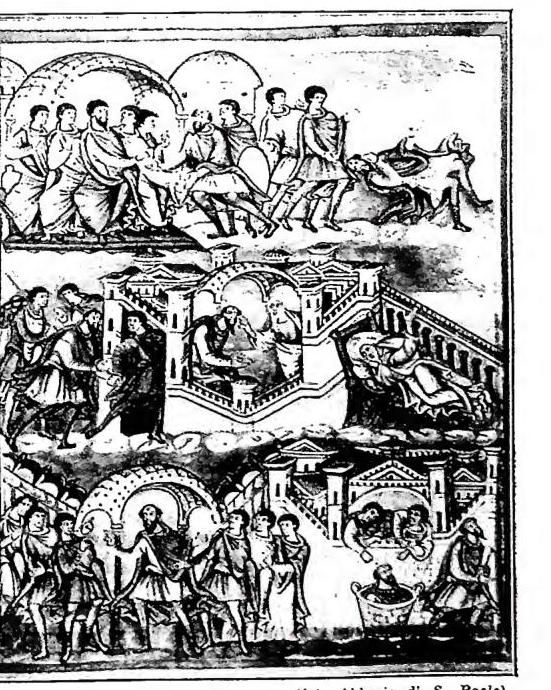
ATTI DEGLI APOSTOLI — Scene della vita di s. Paolo (Act. 9). Fol. miniato della Bibbia detta di S. Paolo — Roma, biblioteca dell'Abbasia di S. Paolo (prima metà del sec. IX).
abbia voluto scrivere od abbia scritto un altro volume perduto.
5. Il valore storico è confermato dal fatto che Luca ebbe a disposizione e consultò ottime fonti, quali i fondatori della Chiesa palestinese e s. Paolo; altra conferma è data dall'accordo con le lettere di s. Paolo e con i documenti storici.
6. Il valore storico sussiste, nonostante siano contenuti nel libro racconti di fatti soprannaturali, discorsi compendiati che sembrano adattati alle circostanze, divergenze apparenti con qualche documento storico, biblico o profano, o con altre asserzioni dello stesso libro o di altri libri sacri (AAS, 5 [1913], p. 291; L. Méchineau, Gli A. degli Apostoli e le epistole pastorali, Roma 1914; L. Pirot, Les Actes des Ap. et la Commission Biblique, Parigi 1919).
BIBL: La bibliografia, immensa, è elencata, fino al 1925, a pp. III-XIV della vasta opera di E. Jacquier, Les Actes des Apôtres (collez. Etudes Bibliques), Parigi 1926. Ci limitiamo a ricordare fra i cattolici recenti: J. Knabenhauer, Commentarius in Actus, Parigi 1899; M. Sales, Gli A. degli Ap. nella Bibbia commentata (Nuovo Test.), I, Torino 1913, pp. 451-503; A. Wilkenhauser, Die Apostelgeschichte und ihr Geschichtswert, Münster 1921; id., Die Apostelgeschichte übersetzt und erklärt, Ratisbona 1938; J. E. Belser (4ª ed. di A. Wilkenhauser), Die Apostelgeschichte, Münster 1922; A. Camerlynch-A. Van der Heeren, Comm. in Actus, 7ª ed., Bruges 1923; L. Pirot, in DBs (1928), 42-86; A. Boudou, Actes des Ap. (collez. Verbum Salutis), Parigi 1933; A. Steinmann, Die Apostelgeschichte übersetzt und erklärt, Ratisbona 1938; P. Vannutelli, A. degli Apostoli e lettere di s. Pietro. Testo greco con versione latina, italiana e note, Roma 1939. - Tra gli acattolici: A. Harnack, Lukas der Arzt, Lipsia 1906; id., Die Apostelgeschichte, ivi 1908; id., Neue Untersuchungen zur Apostelgeschichte, ivi 1911; Th. Zahn, Die Uranusche der Apostelgeschichte des Lukas, ivi 1916; id., Die Apostelgeschichte des Lukas, I, 3ª ed., ivi 1922; II, 4ª ed., ivi 1927; F. J. F. Jackson e K. Lake (con altri), The Beginnings of Christianity, 5 voll., Londra 1926-33; O. Bauernfeind, Die Apostelgeschichte, Lipsia 1939.