
ÁGNOSTOS THEÓS (unknown god). — Pausanias (I, 1, 4) knows at Phaleron βωμοί θεῶν ὀνομαζομένων ἀγνώστων, that is, “altars of unknown gods” (thus Weinreich, in Archiv für Religionswissenschaft, 18 [1915], p. 28; whereas Th. Birt, in Rhein. Museum, 69 [1920], pp. 349, 389, thinks of an altar of an unknown god, or even of several altars; similarly Hoefer, in Roscher, Mythol. Lexicon, V, col. 680). At Olympia, an ἀγνώστων θεῶν βωμός has been found, according to Pausanias himself (V, 14, 8). The meaning of this designation in Pausanias is unclear. If it meant that the names of these divinities were no longer remembered (thus, for example, W. Goeber, s. V. Theoi agnostici, in Pauly-Wissowa, Real-Encycl., 2nd series, X, col. 1988 ff.), one would expect the word ἀνώνυμος rather than ἀγνώστος. Others have interpreted the “unknown gods” as meaning “local divinities” (v. C. Pascal, Studi di antichità, Milano 1896, pp. 85 ff) or “chthonic divinities” (Weniger, in Klio, 14 (1920), p. 414). Other explanations are also possible, for example the text of an Nadim (v. Chwolsohn, Die Stabier und der Stabshaus, II, Pietroburgo 1856, p. 33), which speaks of sacrifices to the “hidden, distant, and absent” gods. The conjecture
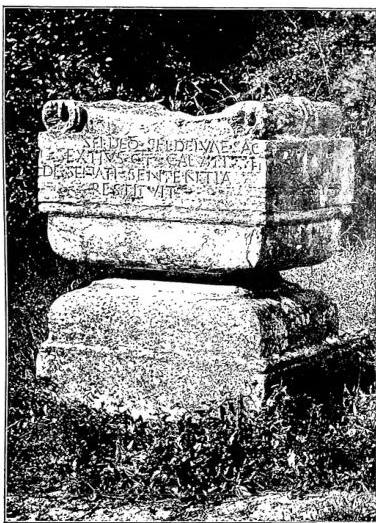
ÁGNOSTOS THEÓS - Ara di travertino dedicata a divinità ignota - Roma, Palatino.
di Hepding che vorrebbe completare il testo lacunoso di una dedica a Pergamo nel senso di una menzione di « Agnostoi Theoi » è molto debole (cf. Athenische Mittel., 35 [1910], p. 456; Ad. Deissmann, Paulus, 2ª ed., Tubinga 1925, pp. 226 sgg.) e l'ipotesi di S. Ferri (Divinità ignote, Firenze 1929, p. 66) di attribuire i busti senza volto, trovati a Cirene, agli Agnostoi Theoi, è errata (v. GERMANO, Philol. Wochenschrift, 51 [1931], p. 1535 e J. Kroll, in Deutsche Literatur Zeitung, 53 [1932], p. 1407).
Il problema dei ἄγνωστοι θεός si è posto in seguito alla menzione di un altare, dedicato a un ἄγνωστοι θεός (singolare!) in Atene, nel discorso indirizzato da s. Paolo all'Areopago (Act. 17, 23). I diversi problemi sono messi bene in luce da Ed. Norden nella sua grande opera Agnostos Theos (Lipsia 1912, 2ª ed. 1929). Una discussione dal punto di vista cattolico si trova in A. Wikenhauser, Die Apostelgeschichte und ihr Geschichtswert, in Neutestam. Abhandlg. (VIII, III-V, Münster 1921, pp. 369-90). Il Wikenhauser ha raccolto tutti i testi patristici riguardanti l'iscrizione di Atene. L'affermazione di Norden che l'idea dello ἄγνωστοι θεός nel neo-platonismo sia di origine gnostica o orientale (pp. 84, 109) è stata contestata da E. R. Dodds, nella sua edizione degli Elementos theologica di Proelo (Oxford 1933, app. 1, p. 310), ed A. I. Festugière (Contemplation et vie contemplative selon Platon, Parigi 1936), ha in una nota penetrante bene chiarito non soltanto il problema storico riguardo alla dottrina platonica, ma anche i diversi significati che può avere la parola ἄγνωστοι θεός (pp. 227 sgg.). Se, come pensa il Dodds, i neo-pitagorici del sec. I d. C. affermarono già l'idea della inconoscibilità di Dio, il problema letterario della dipendenza di s. Luca e di Filostrato, nella Vita Apollonii (VI, 3), da una comune fonte pitagorica, perde un po' della importanza che gli fu data dal Norden in una costruzione forzata.