
ANNA (Hebr. Hannāh “grace”). – Name of various women of the Old and New Testaments.
1) ANNA, wife of the Ephraimite Elkanah (v.), an inhabitant of Ramathaim-Sophim (I Sam. 1–2). Favored by her husband, although barren, she silently endured the insults of her fertile rival Phenenna. One day, while at Shiloh with her husband, who had gone there to offer sacrifices before the Tabernacle, A. made a vow to the Lord to consecrate to him for her entire life the son “if thou wilt indeed look on the affliction of thine handmaid, and wilt give unto thine handmaid a man child” (I Sam. 1:11), vow (v.). While she prayed in a low voice, she was reprimanded by the high priest Eli, to whom she explained herself and from whom she received the priestly blessing. She obtained the grace she had requested, becoming the mother of Samuel (v.). When she had weaned him (at about three years of age, according to Jewish custom: II Mach. 7:27), or raised him (the Hebrew gāmal has both meanings), she brought him to Shiloh and presented him to the Lord, offering thank offerings. She then uttered the sublime inspired hymn in which she praises divine power, justice, and goodness and looks forward to messianic salvation (I Sam. 2:1–10); Magnificat (v.) of Mary Most Holy (Lk. 1:46–55) echoes almost the whole of the sacred joy of the mother of Samuel. A. is regarded as a figure of the Mother of Jesus because of her miraculous fecundity, and of the Church, persecuted in its beginnings and later fruitful and glorious. Phenenna with her children is a figure of the synagogue, at first fruitful and later rejected. St. John Chrysostom devoted five homilies to the moral teachings arising from A.’s motherhood (PG 54, 631–75).
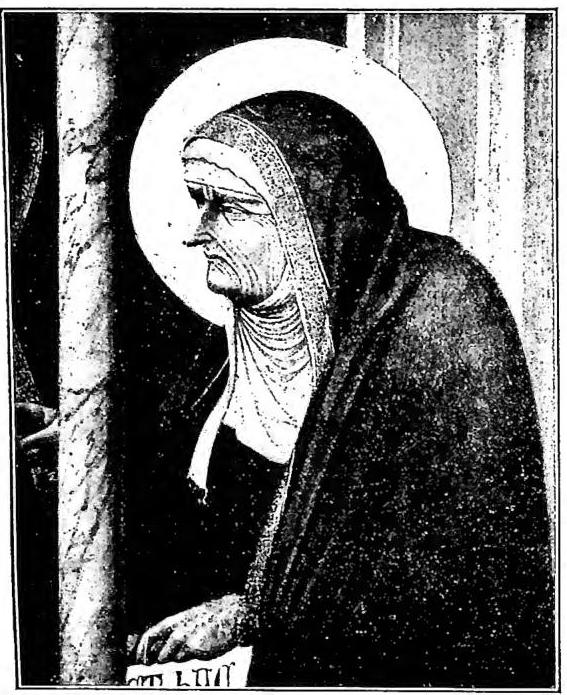
(phot. Alinori)
3) ANNA, wife of Raguel, a relative of Tobit, at Ecbatana. In the Septuagint (Tob. 7:2–18; 8:16) she is called Edna (Hebrew “delight”). She cordially welcomed her cousin Tobias, who had come to marry her daughter Sarah.
4) ANNA, saint. Prophetess, daughter of Phanuel of the tribe of Asher. Having come to the Temple in Jerusalem on the occasion of the presentation of Jesus, she “gave thanks likewise unto the Lord, and spake of him to all them that looked for redemption in Jerusalem” (Lk. 2:36–38). “She departed not from the temple” (ibid.), probably residing in some adjoining room. She had lived with her husband for seven years and, having become a widow, had by then reached the age of eighty-four. The interpretation of St. Ambrose, according to which A. remained a widow for eighty-four years and would therefore have been more than a hundred years old, is improbable. She is commemorated in the Roman Martyrology on 1 September; in the Byzantine rite on 3 February or 28 August; and in the Coptic Church on 2 February.
5) ANNA, saint, mother of the Virgin Mary. She is not mentioned in the canonical books; her name has been widespread since the 2nd century through the Protoevangelium of James and its reworkings. According to these traditions, A., daughter of Mathan, a Bethlehemite priest, is said to have had two elder sisters: Mary (who later became the mother of Mary Salome) and Sobe (who later became the mother of Elizabeth). Married to Joachim (v.), a Galilean from Nazareth, she was barren. After long prayers, already advanced in age, she had the good fortune to become the mother of Mary Most Holy. When the latter was three years old, she presented her at the Temple and died shortly afterward. In these accounts, transmitted with considerable variations in the apocryphal texts, it is difficult to determine to what extent the legend is grafted onto history.
Her cult appears in the 6th century in the East (Justinian built a church in Constantinople in her honor), and in the 8th century in the West (her image in S. Maria Antiqua). Her feast spread increasingly during the 12th century; in the 14th century it was extended to almost all of Europe, and Urban VI (bull Splendor, 1378) prescribed it for all England. Luther attacked the cult of A., which was then very popular. Gregory XIII (1584) imposed A.’s feast as a feast of obligation upon the entire Church. In the East it is celebrated on 25 July, in the West on 26 July. Today she is greatly venerated in Brittany (Ste-Anne d’Auray) and in Canada (Ste-Anne de Beaupré). She is invoked as patroness of mothers and widows, sailors, and miners. “St. Anne’s water” has been used since the end of the Middle Ages against fever and various illnesses, for women in childbirth and for the possessed.
Pietro De Ambroggi
Iconography. – The episodes from the life of St. A. most frequently represented are those inspired by the Protoevangelium of James and relating to the birth of the Virgin; besides constituting a Christological prelude, they document, through the uninterrupted tradition, the Immaculate Conception of Mary. Indeed, the episode of the Meeting of A. and Joachim at the Golden Gate was given the greatest prominence; already known in Byzantine miniature, it passed into the repertory of Romanesque sculpture (Chartres) and then into Giotto’s celebrated fresco in Padua. The scene of the Nativity of Mary follows the model of that of Jesus, as in the mosaic by P. Cavallini at S. Maria in Trastevere; later, with the works of Ghirlandaio and Andrea del Sarto, it is enriched with episodic motifs extraneous to the scene, representing people and settings from the period in which the paintings were made. Episodes from Mary’s childhood are also fairly frequent, in which A. appears as a leading figure, from the fourteenth-century mosaics of the Kahrie giami in Constantinople to the composition of A. teaching Mary to read, which was fairly widespread during the Baroque period. With the International Gothic style, a type of Holy Family with A., the Madonna, and Jesus became widely popular; fairly common beyond the Alps as well, in Italy it attained high expressive values, for example in Masaccio’s painting at the Uffizi, in A. Sansovino’s marble group in S. Agostino in Rome, and in Leonardo’s two different versions in London and Paris.
Kurt Rathe
Nelle tradizioni e nella poesia popolari. — In the anxious expectation of a child, the mothers of the people invoke St. A., so that she may assist them and favor the happy outcome of childbirth; for this purpose they customarily keep her image above the bed. She is also the protector of embroiderers, who, on the day of her feast (26 July), refrain from embroidering because they believe that, if they were to contravene this rule, the frame would fall to the ground, ruining the work. And since legend says that A., in her early youth, was a laundress, it is customary, out of devotion, also to refrain from doing the washing on that day. In France, the pilgrimage of women to Saint'Anne d’Auray is famous. The fact that A. was an «aged pregnant woman» has given rise to various popular expressions. A. appears in numerous lyrical-narrative songs which, within the brief compass of a stanza, portray her in delicate attitudes of solicitude and affection toward the child Maria; they are predominantly charming lullabies, rich in poetic imagery and vivid feeling. Also very widespread are several brief prayers-invocations of a lyrical character: one, quite ancient, since it is found in a manuscript of the Guarnacci Library of Volterra dating from the fourteenth century, is still recited by the women of the people in order to obtain the grace of a child. — Vedi Tav. CXV.