
COPTS. - The name Copts derives from the Greek Αἰγύπτιοι, which the Arabs turned into Qibt.
CONTENTS:
I. Religious History
II. The Literature of the Coptic Church
III. The Coptic Versions of the Bible
IV. Theology
V. Liturgy and Rite
VI. Art.I. RELIGIOUS HISTORY
A Coptic Church can properly be spoken of only after the Council of Chalcedon (451). Monophysitism also manifested the struggle of the Egyptian people against the Greek foreigner. But this national opposition of the Egyptians against the Greeks had already been felt earlier; thus, for example, St. Athanasius in his struggle against Arianism, which was then propagated largely by Greeks, found support among the monks of Upper Egypt, who were the spiritual leaders of the Egyptian people. The Alexandrian bishop Theophilus, engaged in polemics against the rival see of Constantinople, was also aided by the Egyptian monks. This antagonism manifested itself most strongly in the controversy over Monophysitism (v.), which gave rise to the Egyptian national Church, that is, the Coptic Church, which separated from the universal Church to embrace Monophysitism.Dioscorus, bishop of Alexandria, had been condemned and deposed by the Council of Chalcedon for his Monophysite errors. The government of Byzantium imposed, against the will of the people and by force, the election of an orthodox bishop, Proterius, who was killed in 457 in a popular uprising. His successor was the Monophysite Timothy Aelurus, who three years later was exiled to make way for an orthodox bishop, Timothy Salophaciolus. Monophysitism always maintained its preponderance in Egypt, despite the Byzantine government installing orthodox bishops. The Monophysites called their adversaries, because they followed the emperor, basilikoi (from basileus), a name that survived in the Arabic-derived form Melkites (Ar. malakijjah). The strength of the opposition induced Emperor Zeno to attempt a reconciliation, practically sacrificing the Council of Chalcedon. Acacius, the Byzantine patriarch, composed an intermediate profession of faith called the Henotikon, drafted in the form of a letter to the Egyptian clergy. On the basis of that formula, an agreement was reached, and the Monophysite patriarch Peter Mongus was recognized as the sole legitimate head of the Church of Egypt. Even when, in Constantinople, after the death of Emperor Anastasius and the rise of Justin I (518), the environment became unfavorable to Monophysitism, the heresy retained all its power in Egypt. The imperial government did not dare to impose itself. The leader of Monophysitism in Syria, Severus, bishop of Antioch, took refuge in Egypt. However, Justinian began in 538 to take energetic measures against the Egyptian Monophysites as well. The Alexandrian patriarch Theodosius was imprisoned in Constantinople. In 550, there was a massacre of Monophysites in Alexandria who rejected the Council of Chalcedon. All churches were handed over to the orthodox. Officially, only the Melkite hierarchy existed. In fact, however, the people largely recognized the Monophysite episcopate. In the 6th century, internal divisions weakened the strength of the Egyptian Monophysites. The radicals (Julianists) fought against the moderates (Severians).
Until the Persian invasion of Egypt (617), orthodoxy officially predominated. The occupiers, however, during the twelve years of their rule, recognized only the Monophysite hierarchy. The subsequent attempts of Emperor Heraclius Monothelitism (v.) failed to win over the more radical ones. The Monophysite patriarch Benjamin withdrew before the Monothelite Cyrus; but when the Arabs penetrated Egypt, he returned from his hiding place to the great joy of the population.
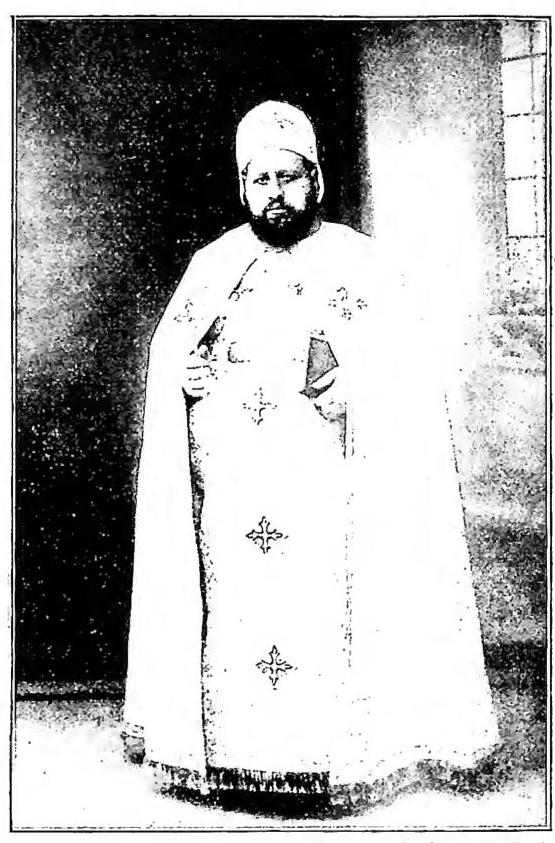
COPTS - Coptic priest in liturgical vestments.
One of the gravest ills of the Coptic Church was the simony of the clergy, explainable by the exorbitant taxes
imposed upon them. Efforts to remedy this were not lacking, as evidenced by the decrees of Church leaders, such as the patriarchs Christodoulos (1047–77), Cyril II (1078–92), and Gabriel II (1131–45). In the 12th century, a priest named Mark ibn Qanbar (ca. 1135–1208) attempted a reform, seeking, among other things, to introduce auricular confession and abolish circumcision. However, his efforts failed, and he joined the Melkites. The period of Mamluk rule (from the mid-13th century until the early 16th century) was very harsh for the Coptic Church; later, Ottoman Turkish rule was equally oppressive, particularly due to the greed of the pashas. This explains why the Coptic community continued to shrink, reaching its lowest point in the early 19th century: approximately 100,000 faithful. Finally, the government of Muhammad ʿAlī (1805–49) brought better times and religious freedom to the Copts. In the 19th century, the number of Copts increased considerably, also due to population growth. Today, they number approximately 900,000 faithful. A characteristic feature of the current situation is the stark discrepancy between progressive laypeople and the ultra-conservative higher clergy. The divide began toward the end of the last century, when in 1874 the laity founded an association for Church reform, demanding participation in the management of schools, the administration of assets, and the election of ecclesiastical dignitaries. A "Lay Council" was formed to support this program. Patriarch Cyril V (1874–1927) firmly opposed II. In 1892, the "Lay Council," backed by the government, declared the patriarch suspended, who then withdrew to a monastery and placed Cairo under interdict. Finally, the patriarch, victorious with the support of the people, returned to the city (1893). The "Lay Council" was suppressed, only to resurface in 1922. During the election of a new patriarch in 1928, the government interfered, simply appointing more than half of the electors. The difficulties continue to this day.
The internal organization of the Coptic Church differs significantly from that of the "Orthodox" Churches. The patriarch governs the Church under a truly monarchical regime, assisted by a council of four bishops elected by him. Currently, there are 18 dioceses in the Coptic Church. Approximately 1,000 priests serve in 600 churches. The clergy is largely lacking in scientific education, although there is a seminary in Cairo, unfortunately heavily influenced by Protestants. Generally speaking, such influence is strongly felt throughout the Coptic Church. Monasticism, once so flourishing, has greatly declined after 13 centuries of Muslim oppression. Few monasteries remain, with a total of 100–150 monks. Even today, the Muslim government offers little support to the Copts, who, as Christians, find themselves in a state of inferiority. This explains the painful fact that approximately 500 Copts convert to Islam each year.
Catholic Copts. — Franciscan missionaries, who have been working steadily in Egypt since the 16th century, succeeded in converting a portion of the Monophysite Copts to the Catholic faith. In 1739, for the first time, a bishop—namely Athanasius, Bishop of Jerusalem, residing in Cairo—converted to Catholicism and was appointed by Benedict XIV as apostolic vicar of the Catholic Copts, who at that time numbered around 2,000. However, since he could not bring himself to break with the dissidents, the Holy See appointed Giusto Maraghi, a former student of the College of Propaganda, as vicar general in his stead (1747). Only in the 19th century could the Catholic Copts spread with some freedom. Leo XIII established their own hierarchy in 1895. Four years later, a patriarch was also appointed for them, Cyril Macarius,
who apostatized in 1908, causing serious disturbances in the Catholic community. In recent decades, following the First World War, the Catholic Copts have flourished notably. For example: from 1927 to 1937, the number of faithful rose from 29,000 to 47,000. Today, they number 63,000, with 85 priests and 70 churches. On August 9, 1947, the patriarchal administrator was appointed Patriarch of Alexandria, and a new diocese, that of Assiut, was also created, in addition to that of Minya, already established in 1938.
II. THE LITERATURE OF THE COPTIC CHURCH
1. In the Coptic language
Coptic literature is far less rich than, for example, Syriac literature. It lacks considerable productive force and largely consists of translations from Greek. However, particularly in poetry, there are also original works.In the Coptic language, three dialects of Upper and Middle Egypt must be distinguished: the Sa'idic, which is the most important and eventually supplanted the others; the Aḫmīmic; and the Fajjūmic. Additionally, there is the more recent dialect of the Nile Delta, the Bohairic, which became a literary language toward the end of the 6th or the beginning of the 7th century and is today the liturgical language of the Coptic Church. After the 13th century, almost nothing original was written even in the Bohairic dialect, and from the 16th century onward, Coptic became a dead language.
Coptic literature was the work of the monks of Upper Egypt. The first Coptic writer was Pachomius (first half of the 4th century). Great merit for Coptic letters belongs to "the White Monastery," whose second abbot, Shenoute of Atripe (d. 451), was the most important Coptic writer. The earliest known monument of the Coptic language is a translation of the Bible made in Sa'idic around the mid-4th century. Not a few apocryphal books, especially concerning the life of Christ and the Apostles, were translated into Coptic. The same fate befell a large part of the canonical literature of the early centuries. No other Christian literature has such a high percentage of translations as Coptic theological literature proper. Before the Council of Chalcedon, the great Greek Fathers were translated. Later, the leaders of Monophysitism: Dioscorus and Severus of Antioch. The little that remains original in Coptic literature arose from the needs of monastic life and apostolic activity. Here, the monastic rules of St. Pachomius and his letters should be mentioned; also the rules, discourses, and letters of Shenoute in his struggle against the remnants of paganism and Arianism. As for narrative prose, the lives of the saints and the acts of the martyrs are worthy of mention, such as the life of Shenoute written by his disciple Bēšā.
In poetry, original Coptic works are more numerous. Fragments of a poetic description of the Passion of Our Lord, written in Fajjūmic and probably intended for liturgical use during Holy Week, are preserved. Toward the end of the 16th century, poetry also flourished in Sa'idic, creating, among other things, a considerable number of Paschal hymns and songs in honor of the saints. All the sapiential books and many other biblical subjects were also treated poetically.
2. In the Arabic language
The Arabic literature of the Copts is more extensive and varied than that of other Eastern Christians. Original literature in Arabic among the Copts begins in the 10th century and reaches its apogee in the 13th. Already in the 8th century, Scripture had been at least partially translated from Coptic into Arabic. Theological literature proper begins with translations. For example, the writings of Shenoute were partially translated into Arabic. The first original Arabic writer of some importance is Severus Abū l-Bār ibn al-Muqaffaʿ, bishop of Ašmūnayn (10th century), who wrote, among other works, a Book of the Councils, comprising in four chapters a synthesis of Christian history. In the last part, the history of the first four councils and their doctrine is described. In his Book of Exposition, Severus provides religious instruction to the people on the fundamental dogmas of the faith and the practice of Christian life. Probably toward the end of the 12th and the beginning of the 13th century lived Peter Severus al-Ǧāmil, bishop of Maliǧ, author of the Book of the Rising (of the Sun), against heresies, and the Book of Demonstration, an apology for Christianity in its Monophysite form. On other dogmatic authors V. below.Canon law literature (v. COLLEZIONI CANONICHE) is of special importance for the Copts, who had their own courts under Muslim rule. A systematic collection of canons, a Nomocanon, was compiled by Michael, bishop of Damietta (d. after 1208). As for historiography, the aforementioned Severus of Ašmūnayn is important, author of a history of the patriarchs of Alexandria that extends to Patriarch Philotheus (976–1000) and was later continued first until the 12th century and subsequently until 1740.
III. THE COPTIC VERSIONS OF THE BIBLE
Among the versions of the Bible in Oriental languages, the Coptic versions hold great importance for textual criticism.The surviving documents show that in each of the Coptic dialects known to date (Ṣa'īdic, Boḥairic, Aḥmīmic, Fajjūmic, Memphitic, and Subaḥmīmic), there existed versions of the Bible. Unfortunately, these versions have come down to us in a fragmentary state. The greatest number of fragments belongs to the Ṣa'īdic and Boḥairic dialects, but what remains of the Aḥmīmic and Subaḥmīmic dialects is also of great importance.
There are no positive documents to assign a terminus a quo to the Coptic versions of the Bible. However, testimonies from ecclesiastical history show that during the 3rd century, the Holy Scriptures were widely diffused among the Christians of the entire Nile Valley, who were mostly of low social condition and ignorant of the Greek language. The Hellenization of Egypt had made fewer advances in the middle and upper Nile Valley, where Christianity had instead flourished greatly, as attested by documents concerning the persecution of Decius. It can therefore be affirmed with moral certainty that in the 3rd century, the Christians of Egypt used versions of the Bible in the local dialects. Indeed, Eusebius, in Hist. Eccl., VI, 1, suggests that such versions must have already existed toward the end of the 2nd century. Regarding the persecution (202-11) of Severus, he states that Alexandria was the great arena where the athletes of Christ were brought from all of Egypt and the Thebaid: thus, the Christians of the Thebaid, mostly ignorant of Greek, must have used the books of the Bible, at least the principal ones, translated into their dialect. It therefore seems legitimate to hold that the version of the Bible in the Coptic dialects, though certainly not completed all at once and at the same time but developed gradually as the need arose for the use of the faithful, had its beginnings in the second half of the 2nd century and was then brought to completion during the 3rd century.
From the above, it is easy to deduce the precedence of the Ṣa'īdic version over the other Coptic versions. The Delta was the first region of Egypt to be evangelized, but the population of the Delta, being highly Hellenized, did not feel such an urgent need for a version of the Bible in the local dialect. Even if the lower strata of the population, who were moreover illiterate, were entirely ignorant of Greek, it was easy for them to have the few indispensable biblical passages explained orally in their own language for their catechetical instruction.
(by courtesy of Fr. II. Ilari)
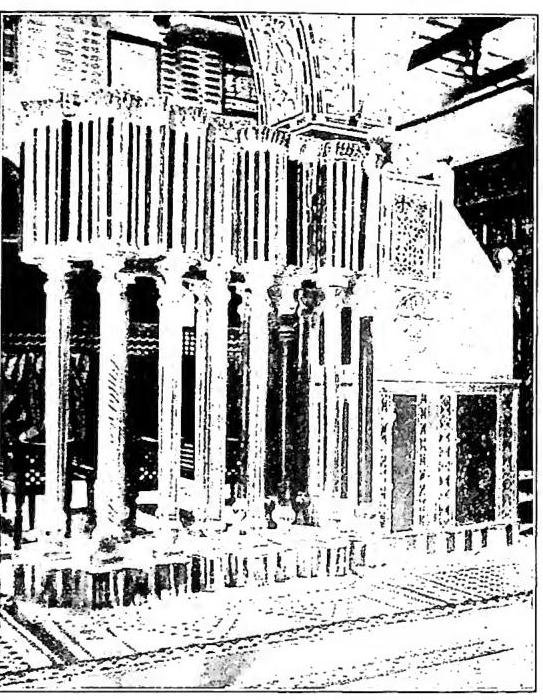
COPTS - Ambo of the Coptic church of el-Mo'allaqah in Cairo.
H. Hyvernat, however (Étude sur les versions coptes de la Bible, in Revue biblique, 6 [1897], pp. 63-75), argues for the anteriority of the Bohairic version, considering that the Delta was the first region to receive the Gospel and basing himself on the observation of Lightfoot, confirmed by Sanday (Appendices ad Novum Testamentum, app. III, p. 182 ff.), that the version of the New Testament in the Bohairic dialect, in its primitive state, presents a purer text without the Western additions that instead appear in the Sahidic version. This observation does not seem to warrant excessive weight, especially due to the lack of complete critical studies on the Coptic versions of the Bible (Revue biblique, 48 [1939], p. 318, beginning of the note signed B. C.). It is also noted that the Coptic versions, having been made for the practical utility of the faithful and not for liturgical or scientific use, were carried out not only independently of one another for the various dialects but also on Greek manuscripts of differing recensions depending on the books, and that often the version of the same book offers readings that agree now with Greek manuscripts of one recension, now with those of another, now with the Hebrew text; sometimes particular readings suggest, more than successive revisions based on Greek manuscripts of different recensions, an origin from Greek exemplars that have not come down to us.
Faced with such a state of affairs and with critical studies thus far only partial, it seems too hasty to conclude in favor of the priority of the Bohairic version over the Sahidic one, entirely rejecting the historical consideration outlined above, just as it is to conclude in favor of any general assertion.
Indeed, the fact that in the Sahidic versions Greek terms abound where the Bohairic has the corresponding Coptic word denotes in favor of the Sahidic a characteristic of antiquity. In fact, the further one ascends toward the era of Roman rule in Egypt, the more Greek is widespread in the Nile Valley, and from it the local language draws much of its vocabulary. When, however, in subsequent centuries the friction between Egyptians and Byzantines increases and mutual relations become ever rarer, the indigenous language feels an ever stronger need to replace foreign terms with Coptic equivalents. If, therefore, the Sahidic translator, unlike the Bohairic translator, did not feel the need to render with the Coptic term those Greek terms that his readers could easily understand (cf. F. M. Abel, in Revue biblique, 32 [1923], p. 304), this supports its greater antiquity.
The Coptic version of the New Testament in the Bohairic and Sahidic dialects was edited by G. Horner, The Coptic Version of the N. T. in the Northern Dialect, 4 vols., Oxford 1898-1905; id., The Coptic Version in the Southern Dialect, 7 vols., ibid. 1911-24. The Bohairic text alone of this version was reprinted in Cairo in 1934 by the Copts.
The Old Testament has been edited only in a fragmentary state in various works. Cf. A. Vaschalde, Ce qui a été publié des versions coptes de la Bible, in Revue biblique, 28 (1919), pp. 220-43, 513-31; 29 (1920), pp. 91-100, 241-58; 30 (1921), pp. 237-46; 31 (1922), pp. 81-88, 234-58; id., in Le Muséon, 43 (1930), pp. 409-31; 45 (1932), pp. 117-56; 46 (1933), pp. 299-313; W. Grossouw, in Studia catholica, 1932-33, pp. 325-53.
Principal editions of fragments: Sahidic: P. De Lagarde, Aegyptiaca, Göttingen 1883; A. Ciasca-J. Balestri, S. Bibliorum fragmenta coptico-sahidica Musei Borgiani, Rome 1885-1904; G. Maspero, Fragments de la version thébaine de l'A. T., in Mémoires de la Mission archéol. franç. au Caire, 1892, pp. 1-296; W. Budge, The Earliest Known Coptic Psalter, London 1898; H. Thompson, A Coptic Palimpsest, Oxford 1911; W. Budge, Coptic Biblical Texts, London 1912; W. H. Worrell, The Proverbs of Salomon in Sah. Copt., Chicago 1931.
Bohairic: H. Tattam, Duodecim Proph. Min. in lingua aegyptiaca, Oxford 1836; id., Prophetae Maiores in dialecta linguae aegyptiacae memphitica, ibid. 1852; I. Bardelli, Daniel coptio-memphitica, Pisa 1849; M. G. Schwartze, Quatuor Evangelia, 2 vols., Leipzig 1846-48; id., Psalterium in dialectum copticae linguae memphiticum translatum, ibid. 1853; P. De Lagarde, Der Pentateuch koptisch, ibid. 1867; A. Baciai, Liber Barne prophetae, Rome 1870; E. Forcher, Le livre de Job, in PO 18 (1924); O. H. Burmester and E. Dévaud, Psalterii versio memphitica e rec. Pauli De Lagarde (1875), Louvain 1925; id., Les Proverbes de Salomon. Texte bohairique, Vienna 1930.
Fayyumic: E. Chassinat, Fragments de manuscrits coptes en dialecte fayoumique, in Bulletin de l'Inst. franç. d'arch. or., 1902, pp. 171-206; W. Till, Koptische Chrestomathie für den Fayumischen Dialekt, Vienna 1930; id., Wiener Fayyumica, in Le Muséon, 49 (1936), pp. 169-217.
Akhmimic: P. Lacau, Textes coptes en dialectes achmimique et sahidique réédités (in Bull. de l'Inst. fr. d'arch. or., 8 [1911], pp. 43-109); C. Wessely, Duodecim Prophetarum Minorum versionis achmimicae codex Rainerianus, Leipzig 1915 (with Bohairic and Sahidic parallels, and the Latin version); W. Till, Die achmimische Version der zwölf kleinen Propheten (Coptica, 4), Copenhagen 1927.
Subakhmimic: H. Thompson, The Gospel of St. John according to the earliest Coptic manuscript, London 1924.
It has already been mentioned that there is a lack of complete critical studies on the Coptic versions of the Bible (cf. Revue biblique, 48 [1939], p. 318). In general, it can be affirmed that in the Sahidic version the Old Testament shows the influence of the Hexapla (Isaiah, Proverbs, Ecclesiastes, Ezekiel), Daniel follows Theodotion, and the version of Job has preserved the pure text of the LXX before Origen. The New Testament in the Pauline Epistles preferentially follows manuscripts of the Alexandrian recension, while in the Gospels it more frequently agrees with manuscripts of the Western recension, although at times it has readings perfectly concordant with the Bohairic version (based on manuscripts of the Alexandrian recension) and at times also has its own unique readings. In the Bohairic version, the New Testament generally agrees with the oldest Greek manuscripts, despite the additions that criticism considers not to have been present in the primitive state. From what remains of the Bible versions in the other dialects, it is not easy to conclude with certainty whether they are entirely independent of one another or derive from the Sahidic version. It is to be hoped that a critical edition, as complete as possible, may be published to provide greater certainty and solidity to the relevant studies of criticism.
IV. THEOLOGY
I. General Overview. The earliest ecclesiastical writers of the Coptic Church dedicated themselves to translating into the national languages—namely, the Sahidic language first and, from the 6th century onward, the Bohairic language—the books of Holy Scripture, numerous apocrypha of the Old and New Testaments, and works of the holy Fathers, particularly those of St. Athanasius, Theophilus of Alexandria, St. Basil, St. Gregory Nazianzen, St. Gregory of Nyssa, St. John Chrysostom, and Severian of Gabala, to whom are added the Fathers of Monophysitism, Dioscorus of Alexandria and Severus of Antioch.To arrive at properly theological treatises, one must descend to the 10th century, if we disregard the little that has been preserved from the writings of the Monophysite patriarch Timothy Aelurus (d. c. 477): some passages preserved by his adversaries and his pamphlets found by Lebon in Syriac translation. The first Coptic author is the bishop of Ašmūnayn, Severus Abū 'l-Baār Ibn al-Muqaffa' (10th century): according to Abū 'l-Barakāt, he composed 26 works against Muslims, Jews, Melkites, and Nestorians; but of these, only two remain: the refutation of Sa'id Ibn Baṭrīq (the Melkite patriarch of Alexandria, Eutychius) and the Explanation of the Foundations of Religion. Severus paved the way for later theologians: John Ibn Severus, Ibn Kolaji, Michael, Metropolitan of Damietta, Peter of Malig in the 12th century, in the following century the three brothers Abū 'l-Faraḳ, Abū 'l-Fadā'il, and Abū Iḥāq Ibn al-'Assāl, and in the 14th century Abū 'l-Ḥajr Ibn at-Tajjib, Abū 'l-Barakāt Ibn Kubr, and Jāhā Ibn Abī Zakarūjā', commonly called Ibn Sabbā', whose works are discussed under these V. names.
A long period of silence follows. But unlike other Monophysite Churches, the Coptic Church experienced a revival of ecclesiastical literature at the end of the 19th century. Without mentioning the printing of ancient treatises, in this period we find Ibrāhīm Rafā'ī at-Tūḥī, author of a book on Monophysitism, the monks of the Monastery of Barāmūs, who published in 1894 a volume against the united Copts, the Qomos (superior) Philotheus Ibrāhīm, author of a catechetical exposition of the faith and a refutation of Catholic doctrine, and the Qomos John Salāmī. They were followed by Macarius, who, being a Coptic Catholic patriarch, wrote in favor of the Roman faith; after his defection (1908), he composed in 1912 the book La Constitution divine de l'Eglise, published posthumously in Bern in 1922.
Apart from this work, all Coptic theological literature has been written in Arabic and favors polemics; polemics that, truth be told, are calmer when refuting the ruling Muslims, more heated when directed against other Christian groups represented in Egypt. Ancient Coptic theology certainly feels the influence of philosophy but remains independent regarding dogma. Only in the modern era, perhaps due to a stance of strong opposition to Rome, does it tend increasingly to merge with dissident Byzantine theology.
The Coptic Catholic priest Michael Khouzam provided in 1941 a summary of the theological opinions of the Copts based on Ibn at-Tajjib’s Illumination of the Intellects and Abū 'l-Barakāt’s Lamp of Darkness. The thought of modern Copts has been expounded by R. Strothmann and G. Kopp. We must content ourselves with mentioning some of the more relevant questions.
2. Monophysite Doctrine. - a) Jesus Christ. Maillet in 1735 said of the Copts that they are « the most obstinate in error ». Certainly, they remain deeply attached to the memory of the patriarch Dioscorus, condemned at the Council of Chalcedon along with Eutyches. Nevertheless, we can assert that the Monophysitism of the Copts was never the rigid Monophysitism of Eutyches but the mitigated or nominal Monophysitism, commonly called Severianism. We speak, of course, of official Monophysitism, without denying that one or another, especially among the monks, adhered to real Monophysitism, such as the anchorite Samuel in the 9th century.
But already the patriarch Timothy Aelurus in the second half of the 5th century takes a firm stance against Eutyches and teaches that in Christ, even after the union, the entire essence or substance of humanity remains, by virtue of which the Emmanuel is consubstantial according to the flesh with the Virgin Mother of God, though it is not permissible to speak of two natures because this necessarily entails the two persons of Nestorius, given the identity between the concepts of person and individual nature. This doctrine is repeated in many other places: for example, in the Paschal epistle of the patriarch Sanuzio (9th century) and in another by the patriarch Mena (10th century), which excludes any destruction, mixture, or corruption of the natures united in Christ. The same opinion, as well as the same prejudice against the Chalcedonian formula suspected of Nestorianism, is found at the beginning of our century in the works of the Qomos Philotheus.
b) Most Holy Trinity. - Ancient authors content themselves with proving through scriptural arguments—to which they add others of a philosophical nature—the unity of the divine nature and the Trinity of persons. The much-debated question between Byzantines and Latins remains foreign to the Copts, who continue to use the Nicene Creed, where it is said only: « (We believe) in the Holy Spirit », without the addition of the Nicene-Constantinopolitan Creed: « who proceeds from the Father ». Modern authors, however, admit the Photian opinion and make their own the arguments of the Byzantines against the Filioque, reported accurately by Philotheus Ibrāhīm and John Salāmī.
c) The Sacraments. - In this field, the controversy over auricular confession, which arose in the 12th century, is specifically Coptic. The persecutions afflicting the Church of Egypt at that time made it so difficult to find priests or hieromonks that the abuse of the so-called confession over the censer, without manifesting one’s sins, was introduced. The priest Mark Ibn Qanbar opposed this custom, which found a staunch defender in the metropolitan of Damietta, Michael, and in the patriarchs John V (1146-67) and Mark III (1167-1180). But already in the 13th and 14th centuries, authors are not in agreement; while Abū 'l-Barakāt still favors the Coptic usage,
This was the ancient doctrine. Modern Copts reject all primacy, both that of the Roman pontiffs and that of St. Peter, following the example of Byzantine writers, whose influence is evident in the treatise of Philotheus Ibrāhīm against Catholics.
LITURGY AND RITE
The Coptic rite, also called Alexandrian or Egyptian, is the Greek-language rite that originated in Egypt, particularly in Alexandria. Translated into Coptic, it became, in the 5th century after the Council of Chalcedon, the liturgy proper to the Monophysite Church of Alexandria; the rite of the faithful who remained orthodox was Byzantinized. It is followed today by the Monophysites of Egypt and by the faithful who have united with the Catholic Church; it had a decisive influence on the Ethiopian rite. From Greek, the anaphora of St. Mark, of Alexandrian origin, which took the name of St. Cyril, was translated into Coptic; that of St. Basil, which became the normal anaphora, and that of St. Gregory Nazianzen, which directs all its prayers to Jesus Christ; these last two, coming from Asia Minor, differ from the first in the placement of the intercessory prayers. We also have the original Greek of the divine office and of several troparia, and in many ceremonies a notable series of formulas are preserved in the Greek language, such as the Kyrie eleison in the Latin rite.
To the early period of the Monophysite Church generally belong the works, or more often, fragments of liturgical works written in the Saidic dialect. We note the fragments of anaphoras translated by H. Hyvernat (Fragmente der alt-coptischen Liturgie, in Röm. Quartalschrift, 1 [1887], pp. 330-45; 2 [1888], pp. 20-26) and partly incorporated into the Syriac anaphoras of Timothy and Severus of Antioch; then the anaphora of St. Matthew edited by A. M. Kropp and others noted by A. Baumstark and L. Th. Lefort; a Mass from the 6th century preserved with the baptismal rite in the Arabic Testamentum Domini; finally, various blessings, such as those of the water on the day of Epiphany. A unification of the Coptic rite occurred around the 9th century because liturgical manuscripts came almost exclusively from the monastery of St. Macarius of Wādī al-Naṭrūn, and because the Patriarch of Alexandria was regularly elected from among the monks of this monastery; thus it is explained that the Bohairic dialect, proper to this region, became the only liturgical language. Around the middle of the 12th century, a priest, Marco ibn Qanbar, attempted to reform the Church by recalling the faithful to the use of auricular confession, frequent communion, and other religious practices; the hierarchy opposed the movement, and he himself passed to the Melkite Church. To the same century belongs the patriarch Gabriel II, reformer and moderator of some ceremonies. Another patriarch Gabriel of the 14th century gave the definitive redaction of the Ritual. On the state of the liturgy of that century, we are well informed by the Lamp of Darkness of Abū'l-Barakāt ibn Kabar, from which L. Villecourt translated long extracts (Les observances liturgiques et la discipline du jeûne dans l'Eglise copte, in Le Muséon 36 [1923], pp. 249-92; 37 [1924], pp. 201-80; 38 [1925], pp. 261-30). For the 17th century, one may profitably consult Abudaenus, a Copt who describes the faith and rites of his people (Historia jacobitarum seu Coptorum, 1675), and I. M. Vansleb, a curious and sympathetic observer, though not always well prepared (Histoire de l'Eglise d'Alessandrie, Paris 1677). In the following century appeared in Rome the collection of Coptic liturgical books edited by R. Tuki: Missal (1736); Breviary (1750); Pontifical and Euchologion (1761-62); Ritual (1763); Theosakis (1764). From the end of the 19th century onward, both dissidents and Catholics have produced editions, sometimes luxurious, of their liturgical books.
1. Language. – The Alexandrian liturgy initially used the Greek language; soon, for the readings, and in the 5th century for the rest, it was performed in Coptic, predominantly in the Saidic dialect, which in the 9th century was almost entirely replaced by the Bohairic dialect. But already after the Arab invasion (7th century), the people increasingly forgot their native language; in the 13th century, almost nothing new was written in Bohairic, and in the 16th century, the Coptic language disappeared from ordinary life. Arabic also prevailed in the liturgy, and today liturgical books present a bilingual Coptic and Arabic text, interspersed here and there with a Greek formula, a vestige of the original language.
2. Mass. – The part preceding the readings is highly developed: it includes, in addition to the preparation of the oblations, the Offertory, which is not repeated after the Gospel. At the altar, the priest, from among the loaves presented to him, chooses one, takes it in his hand, wraps it in a veil, and makes his commemorations; then, holding it above his head and preceded by the deacon holding the wine cruet, he processes solemnly around the altar with the clerics; having placed the bread on the paten and put the wine and water in the chalice, he says, among some prayers, that of the Offertory and covers the oblations. This is followed by a particular ceremony of the Egyptian rite, an absolution recited by the assisting priest: «... that your servants of this sacrifice, the priest, the deacon, the clergy, all the people, and my unworthiness be absolved from their sins by the work (lit.: by the mouth) of the Most Holy Trinity, of the one, holy, catholic, apostolic Church, of the twelve Apostles... (other saints are named), of the Pope, of our bishop, and by the work of my unworthiness...». The incensation of the altar, the sanctuary, and the church concludes this first part of the Mass. The second part includes, besides the chants, four readings taken entirely from the New Testament: St. Paul, the Catholic Epistles, the Acts, and the Gospel; they are read first in Coptic and then in Arabic.
In the prayer after the Gospel, there is a reference to the catechumens, proof that in ancient times the Mass of the Catechumens ended here. The Mass of the Faithful, as in ancient times, begins with the great litany, which here contains the petition so appropriate for the increase of the Nile’s waters. Then the priest recites the prayer of the veil, thus showing that in ancient times at that moment he approached the altar to perform the Offertory; the same is revealed by the three solemn prayers, particular to the Egyptian rite; they are petitions for the peace of the Church, for the hierarchy, and for the community of the faithful; from the ancient Offertory, the incensation remains at that moment, and, after the recitation of the Creed, the lavabo. When the deacon invites the faithful to exchange the peace, they shake hands with one another, and then each kisses his own hand. After a warning from the deacon, the priest begins the great Eucharistic prayer. It is interrupted, in the anaphora of St. Cyril, by the prayer of intercession, which in the other two, as in the Byzantine, Armenian, and Syriac rites, is said after the epiclesis. At the moment of Consecration, the priest’s words are underscored by exclamations of faith from the people: priest: He took the bread in His immaculate hands – people: Amen; – priest: and blessed it – people: Amen; – priest: and sanctified it – people: Amen, Amen, Amen. We believe, and we confess, we glorify; – priest: this is My Body... – people: We believe that it is truly so. The same dialogue is repeated at the consecration of the wine. And the prayers of the anaphora follow: the anamnesis, the epiclesis, the intercession of the saints (except in the anaphora of St. Cyril) for the living and the dead, the concluding doxology. The fraction of the consecrated bread, as performed by the dissidents, is an extremely complicated ceremony. The people say the Pater noster, receive another absolution, and after the Elevation with the Sancta sanctis, the intinction and the administration, they magnificently profess their faith in the Eucharist. Communion is received, by the dissidents, first with the bread and then with the chalice, by the Catholics with the bread alone. With the thanksgiving, the blessing, and the Pater noster, which the whole people recite with hands raised toward heaven, the rites of the holy sacrifice conclude.
For general works, V. ALESSANDRIA (rito di); for the ancient liturgy, H. Hyvernat, Les actes des martyrs de l'Egypte, Paris 1886; A. Baumstark, Die Messe im Morgenland, Kempten 1906; L. Th. Lefort, Les manuscrits coptes de l'Université de Louvain, Louvain 1940; for the modern liturgy, R. Tuki, Rituale coptorum, Roma 1763; Missale coptorum, Roma 1736; Breviarium coptorum, Roma 1750; Euchologium coptorum, Roma 1761-62; Pontificale coptorum, Roma 1761-62; Theosakis, Roma 1764; I. M. Vansleb, Histoire de l'Eglise d'Alessandrie, Paris 1677; Abudaenus, Historia jacobitarum seu Coptorum, 1675; L. Villecourt, Les observances liturgiques et la discipline du jeûne dans l'Eglise copte, in Le Muséon 36-38 (1923-25); M. Jugie, Theologia dogmatica christianorum orientalium, Paris 1933, V, pp. 353-402; C. Kopp, Glaube und Sakramente der koptischen Kirche, Roma 1932; R. Strothmann, Die koptische Kirche in der Neuzeit, Tübingen 1932.
Maurizio Gordillo