
EUCOLOGIO (Εὐχολόγων). — As the name suggests, it is a collection of ecclesiastical prayers. This liturgical book contains the prayers recited by the priest and the deacon during the offices of Vespers and Orthros (Martuzino and Laudi), the text of the three Eucharistic liturgies, the rites of the Sacraments, of funerals for the various categories of persons, and of monastic professions, the blessings and consecrations of persons and objects of worship, the formulas of blessings and prayers for the spiritual and temporal needs of the faithful, etc. G. Goor calls it Rituale, Manuale, Sacerdotale Ecclesiae Graecas. It is a venerable book above all for its antiquity and importance.
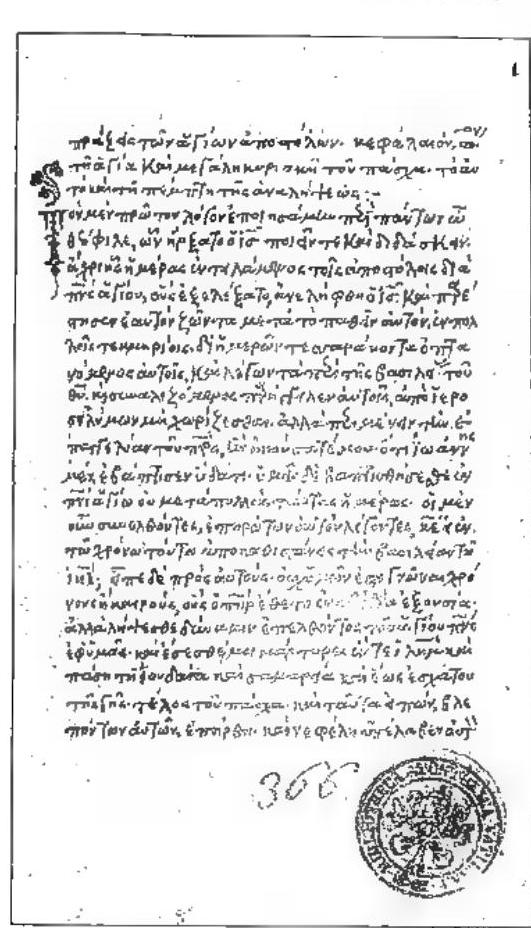
Gracus Barberinus S. Marc. N. III, 55 (77), now Vat.
grec. 366, from the 8th–9th century; the Codex of Bishop Porfirio,
formerly N. CCXXVI of the Imperial Library of
St Petersburg, from the 9th–10th century, which some date
to the end of the 8th century; Cod. Sin. N. 957, from the 9th–10th century; Cod. Sin.
N. 958 and Cod. Cryptof. Γβ'Χ, from the 10th century; Cod. Seba-
stjanov, formerly N. 15 (1474) of the Rumijantsev Museum
(Moscow), from the 10th–11th century. From the 11th century onward, the manuscripts
of E. become more numerous. Cf. Al. Dmitrievskij, Opisanie
liturghievskich rakopisei chronijachchichija v' bibliotekach
Pravoslavnogo Bostoka, vol. II, Εὐχολόγια, Kiev 1901; Ant.
Rocchi, Codices Cryptenses seu Abbotiae Cryptae Fer-
ratiae in Tusculano, Rome 1884; Pl. de Meester, Rituale-
Benedicionale Bizantino, Rome 1930, pp. IX–XVII; M. I.
Orlov, Liturghija sv. Vasilija Velikogo, St Petersburg 1909,
pp. X–XVIII. The Slavonic versions are later (Orlov,
op. cit., pp. XXX–XLVII), whereas euchological elements are
found in Georgian, Syriac, and Arabic manuscripts of the
10th–11th century. The first editions of the Greek text of E. were
published in Venice (1526, 1544, 1550, 1553, 1560 by
Cristoforo Zanetti; 1566 by Andrea Giuliani, etc.). The
hieromonk Teofilatto corrected the later editions and
added some prayers; subsequently E. underwent
various revisions and emendations. The first edition of the Cath-
olics was printed in Rome in 1754 by order of
Benedetto XIV, who had first caused the 82 sessions of the
Commission established by Innocenzo X and continued
under Urbano VIII and his successors to be summarized. The Ro-
man edition of 1873 is a reprint of the preceding one. In these
two Roman editions the rite for the consecration
of a church is lacking. Moreover, no edition contains the
abundant elements of Byzantine euchology scattered throughout
the manuscripts. A large part of this material is
found in the works of G. Goar and A. Dimitrievskij, as
well as in separate liturgical monographs printed in
Greece and Russia. Nic. Pan. Papadopulo enriched
his edition of E., published in Athens in 1927, with rites and
prayers drawn from these sources.
The complete E. (Εὐχολόγιον τὸ Μέγα) described
above must be distinguished from the small E. (Εὐχολόγιον τὸ
Μικρόν), which contains only the liturgy of S. Giovanni
Crisostomo, the sacramental rites, certain Epistles and
Gospels, and a few prayers. The collection of the most
frequently used blessings formed the ritual called the Aghiasmatario and
Benedicionale, while the ritual elements most commonly
used by the bishop are found in the Architetico, and the prayers re-
cited by the deacon gave rise to the Diaconico (Δια-
κοσινός). The most authoritative commentary on E. and a
Latin translation of the texts are found in the magisterial work
of G. Goar: Εὐχολόγιον, sive Rituale Graecorum.
With the exception of the Sacraments, the rites of the Greek E. and
of the Slavonic Trebnik, which is its equivalent, are com-
mented on with the aid of manuscripts in the cited work of de
Meester.
Piscido de Meester