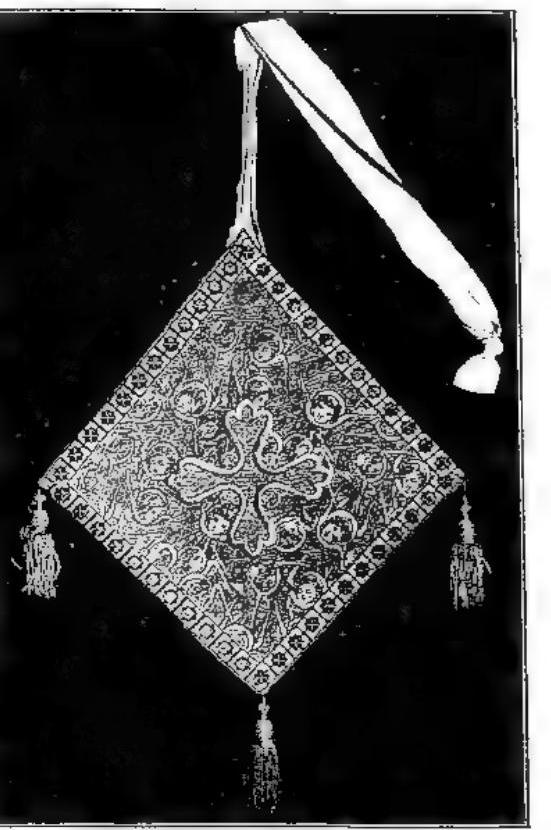
EPIGONATION - Pontifical Russian College of St. Teresa of the Child Jesus - Rome.
EPIGONATION (Ἐπιγωνάτιον, Ἐπιγόνᾰτον). - It is a liturgical ornament of the Byzantine rite worn suspended from a ribbon at the height of the right knee. It has the shape of a rhombus and consists of a fabric and a cardboard covered with richly embroidered fabric and adorned with a sword, a cross or an image: a cherub or a saint. Its origin is not clear.
It could have been a simple handkerchief or a pouch that contained the text of the liturgy or of the homily read by the pontiff. At first only the patriarch had the right to wear the e., then it was granted to bishops, and finally to the archimandrites and other ecclesiastical dignitaries. In the list of officials of the patriarchal Church of Constantinople, one of them carried and placed the e. on the person of the patriarch. Whoever has the privilege of wearing the e., in putting it on, recites a prayer. This alludes to the victory of Christ and of Grace over the powers of death. The e. is also a sign of authority. Placido de Meester
De, Meester Placido. “Epigonation (ἘΠΙΓΩΝΆΤΙΟΝ, ἐπιγόνατο).” In Enciclopedia Cattolica, vol. V, col. 429. Città del Vaticano: Ente per l’Enciclopedia Cattolica e per il Libro Cattolico, 1950. https://azioneromana.com/article/epigonation-epigonation-epigonato.
MLA
De, Meester Placido. “Epigonation (ἘΠΙΓΩΝΆΤΙΟΝ, ἐπιγόνατο).” Enciclopedia Cattolica, vol. V, Ente per l’Enciclopedia Cattolica e per il Libro Cattolico, 1950, col. 429. Azione Romana, https://azioneromana.com/article/epigonation-epigonation-epigonato.
BibTeX
@incollection{ec5_epigonation_epigonation_epigon,
  author    = {De, Meester Placido},
  title     = {Epigonation (ἘΠΙΓΩΝΆΤΙΟΝ, ἐπιγόνατο)},
  booktitle = {Enciclopedia Cattolica},
  volume    = {V},
  pages     = {429},
  note      = {Cited by column},
  publisher = {Ente per l’Enciclopedia Cattolica e per il Libro Cattolico},
  address   = {Città del Vaticano},
  year      = {1950},
  url       = {https://azioneromana.com/article/epigonation-epigonation-epigonato}
}
One of some 20,000 entries brought back from the twelve printed volumes (1948–54). Spotted something? Help us improve it.
Click or scroll to zoom · drag to pan · Esc to close