
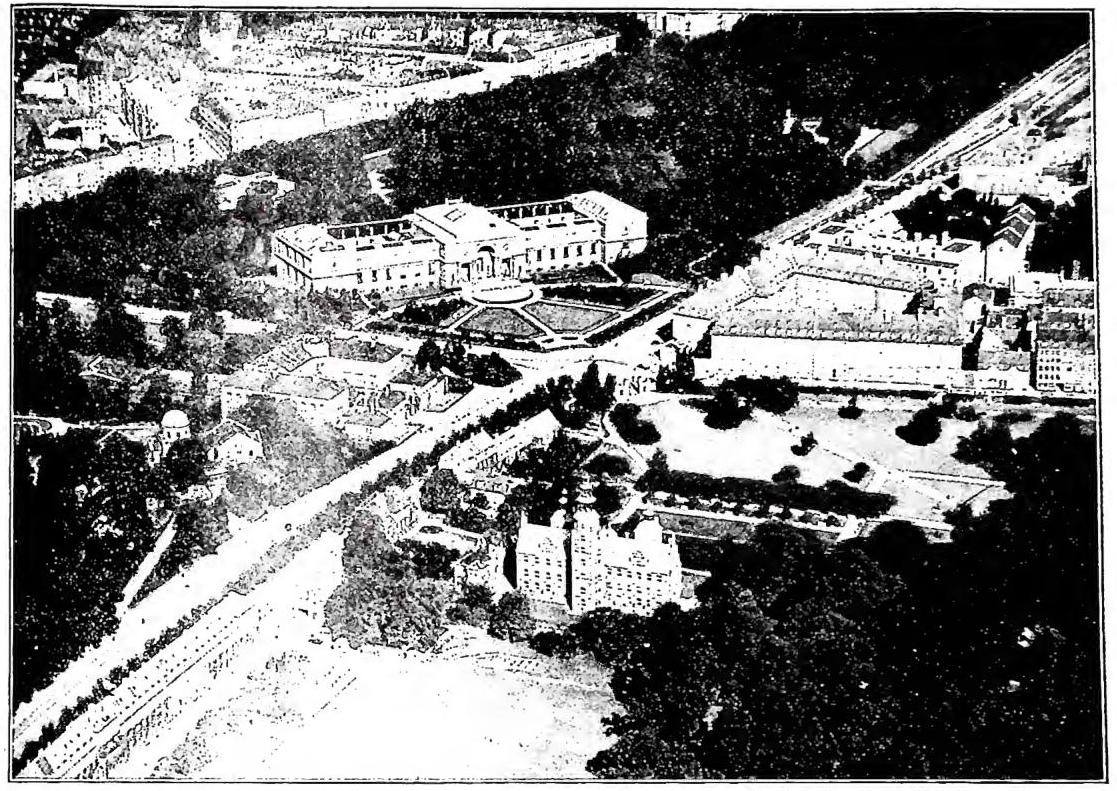
COPENHAGEN. - Etymologically "merchants' harbor," royal and governmental seat, capital city and seat of the Apostolic Vicar of Denmark (v.). It has 617,000 inhabitants and, if the suburbs are added, the figure rises to 843,277. Situated 37 m above sea level in the eastern part of the very fertile island of Zealand, facing the Swedish coast, it dominates the Øresund and is one of the most beautiful cities of northern Europe, with a lagoon-like appearance due to the numerous canals that cross it.
As a settlement it is mentioned as early as 1943 when a fishing village called Havn (=harbor) existed on the site, in Latin Hafnia. In 1165 Bishop Axel of Roskilde built a castle there. In 1479 the University was founded. It is the largest port of Denmark with a traffic of about 6 million tons; also very efficient are the shipyards, the factories of machinery, gloves, porcelain (the city is home to a Royal porcelain manufactory), textiles, alcohol, food preserves and sugar refineries. Banking and stock exchange activity is considerable. C. is connected by regular shipping lines with the Baltic, the North Sea, Iceland, America and East Asia. The inhabitants, who represent a fifth of the Danish population, are distributed among the three municipalities of C. proper: Christianshavn, Frederiksberg and Gentofte. The old part of the city is on the island of Amager; the districts have palaces, gardens and wide streets. Among the monumental buildings are the City Hall, the Amalienborg Palace, the Round Tower, the Stock Exchange, the Palace of the Princes, Frederick's Church, Rosenborg Castle, an important library, the Academy of Fine Arts and the Ny Carlsberg Museum.
Bibliography6 works
Maria Luisa Rondini