
ISLANDA. - I. GEOGRAPHY
It is the largest European island after Great Britain (102,819 sq. km.; more than four times the size of Sicily); it lies approximately 900–950 km from Scotland and Norway, but only 330 km from Greenland. With its northernmost points it reaches the Arctic Circle.
The coastline is extremely irregular, marked by fjords and bays; the interior consists of a plateau (at an average elevation of 400 to 800 m.) composed of lava and surmounted by numerous volcanoes, some of them active (Hekla, 1,557 m.), and covered by extensive ice caps: the glaciers alone, in fact, cover more than 1/8 of the island’s surface. Geysers, mud volcanoes, and thermal springs are frequent (the latter are widely used for heating and can also be harnessed as a source of motive power). The climate is relatively temperate, being moderated along the coast by oceanic influences, but considerably harsher inland, with long, snowy winters and abundant precipitation.
Barely 1/7 of the island is inhabited (along the coasts, especially in the southwest, or at a short distance from them, as well as in the valley bottoms along the lower courses of certain rivers), but it is devoted less to the meagre and precarious crops permitted by the subpolar position of I. (potatoes, turnips) than to livestock raising, almost exclusively extensive and predominantly sheep farming (cattle and horses are few). The centre of economic activity, however, is to be found in fishing, one of the best-equipped fisheries in Europe, which yields a considerable output (420,000 tons in recent years) and supplies the only local industry (fish oil and meal). The presence of bauxite deposits opens up broad possibilities for establishing other industries, especially since the island possesses abundant hydroelectric resources (4 million HP). The merchant fleet amounted to 1.3 million tons in 1948.
I., which after 1918 constituted an independent monarchy linked to Denmark by personal union, has since 1944 been a democratic republic with an elected government and bicameral representation.
II. HISTORY
Iceland was first inhabited toward the end of the eighth century by Irish monks, who hoped to find refuge there after having been driven from the Shetland and Faeröer Islands by the Vikings, who likewise reached Iceland in the ninth century and colonized II. The new settlers, chiefly from Norway and pagan, established an assembly (Althing) in 930, which held legislative and judicial power; but a few decades later (in 965), the Althing retained only legislative authority. The introduction of Christianity into Iceland dates back to 981. In 1262, the king of Norway, Håkon Håkonson, brought Icelandic independence to an end. The island passed under Norwegian sovereignty and, toward the end of the fourteenth century, with the Union of Kalmar, under Danish sovereignty.**The Lutheran Reformation initially encountered considerable resistance, and it was only in 1550, with the condemnation to death of the last Catholic bishop, Jón Arason, that the ordinances of Christian III could be fully introduced. The Peace of Kiel (January 1814), which obliged King Frederick VI of Denmark to renounce in favor of Sweden every right over Norway, did not alter the «status» of Iceland, which continued to depend on Denmark and gradually acquired the right to self-government. The ties with Copenhagen, substantially reduced in 1918 by the personal union between the two kingdoms, were completely severed on 17 June 1944 with the proclamation of the Republic of Iceland. The Constitution, which entered into force on that day, recognizes the Evangelical Lutheran Church as the State Church (art. 62), but also admits the other religious denominations.
III. THE APOSTOLIC VICARIATE
Bishop Federico of Saxony and the Icelander Thorvaldur were the first missionaries of I. (981); but after five yearsthey were expelled. In 996 St. Olaf, king of Norway, sent other missionaries. In 1000 the Catholic religion was proclaimed the state religion by the Althing, the national assembly. In 1056 Pope Victor II established the episcopal see of Skálholt, which was later (1106) divided through the creation of the other diocese of Hólar. The two sees were initially under the jurisdiction of the Patriarchate of the North (Archbishopric of Bremen-Hamburg); in 1104 they came under the authority of the archbishop of Lund, and finally, in 1154, that of Nidaros (Trondheim). The last bishop of Hólar was Jón Arason, who was beheaded for the faith on 17 Nov. 1550; the last bishop of Skálholt also met an heroic end, dying in prison at Soro in Denmark. In 1544 the pseudo-Reformation was introduced there by force of arms by the king of Denmark.
From the death of the two bishops until 1856, no priest was able to go to I., because the laws strictly prohibited all Catholic ministry. From 1859, two priests were permitted to go to I., solely to exercise their ministry among foreign Catholic fishermen. In 1874 the Danish government granted freedom of worship. After the death of the last of the two missionaries (1875), the few Christians, whose number fluctuated between 3,000 and 4,000, remained without assistance for about twenty years. Meanwhile, in 1852, Pius IX had established the Apostolic Prefecture of the Arctic Pole, which also included I. On 28 July 1869 it was divided into the Apostolic Prefecture of Norway and that of Denmark and I.; the latter was elevated to an apostolic vicariate on 22 Feb. 1892. Only in 1895, however, was the apostolic vicar able to send other missionaries from the secular clergy. In 1903 the mission was entrusted to the Company of Mary of Montfort. The island was constituted an apostolic prefecture, detached from the Apostolic Vicariate of Denmark, on 12 June 1923, and was elevated to an apostolic vicariate on 6 June 1929. The state religion is Lutheran, but the Catholic religion is recognized by the State and enjoys complete freedom without any restriction. The Lutheran Church has a bishop residing in Reykjavík, with jurisdiction over the entire island, as well as two other bishops, who are merely country pastors, whose function is to consecrate the bishop of the country.
Of a population of 136,000 inhabitants, Catholics number 388; catechumens, 8; priests: 2 nationals, 6 foreigners; foreign brothers, 2; nuns: 2 nationals, 55 foreigners; schools, 2 elementary schools with 259 pupils; primary stations, 2; churches, 1; chapels, 2.
IV. LITERATURE
Populated from the end of the 9th century to the beginning of the 10th by Norwegian nobles who had come into conflict with their king, Harald Fairhair (Harald Haarfagre), Iceland soon saw the development of a type of civilization and culture which, although closely connected with the other Scandinavian lands (the first Norwegian colonizers were soon joined by others from Denmark and Sweden) and open to the influences of nearby Ireland, bore its own distinctive stamp ofaristocratic exclusiveness and widespread democracy. The sagas and poems of the Eddic type recited among the people, and the precious poems of the Icelandic skalds, the honor and pride of all the courts of the north, are in fact merely two different and complementary aspects of one and the same civilization, in which individuals, practically reduced to the same common denominator by exile and shut up in so many clans, armed against one another in the daily struggle for existence, had not, however, forgotten their noble condition and their common origin. It is an arduous and almost hopeless task to distinguish, in the surviving written sources, the specifically Icelandic element from the Norwegian, or rather Scandinavian, substratum, so much so that it is customary to speak, more comprehensively, of a Norse literature.
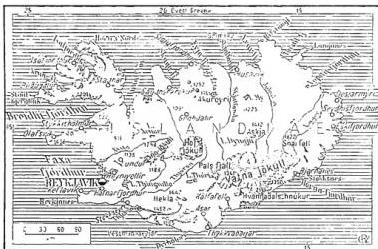
ISLANDA - Map of ecclesiastical I.
(propr. Enc. Catt.)
Although most of this literature, which was the common heritage of the Scandinavian north, disappeared with the advent of Christianity, after having been transmitted orally for generations, it continued to be cultivated in I. and then found precisely in Christian ecclesiastics—elsewhere often enemies of native traditions—its most faithful collectors. Composed for the most part in I. were Edda (v.), or Poetic Edda, collected in the 13th century by an Icelandic ecclesiastic and rediscovered in 1643 by Bishop Brynolf Sveinsson (Codex regius 2365 of the Royal Library of Copenhagen). Since a clear local or chronological distinction is impossible (the oldest songs date back to before the 9th century, while the most recent are contemporary with the collector), they are generally divided, according to subject, into mythical (or divine), heroic, and didactic songs. In the first, alongside gloomy and complicated cosmogonic conceptions, there are burlesque or tragic adventures of entirely anthropomorphized divinities, subject no less than mortals to a harsh destiny. Among the heroic songs, those of the Volsung cycle are noteworthy, in which, through flashes and allusions, appears the tragic legendary material of common Germanic origin that gave rise to the poem of the Nibelungs. Equal concision and a similar abbreviated, allusive technique are found in the didactic poem Håvannál (“Song of the Lord”), in which Viking morality is presented in all its stark simplicity.
Following the loss of independence, and especially after the Union of Kalmar (1307), there was also a decline in the cultural and literary sphere: the imagination of the saga narrators seems to have been completely exhausted, and the Eddic and skaldic tradition was reduced solely to a formal exercise: the difficult alliteration congenial to the spirit of the Germanic languages was replaced by the easier rhyme (the Olafsrima, from ca. 1350, may be mentioned), but poetry was by then no longer an art form sustained by inspiration, but rather an exercise in versification by writers seeking only to escape from daily misery. After the
(from M. Zimmermann, Etats Scandinaves, Régions polaires boricoles, in Géographie universelle, III, Paris 1833, pl. 19 B)
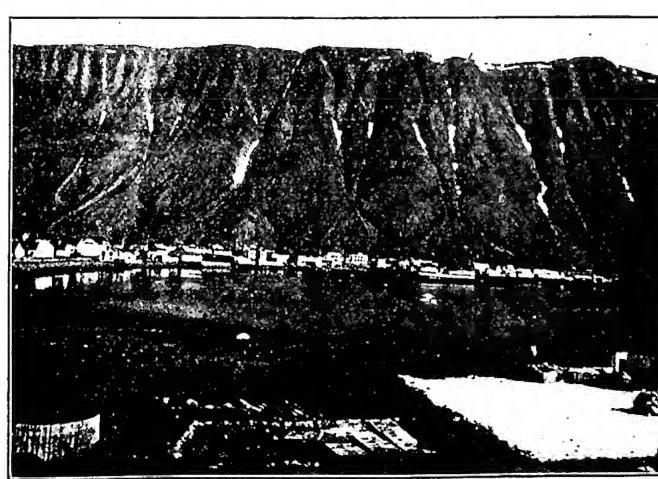
ISLANDA — Utilization of warm currents (from 60° to 63°) near the Reykir farm in the region of the Hvita River.
With the “reform” there was an undoubted enrichment of the language (by now modern Icelandic rather than Middle Icelandic) through the translations of the Old and New Testaments by Oddur Gottskálksson and Bishop Gudhbrandur Thorláksson; but one must go as far as the seventeenth century to find true poets in the persons of the Protestant pastors Stefán Olafsson (1620–88) and Hallgrímur Pétursson (1614–74). While the former is remembered especially for his love songs and convivial songs, in the latter’s psalms, where the sufferings of Christ are shown as the sole path of salvation for tried and sinful humanity, one finds the most powerful echo of the profound misery that dominated I. in those years; the enormous popularity they immediately enjoyed is the best proof of how closely they corresponded to the spirit of the age. After several decades of silence, the voice of Eggert Olafsson (1726–68) was heard, an educator and scientist even more than a lyric poet (his didactic poem Búnadharbalkur, “Rustic Life,” is remembered). German Romanticism reached I. through Denmark after the Napoleonic wars; having recovered from its misery after the abolition of the Danish commercial monopoly, I., which had in practice found itself separated from Denmark from 1807 to 1814, was now ready to profit from the nationalist impulses inherent in the Romantic creed. One may now truly speak of a political and cultural renaissance promoted largely by poets. Foremost among them was Bjarni Thorarensen (1786–1841), who, keeping his eyes fixed on the Eddic tradition, did not lament the poverty of the country or the harshness of its nature, but urged his people to endure their destiny with dignity and strength of spirit. His confidence in life is complete even in the lyrics of a more personal tone, such as Sangen til Sigrun, a beautiful love song. His Íslands Minni (“Remembrance of I.”) is considered a national song.
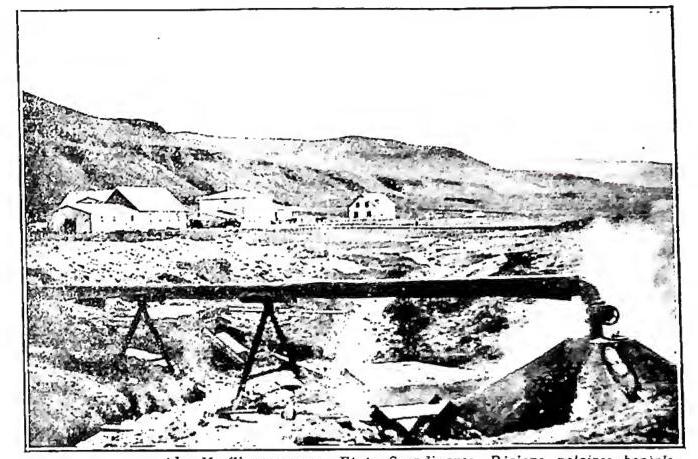
(from Geographia Magazine, Apr. 1925, p. 565)
ISLANDA - View of Isafjörður.
Contemporary with these two poets was Steingrímur Thorsteinsson (1831–1913), author of well-known patriotic and religious songs and translator of H. C. Andersen. European realism reached I. toward the end of the century, together with echoes of G. Brandes’s lectures in Copenhagen: the Icelandic journals Verdundi (1882) and Haindallur (1883), both published in the Danish capital, became advocates of the new doctrine. The first poet to adhere to the new movement was Hannes Hafstein (1861–1922), mindful of his personal contacts with G. Brandes and H. Drachman; his lyric Ved Valagilselven is notable for its fidelity to the native landscape. Also following G. Brandes was Porstein Erlingsson (1858–1914), a socialist and freethinker, whereas Einar Benediktsson (1864–1940) (1864–1940) opposed him in the name of a religious principle and is perhaps to be regarded as the greatest modern Icelandic poet. Fantastic and ingenious (not without reason did he translate Ibsen’s Peer Gynt), mystical and pantheistic, he was always imbued with an immense love for his own language, which he regarded as the text placed by God upon the melody of life. Isolated from the literary currents of the age and far from his homeland (he emigrated to Canada when very young), Stephan G. Stephánsson (1857–1927) meanwhile exalted in his Andvåkur (“Sleepless Nights”) his native land, still more beautiful in memory, and his mother tongue, even dearer in a foreign land. As a whole, the twentieth century has so far been more favorable in I. to prose than to poetry; the novel in particular, generally dealing with local rural or historical subjects, already begun in the nineteenth century through the work of Jón Thóroddsen (his novels Piltur og Stålka, “Boy and Girl,” and Madur og kona, “Man and Woman,” are remembered), has now acquired ever greater importance. The humorous stories of the poet Benedikt Gröndal (1826–1907) are still widely read in I., while Gestur Pålsson (1852–91) enjoys European fame, having succeeded in his novels in merging the ancient tradition of the Icelandic saga with modern realistic technique. Notable narrators include Jón Stefánsson (1851–1915), Jacob Thorarensen (b. 1886), David Stefánsson (b. 1894), Jón Magnússon, Gudmundur, Gislason Hagalin (b. 1898), Gudmundur Fridjönsson (1869–1944), and Sigurdur Nordal (b. 1886). Einar Hjörleifsson Kvaran’s (1859–1938) novel Gull (“Gold”) is widely known. Among contemporary prose writers, first place perhaps belongs to Halldór Kiljan Laxness (b. 1902), author of the successful novel Salka Valke and of the trilogy Íslands Klocka (1943–46); Pórberger Pordarson (1889) should also be mentioned. But the greatest popular success was achieved by Gunnar Gunnarsson (b. 1889), translated into Italian, who preferred the Danish language to his mother tongue. Among his extensive works are the novels Af Borgslaegtens Histoire (“Chronicle of the People of Borg,” 1911–14), Livets Strand (“The Shore of Life,” 1915), Salige er de Enpoldige (“Blessed Are the Simple,” 1920); and Kirken paa Bjerget (“The Church on the Mountain,” 1924–27). His two historical novels Jón Arason, whose protagonist is the last Catholic bishop of I., and Hvide Krist (1934), which describes the final years of Icelandic paganism, are also noteworthy. The Danish language is likewise used in the novels of Jónas Gullaugsson (1887–1916), while Kristmann Gudmundsson (b. 1902) writes in New Norwegian; his works include Brudekjolen (“The Wedding Dress,” 1927), Livets Morgen (“The Morning of Life,” 1929), and Hvide Netter (“White Nights”).
Unlike narrative literature, which was able to draw upon the tradition of the sagas, already artistically developed, dramatic art may be considered to be in its beginnings. The first passionate devotee of the genre was Indridi Einarsson, remembered for the drama Nyarsdóttir (“New Year’s Eve”), and to whom the creation of a dramatic theater in the Icelandic capital is owed; Jóann Sigurjónsson (1880–1919), author of the drama Lagneren (“The Liar”), and Gudmundur Kamban (1888–1945), dramatist, novelist, and lyric poet, instead employed the Danish language. Among modern practitioners of lyric poetry, it will suffice to recall David Stefánsson (1895–), Tónas Gudmundsson (1901–), and Jóhanné úr Kötlum (1899). Taken as a whole, Irish literature is today in a period of ferment and development that bodes well for the future.
V. ORDINAMENTO SCOLASTICO
Icelandic schooling has been compulsory from the ages of 7 to 14, under the law of 1907. Pupils under 10 years of age are exempted from attendance if their homes are far from the school; in this case, elementary education is provided by the “mobile schools.” To facilitate elementary education, there are elementary boarding schools lasting 12 weeks per year. Attendance from 7 to 9 years of age lasts 33 weeks; from 10 to 14 years of age, 24 weeks. Religious instruction is compulsory. By including religious instruction in the curricula of Icelandic schools, it was thought appropriate to alternate theory with practice. The pupil is encouraged to acquire a religious culture on his own, and is led to formulate for himself explanations of God, creation, and the soul; the teacher’s task is then to correct erroneous opinions.Secondary education is provided in lower secondary schools, rural schools, supplementary schools, schools for boys, district schools, middle schools, classical schools, scientific schools, and mixed schools. There is a teachers’ seminary.
Higher education is provided at the University of Reykjavik, founded in 1911.