
SAXONY. -
I. GEOGRAPHY
An ancient State of Germany; although it has no natural boundaries, it may be said to be bounded by the Elster and Ore Mountains (Erzgebirge) as far as the Vogtland and the Lusatian Hills, and to the N. as far as the German lowland.Over an area of approximately 15,000 sq. km., a population of 5,200,000 inhabitants lives, with a density of just under 350 inhabitants per sq. km. (1938), thus one of the highest on the European continent. The country occupies a curious position with regard to its population because of the almost paradoxical conditions of its economic prosperity. To understand this situation, one must consider its accessibility and, above all, the riches of its subsoil, which have attracted abundant masses of workers to this region since the 11th century, especially to the cities, where the concentration has continually increased over the centuries and with constant growth.
(phot. Alinari)
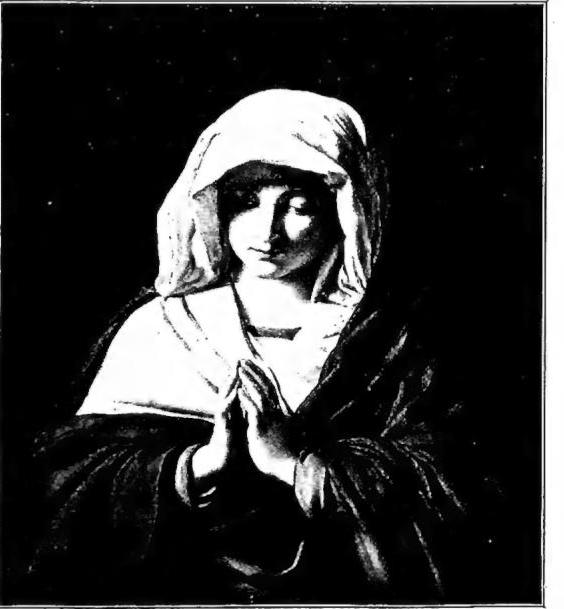
SASSOFERRATO, GIOVAN BATTISTA SALVI, called il - The Madonna in adoration - Rome, Palazzo Doria, gallery.
the Elbe, SE. of Dresden and on the border with Bohemia, lies Saxon Switzerland, with its sandstone mountains, whose prismatic and permeable rocks reveal a plateau eroded and dissected by streams, with erosion pillars, vertical walls, niches, and narrow valleys. From a hydrographic point of view, most of the territory of S. belongs to the Elbe River, its tributaries (the Mulda and the Saale), and the Elster.
(from F. Wetzel-C. Gurlitt, Alt-Sachsen, Dresda s.a., plate 38)
SASSONIA – Church of Our Lady, architect G. Baehr (1722) – Dresden.
II. CONVERSION TO CHRISTIANITY
The Saxons (from sahs = stone knife or short sword, their preferred weapon), unknown to Tacitus and Pliny, are mentioned for the first time by Claudius Ptolemy (ca. 150 A.D.), who places them north of the Elbe.
III. THE ANCIENT DUCHY OF S
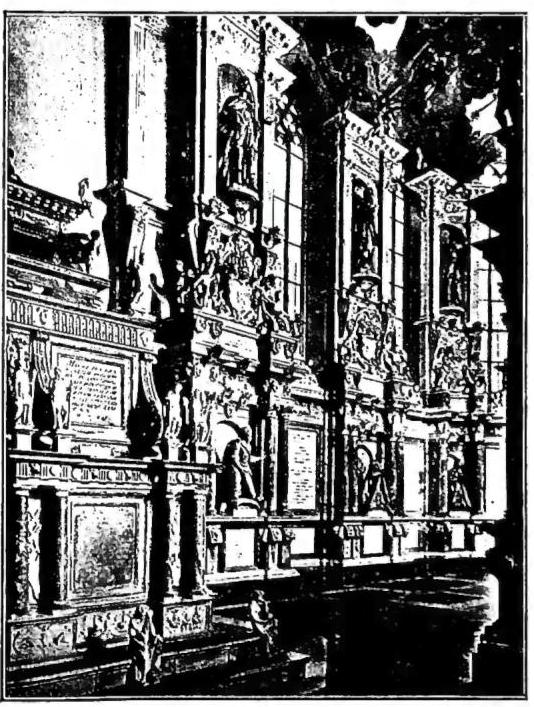
With the partition of Verdun (843), S. became part of the Kingdom of Ludovicus the German; around 850 it was raised to a duchy and given to Liudolf for the defense of the Limen Saxoniae. Ottone the Illustrious (880–912), Liudolf’s second son, imposed his power also over Thuringia; Enrico the Fowler, his son, was made king of Germany in 919. His house held the German crown and the Holy Roman Empire until 1024. Enrico extended the borders of his Duchy as far as the Oder; he founded churches and monasteries, fortified cities, and equipped the eastern frontiers with castles (the castle of Meissen), in order to make them a point of departure also for the spread of Christianity.(from W. Markowsky, Giovanni M. Noserini and die Renaissance in Sachsen, Berlin 1881, p. 58, fig. 9)
SASSONIA – Choir of the cathedral of Freiberg, with the tombs of the Margraves of S. (end of the 16th century).
His son Otto I the Great (936–73) founded the Benedictine abbey of St. Maurice in 937 and, with the consent of Pope Giovanni XII, made Magdeburg an archdiocese, detaching it from Mainz (962). In 960 he granted the Duchy of S. to Hermann Billung with limited powers. The new dynasty pushed the frontier still farther eastward at the expense of the Slavic populations, subjecting the newly acquired lands to the Archbishop of Magdeburg.
S. became the center of opposition by the German princes against the Emperors of the Salian House. Henry III and, above all, Henry IV unsuccessfully built numerous castles around Goslar and in the Harz, to keep watch over the unconquered region, and resided there for long periods in order to hold it more securely in subjection. With the rebellious Duke Magnus, the Billung family became extinct (1106).
Lothar of Supplimburg enfeoffed his son-in-law, Henry the Proud of Bavaria, with the Duchy (1137); after the interlude of Albert the Bear, Margrave of Brandenburg, it passed to his son Henry the Lion, who extended the territory toward the Slavs, conquering Holstein, Mecklenburg, and Western Pomerania; he founded bishoprics and cities there, including Lübeck, spread Christianity, and governed with justice and equity. Struck by the imperial ban of Barbarossa (1180), he was deprived of the Duchy, which, after being partitioned (part of it passed to the Archbishop of Cologne) and reduced to the territories beyond the Elbe alone, was given to Bernard of Anhalt, Count of Ascania, son of Albert the Bear. The new duke, heir to the territory of Wittenberg, acquired Lauenburg. His nephews, John and Albert, divided the country between them (1260); the former received S.-Lauenburg (when the line became extinct in 1689, the country was incorporated into the Principality of Hanover), and the latter S.-Wittenberg.
The brothers disputed the electoral dignity: the Golden Bull (1356) assigned it to the Wittenberg line, which became extinct with Albert III in 1422.
IV. IL PRINCIPATO ELETTORALE DI S
On 6 January 1423, Emperor Sigismund granted the country in fief to Frederick the Warlike, margrave of Meissen and landgrave of Thuringia, conferring upon him also the electoral dignity in compensation for his assistance in the war against the Hussites. He was the first of the Wettins, who retained electoral S. until November 1918. After him, under his nephews Ernest and Albert, the dynasty divided permanently into two branches (Partition of Leipzig, 26 August 1485): the Ernestine line, which reigned with the electoral title at Wittenberg until 1547, and the Albertine line, which obtained the electorate in 1547 and was to become the stem of the royal house of S.V. S. NELL'ETÀ DELLA « RIFORMA » E DELLA GUERRA DEI TRENT'ANNI. - The decline of the elder line was rapid. Frederick III the Wise (1486-1525), son of Ernest, was one of the most powerful princes of the Empire; he protected Luther, and the country thus became the cradle and stronghold of Protestantism. When he died in 1525, while the Peasants’ War was ravaging the region, he was succeeded by his brother John the Steadfast (1525-32), a fervent champion of the Lutheran « reform », and founder and leader, together with Philip of Hesse the Bigamist, of the Schmalkaldic League. His son John Frederick the Magnanimous (1532-1547), defeated and taken prisoner at Mühlberg (1547) by Charles V, lost the electoral title and almost all the territories (Capitulation of Wittenberg), which were assigned to his astute cousin Maurice of the Albertine line. From the lands that remained to him or were recovered shortly thereafter (1554) arose the Duchies of S.-Gotha, S.-Weimar, S.-Coburg, S.-Meiningen, and S.-Altenburg.
Duke George the Bearded (1500-39), son of Albert, a resolute and learned opponent of Luther, had resisted the spread of the Lutheran « reform »; but his brother Henry the Pious (1539-41) had introduced II. The latter’s son, Maurice (1541-53), although a Protestant, had for political reasons allied himself with the Emperor; but during the second Schmalkaldic War (1552), after ceding to Henry II of France the Lorraine bishoprics of Metz, Toul, and Verdun, he marched against him, forcing him to flee and extorting from him the Peace of Passau (1552). He suppressed more than two hundred religious houses. He was the founder of the Academy, later the University, of Jena: S. thus came to possess four universities: Erfurt (1392), Leipzig (1409), Wittenberg (1502), and Jena (1548-58).
Augustus, brother and successor of Maurice (1553-86), expanded the borders of S. and brought it prosperity. He remained at the Emperor’s side, but his religious policy proceeded in strict adherence to Lutheranism; at the Diet of Augsburg in 1555 he worked effectively for the recognition of Protestantism; he secularized the bishoprics of Naumburg, Meissen, and Merseburg. During the brief reign of his son Christian (1586-91), Chancellor Nicola Crell promoted Crypto-Calvinism. But after the prince’s death, Crell was overthrown and beheaded (1601); and under Christian II (1591-1611) Lutheran orthodoxy triumphed, while the Reformed Church was bloodily persecuted.
Also because of its conflict with Crypto-Calvinism, S. drew closer to Austria in its foreign policy, keeping its distance from the Evangelical Union. His brother and successor, John George I (1611-56), refused the Bohemian crown (1618); against the « Winter King » he supported Emperor Ferdinand II, obtaining the two Lusatias as a pledge for the expenses of the war (1623). S. was devastated by the Thirty Years’ War more than any other region. The humiliation of the Protestants, the Edict of Restitution (1629), and Tilly’s invasion induced the Elector to join Gustavus II Adolphus of Sweden, who, with the victory at Breitenfeld (1631), freed the country from the troops of the League. When the Swedish king died at Lützen (1632), in Saxon territory, the prince’s relations with the victorious Swedish generals slackened, and he concluded a separate peace with the Emperor at Prague (1635); the two Lusatias were confirmed to him as an hereditary fief on condition that the Catholic religion be tolerated there. Because of its alliance with the Empire, S. was devastated for a decade by Swedish troops.
VI. L'UNIONE PERSONALE CON LA POLONIA (1697-1763)
With the Peace of Westphalia (1648), the influence of S. also declined. John George II (1656-80) maintained a sumptuous court at Dresden, oppressing the country with heavy taxes; John III (1680-91) organized a standing army (1682), with which he contributed effectively to the liberation of Vienna from the Turks (1683), while the younger sons of John George I had founded secondary lines: S.-Zeitz, S.-Merseburg, and S.-Weissenberg, which soon became extinct (1718, 1738, 1746), their territories returning to the senior line.John George IV (1691-94) was succeeded by his brother Frederick Augustus I (1694-1733), who converted to Catholicism (1697), transferring the administration of the Protestant states to the Elector of Brandenburg; the motherland of the « reform » was thereafter, until 1918, governed by a Catholic dynasty which nevertheless succeeded in obtaining tolerance for Catholicism. Through his conversion, Frederick Augustus sought the Polish crown; after the death of John Sobieski, he was in fact crowned King of Poland at Kraków, with the name Augustus II (15 September 1697), with the Emperor’s assistance.
With the personal union between S. and Poland (1697-1763), the two countries were drawn into the Great Northern War (1700-21). Deposed by Charles XII of Sweden, Augustus II was restored to the throne after the Russian victory at Poltava (1709) by Peter the Great, whose ally he was. He limited the power of the Estates, reorganized the administration, and surrounded himself with great splendour; the cities of Leipzig and Dresden then became centres of a brilliant Franco-German culture. Under his son Frederick Augustus II (1733-63), elected King of Poland under the name Augustus III, the policy conducted by the all-powerful Count Henry Brühl was disastrous for S. In the War of the Austrian Succession (the First and Second Silesian Wars), he was at first opposed to Maria Theresa and then at her side; defeated, he had to pay Prussia a war indemnity of one million thalers (Peace of Dresden, 1745). The Elector died seven months after his return from Poland (5 October 1763), where he had taken refuge. With him the personal union with Poland came to an end; it had brought no advantage, but only wars and ruin.
Brühl’s anti-Prussian policy involved S. in the Seven Years’ War (the Third Silesian War). Frederick the Great suddenly descended upon S., forcing the Saxon army, through the Battle of Pirna (5 October 1756), to capitulate at Lilienstein. The suffering, losses in soldiers, and war indemnity were severe (one hundred million thalers). After the Peace of Hubertsburg (1763), the Prussian occupation came to an end.
Federico Cristiano (6 October–17 December 1763) initiated a radical programme of reconstruction, continued by Prince Saverio, regent (1763–68), for his nephew Federico Augusto III (1768–1827), the minor son of Federico Cristiano. The new sovereign reorganized the administration, restored the finances by increasing the State’s revenues and credit, and revived industry and commerce. In foreign policy, he allied himself with Prussia, participating, as the son of Maria Antonia di Baviera, in the War of the Bavarian Succession (1778–1779) against Austria. By renouncing his claims, he obtained in the Peace of Teschen (1779) substantial monetary compensation and feudal overlordship over Schönburg. He joined (1785) the League of Princes formed by Federico II against the emperor Giuseppe II. In 1791 he declined the offer of the Polish crown. He played only a minor part in the war against France (1792); four years later he concluded a neutrality pact with the Directory. He joined Prussia in the Fourth Coalition; defeated at Jena alongside the Prussians (1806), he made the Peace of Posen with Napoleon (11 December 1806) and entered the Confederation of the Rhine. He was proclaimed king (20 December 1806) under the name Federico Augusto I.
VII. THE KINGDOM OF S. (1806–1918). — In the Peace of Tilsit (1807), Federico Augusto I obtained the Duchy of Warsaw, which in 1809 was enlarged by Cracow and western Galicia. Twenty-one thousand Saxons served with Napoleon in the Russian campaign (1812); only six thousand returned.
From the spring to the autumn of 1813, S. became a theatre of war. Its king, against the will of the people, remained a faithful and devoted ally of Napoleon until after the Battle of Leipzig (16–19 October 1813). The Allies treated him as a prisoner of war and his kingdom as conquered territory. S. was first governed by a Russian general (Prince Repnin), and then by two Prussian ministers; it was on the point of being incorporated into Prussia as compensation for former Prussian Polish territories, which Russia wished to annex. At the Congress of Vienna, however, Talleyrand, in the name of the principle of legitimacy, and Austria and England, in the name of the balance of power, opposed the Russo-Prussian agreement. Prussia received only its northern half: the lands that had constituted the true nucleus of the electorate (20,235 sq km out of 35,000 and 864,404 inhabitants out of 2,000,000), that is, the present-day province of S. The king signed, in the form of a peace treaty with Prussia, the Partition Pact (18 May 1815). This violent separation of lands governed for centuries by the Wettins aroused strong opposition among the people. S., thus mutilated, entered the German Confederation (8 June 1815).
VIII. S. CONSTITUTIONAL MONARCHY. - S. joined the Zollverein (1834), to the great benefit of its commerce.
Under Federico Augusto II (1837-54), the new system of government did not prove successful. Owing to the influence of the French Revolution of February 1848, the sovereign formed a liberal ministry presided over by Braun (16 March 1848), which found itself faced with a democratic-radical diet. Liberal laws were enacted concerning the press, the right of assembly and association, and electoral reform. In 1837 steam navigation on the Elbe was inaugurated and, two years later, the first railway line (Lipsia-Dresda); these gave a powerful impetus to commercial and industrial development. But following the revolt of Dresda (3-9 May 1849), fomented by Bakunin and his associates and suppressed only through the intervention of the Prussian military, the con-
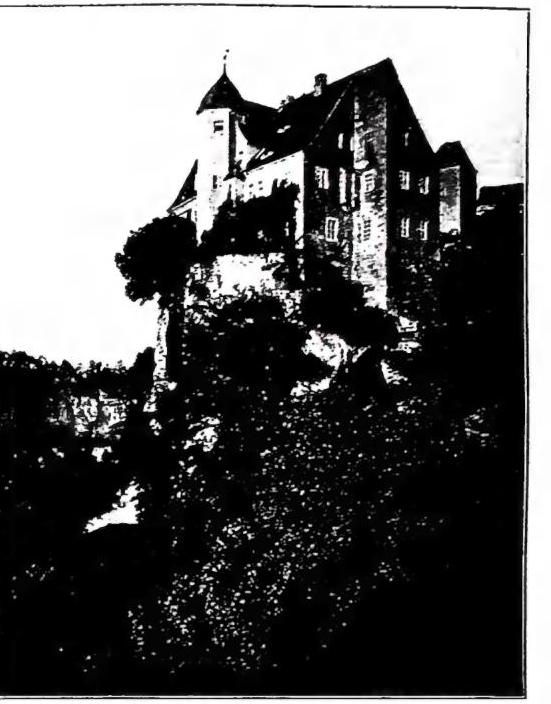
(from F. Wetzel-C. Gurlitt, Alt-Sachsen, Dresda n.d., pl. 59) SASSONIA - The castle of Hohnstein (1440).
quests of democracy were suppressed by Minister F. von Beust, who turned foreign policy toward grand ambitions. In fact, the Alliance of the Three Kings was concluded with Prussia and Hannover, from which S. detached itself in order to ally with Austria; on 17 February 1850 Beust formed with Hannover, Bavaria, and Württemberg the league of the “four kings” to neutralize the two great powers, Austria and Prussia.
IX. S. IN THE NORTH GERMAN CONFEDERATION AND IN THE GERMAN EMPIRE. — The army was reorganized on the model of the Prussian army and, under the command of Crown Prince Alberto, fought in the Franco-German War of 1870–71 alongside Prussia. In 1873 Alberto succeeded his father Giovanni, a man of letters and a celebrated Dante scholar (metrical version of the Divine Comedy). During his reign S. made great strides forward: it redeemed the railways and promoted industry through protective tariffs. In this predominantly industrial country socialist propaganda was so intense that in 1903, of the 23 deputies whom S. had sent to the Reichstag, 22 were socialists; hence S. acquired the appellation of the “red realm.” The second chamber of the Landtag consisted (1908) of 17 deputies
(Alinari photograph)
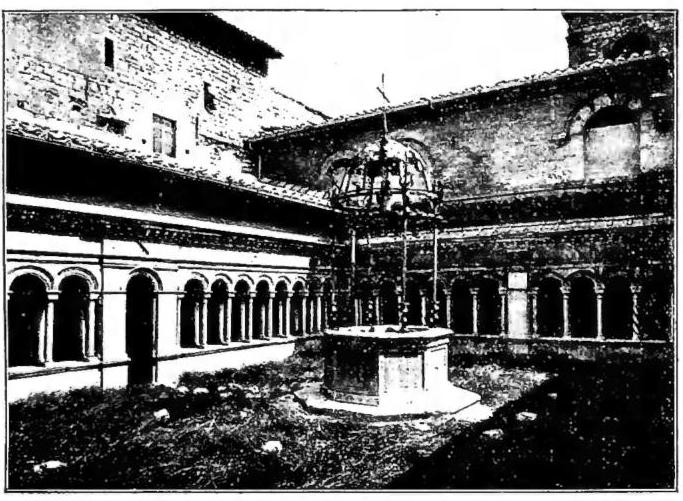
SASSOVIVO — The cloister of the abbey of S. (1229).
conservatives, 36 liberals, and 27 socialists: this composition remained unchanged until November 1918.
X. THE REPUBLICAN S
King Albert, who died without issue, was succeeded by his brother George (1902–1904), whose son, Frederick Augustus III (1904–18), was the last Saxon sovereign.S., a center of the textile, publishing, and steel industries, as well as of the ceramic and porcelain arts, attained, before the war of 1914–18, a high level of material and cultural prosperity. During the First World War it made a substantial contribution to the effort of the German Empire, not only through its industrial strength but also through its dense population.
The consequence of the lost war was revolution. The workers’ and soldiers’ councils seized power (9 Nov. 1918), proclaimed the republic, and deposed the king, who abdicated (13 Nov.). A provisional socialist government was established under Lipinski, and a new constitution, modeled on that of the Reich, was prepared and promulgated on 1 Nov. 1920.
Between 1920 and 1923, power was held by the social-democratic Buck ministry, which was succeeded by the social-communist Zeigner cabinet, which fell almost immediately (Oct. 1923) owing to the armed intervention of the Reich. After the cabinet of the Old Socialist Heldt, S. was governed by the coalition ministry of Bunger (German People’s Party), which, upon resigning, gave way to a ministry of officials under Schieck. During the National Socialist Revolution, the cabinet resigned (10 March 1923); Hitler entrusted the government to von Killinger as Reich commissioner and appointed M. Mutschmann lieutenant governor (May 1933).
S. was a center of anti-Hitlerism (the plot of 20 July 1944 against Hitler). After the fall of the Nazi regime, the region was occupied by Soviet troops (1945). It now forms part of the eastern German zone administered by the Russians.
For art V. GERMANIA, VI. Arte.