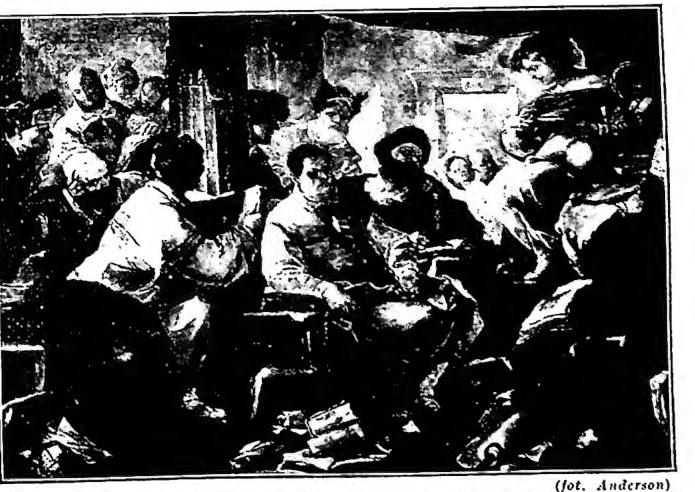
Exceptionally gifted artist with fertile imagination, sure line and touch, master of every subtlety of craft, capable of reproducing the characteristics of every painter to the point of forgery, G. in almost 60 years of uninterrupted toil composed with dizzying speed—hence the nickname "fa presto"—a brilliant, pleasing output aimed at scenographic decoration, dramatic movement and architectural massing, but tending toward easy effects and often lacking depth of thought. After his early Riberesque production, one can discern in his works, from time to time, the decisive influence of Pietro da Cortona, Veronese, Rubens and Lanfranco; and this occurred without any order but through a frantic search—which can only be described as "Giordanesque." The staggering quantity harmed the quality of his output. Nevertheless, the selection of a "dozen works" can lead one to place G. among the foremost exponents of Neapolitan Baroque painting. The mythological scenes in the hall of Palazzo Riccardi in Florence (1682), the *Expulsion of Heliodorus* in the church of the Gerolamini in Naples (1684), and the sumptuous vault of the staircase in the Escorial in Madrid, with the *Exaltation of Philip II* (1692–94), attest to his gifts as a great fresco decorator. The Rubensian *Judgment of Paris* in the Museo Federico in Berlin, the monumental *Martyrdom of St. Peter* in the Gallerie di Venezia (1692), the *Calling of SS. Peter and Andrew* and the *Coin of the Pharisee* in the Certosa of S. Martino in Naples (1704), and the *Jesus among the Doctors* in the Corsini in Rome—these last executed in the so-called "bionda manner" of Veronese’s taste—display his great abilities in oil painting. But his absolute masterpiece remains the frescoed vault with the *Triumph of Judith* in the chapel of the treasury of S. Martino (1704), aerial in composition, of rare artistry in the treatment of figures and events.
---
GIORDANO of QUEDLINBURG. - Augustinian, ascetic-mystical writer of Saxony, b. in Quedlinburg in the last five years of the 13th century, d. in Vienna, perhaps in 1378.
GIORDANO
GIORDANO of QUEDLINBURG – GIORDANO of SAXONY
A man of rare artistry in depicting men and affairs, G. happily prepared the legacy of St. Dominic for the great tasks that the Order of Preachers would soon have to undertake, increasing the number of houses from 30 to 300 and the members from about 300 to 4,000. The *Vitae Fratrum* of Gerard of Frachet (1259–60) devotes an entire book, after the life of St. Dominic, to “our venerable and worthy father Brother Jordan,” rich in personal and spiritual recollections.
He knew the noble Diana d’Andalo, whom, as Master General, he assisted in the foundation of the monastery of S. Agnese in Bologna. Giordano’s letters to the Blessed Diana are important testimonies for religious and cultural history.
As Master General, G. strengthened the constitutional principles, presiding over the General Chapters and two General Congregations (Paris 1228 and 1236) and publishing the *Constitutiones primae Ordinis Fratrum Praedicatorum quae erant tempore magistri Iordani* (ed. H. Ch. Scheeben [Quellen und Forschungen zur Geschichte des Dominikanerordens, 38] Cologne 1939). He promoted conventual studies and saw two friars rise to chairs at the University of Paris (1230 and 1231), gave impetus to the priestly ministry in preaching, administration of the sacraments, and burials. From 1231 he had to accept the appointment of his friars as inquisitors in France, Germany, Lombardy, Tuscany, the Kingdom of Sicily, and Spain.
G. was the first Dominican scholastic writer (*In Priscianum minorem*; *Postilla super Apocalypsim*), historian (*Libellus de principiis Ordinis Praedicatorum*, ed. H. Ch. Scheeben [Monumenta Ordinis Praedicatorum historica, 16] Rome 1935, pp. 25–88), homilist (cf. *Archivum Fratrum Praedicatorum*, 10 [1940], pp. 5–19), and spiritual writer (*Epistulae*, ed. A. Walz, in *Archivum Fratrum Praedicatorum*, 20 [1950], p. 1 ff.; cf. Quétif-Echard, I, pp. 93–100; H. Ch. Scheeben, *Der literarische Nachlass des Jordan von Sachsen*, in *Historisches Jahrbuch*, 52 [1932], pp. 56–71).
---
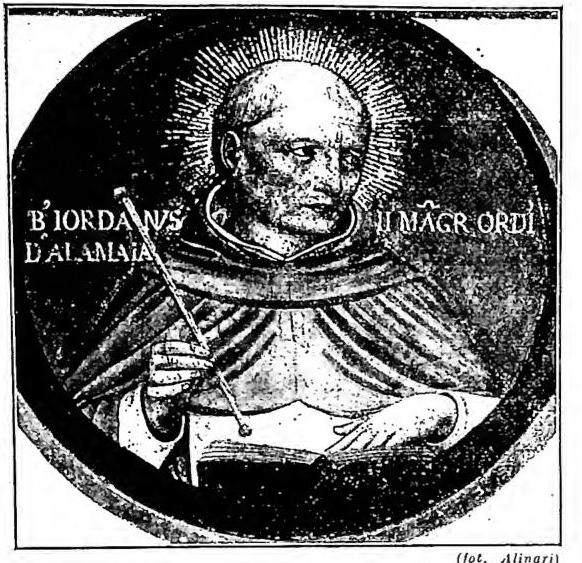
GIORDANO of SAXONY, Blessed – Fresco by Fra Angelico in the convent of S. Marco – Florence.
He taught theology at Marburg and Erfurt. In the diocese of Brandenburg he vigorously combated the Luciferian heretics. He governed as superior the religious province of Germany and that of Saxony for many years, always esteemed and loved for his learning and holiness of life. He wrote much on sacred matters. But his literary fame rests chiefly on the book *Vitasfratrum*, by which he exerted considerable influence on all later Augustinian historians.
Principal works: *Opus postillarum et sermonum de tempore* (Strasbourg 1483); *De vitiis et virtutibus* (ms. Cod. A. IV. 14 in the Library of the University of Basel); *Meditationes de Passione Christi* (Antwerp 1485); *Vitasfratrum* (Rome 1587, Liège 1625, New York 1943).