
PRAGA, ARCIDIOCESI di. — Capital city of Czechoslovakia and an archdiocese situated in the center of Bohemia on the banks of the Moldava, built on seven hills. Because of its position and its very numerous churches it is called the “Rome of the North”; because of its numerous towers, the “city of a hundred towers”; and because of its natural and artistic beauty, the “golden city.”
The archdiocese covers 15,000 sq. km and has a population of 2,943,868 inhabitants, of whom 2,052,154 are Catholics, distributed among 604 parishes served by 607 diocesan priests and 314 religious priests; it has 43 men’s and 127 women’s religious communities (statistics for 1949: Ann. Pont., 1952, p. 328).
(courtesy of Msgr. A. P. Frutuc)
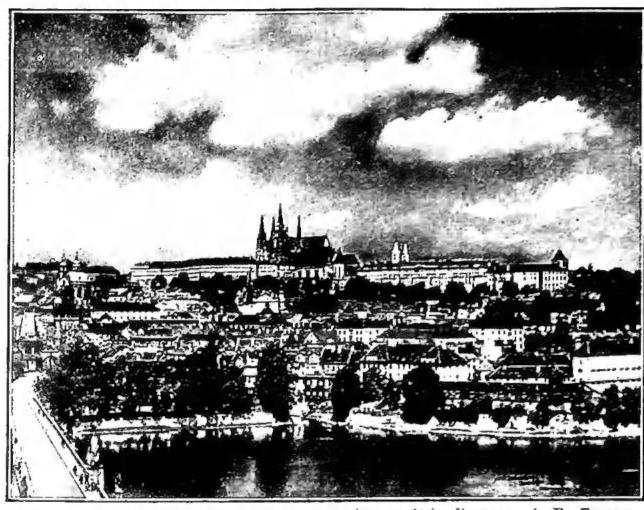
PRAGA, ARCIDIOCESI di — The castle of S. Venceslao and the cathedral of S. Vito.
in concentration convents. After suppressing all seminaries and theological faculties in Aug. 1950, the Communists established in P. a general seminary for Bohemia and Moravia under their own authority. The archbishop of P. has long enjoyed special privileges: he bears the title of Dux et Princeps S. Romani Imperii, of “Born Legate of the Apostolic See in the illustrious dioceses of Bamberg, Meissen, and Regensburg” (1365), and of “perpetual chancellor of the University of Charles IV” (1384), and formerly enjoyed the right to crown the king of Bohemia. The Metropolitan Chapter of S. Vito bears the title “always faithful,” and the canons wear pontifical vestments (1390). Its distinguished bishops included: St. Adalbert the Martyr (982–97), adviser to the Emperor Otto III and founder of the first Benedictine abbey of P., Břevnov (993); Andrea (1214–24), who fought for the freedom of the clergy against the oppression of the nobility. Among the archbishops, the following distinguished themselves: Ernesto di Pardubice (1343–64), co-founder of the University of P., adviser to Emperor Charles IV, and first archbishop of P.; Giovanni Očko di Vlašim (1364–79), appointed the first Czech cardinal for his fidelity to the Holy See; Giovanni di Jenštejn (1379–1400), defender of the ecclesiastical rights of the papacy; Cardinal Federico Giuseppe Schwarzenberg (1849–85), an eminent member of the First Vatican Council; Giuseppe Beran, elected in 1946, defender of the rights of the Church, expelled from his diocese in 1951 and interned. Centers of religious life are the Marian pilgrimage shrines of Svátá Hora near Příbram and Stará Boleslav, with the miraculous image of the Madonna called the Palladium of the Czech lands, and the seventeenth-century church of S. Maria della Vittoria in P., where the Infant Jesus of P. is venerated.
(courtesy of Msgr. A. P. Frutuc)
(courtesy of Prof. E. Jasi)
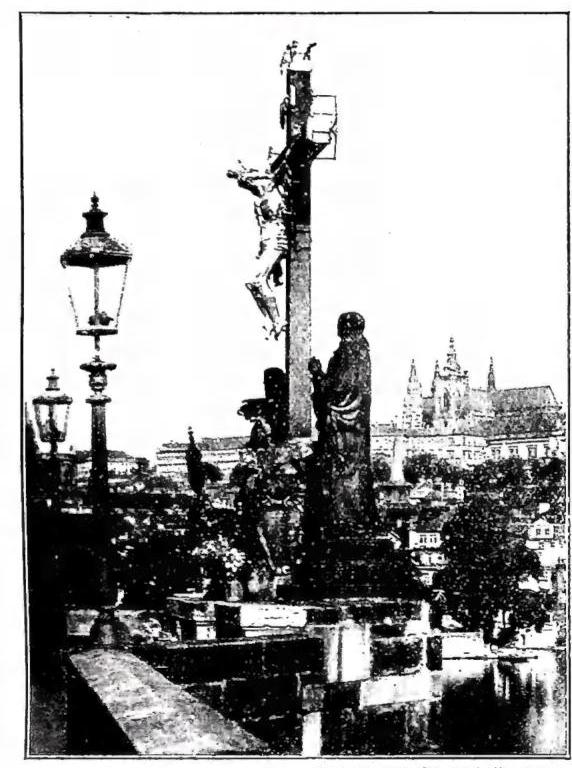
PRAGA, ARCIDIOCESI di — The Cross on the Charles Bridge.
the Lutheran classes rebelled, defenestrating the imperial lieutenants; in 1619 they invited Federico del Palatinato to P. as king, exiled the Catholic clergy, and devastated the churches. On Nov. 8, 1620, they were defeated by Ferdinand II on White Mountain near P., and on June 11, 1621, 27 of them were executed before the town hall. In 1622 the Jesuits were summoned to P. and entrusted with the university, which since the time of the Hussite wars had been in non-Catholic hands. During the Thirty Years’ War (1618–48), P. suffered enormous damage from several occupations, the last of which cost it a sack by the Swedes in 1648. From then on it was no longer the seat of the emperors and became a provincial city. During the Baroque period art flourished there, and from 1729, after the canonization of Giovanni Nepomuceno, it became the destination of great popular pilgrimages. During the government of Giuseppe II (1780–90), it suffered severe losses to its cultural heritage through the demolition of 20 churches, 38 convents, and libraries. Since 1918 it has been the capital of the Czechoslovak Republic, except during the period of Nazi occupation (1939–45). Since Jan. 18, 1922, it has comprised 37 municipalities under the title of Greater P.
ART. — P. is still very rich in cultural and artistic treasures, although most of them were destroyed in the past by successive disasters. Architecture is represented there by various styles: in the Romanesque style, dating from the 12th century, are preserved the church of S. Giorgio at the Castle of P., the oldest in the city, and several stone rotundas. The finest flower of Gothic art is the cathedral of S. Vito, which, together with the monumental castle of Hradčany, formerly the residence of the kings and now that of the President of the Republic, forms a characteristic and evocative panorama of the capital. The Cathedral was erected on the site of the rotunda of S. Venceslao of 928, on which a basilica had already been built in the 11th century. Its foundation stone was laid in 1344, and its construction was carried out by Mattia di Arras (1344-52) and the German Pietro Parler (1353-99). It was completed only
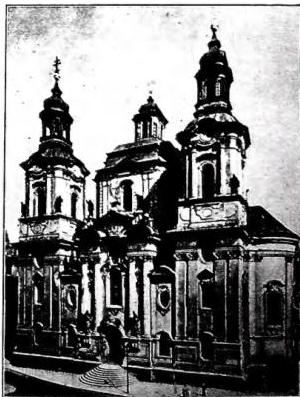
in 1929 by K. Hilbert and is one of the largest churches in the world, measuring 124 m. in length. The chapel containing the tomb of S. Venceslao is its most precious monument; it also preserves the coronation jewels of the kings of Bohemia, the silver funerary monument of S. Giovanni Nepomuceno (1736), and the Renaissance tomb of the kings of Bohemia and the archbishops of P. Architecturally important are the sanctuary of the Madonna of Karlov (1350), with its daring Gothic dome, and the celebrated church of Maria di Týn, from the 15th century, which during the Hussite period served the Utraquists. Among the civic buildings, the Charles Bridge (1357) deserves attention, with its two Gothic towers, richly decorated with sculptures, as does the Powder Tower of the 15th century, with sculptures of the kings of Bohemia. In 1945 the Benedictine monastery of Emmaus, founded in 1347, was destroyed by bombing, and the town hall of P. dating from 1336 was set on fire by the Nazis. The Renaissance buildings are the work of Italian architects, such as the Belvedere (1534) by the Genoese Paolo della Stella, the finest example of the Italian Renaissance beyond the Alps, or they were inspired by southern art. In the 16th and 17th centuries, large palaces were built there, the most important of which are that of Valdštejn, erected by Giovanni Marini, the Palazzo Toscano, that of the Schwarzenberg family, and that of Černín (1669-87). The Baroque style, which adorns so much of P. with its beauty, likewise often draws its inspiration from works that flourished under the Italian sun. Vincenzo Scamozzi worked in P.; among the local architects were Cristoforo Dientzenhofer (father) and Kilián Dientzenhofer (son) (1669-1751). The latter enriched P. with the monumental church of S. Nicola, the chapel of Loreto, a faithful copy of the Italian Marian sanctuary, with its characteristic peal of bells and magnificent Treasury. The former Premonstratensian church of Strahov also displays Baroque decorations, together with the adjoining convent library, which preserves precious manuscripts and incunabula. Among P.’s Baroque civic buildings are numerous bourgeois houses, palaces, and gardens with small castles. In the 18th century, the Charles Bridge was decorated with Baroque sculptures on both sides. In the second half of the 19th century, P. was enriched by several large churches, the Museum, and the National Theatre. In the 20th century, several modern-style churches arose on the outskirts of P. — Vedi tav. CXXVIII.