
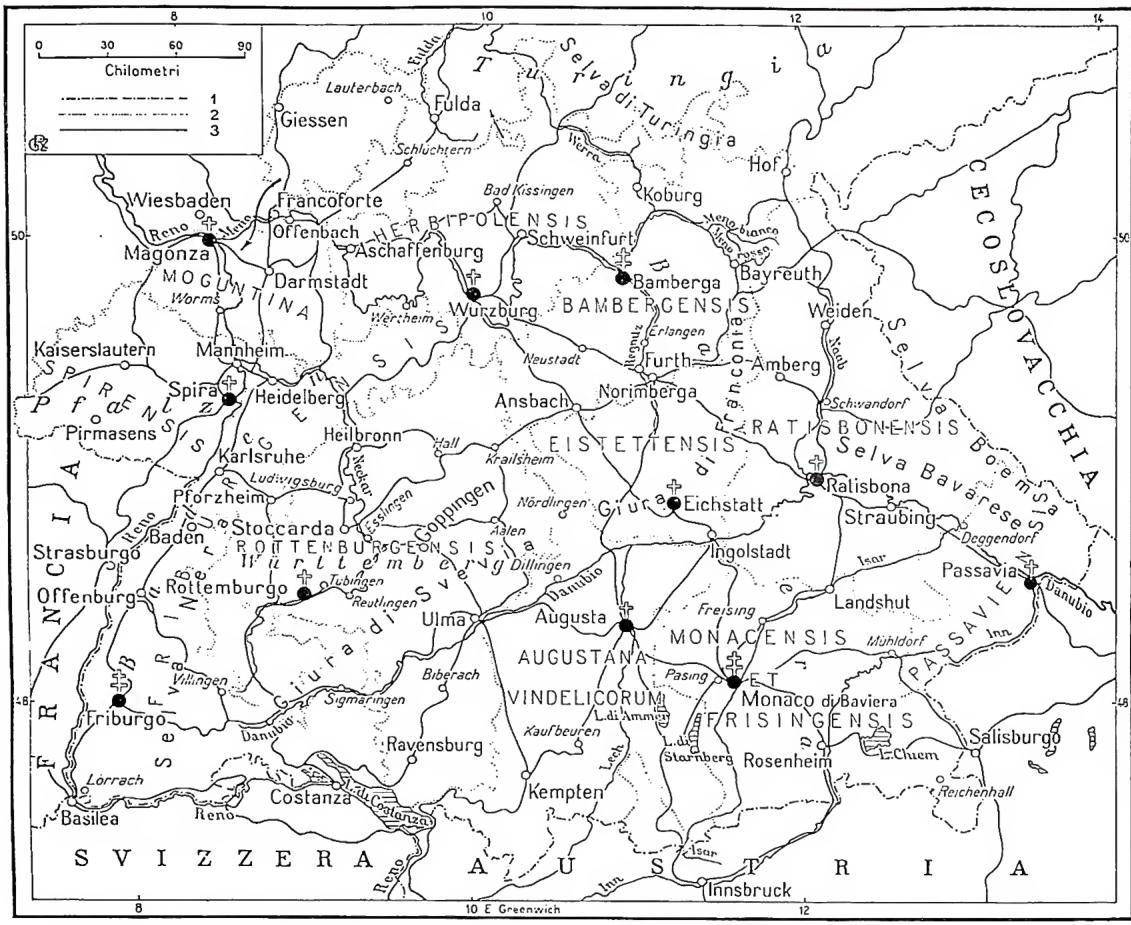
BAVARI. – Of Marcomannic stock (v. MARCOMANNI), belonging to the great Germanic family and originating in the territory of present-day Bohemia, the “Baiuvari” or B., drawn into the vast migration of peoples that marks the period of the invasions, settled in the region watered by the southern course of the Danube, between its two tributaries, the Lech and the Inn, replacing the Celts who had occupied that part of ancient Roman Raetia. There, in 551, Jordanes places the B., who, moreover, immediately thereafter began a movement of expansion into the subalpine valleys and beyond the Danube, toward the Nordgau and the Ostmark. They then appear as stably organized into a duchy and ruled by the Agilolfing dynasty. To this dynasty belonged Theodelinda, queen of the Lombards. But even earlier, between the B. and the Lombards, after the latter had first passed beyond the Arian phase, contacts and relations had been established, with a marked influence upon the people—the B.—of a more advanced civilization. This did not, however, prevent Bavaria, like Langobardia, from falling under the domination of the stronger western neighbour: the Franks, whose Carolingian ability and fortune assured them a magnificent place in the development of historical life and culture. The formula of union between the Franks and the B. nevertheless guaranteed Bavaria, at least during an initial period, the role of intermediary and disseminator toward eastern Europe of the new Christian-Germanic civilization. It was precisely then, in the second half of the 8th century, that it fulfilled the highest function of its history.
Already in 788, however, the Bavarian dukes felt the anguish of lost autonomy: Tassilo, having come into conflict with Charlemagne, was deposed by him. The autonomy of the duchy also came to an end: divided into counties in its central part, it was incorporated into the Carolingian defensive system as regards the frontier lands—Nordgau, Austria, Carniola, Verona—which were placed under the authority of margraves and marquises. At the division of the Frankish Empire, the chief city of the ancient duchy, Regensburg, became the capital of the kingdom of the East Franks and of its first dynasty, Louis the German. This was the path that led to the emergence of a kingdom of Germany, based precisely on the Bavarian duchy: after a brief period of renewed semi-autonomy, Bavaria entered, in the 10th century, the great kingdom of Otto I, who made it a duchy of the co-
In Bavaria, the rule of the Welf family took over for more than a century, around which the shattered panorama of the age revolved—as the general history that from then on took possession of the ancient duchy demonstrates.