
GIORGIO, saint, martyr. – He has been held in the highest veneration since antiquity, both in the East and in the West. The sanctuary built over his tomb at Lydda (Diospolis) in Palestine, a destination for frequent pilgrimages since the 4th century (CSEL, 39, p. 139, 176; V. p. 288 ff.), still existed in the 9th century. Unfortunately, such veneration is not matched by reliable information about the Saint’s life and martyrdom. His identity is unknown, to the extent that attempts have been made to identify him with some of the martyrs attested by authentic sources: with the anonymous young man who tore down Diocletian’s edict of persecution at Nicomedia (Eusebius, Hist. eccl., VIII, 5), with Elpidio, the martyr of Mesopotamia venerated on the same day as G., and even with the Arian bishop of Alexandria of the same name who perished in a popular riot under Julian the Apostate (Socrates, Hist. eccl., III, 3).
The «dies natalis», recorded in the Hieronymian Martyrology on 23 April, derives from the indication in the Passio. This is very ancient and certainly existed in the 5th century, since it is mentioned and proscribed in the famous pseudo-Gelasian decree De libris recipieudis; but it is entirely fabulous and fanciful. Over the centuries, various recensions of it were produced, gradually transforming it by stripping away passages that were clearly suspect and enriching it with arbitrarily selected historical elements; there are also many versions translated from the Greek original into Latin, Coptic, Armenian, etc.

(phot. Atmari)
GIORGIO, saint, martyr – Statue of s. G. sculpted by Donatello for the Armourers’ Guild (a. 1416), formerly in Orsanmichele – Florence, National Museum.
the West. It probably arose from the false interpretation of an image of Constantine existing in Constantinople (Vita, III, 3: PG 20, 1058), connected with a passage from the panegyric that s. Andrea di Creta delivered in honour of G. (ibid., 87, 1189).
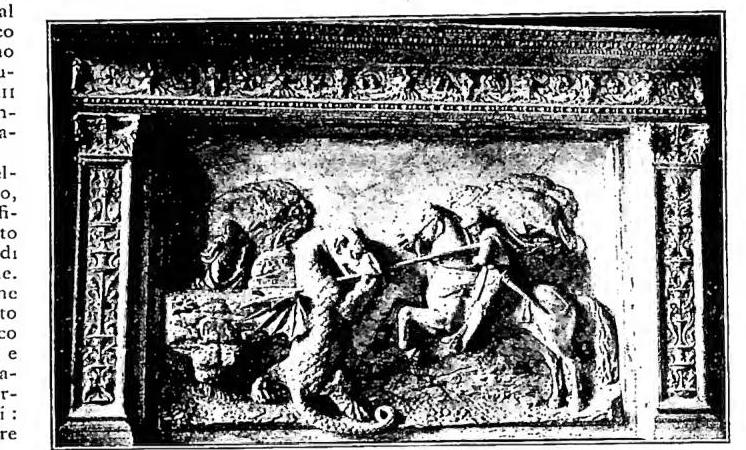
From as early as the 12th century, representations of the Saint on horseback, in the act of killing a dragon, appear in the European West. This model was followed especially by late French and German Gothic art and by the Italian Renaissance. Prototypes may be cited: besides certain sculptures in the Museum of Lubeck, the two panels by Paolo Uccello, one in the Lanckoronski collection in Vienna, the other in the Jacquemart André collection in Paris; the panel by Francia in the Galleria Corsini in Rome; and the small panel in the Louvre, a youthful work by Raphael.
Italian Renaissance art, however, sometimes depicts him standing, armed and in armor, omitting the dragon, as in Donatello’s statue for the tabernacle of Orsanmichele, now in the Museo del Bargello in Florence, or making it loom behind the fallen monster, as in the small panel in the Accademia in Venice, by Mantegna. Dürer’s engraving of 1514 also depicted him in this manner.
The entire legend of s. G. was frescoed in 1377 by Jacopo degli Avanzi in the basilica of the Santo in Padua, and in 1505 by Vittore Carpaccio in S. Giorgio degli Schiavoni in Venice. By the same painter there also remains a predella from the altarpiece of S. Giorgio Maggiore in Venice, with Stories of the Saint.
As regards the development of the legend, Delehaye himself acknowledges that it “renferme un grand nombre d'éléments empruntés au folklore”: it must nevertheless be noted that popular tradition generally ignores the entire first part of the Saint’s life and concentrates its narrative solely on the episode of the dragon, which, as is well known, appears quite late in the hagiographic texts. This episode inspired numerous popular songs in the various countries of Europe, and especially in the Slavic world. In Italy, an “oration” in epic hendecasyllables, of considerable power and beauty, is widespread from Romagna to Calabria in numerous versions:
it reveals certain connections with a Venetian poem, still unpublished, preserved in the Bibliothèque Nationale in Paris (Italian MSS 1069, fols. 100–111). A Tuscan poem in ottava rima, from the fifteenth century, is preserved in old printings and was reproduced several times: it develops the entire legend of the Saint as given by Jacopo da Varazze. Various lyrical-narrative laude are likewise inspired by the same source: one is preserved in a Tuscan laudario of the early fourteenth century (Cod. magliabechiano 11-1-22), another was composed by Feo Belcari, and yet another by Francesco di Albizzo. In Renaissance Florentine theatre there was more than one sacra rappresentazione
inspired by St G., also because one quarter of the city was dedicated to him and the Compagnia di S. G. was charged with commemorating his miraculous deeds every year: at times the commemoration was performed by means of a processional float with “the dragon that spewed fire from its mouth, its tail, and other parts, and behind it followed the daughter of the king of Libya upon a white chinca.”
(Ist. Alinari)
GIORGIO, saint, martyr. — St G. slaying the dragon. Bas-relief from the castle of Gallon, a work by Michel Colombe (1508) — Paris, Musée du Louvre.
it was widespread in Sicily, Italy, and even in Gaul: at Rome, Belisarius invoked him as defender of the Porta S. Sebastiano. The worship thus has Eastern origins, and in the West it was revived with the Crusades. For a time the Dardanelles were called the Strait of St G. Various nations, regions, and cities have him as their patron, such as England (since 1222, the Synod of Oxford), Portugal, Catalonia and Aragon, Georgia, and Lithuania.
Genoa, which likewise venerates him as its protector, named its Bank after him; Venice dedicated three churches to him, notable for their works of art; in Italy there are 118 municipalities bearing the Saint’s name, scattered everywhere; famous is the inscription in the vernacular (1135) on the cathedral of Ferrara dedicated to him. The churches and chapels dedicated to the Saint are innumerable: many of them are destinations for pilgrimages and objects of particular forms of popular worship.
The date of the feast, which falls on 23 April, marks for the common people of many European countries the beginning of spring, with all the related customs and manifestations of an agrarian and propitiatory character, similar to those associated with Calendimaggio. Among the Slavs of Carinthia, young people adorn a tree with flowers and carry it in procession amid songs of joy and music; the principal figure in the procession is the “green G.,” a boy clad in foliage who, at the end, is thrown into the water, with the intention of ensuring rain for the hay and crops; often, at the last moment, the boy is replaced by an effigy. Analogous customs are found in certain districts of Russia, as well as among the Gypsies of Transylvania and Romania, who attribute to the flowering tree powers effective against illness or conducive to childbirth. In many other countries too, St G. is invoked as a healer; in France and Germany, the waters of many fountains dedicated to him are considered miraculous. Protector of knights, he is also the protector of horses and, generally, of livestock. In Germany and the Slavic countries he is invoked as a powerful enemy of witches. As slayer of the dragon, he also protects against reptiles. It is believed that in some countries his worship replaced that of earlier pagan spring deities: in Lithuania, the god Pergrubius; in Georgia (where the feast is celebrated on 14 August), the god Lano. Comparisons, though arbitrary, have also been made with the Egyptian god Horus and the Indian Siva.
In Italy, these springtime and agrarian aspects of the popular worship of St G. have almost entirely disappeared; indeed, in many regions his feast passes unnoticed. Significant traces, however, are preserved in Sardinia and northern Italy, from Piedmont to Istria.