
ANDREA DI CRETA, saint. — Byzantine orator and hymnographer, born in Damascus around 660, died at Porto di Erisso, on the island of Mitilene, on 4 August 740. A monk in Jerusalem, he remained there until 685, when he was sent to the emperor Costantino Pogonato to convey the adherence of the patriarchate of Jerusalem to the decisions of the Sixth Ecumenical Council (681). He was therefore called Gerosolimitano, but is better known by the name of A. di Creta, because toward the end of the 7th century or at the beginning of the 8th he was appointed bishop of Gortina, the Cretan metropolis.
While he was metropolitan of Crete, A. had the weakness of yielding to the injunctions of the usurper Filippico Bardane, signing the decrees of the council held at Constantinople in 712, which restored Monothelitism and condemned the Sixth Ecumenical Council. But he atoned for this error the following year (713), after the disappearance of Filippico, by adhering to the dogmatic definition of the Sixth Council (cf. A. Heisenberg, Ein iambisches Gedicht des Andreas von Creta, in Byzantinische Zeitschrift, 10 [1901], pp. 505–14), and subsequently opposed energetically the decree of Leone Isaurico against images (PG 19, 1301–1304).
A. also distinguished himself as a preacher. His sermons have been published only in part: twenty-two homilies or panegyrics are collected in PG 97, 805–1302. One must add a Panegirico di s. Giorgio, in Acta SS. Aprilis, III, Anversa 1675, pp. 123–31, and another on St James, Brother of the Lord, edited by A. Papadopoulos-Kerameus, in Ἀνάλεκτα Ἱεροσολωτικῆς στεχνολογίας, V, pp. 1–14. On the unpublished homilies V. J. A. Fabricius, Bibliotheca graeca, XI, Amburgo 1740, p. 84. The authenticity of the published homilies is generally recognized. The five homilies on the Presentation of the Virgin in the Temple, contained in cod. Laud. graeca. 81 of the Oxford library, are apocryphal. The orator’s style is elaborate and at times obscure.
As a hymnographer, A. was the initiator of the poetry of the canons and the principal representative of this genre. He also left numerous troparia, called idiomela, a kind of rhythmic antiphons, each having its own melody. On the poetic work of A., V. the comprehensive article by L. Petit, André de Crète, in DACL, I, cols. 2034–41.
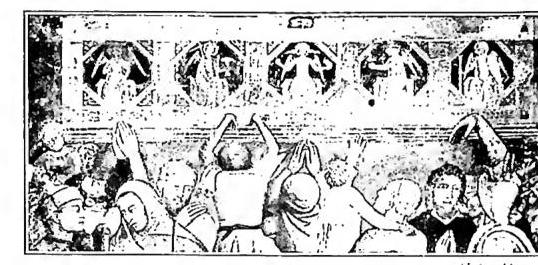
ANDREA DA FIRENZE – Faithful supplicants before the area of St. Pietro Martire – Detail of the fresco in the Cappellone degli Spagnoli – Florence, S. Maria Novella.
The Questore, published by Papadopoulos-Kerameus in vol. V of the Ἀνάλεκτα Ἱεροσολωτικῆς στεχνολογίας, pp. 169–80. The principal published works are collected in PG 97, 805–1302. For the published and unpublished poetic works, see the article by L. Petit cited above. Several are scattered throughout Byzantine liturgical books. See also: M. Jugie, Saint André de Crète et l'Immaculée Conception, in Echos d'Orient, 13 (1910), pp. 120–33; O. Bardenhever, Geschichte der althochlichen Liturgie, V, Friburgo in Br. 1932, pp. 152–57. Martino Jugie