
Papal sovereignty over the R., explicitly and definitively recognized in 1278 by Rudolf I of Habsburg to Pope Nicholas III, lasted only until the Avignon captivity of the papacy, when the tyrants of Romagna raised their heads again. Cardinal Bertrando del Poggetto, sent by John XXII to re-establish pontifical authority, was at first generally recognized, but then, defeated by the Este (1333) and with Bologna having risen, he lost what he had previously regained. Later Innocent VI sent to Italy, as a new legate, Cardinal Egidio Alvarez Albornoz (1353), who tenaciously resumed the struggle against the petty lords of Romagna, defeated them and transformed them into servants of the Church, confirmed and revived the communal liberties; he restored the temporal dominion, which he reorganized with the famous Constitutiones Aegidianae
(Fano 1357), which remained in force until the beginning of the nineteenth century. After Albornoz died at Viterbo (1367), revolts broke out again, albeit in a different form, and the R. was bloodied by foreign companies of mercenaries; it nevertheless had the distinction of giving the Italian armies their first victorious commanders, with Alberico da Barbiano, Attendolo Sforza, and his son Francesco. Cardinal Anglico de Grimaud, brother of Urban V, compiled the Descriptio Romandiolae facta a. 1371, which is a complete statistical account of the region.
Under Alexander VI, Cesare Borgia occupied Imola and Forlì, defended in vain by Caterina Sforza. Appointed gonfalonier of justice (March 1500) and then duke of R. (May 1501), he assembled and organized an army with able captains and successively took possession of Cesena, Pesaro, Rimini, and Faenza, whose lord, the young Astorre Manfredi, he had barbarously put to death in Castel S. Angelo, while Caterina Sforza, lady of Forlì, was saved only through the intervention of Louis XII. Cesare, having allied himself with France and assisted by Alfonso I d’Este, was about to embark upon new conquests when the sudden death of Alexander VI (18 August 1503) cut short his ambitious designs.
The Venetians, ever vigilant from Ravenna (where they had established themselves in 1441), occupied Rimini and Faenza and other territories. On 15 March 1505, through an agreement with Julius II, while retaining Ravenna, Cervia, Faenza, and Rimini with their territories, they returned to the Church the other lands it had held. From Bologna, which, after the flight of the Bentivoglio (1506), had returned to the Church, Julius II joined the League of Cambrai formed by Louis XII of France and Maximilian I of Austria (10 August 1508), and recovered Ravenna, Cervia, and Rimini. When the Pontiff prepared the Holy League (15 October 1511) against the French, Bologna, Ferrara, and the exiled Pandolfo Malatesta took the side of France. The R. was traversed by the Spanish army and by the French forces, whose commander, Gaston de Foix, entrenched himself on the banks of the Ronco. Here, on 11 April 1512, the famous battle of Ravenna was fought, and the French, left masters of the field, ruthlessly sacked the city. As French fortunes in Italy declined, Clement VII drew closer to Charles V (Treaty of Barcelona, 1529), who undertook to drive the Venetians from Ravenna, which they had re-entered in 1527. Venice, having made peace with Rome, definitively returned Ravenna and Cervia to the Church in 1529. With the recovery of Ferrara in 1598, upon the death of Alfonso II, the last legitimate heir of the Este, the whole of the R. came under the obedience of the Papacy, within the broader boundaries assigned to it by Dante, (Purg., XIV, 92), between «il Po, il monte, la marina e il Reno». A new historical period began for it (1598–1797), in which the factions were not entirely extinguished and, under the old names of Guelphs and Ghibellines, gave vent to their centuries-old resentments.
In February 1797 the revolutionary troops spread throughout the R., welcomed with the first dawn of liberty. In the Peace of Tolentino (19 February 1797), Pius VI renounced the Apennine-Adriatic side of his States, which entered the new Cisalpine Republic, whose capital was Bologna. With the Cisalpine Republic, the R. passed to the Cisalpine Republic, then to the Italian Republic, and finally to the Kingdom of Italy. The R. was divided by the French into the three departments of the Reno (capital, Bologna), the Lower Po (capital, Ferrara), and the Rubicon (capital, Forlì), which, under the Italian Kingdom, were transformed into prefectures. The Austrian troops, which had occupied the R. in the early years of the Second Coalition, returned there with General Nugent (1813–14). In February 1814 the Neapolitan soldiers of Joachim Murat appeared there, allied with Austria; they were again succeeded by the Austrians when Murat took the side of his former allies and, with the Rimini proclamation (30 March 1815), proclaimed the independence and unity of Italy.
The Congress of Vienna restored papal power in the R. as well, not without resistance from Austria. Pius VII re-established there the three ancient legations of Ravenna, Bologna, and Ferrara, subdivided into the two delegations of Bologna and Ferrara and the two legations of Ravenna and Forlì.
The Revolution of Naples (1820) and that of Piedmont (1821) found only a faint echo in the R. A stronger repercussion there was produced instead by the Paris Revolution of July 1830. During the vacancy of the Holy See, the pontifical authorities were deposed in Bologna, Forlì, and the other cities as far as Ancona; in Bologna, the temporal power was declared abolished and the provisional government of the « Provincie unite italiane » was established. Austria came to the aid of the new pope, Gregory XVI; near Rimini (25 March 1831), the forces of General Carlo Zucchi were dispersed. The Austrians, under the pretext of new liberal disturbances, re-entered the legations (1832), where they remained until 1838, while the French, under the pretext of maintaining equilibrium, occupied Ancona. After the Habsburg troops withdrew, unrest resumed in the ever-turbulent R. (disturbances of 1843 and 1845). The Rimini insurrection gave Massimo d’Azeglio the occasion for his pamphlet on Gli ultimi casi di R. (January 1846).
The liberal policy of Pius IX was greeted enthusiastically in the R. When the Roman Republic was proclaimed on 9 February 1849, it found a following in the R.; but toward the end of that same month the Austrians returned. Although Cavour had proposed at the Congress of Paris (1856) the abolition of the military occupation in the Papal States, they left the R. only after the battle of Magenta (11 June 1859). Papal rule then definitively ceased there; a provisional government proclaimed the dictatorship of Victor Emmanuel II. Massimo d’Azeglio was immediately sent as royal commissioner and took up residence in Bologna; after the armistice of Villafranca he was replaced by Colonel Leonetto Cipriani, who assumed the title of governor-general of the R., until the latter united with the former duchies of Modena and Parma under L. C. Farini, appointed « dittatore della Emilia ». With the plebiscite of 11–12 March 1860, Emilia, together with Tuscany, decreed its annexation to the Kingdom of Victor Emmanuel II. The R., thus united with the Kingdom of Italy, has shared its history ever since.
III. CONCILIAR REGION
It bears the title of Flaminian Region (Regio Flaminia). It appears in the form of a right triangle, whose longest side is formed by the Apennines and the shorter sides respectively by the Adriatic Sea and the Po; it embraces part of Emilia.Ecclesiastically, it comprises three archdioceses: Ferrara, Bologna, and Ravenna; nine dioceses: Bertinoro, Cervia, Cesena, Comacchio, Forlì, Faenza, Imola, Rimini, and
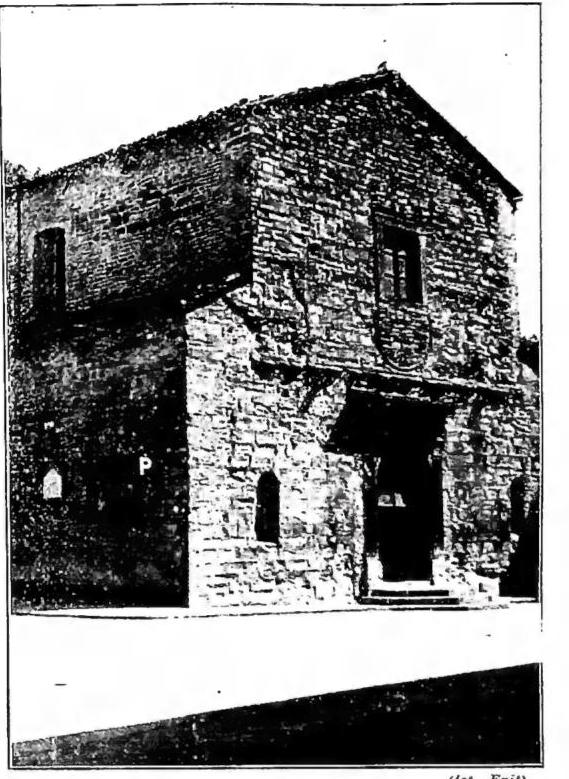
(phot. Emili)
ROMAGNA – Pieve of S. Maria (15th century) – Bagno di Romagna.
Sarsina. Bologna and Ravenna are also metropolitan sees, with Bertinoro, Cervia, Cesena, Comacchio, Forlì, Rimini, and Sarsina as suffragans of Ravenna; Faenza and Imola as suffragans of Bologna. Ferrara is immediately subject [to the Holy See].
Bologna is the seat of the court (Tribunale della Via Flaminia) of first instance in cases concerning the nullity of marriage, with appeal to Venice. This court also exercises its jurisdiction over that part of the territory of the Republic of S. Marino which belongs to the diocese of Rimini. Bologna is also the seat of the Pontifical regional seminary of Romagna, founded by Benedetto XV; but not all the dioceses send their students to Bologna. In civil terms, the Romagna ecclesiastical region comprises four provinces: Ferrara, Bologna, Ravenna, and Forlì. The last plenary council of the region was held on 27 September 1932.
The pre-Romanesque architecture of the territory of the ancient Exarchate of Ravenna, deriving from the Byzantine and late Roman themes that appeared in Ravenna in the fifth and sixth centuries and linked to the development of the architectural forms of the Po valley, as well as the characteristics of the Romagnol, or Riminese, school of painting, as one may call it, of the fourteenth century, bear ample witness to this in the Middle Ages.
The same occurred during the Renaissance, when the Florentines Leon Batt. Alberti and Agostino di Duccio, Piero della Francesca of Arezzo, and Matteo de' Pasti of Verona contributed to creating at Rimini that Malatesta Temple, which is one of the most distinguished and harmonious works of the fifteenth century. In direct and constant relationship with the art flourishing in Bologna
is the art of R. during the Baroque period, whereas toward the end of the eighteenth century and throughout the nineteenth, chiefly through the work of Felice Giani, a painter of the Neoclassical period, Faentine by adoption if not by birth, and of Tommaso Minardi, acknowledged leader of “Purism” in Italy, R. demonstrated considerable independence from the Bolognese artistic milieu.
Emilio Lavagnino
V. FOLKLORE
The distinctive character of the folklore of R. derives from the encounter of two different traditions: Po Valley and Italic. This dimorphism has been noted in the rural house, whose principal forms can be grouped into two types, Emilian and Italic; and also in other fields: for example, with regard to agricultural transport, the four-wheeled cart, decorated with flowers and resembling the Piedmontese cart, which predominates west of the Savio, and the two-wheeled cart with painted sides, used in the Rimini-Cesena area. The castellate, special elongated barrels used for transporting must, are painted with the same floral decoration. Other characteristic expressions of folk art are rustic ceramics: plates, vases, jars, and in particular the mezzina or mezzetta, a vessel with broad sides brightly painted with floral designs and bearing playful inscriptions inviting one to drink, and the gotto, the traditional drinking glass. But rustic art reaches its greatest originality in the manufacture of rust-printed fabrics, with various decorative motifs according to whether they are tablecloths, bedspreads, or intended for oxen’s backs. On the rust-printed cloths, as on the sides of the wagons, images of s. Giorgio and s. Antonio abate are often reproduced; these are among the most venerated saints. Devotion to the Madonna del Fuoco of Forlì is also noteworthy; her feast (4 Feb.) is enlivened by great bonfires, as is devotion to the Madonna del Monte of Cesena, whose sanctuary preserves ancient and beautiful painted ex-votos.The most common beliefs and customs marking the cycles of human life and the year may be mentioned. A pregnant woman is forbidden to throw stones at a walnut and to cross the reins or halters of animals. Anyone born with the “caul” is considered exceptionally fortunate. When two engaged couples hold a child at Baptism, they may not marry before a year and three days have passed, because they believe that through this ceremony they have become relatives. The figure of the bracco, or marriage intermediary, is very widespread; among the betrothal ceremonies, the hand-clasp (toccamano) should be noted, repeating the ancient dextrarum coniunctio. When the bride and groom are kneeling on the stool in church, once the rite is over the bride does not rise until her mother, or in her absence an appointed person (filippa), has pulled her by the dress. After eight days of married life, the bride returns to her father’s house, where she remains for another eight days (rivoltaglio or ritornello). Falling asleep on Easter Day and falling in church are signs foretelling death.
The annual cycle is characterized by certain customs and feasts of agricultural origin and significance, which R., an eminently agricultural region, has preserved and often revived. On Christmas Eve the peasants set fire to a large log (whoever burns the largest will kill the largest pig), which must burn all night and sometimes until Epiphany; on Christmas morning they scatter the extinguished embers in the vineyard, seed of blessings, and preserve the remains of the burned trunk to ward off hail and thunderstorms. On the first day of the year they are careful to note the first person they meet, deriving from whether that person is rich or poor, young or old, a favorable or unfavorable omen. It is believed that animals speak on the night of Epiphany. Young people go from house to house singing the pasquella in order to receive gifts. On the last evening of Carnival, the oldest hen in the henhouse is eaten, otherwise all the others will die. The feast of Mid-Lent (Segavecchia) is celebrated with particular splendor at Forlimpopoli and Cotignola: a large effigy, adorned with necklaces of dried fruit, is sawn apart amid joyful cries, and the fruits fall, fiercely contested by the children. Various traces of the ancient sacred drama have also survived in R. in the rites of Holy Week: the most important is the feast of the Signor morto at Modigliana. Special healing virtues are attributed to the dew of the night of s. Giovanni, especially for those suffering from scabies, who at dawn roll naked in the grass. This day is also propitious for omens.
11 Nov. (s. Martino) is the feast of the wine pressing.
Most folk songs are not of Romagnol origin; they have, however, acquired a certain local character here, discernible in the various names they take according to their subjects and occasions, and a particular dialectal color that constitutes the poetic language proper to the Romagnol singers. Lyric poetry includes the canti a la stesa (extended songs), which vary in name as follows: canti a la biogga (peasant songs), canti a la rastladora or a la sfujadora (of raking and leaf-stripping), and in the Ferrara area rumanelli (romanelle). Narrative poetry comprises two groups, representing the confluence of two traditions: the first consists of Franco-Provençal-type epic-lyric songs formed of short stanzas with a more or less elaborate refrain (e.g., La donna lombarda); the other consists of legends, mostly sacred, originating in central Italy, in laisses of rhymed or assonant hendecasyllables (e.g., S. Alessio): they are called urazión and recited by country beggars. The treasury of fairy tales and stories, riddles, and proverbs is also rich.
Among the ancient folk dances, the saltarello, the trescone, the Bergamasque dances, and in the upper Savio valley the ballo della mela survive. They are usually performed at Carnival and during agricultural work, among which the stripping of maize and the scutching of hemp and flax take on a particularly festive character for engaged couples. Traditional forms of dress are disappearing. The ancient Romagnol peasant wore on his head the galoza, a horn-shaped felt or fur cap; he wore a garment of coarse brown or dark-blue cloth and, in winter, wrapped himself in the double-sided cloak (caparèla). — Vedi tavv. LXXV-LXXVI.