BERTINORO, DIOCESE of. – In Romagna, in the province of Forlì, suffragan of Ravenna. It is identified with the ancient Cesubium or Sussubium, mentioned among Pepin’s donations to the Church (Liber Pont., ed. L. Duchesne, I, Paris 1886, p. 454). Cavalcaconte, lord of Brettanorium (Sussubium), redonated it to Pope Alexander III in 1177 (op. cit., II, ibid. 1892, p. 441). It was erected as a diocese in 1360 when, after Forlimpopoli was destroyed by Cardinal Albornoz, Bishop Roberto Boyssel moved there permanently, assuming the title of the new residence. The church of Forum Popilii, however, is of more ancient origin. Roberto’s successor (d. in 1365) was Roberto de Bretteville (1365–78), who raised the parish of S. Caterina to cathedral status, followed by Tebaldo Pellisier (1378–95), to whom Urban IV entrusted the temporal jurisdiction of B. and Cesena. Later came Giovanni Ruffo Theodoli (1505–12), cardinal and nuncio of Leo X to Charles V; Andrea Caligari (1579–1613), who reconstructed the cathedral; and Giambattista Missiroli (1701–34), who built the seminary.
The diocese was suppressed in 1803, restored in 1817, and in 1824 united by Leo XII with Sarsina until 1853. The bishops of B. continued to serve as administrators of the diocese of Sarsina until 1872, and thereafter the two dioceses were often united ad personam. At present the diocese has 64 parishes, 5 Marian sanctuaries (Lago, Suasia, Fornò, Carminate, Madonna di Fuori), 87 diocesan priests and 4 religious priests, with 50,000 inhabitants over 307 sq km (1948).
Among the monastic foundations in the territory of B. are noteworthy: S. Ruffillo, the Benedictine abbey of Forlimpopoli, which Abbot Benedetto placed under the protection of the Apostolic See in 1181. It was granted in commendam to the bishop of B. and in 1364 annexed by Pius IV to the chapter treasury of S. Pietro in Vaticano. In the 18th century a lengthy dispute arose between the bishop of B. and the nullius of Forlimpopoli. In 1847 Pius IX suppressed the nullius, assigning Forlimpopoli to the diocese of B. and Meldola to the diocese of Forlì. In 1867 the collegiate church of the Canons of S. Ruffillo also disappeared (L. Ricci, S. Ruffillo di Forlimpopoli, Forlì 1914).
On the hill of B. stood the Benedictine abbey of S. Maria in Urano, which passed in the 12th century to the Camaldolese, who made it a center of culture: in 1431 TRAVERSARI, AMBROGIO (v.) was elected prior general of the Camaldolese there. Destroyed by fire, it was rebuilt in 1376 in a more pleasant location. Its church contains the relics of the saints Maglorio, Sansone, and Pascasio (A. Pasini, B. e i suoi santi protettori, Forlì 1932). Suppressed during the Napoleonic period, the complex was preserved by the Manzoni counts of Forlì. The bombardments of 1944 destroyed the monastery (since 1898 the motherhouse of the Poor Clares of the Most Blessed Sacrament, known as the Sisters of B.) and damaged the church, which contained canvases by Cignani.
In 1228 Egidio, bishop of Forlimpopoli, entrusted to the Camaldolese of Urano a chapel in a locality called Lago, where an ancient image of the Blessed Virgin was venerated. In 1262 it was transformed into a church, known as the sanctuary of Madonna del Lago (crowned by the Vatican Chapter in 1704), the principal patroness of the city and diocese of B. (L. Gatti, La Madonna del Lago, Forlì 1902).
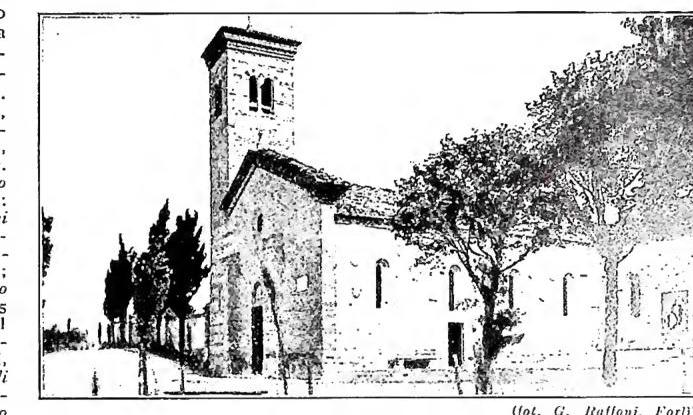
The abbey of Fornò is also located in the territory of B.; it has a round temple containing a venerated image of the Blessed Virgin, donated in the 15th century by a converted corsair, Pietro di Durazzo. It later passed to the Regular Canons of Porto di Ravenna. In the 18th century it fell into decline; Napoleon stripped it, while Pius IX saved it from utter ruin in 1857 (cf. P. Nadiani, L'abbazia di S. Maria delle Grazie di F., Rome 1910).
Bordering B. was also the Benedictine abbey of S. Ilario di Galeata (S. Ellero), where Pope Stephen II stayed on his return from France in 754. Suppressed in 1784, it was transferred to the diocese of Borgo S. Sepolcro (D. Mambrini, Galeata nella storia e nell'arte, Bagno di Romagna 1936).
Monuments. – The cathedral, dedicated to S. Caterina d'Alessandria, patroness of the city, has three naves and dates from the end of the 17th century (P. Amaducci, Ecclesia S. Catharinae de platea, Bertinoro 1934). Its exterior, in the Doric style and entirely of exposed brick, was restored in 1942.