
SANSONE. — The last of the Israelite judges, son of Manue (Mānōah) of the tribe of Dan, a native of Saraa (Heb. Ṣor'āh, today Ṣar'āh, approximately 25 km west of Jerusalem), whose deeds against the Philistines are recounted in Iudc. 13–16. The name is connected with šēmaš, “sun”: Heb. Šimšōn; but the older form had a: Gr. Σαμψών, Vulg. Sampson; cf. Akkad. šamšānu and Šamaš, solar deity, and c. He possessed extraordinary strength, which is related to the “nazirite status” to which S. dedicated himself by his parents’ vow (Iudc. 13, 5). Nazirite status entailed, among other things, abstention from cutting the hair: S. possessed his strength as an extraordinary gift from God, precisely because he observed the vow.
He manifested his strength from a young age, on the occasion of adventures among the Philistines (among whom he chose his wife, despite his parents’ reluctance): he tore apart a lion; in self-defense he killed thirty men single-handedly; he burned the Philistines’ ripe crops by sending jackals among them, tied in pairs with a lit torch fastened to their tails; once again, in self-defense, he killed a great number of enemies (Iudc. 14, 1–15, 8). The Philistines then mounted an expedition to seize the hero, entering for the first time into that hostile relationship with Israel which continued for centuries.
The extra-biblical Philistines (v.)—for approximately a century on the move after departing from their original settlements in Anatolia and Crete, and settled on the coast of southern Canaan after a defeat inflicted on them by Ramses II of Egypt—between the 12th and 11th centuries B.C. sought to extend themselves into the hinterland, correspond to the historical facts.
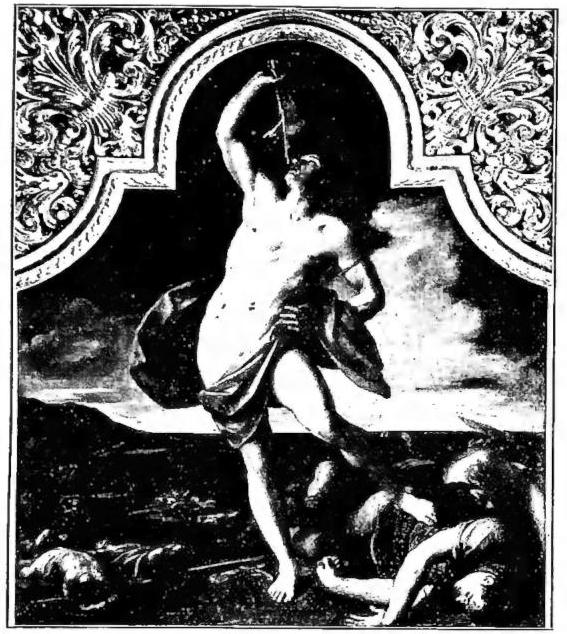
(Alinari photograph)
SANSONE — S. with the donkey’s jawbone. Painting by Guido Reni (ca. 1613) — Bologna, Pinacoteca.
with a jawbone of a donkey he killed 1,000 Philistines. On another occasion, shut up in a city, at night he tore out the doors and bars and carried everything up onto a mountain. He was brought down by a woman, Dalila (v.), who, having learned the secret of his strength, rendered him powerless by having his hair cut: the hero was captured and blinded. But later, when his hair had grown back, an outward sign of the return to the Nazirite state and the Yahwistic spirit, during a Dagon (v.), he shook himself with all his strength and brought down the supporting columns of a temple, burying himself and the Philistines in the ruins.
That the taste of popular narrators for the heroic and the marvelous, during the period of the story’s oral transmission, found some satisfaction in S.’s exploits is probable and is not even blameworthy: the story acquires fanciful contours, and the exegete must know how to distinguish them. But since the entire background of the incipient Philistine danger is historically accurate, the hero’s personality established, and the reason for his gifts suitably explained, it is mistaken to speak of a “myth” and to reject the whole of the episodes as legendary. The religious meaning of the narrative lies in the idea of providential graces for the salvation of Israel and in the personal story of the sinful and converted hero (Iudc. 16, 28).
145. Archaeology
Although the biblical figure of S. was likened by the Fathers of the Church (s. Agostino, s. Paolino da Nola, s. Gregorio Magno, etc.) to that of Christ, and although the triumph over the Philistines came among Christians to signify divine Redemption and victory over death, ancient Christian art almost entirely ignored II. Nevertheless, the early scholars (Aringhi, etc.) occasionally fell into the error of mistaking for S., who carries the gates of Gaza on his back, the scene of the paralytic healed with his bed; and a mosaic discovered in Malta in the Old City is regarded by some, without foundation, as Christian (cf. E. Becker, Malta sotterranea. Studien zur altchristl. und jüdisch. Sepulkrelkunst, Strasburg 1913, p. 79, pl. XXVI). An exception seems to be a fragment of wooden sculpture with its scenes of Dalila’s betrayal and the collapse of the Philistine temple (DACL, XV, 1, col. 740); another scene has been recovered from a marble sculpture of the fifth century in the « Martyrion » at Seleucia near Antioch (Antioch., III [1941], pl. XVII). The scene of S. felling the lion was represented in a fifth-century basilica in Spain, in separate scenes, for which Prudentius composed the illustrative couplets (Prudenzio, Dittochaeon, nos. 19-20).All the other known representations belong to the minor arts. The decoration of a silk fabric kept at the Lateran reproduces the episode of the struggle with the lion (cf. P. Lauer, Le trésor du Sancta Sanctorum, in Fondation E. Piot, Monum. et mém., 15 [1906], pl. XVIII). A group of scenes with episodes from the life of S. is distributed across the first two registers on folio 347° of the manuscript of s. Gregorio Nazianzeno (the Parisinus graecus 510 of the ninth century; cf. H. Bordier, Description des peintures et autres ornements contenus dans les manuscrits, grecs de la Biblioth. nation., Paris 1883-84, p. 63 ff.). Another representation is found among Christian symbols on a bronze medallion published by G. Ciampini (De duobus emblematibus, p. 4) and by F. Buonarroti (Osservaz. sopra alcuni framm. di vasi ant. di vetri ornati di figure trovati ne' cimit. di Roma, Florence 1716, p. 2, pl. I, 1).
Pasquale Testini
146. Art
The earliest medieval representations of S. appear in cycles of several consecutive scenes drawn from his history; among these cycles, the most notable is the one sculpted on various panels of a Romanesque marble screen (twelfth-thirteenth century), preserved in the chapel of S. Restituta, adjoining the cathedral of Naples.The scene of S.’s struggle with the lion was first of all usually depicted separately; it was often repeated in transalpine sculpture of the late Middle Ages. Such Gothic sculptures adorn, for example, the northern portal of Chartres Cathedral and the main portal of the cathedral of S. Stefano in Vienna. Two panels with scenes from the history of S. are by Luca Cranach the Elder: in one of them, owned by the Castle Museum of Weimar, the struggle with the lion is depicted; in the second, preserved in the Massimilianeum Museum in Asburgo, Dalila is shown cutting S.’s hair.
Representations of S. in the art of the Italian Renaissance are exceedingly rare; among them is a fine miniature by the Florentine Attavante, datable to 1476, which adorns the text of the Book of Judges in the splendid Bible of Duke Federico, one of the most distinguished manuscripts in the Vatican Library. Also noteworthy is G. Reni’s painting, S. vittorioso (Pinacoteca, Bologna).