DELILAH (Heb. Dillah = "Exile, Delicate", According to the Most Probable Etymology; Septuagint: Δαλ88). -
A woman, debated whether Hebrew or Philistine, wife or companion (probably Philistine and a lover) of Samson (v.) and certainly the fatal cause of his end, according to the account in Judg. 16:4-18. She was from Sorek (today the ruins of Sörök?) on the northern border of Philistia with the territory of Dan, a few km. from Zorah (today Şar'ah), the homeland of Samson.
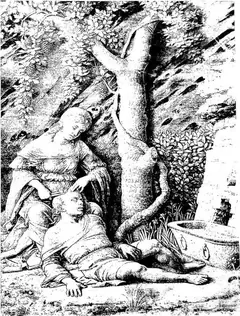
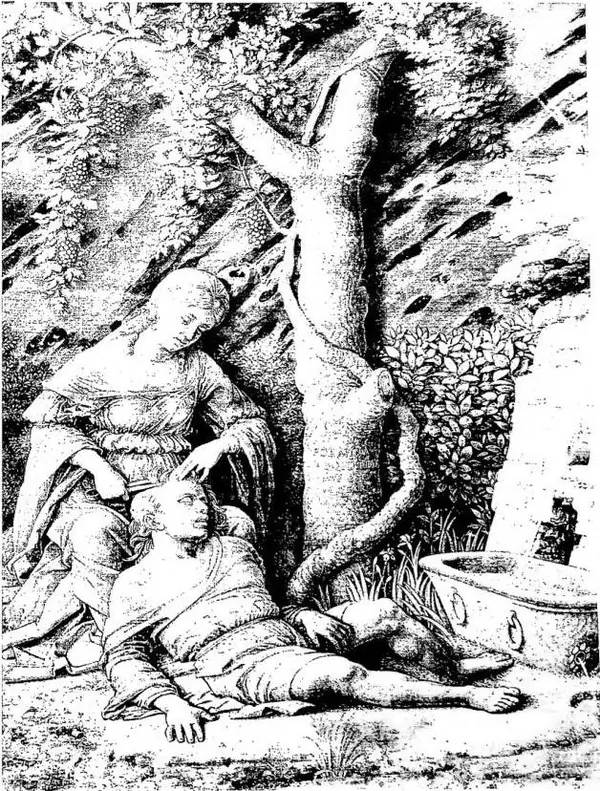
With the arts of seduction, D. tried several times to wrest from the giant the secret of his prodigious strength. Foiled three times by false revelations of the secret — as if the strong man could be subdued by binding him with fresh bowstrings, or with new ropes, and with seven of his long hairs tied to the loom — in the end, with her insistences paid for by the gold of the Philistines, she learned that Samson could be subdued by shaving off his long Nazirite hair. The giant, shaved by her in his sleep and then sold for 5,500 shekels, blinded by his enemies and forced in irons to turn the mill in Gaza, later took revenge, once his hair and the spirit of a Nazirite had grown back, by the collapse of the temple of Dagon, which he brought down during an insulting celebration of his defeat. - See plate LXXV.
Plate LXXVSAMSON AND DELILAHChiaroscuro by A. Mantegna - London, National Gallery.(fol. Anderson)Bibliography4 worksM.-J. Lagrange, Le livre des Juges, Paris 1903, pp. 246-56; C. F. Burney, The book of Judges, London 1920, pp. 377-91; A. Schulz, Das Buch d
BIBL.: M.-J. Lagrange, Le livre des Juges, Paris 1903, pp. 246-56; C. F. Burney, The book of Judges, London 1920, pp. 377-91; A. Schulz, Das Buch der Richter (Die heil. Schrift d. Alt. Text.), 4, Bonn 1926, pp. 86-89; G. Ricciotti, Storia d'Israele, II, Turin 1934, pp. 306-10.
Piatti, Tommaso. “Dalila (Ebr. Dëllah = « Esile, delicata », secondo l'etimologia più probabile; settanta: δαλ88).” In Enciclopedia Cattolica, vol. IV, coll. 1115–1116. Città del Vaticano: Ente per l’Enciclopedia Cattolica e per il Libro Cattolico, 1950. https://azioneromana.com/article/dalila-ebr-dellah-esile-delicata-secondo-l-etimologia-piu-probabile-settanta-dal88.
MLA
Piatti, Tommaso. “Dalila (Ebr. Dëllah = « Esile, delicata », secondo l'etimologia più probabile; settanta: δαλ88).” Enciclopedia Cattolica, vol. IV, Ente per l’Enciclopedia Cattolica e per il Libro Cattolico, 1950, coll. 1115–1116. Azione Romana, https://azioneromana.com/article/dalila-ebr-dellah-esile-delicata-secondo-l-etimologia-piu-probabile-settanta-dal88.
BibTeX
@incollection{ec4_dalila_ebr_dellah_esile_delica,
  author    = {Piatti, Tommaso},
  title     = {Dalila (Ebr. Dëllah = « Esile, delicata », secondo l'etimologia più probabile; settanta: δαλ88)},
  booktitle = {Enciclopedia Cattolica},
  volume    = {IV},
  pages     = {1115--1116},
  note      = {Cited by column},
  publisher = {Ente per l’Enciclopedia Cattolica e per il Libro Cattolico},
  address   = {Città del Vaticano},
  year      = {1950},
  url       = {https://azioneromana.com/article/dalila-ebr-dellah-esile-delicata-secondo-l-etimologia-piu-probabile-settanta-dal88}
}
One of some 20,000 entries brought back from the twelve printed volumes (1948–54). Spotted something? Help us improve it.
Click or scroll to zoom · drag to pan · Esc to close